
Narrowly Utilitarian Arguments — Bioprospecting and Drug Discovery
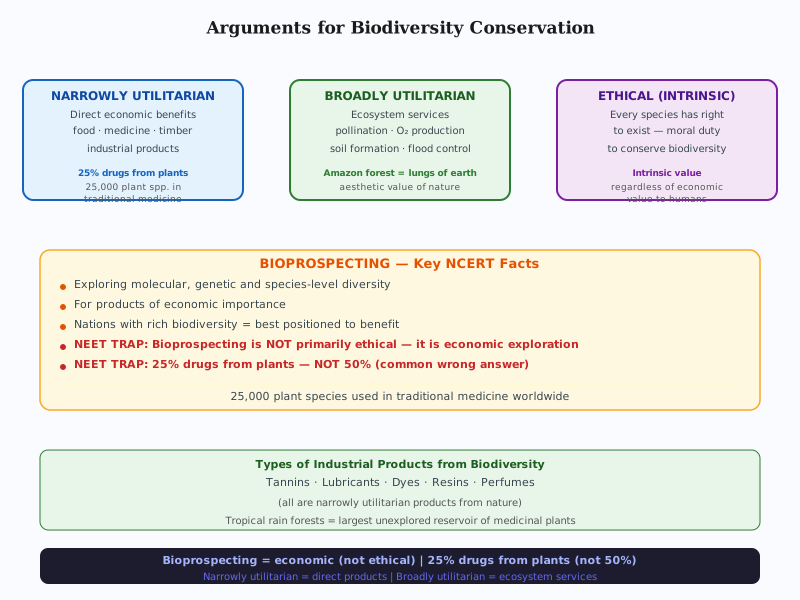
📚 Practice ConceptThe narrowly utilitarian arguments for conserving biodiversity are obvious; humans derive countless direct economic benefits from nature- food (cereals, pulses, fruits), firewood, fibre, construction material, industrial products (tannins, lubricants, dyes, resins, perfumes) and products of medicinal importance. More than 25 per cent of the drugs currently sold in the market worldwide are derived from plants and 25,000 species of plants contribute to the traditional medicines used by native peoples around the world. Nobody knows how many more medicinally useful plants there are in tropical rain forests waiting to be explored. With increasing resources put into 'bioprospecting' (exploring molecular, genetic and species-level diversity for products of economic importance), nations endowed with rich biodiversity can expect to reap enormous benefits.
More than 50% of drugs sold globally are derived from plants, and bioprospecting is primarily an ethical argument for conservation.
Only 25% of drugs are plant-derived (NCERT exact figure). Bioprospecting is an ECONOMIC (narrowly utilitarian) argument, not ethical.
25% drugs from plants — quarter, not half. Bioprospecting = business case for biodiversity, not moral argument.
- More than 25% of currently sold drugs worldwide are plant-derived — NCERT exact statistic.
- 25,000 plant species are used in traditional medicines by native peoples worldwide.
- Bioprospecting explores molecular, genetic, and species-level diversity for economically important products.
- Tropical rain forests are the largest unexplored reservoir of potentially medicinal plants — most species uncharacterised.
Evaluate the following statements about biodiversity conservation arguments: S1: The narrowly utilitarian argument includes ecosystem services like pollination and oxygen production. S2: Bioprospecting involves exploring genetic and species-level diversity for products of economic importance. S3: Nations with rich biodiversity are particularly well-positioned to benefit from bioprospecting. S4: According to NCERT, more than 25% of currently sold drugs worldwide are derived from plants. S5: The intrinsic value argument holds that species should be conserved regardless of their economic utility to humans.
View bonus solution & explanation
Correct answer: C — S2, S3, S4 and S5
S1 WRONG: Ecosystem services (pollination, O2 production) are the BROADLY utilitarian argument — not narrowly utilitarian. Narrowly utilitarian = direct economic products. S2 CORRECT: Bioprospecting = exploring diversity for economically important products (NCERT). S3 CORRECT: Nations with rich biodiversity can reap enormous benefits from bioprospecting. S4 CORRECT: NCERT explicitly states >25% of drugs are plant-derived. S5 CORRECT: Intrinsic value = ethical argument — species have right to exist independent of human use.
What is Narrowly Utilitarian Arguments?
What did NEET previous years ask on Narrowly Utilitarian Arguments?
What is the most common NEET trap on Narrowly Utilitarian Arguments?
How do you remember Narrowly Utilitarian Arguments for NEET?
What are the key components of Narrowly Utilitarian Arguments?
Through deep analysis of NEET and NTA, 176 of the 180 ReNEET 2026 (June 21) questions were already in the MedicNEET question bank before the exam.
176/180MedicNEET's Biology question bank is built from the same NCERT lines NTA picks repeatedly. Not random MCQs — questions crafted exactly like NTA crafts them.
You just learned this concept. The free app turns it into a daily goal built from your weak topics and brings it back just before you forget it — using active recall and spaced repetition — so it stays till exam day.