
Homology in Vertebrate Forelimbs — Divergent Evolution from Common Ancestor
✅ Asked in NEET 2018The similarity of bone structure in the forelimbs of many vertebrates is an example of: (NEET 2018)
The similarity of bone structure in the forelimbs of many vertebrates is an example of: (NEET 2018)
Answer & NCERT explanation
Correct answer: A — Homology
Homology refers to structures with similar origin and basic plan but different functions. Vertebrate forelimbs (human arm, bat wing, whale flipper) have similar bone arrangement - humerus, radius, ulna, carpals - indicating common ancestral origin. This pentadactyl limb pattern demonstrates divergent evolution from a common ancestor, not convergent evolution or analogy.
Read more NCERT concept on the PYQ
Such similarities can be interpreted to understand whether common ancestors were shared or not. For example whales, bats, Cheetah and human (all mammals) share similarities in the pattern of bones of forelimbs. Though these forelimbs perform different functions in these animals, they have similar anatomical structure – all of them have humerus, radius, ulna, carpals, metacarpals and phalanges in their forelimbs. Hence, in these animals, the same structure developed along different directions due to adaptations to different needs. This is divergent evolution and these structures are homologous. Homology indicates common ancestry. Other examples are vertebrate hearts or brains. In
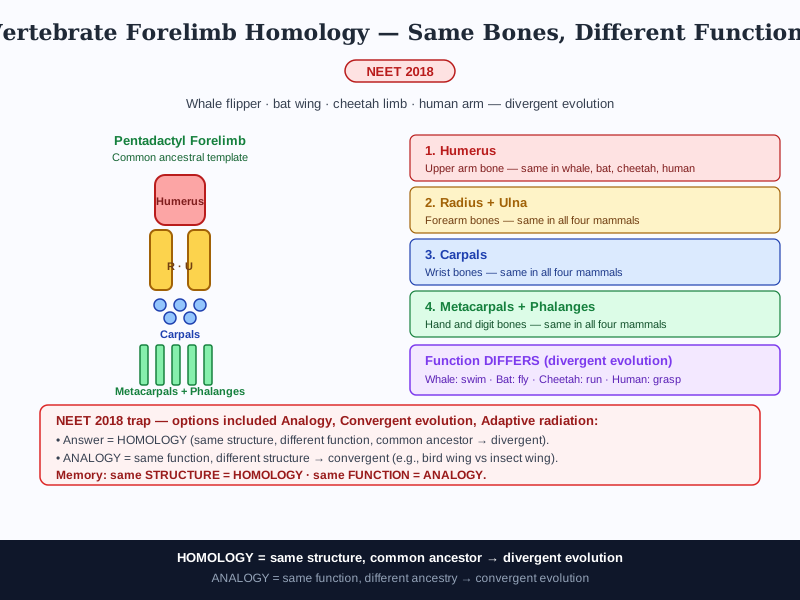
The forelimbs of whales, bats, cheetah and humans — all mammals — share the SAME bone pattern: humerus, radius, ulna, carpals, metacarpals and phalanges. Yet these forelimbs perform very DIFFERENT functions — swimming flipper, flying wing, running limb, grasping hand. This is HOMOLOGY: similar anatomical structure inherited from a common ancestor, modified along different directions for different needs. The process is called DIVERGENT EVOLUTION — the same starting structure diverges into multiple specialised forms. Homology INDICATES COMMON ANCESTRY. NCERT also cites vertebrate hearts and brains as other examples of homologous organs. Homology is contrasted with analogy (similar function, different ancestry → convergent evolution).
NEET 2018 tested this directly: 'similarity of bone structure in forelimbs of many vertebrates' → answer HOMOLOGY (not analogy, not convergent evolution, not adaptive radiation). The trap is ANALOGY — students confuse it with homology, but analogy is similar FUNCTION with different structure (e.g., wing of bird vs wing of insect). Bird wing vs bat wing is subtle: as wings they're ANALOGOUS, but as forelimbs they're HOMOLOGOUS. The pentadactyl limb is the homologous template across all tetrapods.
The similarity of bone structure in vertebrate forelimbs is an example of analogy or convergent evolution.
Vertebrate forelimbs sharing the same bones (humerus, radius, ulna, carpals, metacarpals, phalanges) is HOMOLOGY — divergent evolution from a common ancestor.
Same STRUCTURE, different FUNCTION = HOMOLOGY (divergent). Same FUNCTION, different STRUCTURE = ANALOGY (convergent).
- Vertebrate forelimb homologous bones: humerus, radius, ulna, carpals, metacarpals, phalanges.
- Examples of homologous forelimbs: whale (flipper), bat (wing), cheetah (running limb), human (grasping hand).
- Homology = divergent evolution = common ancestry; same structure adapted to different needs.
- Other NCERT homology examples: vertebrate hearts and vertebrate brains.
Consider the following statements about homology in vertebrate forelimbs: S1: Whales, bats, cheetah and human forelimbs share the same bone pattern: humerus, radius, ulna, carpals, metacarpals, phalanges. S2: All four mammal forelimbs perform similar functions across species. S3: Homologous structures indicate common ancestry and arise through divergent evolution. S4: The wing of a bird and the wing of an insect are examples of homology. S5: NCERT cites vertebrate hearts and brains as additional examples of homologous organs.
View bonus solution & explanation
Correct answer: B — S1, S3 and S5
S1 CORRECT: All four mammals share the same bone list (NCERT exact). S2 WRONG: Forelimbs perform DIFFERENT functions (swimming/flying/running/grasping) — this is precisely the point of divergent evolution. S3 CORRECT: Homology = common ancestry via divergent evolution (NEET 2018 answer). S4 WRONG: Bird wing vs insect wing = ANALOGY (similar function, different ancestry) — convergent evolution, not homology. S5 CORRECT: NCERT also cites vertebrate hearts and brains as homologous.
What is Homology in Vertebrate Forelimbs?
What did NEET 2018 ask on Homology in Vertebrate Forelimbs?
What is the most common NEET trap on Homology in Vertebrate Forelimbs?
How do you remember Homology in Vertebrate Forelimbs for NEET?
What are the key components of Homology in Vertebrate Forelimbs?
Through deep analysis of NEET and NTA, 176 of the 180 ReNEET 2026 (June 21) questions were already in the MedicNEET question bank before the exam.
176/180MedicNEET's Biology question bank is built from the same NCERT lines NTA picks repeatedly. Not random MCQs — questions crafted exactly like NTA crafts them.
You just learned this concept. The free app turns it into a daily goal built from your weak topics and brings it back just before you forget it — using active recall and spaced repetition — so it stays till exam day.