
Population Density Changes — The BIDE Equation Explained
✅ Asked in NEET 2024When will the population density increase, under special conditions?
When will the population density increase, under special conditions?
Answer & NCERT explanation
Correct answer: D — When the number of births plus the number of immigrants is more than the sum of the number of deaths and the number of emigrants.
Population density increases when inputs (births + immigrants) exceed outputs (deaths + emigrants). This fundamental equation: ΔN = (B+I) - (D+E) shows population change. When (B+I) > (D+E), population grows. This is the basic principle of population dynamics in NCERT.
Read more NCERT concept on the PYQ
You can see from the above equation that population density will increase if the number of births plus the number of immigrants (B + I) is more than the number of deaths plus the number of emigrants (D + E). Under normal conditions, births and deaths are the most important factors influencing population density, the other two factors assuming importance only under special conditions. For instance, if a new habitat is just being colonised, immigration may contribute more significantly to population growth than birth rates.
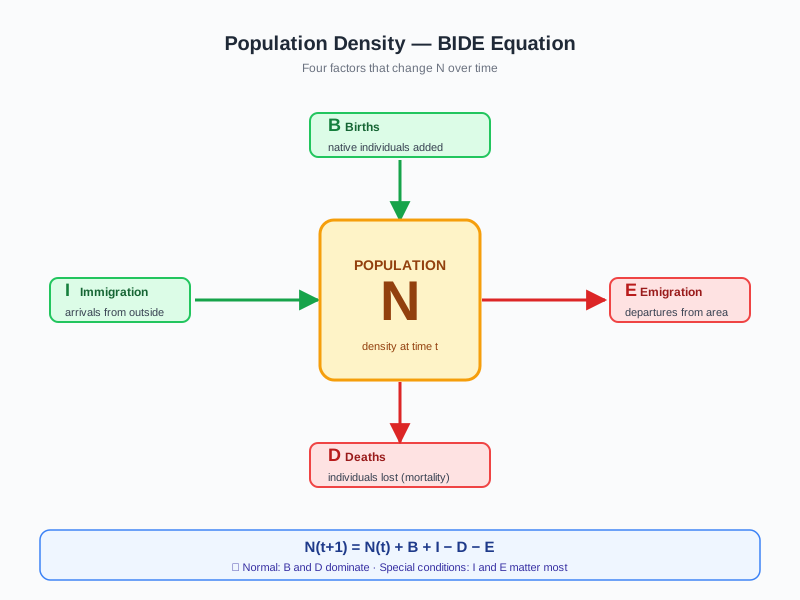
Population density at any given time changes based on four processes: Births (B), Immigration (I), Deaths (D), and Emigration (E). The equation is simple: population grows when inputs (B+I) exceed outputs (D+E). Under NORMAL ecological conditions, births and deaths are the dominant factors because most populations exist in stable habitats where movement is limited. Immigration and emigration only become significant under SPECIAL CONDITIONS — most importantly when a new habitat is being colonised. A classic example is the colonisation of an island by a species: initially there are no births yet (population too small to reproduce effectively) but immigration from the mainland drives rapid population growth.
NCERT states this equation but doesn't explain the ecological significance. Deeper: The equation ΔN = (B+I) - (D+E) is the basis of all population dynamics models. When B > D and I = E = 0, you get the simple exponential growth model. When resources are limited, death rate rises as population grows — this gives logistic (S-shaped) growth. The 'special conditions' mentioned in NCERT refer to: invasive species colonisation (immigration dominant), after mass extinction events, island biogeography scenarios. In practice, wildlife managers use this equation to determine if a population is growing or declining.
All four factors (B, I, D, E) are always equally important
Under NORMAL conditions: B and D dominate. I and E important only under SPECIAL conditions.
BIDE = Births Immigration Deaths Emigration | Normal: BD matter | Special: I matters more
What is Population Density Changes?
Has Population Density Changes been asked in NEET?
What is the most common NEET trap on Population Density Changes?
How do you remember Population Density Changes for NEET?
Through deep analysis of NEET and NTA, 176 of the 180 ReNEET 2026 (June 21) questions were already in the MedicNEET question bank before the exam.
176/180MedicNEET's Biology question bank is built from the same NCERT lines NTA picks repeatedly. Not random MCQs — questions crafted exactly like NTA crafts them.
You just learned this concept. The free app turns it into a daily goal built from your weak topics and brings it back just before you forget it — using active recall and spaced repetition — so it stays till exam day.