
Verhulst-Pearl Logistic Growth — Sigmoid Curve and Carrying Capacity
✅ Asked in NEET 2026Which equation depicts Verhulst-Pearl logistic population growth?
Which equation depicts Verhulst-Pearl logistic population growth?
The population growing in a habitat with limited resources will show: A. Lag phase, followed by phases of acceleration and deceleration and finally an asymptote. B. The ability to realise its innate potential to grow in number and reach enormous densities in a short time. C. Exponential growth D. Logistic growth Choose the correct answer from the options given below:
Match List-I with List-II: (NEET 2023) List-I (Population Term) A. Logistic growth B. Exponential growth C. Expanding age pyramid D. Stable age pyramid List-II I. Unlimited resource availability condition II. Limited resource availability condition III. % individuals: Pre > Reproductive > Post IV. % individuals: Pre ≈ Reproductive
Asymptote in a logistic growth curve is obtained when: (NEET 2017)
Answer & NCERT explanation
Correct answer: B — dN/dt = rN(K-N)/K
The Verhulst-Pearl logistic growth equation is dN/dt = rN(K-N)/K, where K is the carrying capacity, r is intrinsic rate of natural increase, and N is population density.
Read more NCERT concept on the PYQ
A population growing in a habitat with limited resources show initially a lag phase, followed by phases of acceleration and deceleration and finally an asymptote, when the population density reaches the carrying capacity. A plot of N in relation to time (t) results in a sigmoid curve. This type of population growth is called Verhulst-Pearl Logistic Growth and is described by the following equation:
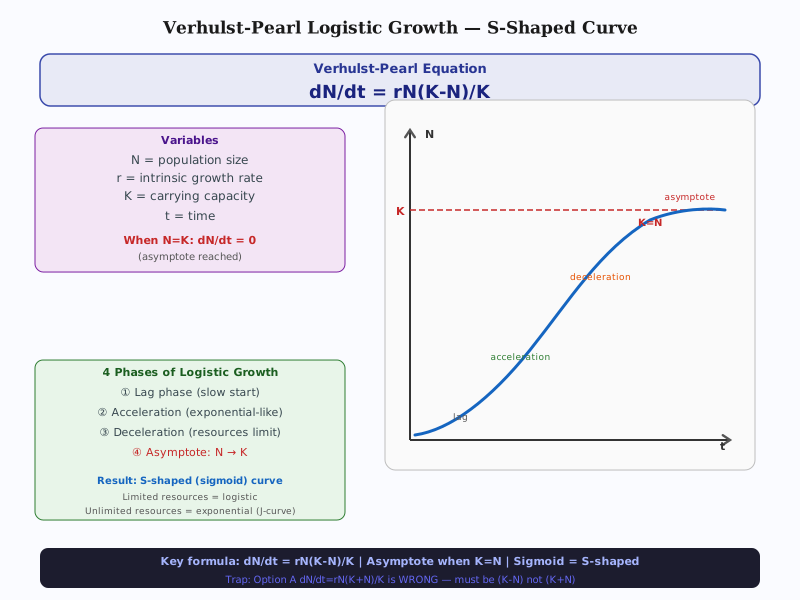
When resources are limited, populations cannot grow exponentially indefinitely. Verhulst and Pearl described logistic growth with the equation dN/dt = rN(K-N)/K, where N = population size, r = intrinsic growth rate, K = carrying capacity. This produces a characteristic S-shaped (sigmoid) curve with four phases: (1) lag phase — slow start as population is small, (2) acceleration — rapid growth as N is still much smaller than K, (3) deceleration — growth slows as resources diminish, and (4) asymptote — when N equals K, dN/dt = 0 and growth stops. The sigmoid curve is the defining feature of logistic growth and contrasts with the J-shaped curve of exponential growth.
NCERT gives the equation but NTA tests your ability to identify it from wrong alternatives. The critical term is (K-N)/K — this is the fraction of carrying capacity still available. When N approaches K, this term approaches zero, slowing growth to a halt. The wrong options in NEET use (K+N)/K or (K-N)/N — memorise that the denominator must be K (not N), and the numerator must be (K-N) not (K+N). The asymptote at K=N is where dN/dt = 0, which is the mathematical definition of the asymptote condition.
dN/dt = rN(K+N)/K — students confuse the + and - sign, or place N in the denominator instead of K.
dN/dt = rN(K-N)/K — always (K-N) in numerator and K in denominator. When N=K, growth = 0.
K-N over K: as N fills K, the fraction SHRINKS to zero — growth stops at K=N (asymptote)
- When N = K (population equals carrying capacity): dN/dt = 0 — this is the mathematical asymptote condition.
- Logistic growth produces S-shaped (sigmoid) curve; exponential growth produces J-shaped curve.
- K = carrying capacity = maximum population the environment can sustainably support.
- Expanding age pyramid: pre-reproductive > reproductive > post-reproductive (% individuals). Stable pyramid: pre-reproductive ≈ reproductive.
Match List-I (Population Growth Term) with List-II (Correct Description): List-I A. Logistic growth asymptote B. r-value approaches zero C. dN/dt = rN D. (K-N)/K approaches zero List-II I. Exponential growth equation II. Occurs when N = K III. Population growth slowing but not zero IV. Population is near carrying capacity
View bonus solution & explanation
Correct answer: A — A-II, B-III, C-I, D-IV
A-II: Asymptote occurs when N=K (dN/dt=0). B-III: When r approaches zero, growth slows but doesn't necessarily equal K=N (distinguishes from asymptote). C-I: dN/dt = rN is the exponential growth equation (no K term). D-IV: (K-N)/K approaches zero when N approaches K — meaning population is near carrying capacity. This tests precise understanding of all logistic growth terms.
What is Verhulst-Pearl Logistic Growth?
What did NEET 2026 ask on Verhulst-Pearl Logistic Growth?
What is the most common NEET trap on Verhulst-Pearl Logistic Growth?
How do you remember Verhulst-Pearl Logistic Growth for NEET?
What are the key components of Verhulst-Pearl Logistic Growth?
Through deep analysis of NEET and NTA, 176 of the 180 ReNEET 2026 (June 21) questions were already in the MedicNEET question bank before the exam.
176/180MedicNEET's Biology question bank is built from the same NCERT lines NTA picks repeatedly. Not random MCQs — questions crafted exactly like NTA crafts them.
You just learned this concept. The free app turns it into a daily goal built from your weak topics and brings it back just before you forget it — using active recall and spaced repetition — so it stays till exam day.