
Plant Growth is Indeterminate — Meristems Enable Open Form of Growth
✅ Asked in NEET 2023Which of the following statements is not correct? (NEET 2023)
Which of the following statements is not correct? (NEET 2023)
Answer & NCERT explanation
Correct answer: C — Plant growth is generally determinate
Plant growth is INDETERMINATE, not determinate. According to NCERT, plants continue growing throughout their life due to presence of meristems, unlike animals which have determinate growth that stops after maturity. Options a and b are correct - elongation phase has increased vacuolation and meristematic cells have plasmodesmatal connections. Option d is also correct as growth is measurable.
Read more NCERT concept on the PYQ
Plant growth is unique because plants retain the capacity for unlimited growth throughout their life. This ability of the plants is due to the presence of meristems at certain locations in their body. The cells of such meristems have the capacity to divide and self-perpetuate. The product, however, soon loses the capacity to divide and such cells make up the plant body. This form of growth wherein new cells are always being added to the plant body by the activity of the meristem is called the open form of growth. What would happen if the meristem ceases to divide? Does this ever happen?
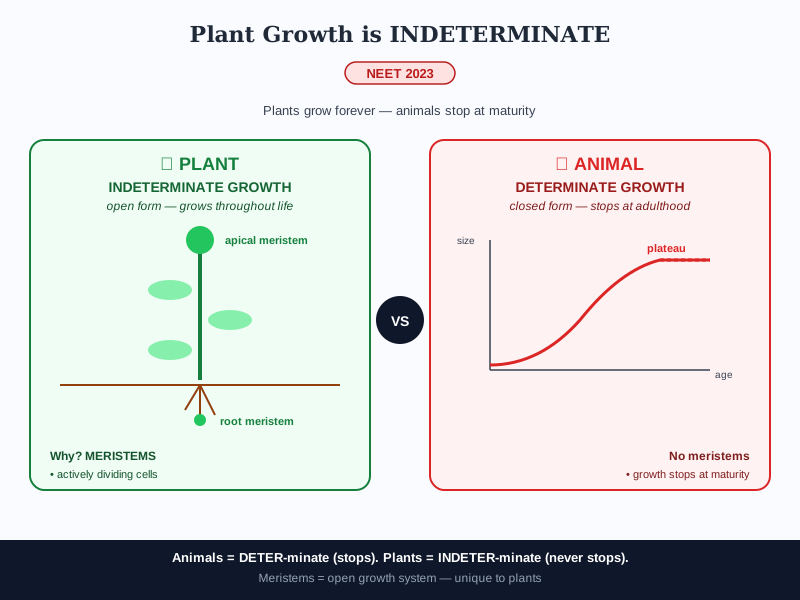
Plant growth is unique because plants retain the capacity for unlimited (indeterminate) growth throughout their lives, unlike animals whose growth is determinate (stops after maturity). This ability depends on meristems — regions of actively dividing cells at specific body locations. Meristematic cells can divide and self-perpetuate indefinitely. Their daughter cells soon lose the capacity to divide and form the permanent plant body. This continuous addition of new cells by meristematic activity is called the open form of growth. Plant growth passes through three phases: meristematic (active division with abundant plasmodesmatal connections), elongation (increased vacuolation), and maturation (differentiation).
NEET 2023 asked: 'Which statement is NOT correct?' — Option C (plant growth is generally determinate) was the wrong statement. The distinction between determinate and indeterminate growth is explicitly in NCERT: animals stop growing, plants don't. The elongation phase is characterised by increased vacuolation — this is the phase where cell size increases dramatically due to water uptake into the central vacuole. Meristematic cells specifically have abundant plasmodesmatal connections, dense cytoplasm, and prominent nuclei — these are histological markers tested in NEET.
Plant growth is generally determinate because plants eventually stop growing when resources are limiting.
Plant growth is INDETERMINATE — plants retain capacity for growth throughout life due to meristems. This is an open form of growth.
Animals = DETER-minate (stops). Plants = INDETER-minate (never stops). Meristems = open growth system.
- Open form of growth: new cells always added by meristematic activity — unique to plants.
- Meristematic phase cells: abundant plasmodesmatal connections, prominent nuclei, dense cytoplasm.
- Elongation phase: increased vacuolation — central vacuole expands, taking in water to increase cell volume.
- Maturation phase: cells differentiate and thicken their walls to perform specific functions.
Which of the following statements about plant growth are CORRECT? S1: Plants retain the capacity for unlimited growth throughout their life — called indeterminate growth. S2: The phase of cell elongation is characterised by increased vacuolation. S3: Meristematic cells have abundant plasmodesmatal connections. S4: Plant growth is generally determinate, similar to animals. S5: New cells are always being added to the plant body by meristematic activity — called open form of growth.
View bonus solution & explanation
Correct answer: A — S1, S2, S3 and S5
S1 CORRECT: Plant growth is indeterminate — retained throughout life. S2 CORRECT: Elongation phase = increased vacuolation (NEET 2023 tested this). S3 CORRECT: Meristematic cells have abundant plasmodesmatal connections (NEET 2023 tested this). S4 WRONG: Plant growth is INDETERMINATE not determinate — this is exactly what NEET 2023 tested as the wrong statement. S5 CORRECT: Open form of growth = meristematic activity continually adds new cells.
What is Plant Growth is Indeterminate?
What did NEET 2023 ask on Plant Growth is Indeterminate?
What is the most common NEET trap on Plant Growth is Indeterminate?
How do you remember Plant Growth is Indeterminate for NEET?
What are the key components of Plant Growth is Indeterminate?
Through deep analysis of NEET and NTA, 176 of the 180 ReNEET 2026 (June 21) questions were already in the MedicNEET question bank before the exam.
176/180MedicNEET's Biology question bank is built from the same NCERT lines NTA picks repeatedly. Not random MCQs — questions crafted exactly like NTA crafts them.
You just learned this concept. The free app turns it into a daily goal built from your weak topics and brings it back just before you forget it — using active recall and spaced repetition — so it stays till exam day.