
Gymnosperms — Heterosporous; Pinus is Monoecious, Cycas is Dioecious
✅ Asked in NEET 2017Select the mismatch. (NEET 2017)
Select the mismatch. (NEET 2017)
Match the plant with the kind of life cycle it exhibits: Column I (Plant) A. Spirogyra B. Fern C. Funaria D. Cycas Column II (Life cycle type) i. Dominant diploid sporophyte vascular plant, with highly reduced male or female gametophyte ii. Dominant haploid free-living gametophyte iii. Dominant diploid sporophyte alternating with reduced gametophyte called prothallus iv. Dominant haploid leafy gametophyte alternating with partially dependent multicellular sporophyte Choose the correct matching:
Answer & NCERT explanation
Correct answer: D — Pinus – Dioecious
Pinus is monoecious (having both male and female cones on same plant), not dioecious, making option d the mismatch. According to NCERT, Cycas is dioecious (separate male and female plants), Salvinia is heterosporous (produces two types of spores), and Equisetum is homosporous (produces one type of spore). Pinus has both microsporangiate and megasporangiate cones on same tree.
Read more NCERT concept on the PYQ
The gymnosperms are heterosporous; they produce haploid microspores and megaspores. The two kinds of spores are produced within sporangia that are borne on sporophylls which are arranged spirally along an axis to form lax or compact strobili or cones. The strobili bearing microsporophylls and microsporangia are called microsporangiate or male strobili. The microspores develop into a male gametophytic generation which is highly reduced and is confined to only a limited number of cells. This reduced gametophyte is called a pollen grain. The development of pollen grains take place within the microsporangia. The cones bearing megasporophylls with ovules or megasporangia are called macrosporangiate or female strobili. The male or female cones or strobili may be borne on the same tree (Pinus). However, in cycas male cones and megasporophylls are borne on different trees. The megaspore mother cell is differentiated from one of the cells of the nucellus. The nucellus is protected by envelopes and the composite structure is called an ovule. The ovules are borne on megasporophylls which may be clustered to form the female cones. The megaspore mother cell divides meiotically to form four megaspores. One of the megaspores enclosed within the megasporangium develops into a multicellular female gametophyte that bears two or more archegonia or female sex organs. The multicellular female gametophyte is also retained within megasporangium.
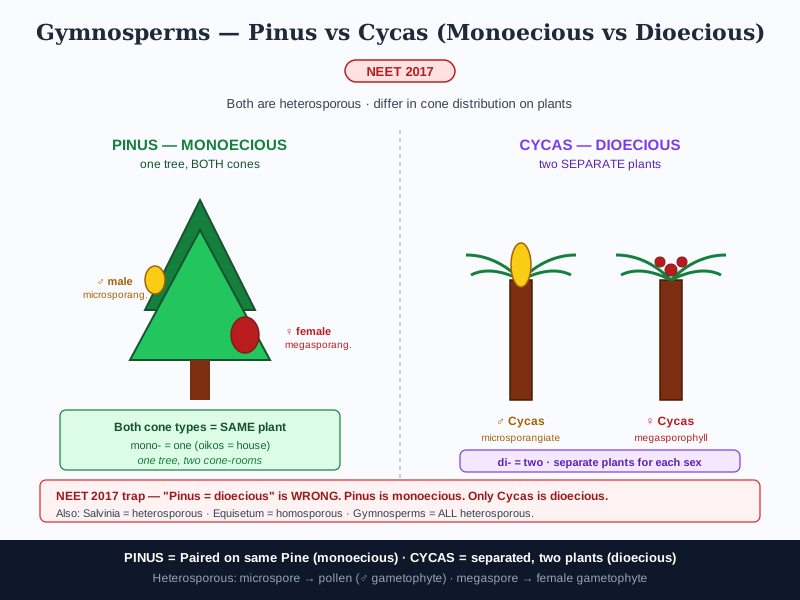
Gymnosperms are heterosporous — they produce two types of spores: microspores (which develop into male gametophytes/pollen grains) and megaspores (which develop into female gametophytes). Spores are borne on sporophylls arranged on strobili (cones). Male strobili bear microsporangia; female strobili (macrosporangiate cones) bear megasporangia. A critical NEET distinction: Pinus is MONOECIOUS — both male and female cones are borne on the same tree. Cycas is DIOECIOUS — male cones and megasporophylls are borne on different trees. Salvinia is heterosporous. Equisetum is homosporous.
NEET 2017 asked to identify the mismatch — the answer was 'Pinus = Dioecious' because Pinus is actually monoecious. Students confuse Pinus with Cycas. The distinction: Cycas is a primitive gymnosperm with separate male plants (bearing microsporangiate cones) and female plants (bearing megasporophylls with ovules) — truly dioecious. Pinus has both cone types on the same tree — monoecious. Salvinia is an aquatic fern that is heterosporous. Equisetum produces only one spore type — homosporous.
Pinus is dioecious — male and female cones are borne on different trees.
Pinus is MONOECIOUS — both male (microsporangiate) and female (megasporangiate) cones are on the SAME tree. Only Cycas is dioecious among gymnosperms.
CYCAS = Separated (dioecious). PINUS = Paired on same Pine (monoecious).
- Gymnosperms = heterosporous: microspores → pollen grain (male gametophyte), megaspores → female gametophyte.
- Pinus = monoecious: both male and female cones on same plant. Cycas = dioecious: separate plants.
- Salvinia (water fern) = heterosporous. Equisetum (horsetail) = homosporous.
- Megaspore mother cell in gymnosperms differentiates from nucellus cells — protected by envelopes forming the ovule.
Match Column I (Plant) with Column II (Characteristic): Column I A. Pinus B. Cycas C. Salvinia D. Equisetum Column II I. Dioecious gymnosperm II. Monoecious gymnosperm (both cones on same plant) III. Heterosporous pteridophyte IV. Homosporous pteridophyte
View bonus solution & explanation
Correct answer: C — A-II, B-I, C-III, D-IV
A-II: Pinus is MONOECIOUS — both cone types on same plant. B-I: Cycas is DIOECIOUS — male and female on separate plants (NCERT explicit). C-III: Salvinia is a heterosporous pteridophyte (produces two types of spores). D-IV: Equisetum is homosporous — produces only one type of spore. Option D (Pinus = dioecious) is the NEET 2017 mismatch.
What is Gymnosperms?
What did NEET 2017 ask on Gymnosperms?
What is the most common NEET trap on Gymnosperms?
How do you remember Gymnosperms for NEET?
What are the key components of Gymnosperms?
Through deep analysis of NEET and NTA, 176 of the 180 ReNEET 2026 (June 21) questions were already in the MedicNEET question bank before the exam.
176/180MedicNEET's Biology question bank is built from the same NCERT lines NTA picks repeatedly. Not random MCQs — questions crafted exactly like NTA crafts them.
You just learned this concept. The free app turns it into a daily goal built from your weak topics and brings it back just before you forget it — using active recall and spaced repetition — so it stays till exam day.