
Mendel's 14 True-Breeding Varieties — 7 Contrasting Traits in Pea
✅ Asked in NEET 2020How many true-breeding pea plant varieties did Mendel select as pairs, which were similar except in one character with contrasting traits? (NEET 2020)
How many true-breeding pea plant varieties did Mendel select as pairs, which were similar except in one character with contrasting traits? (NEET 2020)
Among the following characters, which one was not considered by Mendel in his experiments on pea? (NEET 2017)
Answer & NCERT explanation
Correct answer: A — 14
Mendel selected 14 true-breeding pea plant varieties arranged in 7 pairs. Each pair was similar except for one contrasting character. For example, one pair differed only in height (tall vs dwarf), another in seed color (yellow vs green), etc. This gave him 7 contrasting traits to study, requiring 14 different true-breeding varieties in total as mentioned in NCERT Chapter 5.
Read more NCERT concept on the PYQ
Mendel conducted such artificial pollination/cross pollination experiments using several true-breeding pea lines. A true-breeding line is one that, having undergone continuous self-pollination, shows the stable trait inheritance and expression for several generations. Mendel selected 14 true-breeding pea plant varieties, as pairs which were similar except for one character with contrasting traits. Some of the contrasting traits selected were smooth or wrinkled seeds, yellow or green seeds, inflated (full) or constricted green or yellow pods and tall or dwarf plants.
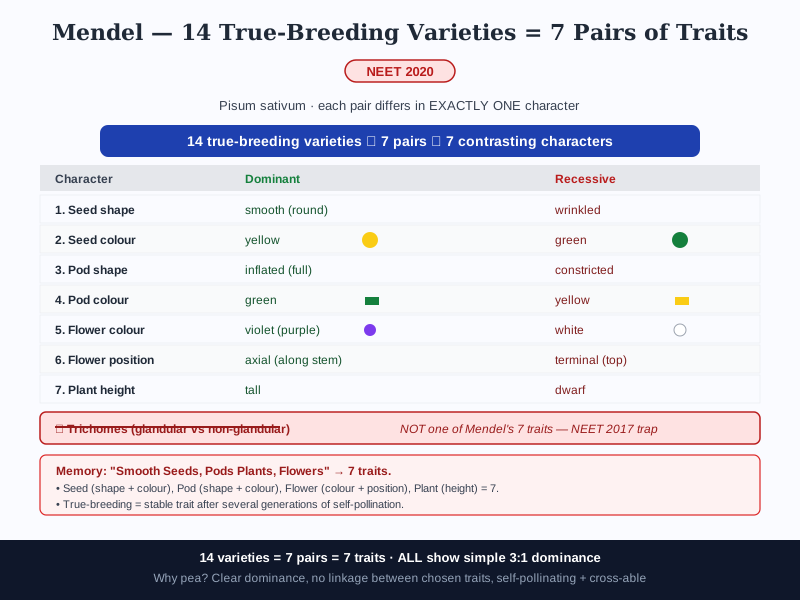
Mendel used true-breeding pea lines — varieties that show stable trait inheritance after continuous self-pollination for several generations. He selected 14 true-breeding varieties arranged in 7 pairs, each pair differing in exactly one character with contrasting traits. The 7 traits: (1) Seed shape — smooth/wrinkled, (2) Seed colour — yellow/green, (3) Pod shape — inflated/constricted, (4) Pod colour — green/yellow, (5) Flower colour — violet/white, (6) Flower position — axial/terminal, (7) Plant height — tall/dwarf. NEET 2020 tested the number 14; NEET 2017 tested which trait was NOT studied.
The NEET 2017 trap: trichomes (glandular vs non-glandular) were NOT among Mendel's 7 traits. Students who memorise only some traits assume trichomes must be studied. The mnemonic for all 7: Smooth Seeds Pod Flower Plant (SSPPFP) — Seed shape, Seed colour, Pod shape, Pod colour, Flower colour, Flower position, Plant height. Each of the 7 traits shows simple dominance, which is why Mendel chose them — traits with complex inheritance patterns would have obscured his ratios.
Mendel selected 7 or 8 true-breeding pea plant varieties. Trichomes (glandular/non-glandular) was one of his studied traits.
Mendel selected 14 varieties (7 pairs). Trichomes was NOT studied — the 7 traits were seed shape, seed colour, pod shape, pod colour, flower colour, flower position, and plant height.
14 varieties = 7 pairs = 7 traits. Trichomes NOT included. Remember: Smooth Seeds, Pod shape/colour, Flower colour/position, Plant height.
- 14 true-breeding varieties in 7 pairs — NEET 2020 answer is 14.
- Trichomes (glandular vs non-glandular) was NOT one of Mendel's 7 chosen traits — NEET 2017 trap.
- True-breeding = stable trait expression after continuous self-pollination for several generations.
- Mendel's success: chose traits with clear dominance, no linkage, and simple 3:1 or 9:3:3:1 ratios.
Which of the following sets includes ONLY the traits studied by Mendel in his pea experiments? A. Seed shape, Seed colour, Trichome type B. Pod shape, Pod colour, Flower colour, Flower position C. Plant height, Stem colour, Leaf shape D. Seed shape, Seed colour, Pod shape, Pod colour
View bonus solution & explanation
Correct answer: B — B and D only
Set A includes Trichome type — NOT a Mendel trait. Set B: Pod shape, Pod colour, Flower colour, Flower position — ALL are Mendel traits. Set C: Stem colour and Leaf shape are NOT Mendel traits. Set D: Seed shape, Seed colour, Pod shape, Pod colour — ALL are Mendel traits. Therefore B and D are the only sets containing only real Mendel traits.
What is Mendel's 14 True-Breeding Varieties?
What did NEET 2020 ask on Mendel's 14 True-Breeding Varieties?
What is the most common NEET trap on Mendel's 14 True-Breeding Varieties?
How do you remember Mendel's 14 True-Breeding Varieties for NEET?
What are the key components of Mendel's 14 True-Breeding Varieties?
Through deep analysis of NEET and NTA, 176 of the 180 ReNEET 2026 (June 21) questions were already in the MedicNEET question bank before the exam.
176/180MedicNEET's Biology question bank is built from the same NCERT lines NTA picks repeatedly. Not random MCQs — questions crafted exactly like NTA crafts them.
You just learned this concept. The free app turns it into a daily goal built from your weak topics and brings it back just before you forget it — using active recall and spaced repetition — so it stays till exam day.