
IVF and Embryo Transfer — ZIFT vs IUT by the 8-Blastomere Rule
✅ Asked in NEET 2024Which of the following is NOT an example of Assisted Reproductive Technology (ART)? (NEET 2024)
Which of the following is NOT an example of Assisted Reproductive Technology (ART)? (NEET 2024)
In which of the following techniques, the embryos are transferred to assist those females who cannot conceive? (NEET 2020)
Embryo with more than 16 blastomeres formed due to in vitro fertilisation is transferred into:
Answer & NCERT explanation
Correct answer: C — IUD
IUD (Intrauterine Device) is a contraceptive method, not an Assisted Reproductive Technology. ART techniques help couples conceive, while IUD prevents conception by creating unfavorable uterine conditions. IVF (In Vitro Fertilization), GIFT (Gamete Intra Fallopian Transfer), and IUI (Intrauterine Insemination) are all ART methods that assist in reproduction.
Read more NCERT concept on the PYQ
In vitro fertilisation (IVF–fertilisation outside the body in almost similar conditions as that in the body) followed by embryo transfer (ET) is one of such methods. In this method, popularly known as test tube baby programme, ova from the wife/donor (female) and sperms from the husband/donor (male) are collected and are induced to form zygote under simulated conditions in the laboratory. The zygote or early embryos (with upto 8 blastomeres) could then be transferred into the fallopian tube (ZIFT–zygote intra fallopian transfer) and embryos with more than 8 blastomeres, into the uterus (IUT – intra uterine transfer), to complete its further development. Embryos formed by in-vivo fertilisation (fusion of gametes within the female) also could be used for such transfer to assist those females who cannot conceive.
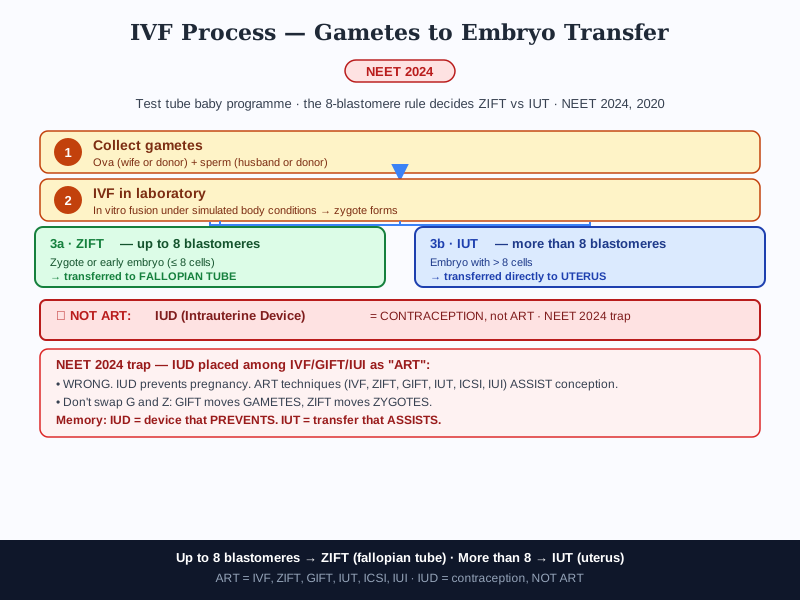
In vitro fertilisation (IVF) is fertilisation OUTSIDE the body under simulated lab conditions — popularly known as the test tube baby programme. Ova (from wife/donor) and sperm (from husband/donor) are collected and induced to form a zygote in the lab. The destination of the embryo depends on its developmental stage: ZIFT (Zygote Intra Fallopian Transfer) is used for zygotes or early embryos with UP TO 8 blastomeres — these go into the FALLOPIAN TUBE. IUT (Intra Uterine Transfer) is used for embryos with MORE THAN 8 blastomeres — these go directly into the UTERUS. Embryos formed by in-vivo fertilisation can also be transferred.
The cutoff is exact and frequently tested: up to 8 blastomeres → ZIFT (fallopian tube); more than 8 blastomeres → IUT (uterus). Students who memorise only 'embryo → uterus, zygote → tube' miss the 8-cell rule. ART (Assisted Reproductive Technology) includes IVF, ZIFT, GIFT, IUT, ICSI and IUI. IUD (intrauterine device) is contraception — NOT ART — and this is the NEET 2024 trap. GIFT moves GAMETES (not zygotes); ICSI injects sperm directly into ovum.
IUD (Intrauterine Device) is an Assisted Reproductive Technology that helps couples conceive.
IUD is CONTRACEPTION (prevents conception). ART includes IVF, ZIFT, GIFT, IUT, ICSI, IUI — these ASSIST conception.
IUD = device that PREVENTS pregnancy. IUT = transfer that ASSISTS pregnancy. Don't confuse the D (device) with the T (transfer).
- ZIFT = zygote or embryo with UP TO 8 blastomeres → fallopian tube.
- IUT = embryo with MORE THAN 8 blastomeres → uterus directly.
- ART techniques: IVF, ZIFT, GIFT, IUT, ICSI, IUI. NOT ART: IUD (contraceptive device).
- GIFT transfers GAMETES (egg + sperm). ICSI injects a single sperm directly into the ovum.
Consider the following statements about IVF and Assisted Reproductive Technology (ART): S1: ZIFT involves transfer of zygotes or embryos with up to 8 blastomeres into the fallopian tube. S2: IUT involves transfer of embryos with more than 8 blastomeres into the uterus. S3: IUD (Intrauterine Device) is an example of Assisted Reproductive Technology. S4: IVF is fertilisation that occurs outside the body in simulated laboratory conditions. S5: GIFT involves transfer of zygotes rather than gametes into the fallopian tube.
View bonus solution & explanation
Correct answer: A — S1, S2 and S4
S1 CORRECT: ZIFT = zygote or up-to-8-blastomere embryos → fallopian tube (NCERT exact). S2 CORRECT: IUT = more-than-8-blastomere embryos → uterus directly. S3 WRONG: IUD is a CONTRACEPTIVE device (prevents pregnancy), NOT an ART technique — NEET 2024 trap. S4 CORRECT: IVF = in vitro = outside the body in simulated conditions. S5 WRONG: GIFT transfers GAMETES, not zygotes — Gamete Intra Fallopian Transfer. ZIFT (with Z) is the one that transfers zygotes.
What is IVF and Embryo Transfer?
What did NEET 2024 ask on IVF and Embryo Transfer?
What is the most common NEET trap on IVF and Embryo Transfer?
How do you remember IVF and Embryo Transfer for NEET?
What are the key components of IVF and Embryo Transfer?
Through deep analysis of NEET and NTA, 176 of the 180 ReNEET 2026 (June 21) questions were already in the MedicNEET question bank before the exam.
176/180MedicNEET's Biology question bank is built from the same NCERT lines NTA picks repeatedly. Not random MCQs — questions crafted exactly like NTA crafts them.
You just learned this concept. The free app turns it into a daily goal built from your weak topics and brings it back just before you forget it — using active recall and spaced repetition — so it stays till exam day.