Which type of tissue correctly matches with its location?
Smooth muscles are
Frog's heart when taken out of the body continues to beat for some time. Select the best option from the following statements: (a) Frog is a poikilotherm (b) Frog does not have any coronary circulation (c) Heart is "myogenic" in nature (d) Heart is autoexcitable Options
Select the correct route for the passage of sperms in male frogs:
Myelin sheath is produced by
Nissl bodies are mainly composed of
Two ways to go deeper on this chapter
Choose your next step
The ciliated epithelial cells are required to move particles or mucus in a specific direction. In humans, these cells are mainly present in
Match the following structures with their respective location in organs. List I A. Crypts of Lieberkuhn B. Glisson's Capsule C. Islets of Langerhans D. Brunner's Glands List II I. Pancreas II. Duodenum III. Small intestine IV. Liver Select the correct option from the following:
Match the following cell structure with its characteristic feature: List I (a) Tight junctions (b) Adhering junctions (c) Gap junctions (d) Synaptic junctions List II (i) Cement neighbouring cells together to form a sheet (ii) Transmit information through chemicals to another cell (iii) Establish a barrier to prevent leakage of fluid across epithelial cells (iv) Cytoplasmic channels to facilitate communication between adjacent cells Select the correct option from the following:
Cuboidal epithelium with brush border of microvilli is found in:
Goblet cells of alimentary canal are modified from:
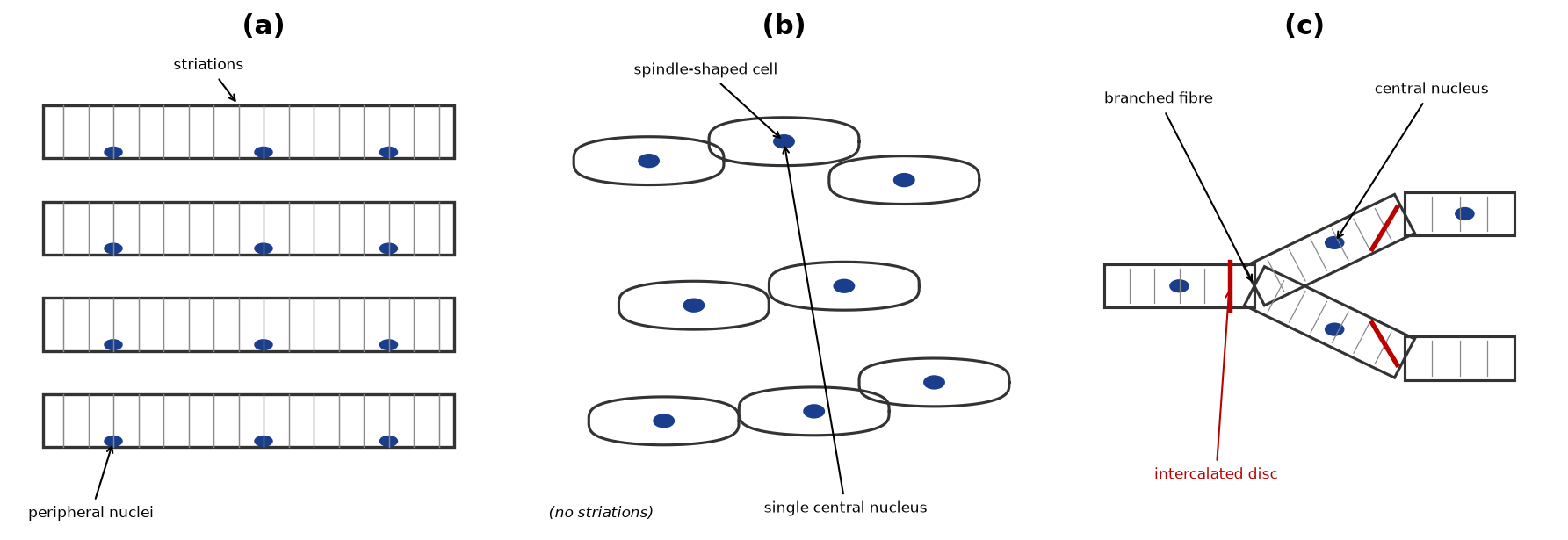
Which of the following statements wrongly represents the nature of smooth muscle? (a) Communication among the cells is performed by intercalated discs (b) These muscles are present in the wall of blood vessels (c) These muscle have no striations (d) They are involuntary muscles Choose the correct answer:
Identify the types of cell junctions that help to stop the leakage of the substances across a tissue and facilitation of communication with neighbouring cells via rapid transfer of ions and molecules
Which of the following is not a connective tissue?
Match List I with List II. List I (a) Bronchioles (b) Goblet Cell (c) Tendons (d) Adipose Tissue List II (i) Dense Regular Connective Tissue (ii) Loose Connective Tissue (iii) Glandular Tissue (iv) Ciliated Epithelium Choose the correct answer from the options given below:
Given below are two statements: Statement I: Goblet cells are unicellular glands. Statement II: Earwax is the secretion of exocrine gland. In the light of the above statements, choose the correct answer from the options given below:
Match List I and List II. List I A. Mast cells B. Inner surface of bronchiole C. Blood D. Tubular parts of nephron List II I. Ciliated epithelium II. Areolar connective tissue III. Cuboidal epithelium IV. Specialised connective tissue Choose the correct answer from the options given below:
Given below are two statements: Statement I: Ligaments are dense irregular tissue. Statement II: Cartilage is dense regular tissue. In the light of the above statements, choose the correct answer from the options given below:
Match List-I with List-II. List-I (A) Columnar epithelium (B) Ciliated epithelium (C) Squamous epithelium (D) Cuboidal epithelium List-II (I) Ducts of glands (II) Inner lining of stomach and intestine (III) Inner lining of bronchioles (IV) Endothelium Choose the correct answer from the options given below:
Match List I with List II. List I A. Unicellular glandular epithelium B. Compound epithelium C. Multicellular glandular epithelium D. Endocrine glandular epithelium List II I. Salivary Glands II. Pancreas III. Goblet cells of alimentary canal IV. Moist surface of buccal cavity Choose the correct answer from the options given below:
Three types of muscles are given as a, b and c. Identify the correct matching pair along with their location in the human body.
Which of the following statement is correct about location of the male frog copulatory pad?
In frog, the Renal system is a special venous connection that acts to link:
What is the name of the blood vessel that carries deoxygenated blood from the body to the heart in a frog?
Frogs respire in water by skin and buccal cavity and on land by skin, buccal cavity and lungs. Choose the correct answer from the following:
Choose the correct statements regarding frog's anatomy: A. Hepatic portal system is the special venous connection between liver and intestine. B. There are twelve pairs of cranial nerves arising from the brain. C. The ureters and oviducts open separately into the cloaca in female frogs. D. Hind-brain consists of cerebellum, medulla oblongata and optic lobes. E. Sinus venosus joins the right atrium of heart. Choose the correct answer from the options given below:
Male frogs can be distinguished from female frogs due to the presence of A. Bulging eyes B. Vocal sacs C. Webbed digits in feet D. Copulatory pad on first digit of fore limbs E. Olive green-coloured skin with dark irregular spots Choose the correct answer from the options given below
Want more Structural Organisation in Animals questions?
MedicNEET has 43,000+ NEET-style questions across Physics, Chemistry & Biology with detailed NCERT-based explanations — including the long, tricky questions that actually come in the exam.
Download MedicNEET App — Free