How many questions from Ecosystems in NEET?
3–4 questions from Ecosystem appear in NEET every year (12–16 marks, ~3% of NEET Biology). High-yield: energy flow (10% law), food chains vs food webs, ecological pyramids, decomposition steps, nutrient cycling (carbon, phosphorus), productivity types (GPP/NPP). Practice all 322 Ecosystem questions free in bilingual Hindi & English in the MedicNEET app.
Year-wise NEET Questions — Ecosystems
| Year | Questions | Marks |
|---|---|---|
| NEET 2016 | 3 | 12 |
| NEET 2017 | 2 | 8 |
| NEET 2018 | 1 | 4 |
| NEET 2019 | 2 | 8 |
| NEET 2020 | 3 | 12 |
| NEET 2021 | 3 | 12 |
| NEET 2022 | 3 | 12 |
| NEET 2023 | 5 | 20 |
| NEET 2024 | 1 | 4 |
| NEET 2025 | 3 | 12 |
| NEET 2026 | 5 | 20 |
Practise Ecosystems MCQs — Free
Every Ecosystems question format NEET uses, starting with the newest ReNEET 2026-style reasoning MCQs. Tap an option for the answer + NCERT explanation.
✨ Ecosystems — ReNEET 2026-Style Reasoning Questions
The newest, most exam-current format — reasoning-based questions modelled on ReNEET 2026. This is where NEET is heading; practise the pattern before the exam does.
- Q1. What would be the effect of drastically reduced solar input in a pond ecosystem?
- Q2. Which of the following illustrates the interrelationship of biotic and abiotic components in an ecosystem?
- Q3. Which best explains why NPP is ecologically more relevant than GPP?
- Q4. Why is Gross Primary Productivity (GPP) always higher than Net Primary Productivity (NPP)?
- Q5. Why does detritus rich in lignin decompose slowly?
- Q6. Why are decomposers essential to ecosystem function?
- Q7. How can some organisms occupy more than one trophic level in an ecosystem?
- Q8. Why is the grazing food chain limited in the number of trophic levels?
- Q9. Why is the detritus food chain more dominant in terrestrial ecosystems?
- Q10. Why does the pyramid of biomass differ between grasslands and ponds?
You’ve practised 10 of 54 Ecosystems questions in this set.
Practise all 54 + every chapter — free app →📑 Ecosystems — NEET 2025 & 2026 Long-Form MCQs
The long, multi-statement questions that dominated NEET 2025 & 2026 — each covers 5-6 concepts at once, so they double as fast full-chapter revision.
- Q1. Which of the following statements are correct regarding the biotic components and their roles in a pond ecosystem? S1. Phytoplankton and algae are the primary autotrophic components responsible for converting radiant energy into organic material. S2. Zooplankton represents the primary consumers, feeding directly on the autotrophic components in the pond. S3. Fungi and bacteria are the primary decomposers, predominantly found at the bottom of the pond, facilitating mineralisation. S4. Dissolved inorganic substances, solar input, and temperature cycles are crucial biotic factors regulating the pond ecosystem. S5. Flagellates are exclusively photosynthetic organisms found in the upper layers of the pond.
- Q2. Which of the above statements are correct? S1: Gross Primary Productivity (GPP) represents the total rate of organic matter production during photosynthesis. S2: Net Primary Productivity (NPP) is the available biomass for consumption by heterotrophs. S3: Energy used in plant respiration (R) is considered part of Net Primary Productivity (NPP). S4: Primary productivity is expressed in terms of weight (gm⁻² yr⁻¹) or energy (kcal m⁻² yr⁻¹). S5: GPP is always lower than NPP because of the energy utilised in plant respiration.
- Q3. Match the following decomposition step (Column I) with its characteristic activity (Column II) and primary product/outcome (Column III). Column I A. Fragmentation B. Leaching C. Catabolism D. Humification E. Mineralisation Column II 1. Movement of water-soluble inorganic nutrients 2. Breakdown of detritus into smaller particles 3. Enzymatic degradation of detritus 4. Further degradation of humus by microbes 5. Accumulation of amorphous organic matter resistant to microbial action Column III I. Dark-coloured amorphous substance II. Release of inorganic nutrients from humus III. Precipitation of unavailable salts in soil IV. Increased surface area for microbial action V. Simpler inorganic substances Which of the following options correctly matches all three columns for the respective decomposition steps?
- Q4. Which of the following statements correctly explain the ecological observations related to biomass and productivity in ecosystems? S1: Primary productivity is solely dependent on the plant species inhabiting a particular area, unaffected by environmental factors or nutrient availability. S2: Secondary productivity is defined as the rate of formation of new organic matter by consumers. S3: The pyramid of biomass in the sea is often inverted because the standing crop of phytoplankton, despite their high turnover rate, is generally less than that of the zooplankton and larger organisms it supports. S4: The annual net primary productivity of the whole biosphere is approximately 170 billion tons, with oceans contributing a larger fraction due to their vast surface area. S5: Standing crop is a measure of the flow of energy over a time period, whereas productivity is the total mass of living material at a particular time. S6: Dry weight is considered a more accurate measure for biomass of standing crop than fresh weight because it eliminates variations due to water content.
You’ve practised 4 of 47 Ecosystems questions in this set.
Practise all 47 + every chapter — free app →🧩 Ecosystems — All-Format Questions — Match, Assertion-Reason, Statement & Image-Based
Every question format NEET uses — match-the-column, assertion-reason, statement-based, and image/diagram questions — not just plain MCQs. Each with an instant NCERT-referenced solution.
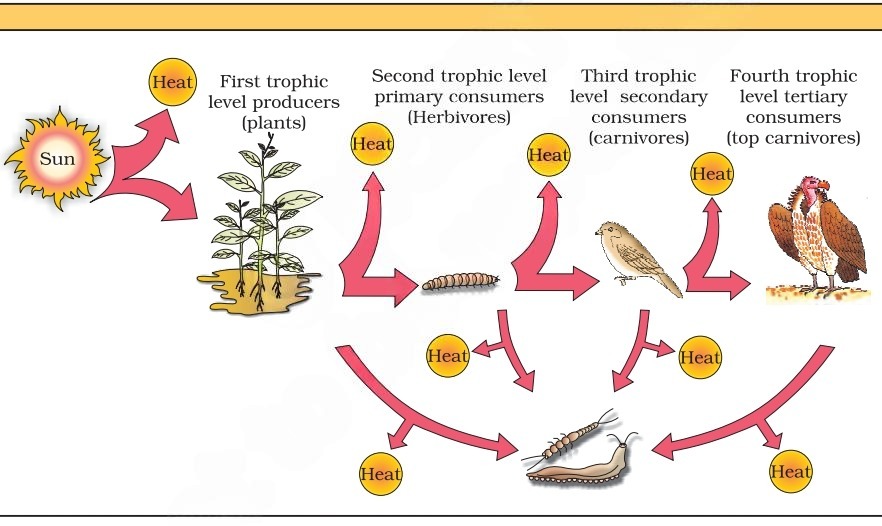
- Q1. Based on the image, which of the following correctly explains the limitation in length of the food chain?
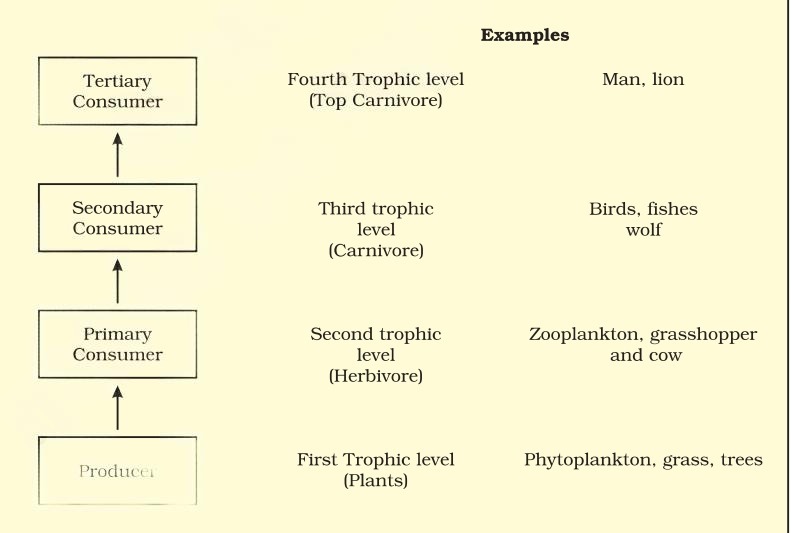
- Q2. Based on the diagram, what would be the most direct impact if the second trophic level collapses due to pesticide poisoning?
- Q3. Match the following : Column I A. Abiotic component B. Producers (aquatic) C. Primary consumers (terrestrial) D. Decomposers E. Stratification Column II 1. Zooplankton, insects, birds 2. Fungi, bacteria, flagellates 3. Phytoplankton, algae 4. Water, soil, temperature 5. Vertical distribution of species
- Q4. Match the following : Column I A. Fragmentation B. Leaching C. Catabolism D. Humification E. Mineralisation Column II 1. Water-soluble nutrients percolate into soil horizon 2. Formation of dark, resistant humus 3. Breakdown into smaller detritus particles 4. Enzymatic degradation into simple substances 5. Microbial release of inorganic nutrients
- Q5. Assertion (A): In a pond ecosystem, decomposers are especially abundant at the bottom. Reason (R): Decomposers such as fungi and bacteria degrade organic detritus and release nutrients.
- Q6. Assertion (A): Energy movement in a pond ecosystem is cyclic. Reason (R): Energy is repeatedly reused between autotrophs and decomposers.
- Q7. Consider the following statements on productivity: 1. Net primary productivity (NPP) = Gross primary productivity (GPP) – Respiration losses (R). 2. Secondary productivity refers to the rate of formation of organic matter by producers. 3. Annual NPP of the biosphere is ~170 billion tons. 4. Ocean productivity is higher than terrestrial productivity despite covering 70% of Earth’s surface. 5. Primary productivity depends on plant species, environment, and nutrients.
- Q8. Which of the following statements about ecosystem structure and function are correct? 1. Stratification in a forest places shrubs above trees and herbs. 2. Aquatic ecosystems do not exhibit self-sustainability. 3. Species composition refers to identification and enumeration of plant and animal species. 4. Pond ecosystems include abiotic and biotic components functioning as a unit. 5. Consumers in a pond include zooplankton and free-swimming animals.
- Q9. Arrange the following steps of decomposition in the correct sequence as they occur in nature: 1. Catabolism 2. Mineralisation 3. Humification 4. Leaching 5. Fragmentation
- Q10. Arrange the following organisms in the correct sequence of a grazing food chain in a terrestrial ecosystem: 1. Grass 2. Snake 3. Hawk 4. Frog 5. Grasshopper
You’ve practised 10 of 192 Ecosystems questions in this set.
Practise all 192 + every chapter — free app →Sample NEET PYQs — Ecosystems
The term ecosystem was coined by:
- A. E.P. Odum
- B. A.G. Tansley
- C. E. Haeckel
- D. E. Warming
Explanation: Answer: (B) The term 'ecosystem' was coined by A.G. Tansley (1935), making (b) correct. E.P. Odum is known for developing modern ecosystem ecology, Haeckel coined 'ecology', and Warming is associated with plant ecology. This is a history-of-the-term fact tied to NCERT's chapter framing the ecosystem as a functional unit of nature; the specific attribution is standard textbook knowledge not printed verbatim in this reprint. NCERT Reference: Ch 12, p.205 — “An ecosystem can be visualised as a functional unit of”
(Out of current syllabus — rationalised out of NCERT; included as it was asked in earlier NEET papers) Which of the following would appear as the pioneer organisms on bare rocks?
- A. Lichens
- B. Liverworts
- C. Mosses
- D. Green algae
Explanation: Answer: (A) (Out of current syllabus — rationalised out; last asked ≤2023) On bare exposed rock (a lithosere/xerarch sere) the very first colonisers are lichens, the pioneer community. They secrete acids that dissolve and weather the rock, releasing minerals and trapping detritus to form a thin soil that later supports mosses and higher plants. Liverworts, mosses and green algae need pre-formed moisture or soil and so appear only at later seral stages, not on the bare rock itself. NCERT Reference: Class XII, Ecosystem — ecological succession (pre-2023 NCERT; rationalised out of current reprint).
Which of the following statements is not correct?
- A. Pyramid of energy is always upright
- B. Pyramid of numbers in a grassland ecosystem is upright
- C. Pyramid of biomass in sea is generally inverted.
- D. Pyramid of biomass in sea is generally upright
Explanation: Answer: (D) We must find the statement that is NOT correct. (a) pyramid of energy is always upright — correct; (b) pyramid of numbers in grassland is upright — correct; (c) pyramid of biomass in sea is generally inverted — correct. (d) says the pyramid of biomass in sea is generally upright, which contradicts NCERT (it is inverted), so (d) is the incorrect statement and is the answer. NCERT Reference: Ch 12, p.213 — “The pyramid of biomass in sea is generally inverted”
Which ecosystem has the maximum biomass?
- A. Forest ecosystem
- B. Grassland ecosystem
- C. Pond ecosystem
- D. Lake ecosystem
Explanation: Answer: (A) Among the options, a forest ecosystem has the maximum biomass (standing crop) because large woody producers accumulate huge amounts of living material per unit area. NCERT notes each trophic level has a certain mass of living material called the standing crop and that pyramids of biomass decrease sharply at higher levels; forests, with massive producer biomass, hold the greatest standing crop versus grassland, pond or lake. Hence (a) forest ecosystem. NCERT Reference: Ch 12, p.211 — “certain mass of living material at a particular”
Frequently Asked Questions — Ecosystems NEET
How many questions from Ecosystem come in NEET?+
How many Ecosystem questions does MedicNEET have?+
What is the NEET weightage of Ecosystem?+
Are Ecosystem questions available in Hindi?+
Are Ecosystem questions NCERT-based?+
What are ReNEET 2026-style reasoning Ecosystems questions?+
Are these Ecosystems MCQs free to practise?+
Practise Ecosystems — Free
All 293+ Ecosystems questions · ReNEET 2026 reasoning + every format · Bilingual Hindi & English · NCERT-mapped explanations · No paywall
📲 Download MedicNEET App (Free)