How many questions from Organisms and Populations in NEET?
Organisms and Populations is tested with approximately 2–3 questions per NEET exam (~3% of Biology, 8–12 marks). Key topics: population growth models (logistic S-curve, exponential J-curve), interspecific interactions (mutualism +/+, competition −/−, predation +/−, parasitism +/−, commensalism +/0, amensalism −/0), population attributes (birth rate, death rate, age structure). Practice all 315 questions free in bilingual Hindi & English in the MedicNEET app.
Year-wise NEET Questions — Organisms and Populations
| Year | Questions | Marks |
|---|---|---|
| NEET 2016 | 5 | 20 |
| NEET 2017 | 2 | 8 |
| NEET 2018 | 5 | 20 |
| NEET 2020 | 1 | 4 |
| NEET 2021 | 3 | 12 |
| NEET 2022 | 3 | 12 |
| NEET 2023 | 10 | 40 |
| NEET 2024 | 2 | 8 |
| NEET 2025 | 3 | 12 |
| NEET 2026 | 6 | 24 |
Practise Organisms and Populations MCQs — Free
Every Organisms and Populations question format NEET uses, starting with the newest ReNEET 2026-style reasoning MCQs. Tap an option for the answer + NCERT explanation.
✨ Organisms and Populations — ReNEET 2026-Style Reasoning Questions
The newest, most exam-current format — reasoning-based questions modelled on ReNEET 2026. This is where NEET is heading; practise the pattern before the exam does.
- Q1. Why is exponential growth unsustainable in nature over long periods?
- Q2. Which of the following statements best explains life history variation among species?
- Q3. If a banyan tree and 200 carrot grass plants exist in an area, why is the banyan population not truly “smaller”?
- Q4. If an organism lives in an unpredictable, high-risk environment, which strategy is most favorable?
- Q5. Why don't predators in nature overexploit their prey?
- Q6. Why is it impossible to find a natural habitat with only a single species?
- Q7. Why is the female mosquito not considered a parasite?
- Q8. How does brood parasitism in birds like koel succeed?
- Q9. Which of the following is the evolutionary trade-off in life history strategies?
- Q10. Why do semelparous organisms like bamboo reproduce only once in their lifetime?
You’ve practised 10 of 48 Organisms and Populations questions in this set.
Practise all 48 + every chapter — free app →📑 Organisms and Populations — NEET 2025 & 2026 Long-Form MCQs
The long, multi-statement questions that dominated NEET 2025 & 2026 — each covers 5-6 concepts at once, so they double as fast full-chapter revision.
- Q1. Which of the following statements about prey defense mechanisms against predation are correct? S1: Cryptic coloration, or camouflage, allows some insects and frogs to blend with their surroundings, making them difficult for predators to detect. S2: The Monarch butterfly is distasteful to its bird predators due to special chemicals ingested from poisonous weeds during its larval stage. S3: Aposematic coloration, characterized by bright and conspicuous colours, serves as a warning signal to predators, indicating that the prey is poisonous or unpalatable. S4: Morphological defenses in plants, such as thorns in Acacia and Cactus, are examples of adaptations to deter herbivores. S5: All chemical substances produced by plants, like nicotine and opium, are solely for commercial extraction and do not serve as defenses against herbivores.
- Q2. Match Column I (Organism / Phenomenon) with Column II (Ecological Interaction / Adaptation) based on the descriptions in NCERT. Column I A. Cuscuta B. Monarch butterfly C. Ophrys orchid D. Koel (Cuckoo) Column II i. Commensalism ii. Chemical defense against predators iii. Sexual deceit for pollination iv. Brood parasitism v. Ectoparasitism
- Q3. Match the following organism relationships with their respective interspecific interaction types: Column I (Organism Relationship) A. Fig tree and its pollinator wasp B. Cattle egret and grazing cattle C. Starfish Pisaster and intertidal invertebrates D. Human liver fluke and human host E. Abingdon tortoise and goats on Galapagos Islands Column II (Interspecific Interaction Type) i. Competition ii. Predation iii. Parasitism iv. Commensalism v. Mutualism
- Q4. Which of the above statements are NOT correct? S1: The size of a population for any species is a static parameter, remaining largely constant over time. S2: Natality refers to the number of deaths in a population during a given period. S3: Immigration contributes to an increase in population density, whereas emigration leads to a decrease. S4: Under normal conditions, births and deaths are generally the most important factors influencing population density. S5: When a new habitat is being colonised, immigration may contribute more significantly to population growth than birth rates.
You’ve practised 4 of 39 Organisms and Populations questions in this set.
Practise all 39 + every chapter — free app →🧩 Organisms and Populations — All-Format Questions — Match, Assertion-Reason, Statement & Image-Based
Every question format NEET uses — match-the-column, assertion-reason, statement-based, and image/diagram questions — not just plain MCQs. Each with an instant NCERT-referenced solution.
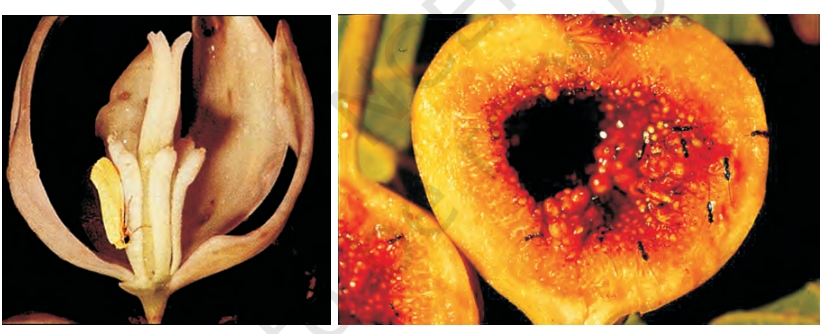
- Q1. From the given image and context, which of the following statements is correct regarding the interaction?
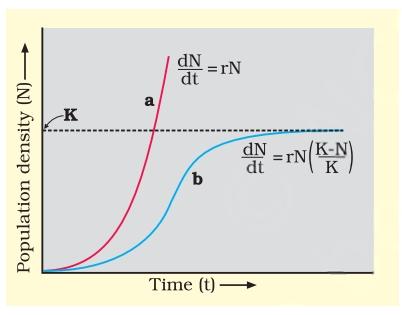
- Q2. Suppose a population is growing as per curve ‘a’ in the image. What must be true about its environment?
- Q3. Match the following population attributes with their correct definitions: Column I A. Birth rate B. Death rate C. Sex ratio D. Age pyramid E. Per capita rates Column II 1. Proportion of males and females in a population 2. Number of births per individual per unit time 3. Number of deaths per individual per unit time 4. Graphical representation of age distribution within a population 5. Change in numbers (increase or decrease) per member of population
- Q4. Match the following population interactions with the effects on Species A and Species B: Column I (Interaction type) A. Mutualism B. Competition C. Predation D. Parasitism E. Commensalism F. Amensalism Column II (Species A) 1. + 2. – Column III (Species B) i. + ii. – iii. 0
- Q5. Assertion (A): Some insects are cryptically coloured to avoid predation. Reason (R): Bright colours increase the chance of predation.
- Q6. Assertion (A): Monarch butterflies are preyed upon by birds. Reason (R): Monarch caterpillars ingest cardiac glycosides from Calotropis.
- Q7. Which of the following statements are correct? 1. Logistic growth curve is J-shaped, whereas exponential growth curve is S-shaped. 2. Carrying capacity (K) limits growth and defines the asymptote in logistic growth. 3. Exponential growth can be described mathematically as . Nt = No * e^(rt) 4. Verhulst–Pearl equation for logistic growth is . dN/dt = rN * (1 - N/K) 5. In natural conditions, logistic growth is considered more realistic than exponential growth.
- Q8. Arrange the following phases of a sigmoid (logistic) growth curve in the correct sequential order: 1. Decelerating phase, growth rate slows as resources become limiting 2. Exponential (log) phase, rapid increase under abundant resources 3. Lag phase, initial period of slow growth as organisms adjust 4. Stationary phase, population stabilises near carrying capacity (K) 5. Carrying capacity (K) determines the asymptote of the curve
- Q9. Consider the following statements about population size and its measurement: 1. Population size, also called population density (N), is always measured only in terms of number of individuals present. 2. In some cases, biomass or percentage cover is a more meaningful measure of population size than absolute number. 3. Relative density (e.g., number of fish caught per trap) can be sufficient for certain ecological investigations. 4. The tiger census in national parks is often estimated indirectly using pug marks and fecal pellets. 5. Age pyramids of human populations represent age distribution of males and females and can indicate whether a population is growing, stable, or declining.
- Q10. Which of the following statements are correct? 1. Predators only reduce species diversity by killing prey populations. 2. Pisaster starfish removal experiment showed predators can maintain species diversity. 3. Plant chemicals like cardiac glycosides in Calotropis protect against herbivores. 4. Monarch butterfly accumulates such toxins, making it distasteful to birds. 5. Thorns in Acacia and cactus act as structural defenses against herbivory.
You’ve practised 10 of 181 Organisms and Populations questions in this set.
Practise all 181 + every chapter — free app →Sample NEET PYQs — Organisms and Populations
When does the growth rate of a population following the logistic model equal zero? The logistic model is given as dN/dt = rN(1 − N/K): (NEET 2016 (Phase 1))
- A. When N/K is exactly one
- B. When N nears the carrying capacity of the habitat
- C. When N/K equals zero
- D. When death rate is greater than birth rate
Explanation: Answer: (A) When N/K is exactly one. Solution: In dN/dt = rN(1 − N/K), the growth rate is exactly zero when the bracket (1 − N/K) = 0, i.e. when N/K = 1 (N = K, the carrying capacity). At this point the population has reached its asymptote and stops growing. NCERT: Ch 11, p.195, lines 37-42 — "finally an asymptote, when the population density reaches the carrying capacity"
Gause's principle of competitive exclusion states that: (NEET 2016 (Phase 1))
- A. More abundant species will exclude the less abundant species through competition
- B. Competition for the same resources excludes species having different food preferences
- C. No two species can occupy the same niche indefinitely for the same limiting resources
- D. Larger organisms exclude smaller ones through competition
Explanation: Answer: (C) No two species can occupy the same niche indefinitely for the same limiting resources. Solution: Gause's Competitive Exclusion Principle states that two closely related species competing for the same limiting resources cannot co-exist indefinitely; the competitively inferior one is eventually eliminated. Option C captures this idea (same niche/same limiting resources), whereas A and D wrongly base exclusion on abundance or body size. NCERT: Ch 11, p.199, lines 30-33 — "Gause’s ‘Competitive Exclusion Principle’ states that two closely related species competing for the same resources cannot co-exist indefinitely and the competitively inferior one will be eliminated eventually."
Which of the following is correct for r-selected species? (NEET 2016 (Phase 2))
- A. Large number of progeny with small size
- B. Large number of progeny with large size
- C. Small number of progeny with small size
- D. Small number of progeny with large size
Explanation: Answer: (A) Large number of progeny with small size. Solution: r-selected species maximise their intrinsic growth rate (high r) by producing a large number of small-sized offspring (e.g. oysters, pelagic fishes), as opposed to K-selected species which produce a small number of large offspring (birds, mammals). NCERT: Ch 11, p.196, lines 19-21 — "Some produce a large number of small-sized offspring (Oysters, pelagic fishes) while others produce a small number of large-sized offspring (birds, mammals)."
If '+' sign is assigned to beneficial interaction, '–' sign to detrimental and '0' sign to neutral interaction, then the population interaction represented by '+' '–' refers to (NEET 2016 (Phase 2))
- A. Mutualism
- B. Amensalism
- C. Commensalism
- D. Parasitism
Explanation: Answer: (D) Parasitism. Solution: A (+ , −) interaction means one species benefits and the other is harmed. Per Table 11.1 this applies to both Predation and Parasitism; since Predation is not among the options, the answer is Parasitism. Mutualism is (+,+), commensalism (+,0) and amensalism (−,0). NCERT: Ch 11, p.197, lines 47-49 — "+ – Parasitism"
Frequently Asked Questions — Organisms and Populations NEET
How many questions come from Organisms and Populations in NEET?+
How many Organisms and Populations questions does MedicNEET have?+
What is the NEET weightage of Organisms and Populations?+
Are Organisms and Populations questions NCERT-based?+
Can I practice Organisms and Populations questions in Hindi?+
What are ReNEET 2026-style reasoning Organisms and Populations questions?+
Are these Organisms and Populations MCQs free to practise?+
Practise Organisms and Populations — Free
All 268+ Organisms and Populations questions · ReNEET 2026 reasoning + every format · Bilingual Hindi & English · NCERT-mapped explanations · No paywall
📲 Download MedicNEET App (Free)