
Cyclostomata — No Jaws, No Paired Fins, 6-15 Gill Slits
✅ Asked in NEET 2016Choose the correct statement: NEET Year: NEET-II 2016
Choose the correct statement: NEET Year: NEET-II 2016
Answer & NCERT explanation
Correct answer: B — All cyclostomes do not possess jaws and paired fins
Cyclostomes (lampreys and hagfish) are primitive vertebrates that lack both jaws and paired fins, making option b correct. Option a is wrong because some mammals like monotremes lay eggs. Option c is incorrect as crocodiles have a four-chambered heart. Option d is wrong since cartilaginous fish lack an operculum covering their gills.
Read more NCERT concept on the PYQ
All living members of the class Cyclostomata are ectoparasites on some fishes. They have an elongated body bearing 6-15 pairs of gill slits for respiration. Cyclostomes have a sucking and circular mouth without jaws. Their body is devoid of scales and paired fins. Cranium and vertebral column are cartilaginous. Circulation is of closed type. Cyclostomes are marine but migrate for spawning to fresh water. After spawning, within a few days, they die. Their larvae, after metamorphosis, return to the ocean.
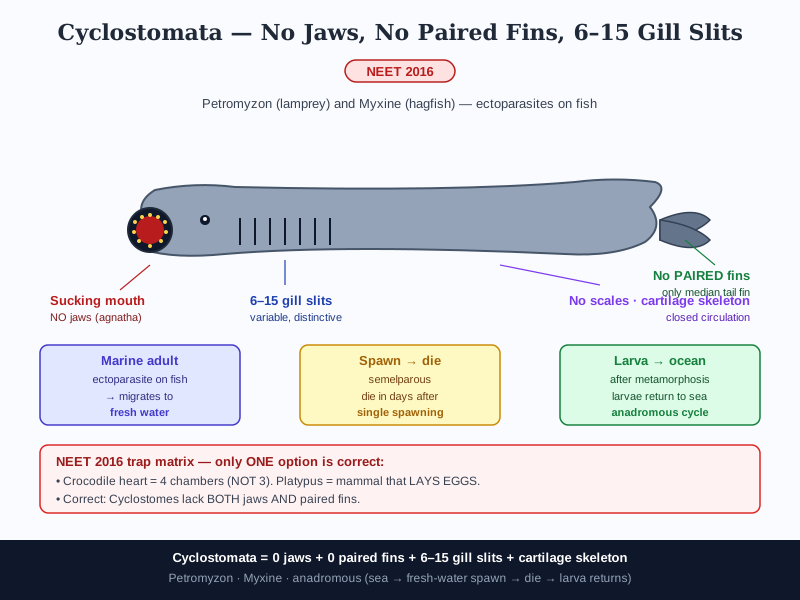
All living Cyclostomata are ectoparasites on fish. They have an elongated body with 6-15 pairs of gill slits for respiration. Their most distinctive features: a circular sucking mouth without jaws, and body devoid of both scales and paired fins. Cranium and vertebral column are cartilaginous. Circulation is closed type. Cyclostomes are marine but migrate to freshwater for spawning. After spawning, they die within a few days. Larvae, after metamorphosis, return to the ocean. Examples: Petromyzon (lamprey) and Myxine (hagfish).
NEET 2016 tested the correct statement among four options. Option B ('All cyclostomes do not possess jaws and paired fins') was the correct statement because NCERT explicitly states these two absences as defining characters of Cyclostomata. The other options failed because: Platypus (monotreme) is a mammal that lays eggs (so not all mammals are viviparous); Crocodiles have a 4-chambered heart (not 3-chambered); Cartilaginous fish (Chondrichthyes) like sharks lack the operculum covering gills.
All reptiles have a three-chambered heart.
Crocodiles have a FOUR-chambered heart. Only cyclostomes lack BOTH jaws AND paired fins — this is the correct statement.
CROCodile = 4 chambers. Cyclostomes = 0 jaws + 0 paired fins. Platypus = mammal that lays eggs.
- 6-15 pairs of gill slits in cyclostomes — variable number distinguishes them from other vertebrates.
- Marine but migrate to fresh water for spawning — anadromous migration pattern.
- Die shortly after spawning — unusual among vertebrates (semelparous reproduction).
- Cartilaginous cranium and vertebral column — primitive character shared with Chondrichthyes.
Which of the following statements is CORRECT? S1: All members of Cyclostomata lack jaws and paired fins. S2: All mammals are viviparous and nurse their young with milk from nipples. S3: All reptiles possess a three-chambered heart for double circulation. S4: All pisces (fish) have gills covered by an operculum. S5: Cyclostomes are marine animals that migrate to fresh water for spawning.
View bonus solution & explanation
Correct answer: A — S1 and S5
S1 CORRECT: All cyclostomes lack jaws AND paired fins (NCERT explicit). S2 WRONG: Ornithorhynchus (Platypus) is viviparous — WRONG, it is oviparous (lays eggs); also lacks nipples. S3 WRONG: Crocodiles have 4-chambered heart — not all reptiles are 3-chambered. S4 WRONG: Cartilaginous fish (sharks, rays) lack operculum — only bony fish have it. S5 CORRECT: Cyclostomes are marine but migrate to fresh water for spawning (NCERT).
What is Cyclostomata?
What did NEET 2016 ask on Cyclostomata?
What is the most common NEET trap on Cyclostomata?
How do you remember Cyclostomata for NEET?
What are the key components of Cyclostomata?
Through deep analysis of NEET and NTA, 176 of the 180 ReNEET 2026 (June 21) questions were already in the MedicNEET question bank before the exam.
176/180MedicNEET's Biology question bank is built from the same NCERT lines NTA picks repeatedly. Not random MCQs — questions crafted exactly like NTA crafts them.
You just learned this concept. The free app turns it into a daily goal built from your weak topics and brings it back just before you forget it — using active recall and spaced repetition — so it stays till exam day.