
Nitrogenous Bases — Purines A G vs Pyrimidines C T U
✅ Asked in NEET 2022Match List-I with List-II (NEET 2022 Phase 2) List I A. Adenine B. Anthocyanin C. Chitin D. Codeine List II i. Pigment ii. Polysaccharide iii. Alkaloid iv. Purine Choose the correct answer:
Match List-I with List-II (NEET 2022 Phase 2) List I A. Adenine B. Anthocyanin C. Chitin D. Codeine List II i. Pigment ii. Polysaccharide iii. Alkaloid iv. Purine Choose the correct answer:
Answer & NCERT explanation
Correct answer: B — A – (iv), B – (i), C – (ii), D – (iii)
Adenine is a purine base (iv) found in nucleic acids. Anthocyanin is a pigment (i) responsible for red, blue, purple colors in plants. Chitin is a polysaccharide (ii) found in fungal cell walls and arthropod exoskeletons. Codeine is an alkaloid (iii) derived from opium poppy.
Read more NCERT concept on the PYQ
As you notice in, the heterocyclic compounds in nucleic acids are the nitrogenous bases named adenine, guanine, uracil, cytosine, and thymine. Adenine and Guanine are substituted purines while the rest are substituted pyrimidines. The skeletal heterocyclic ring is called as purine and pyrimidine respectively. The sugar found in polynucleotides is either ribose (a monosaccharide pentose) or 2' deoxyribose. A nucleic acid containing deoxyribose is called deoxyribonucleic acid (DNA) while that which contains ribose is called ribonucleic acid (RNA).
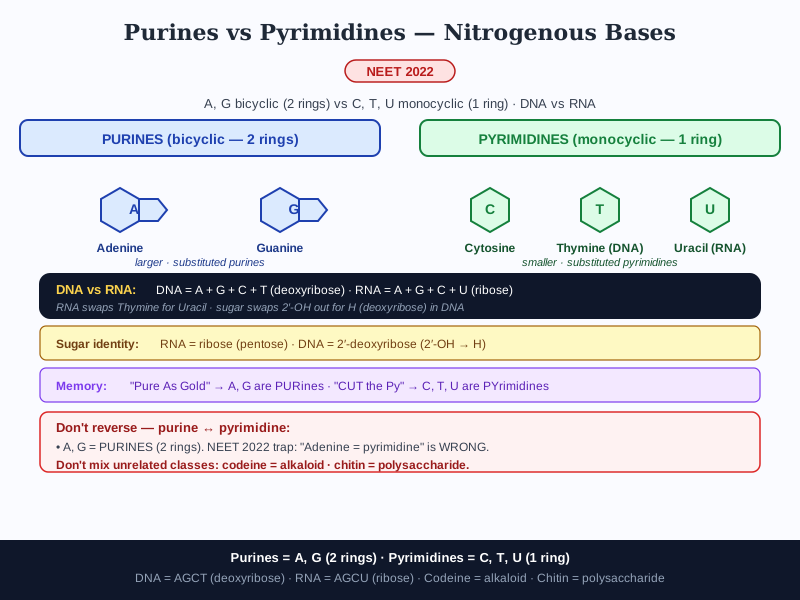
The HETEROCYCLIC nitrogen-containing compounds in nucleic acids are the NITROGENOUS BASES: ADENINE (A), GUANINE (G), URACIL (U), CYTOSINE (C), and THYMINE (T). ADENINE and GUANINE are SUBSTITUTED PURINES (the bicyclic skeleton called PURINE). The remaining three — URACIL, CYTOSINE, THYMINE — are SUBSTITUTED PYRIMIDINES (the monocyclic skeleton called PYRIMIDINE). The SUGAR in polynucleotides is either RIBOSE (a pentose monosaccharide) or 2'-DEOXYRIBOSE (ribose with the 2'-OH replaced by H). A nucleic acid containing DEOXYRIBOSE is called DEOXYRIBONUCLEIC ACID (DNA); one containing RIBOSE is RIBONUCLEIC ACID (RNA). DNA has A, G, C, T; RNA has A, G, C, U (thymine replaced by uracil).
NEET 2022 Phase 2 matching: Adenine = Purine; Anthocyanin = Pigment; Chitin = Polysaccharide; Codeine = Alkaloid → answer B. Memory rules: PURINES = A, G (bicyclic, 2 rings — 'Pure As Gold'). PYRIMIDINES = C, T, U (monocyclic, 1 ring — 'CUT the Py'). DNA: A, G, C, T. RNA: A, G, C, U. Don't reverse purine and pyrimidine. Anthocyanin = plant pigment; chitin = polysaccharide (fungal walls); codeine = opium alkaloid.
Adenine and guanine are substituted pyrimidines, while uracil and cytosine are substituted purines.
Adenine and Guanine are substituted PURINES (bicyclic). Uracil, Cytosine, Thymine are substituted PYRIMIDINES (monocyclic).
PURINES = A, G (Pure As Gold). PYRIMIDINES = C, T, U (CUT the Py). DNA: A,G,C,T. RNA: A,G,C,U.
- PURINES (bicyclic, 2 rings) = Adenine (A) + Guanine (G).
- PYRIMIDINES (monocyclic, 1 ring) = Cytosine (C) + Thymine (T) + Uracil (U).
- Sugar: ribose (in RNA) or 2'-deoxyribose (in DNA). DNA has A,G,C,T; RNA has A,G,C,U.
- NEET 2022 match: Adenine=Purine, Anthocyanin=Pigment, Chitin=Polysaccharide, Codeine=Alkaloid.
What is Nitrogenous Bases?
What did NEET 2022 ask on Nitrogenous Bases?
What is the most common NEET trap on Nitrogenous Bases?
How do you remember Nitrogenous Bases for NEET?
What are the key components of Nitrogenous Bases?
Through deep analysis of NEET and NTA, 176 of the 180 ReNEET 2026 (June 21) questions were already in the MedicNEET question bank before the exam.
176/180MedicNEET's Biology question bank is built from the same NCERT lines NTA picks repeatedly. Not random MCQs — questions crafted exactly like NTA crafts them.
You just learned this concept. The free app turns it into a daily goal built from your weak topics and brings it back just before you forget it — using active recall and spaced repetition — so it stays till exam day.