
Protein Primary Structure — Linear Amino Acid Sequence, N to C Terminal
📚 Practice ConceptProteins, as mentioned earlier, are heteropolymers containing strings of amino acids. Structure of molecules means different things in different contexts. In inorganic chemistry, the structure invariably refers to the molecular formulae (e.g., NaCl, MgCl₂, etc.). Organic chemists always write a two dimensional view of the molecules while representing the structure of the molecules (e.g., benzene, naphthalene, etc.). Physicists conjure up the three dimensional views of molecular structures while biologists describe the protein structure at four levels. The sequence of amino acids i.e., the positional information in a protein – which is the first amino acid, which is second, and so on – is called the primary structure of a protein. A protein is imagined as a line, the left end represented by the first amino acid and the right end represented by the last amino
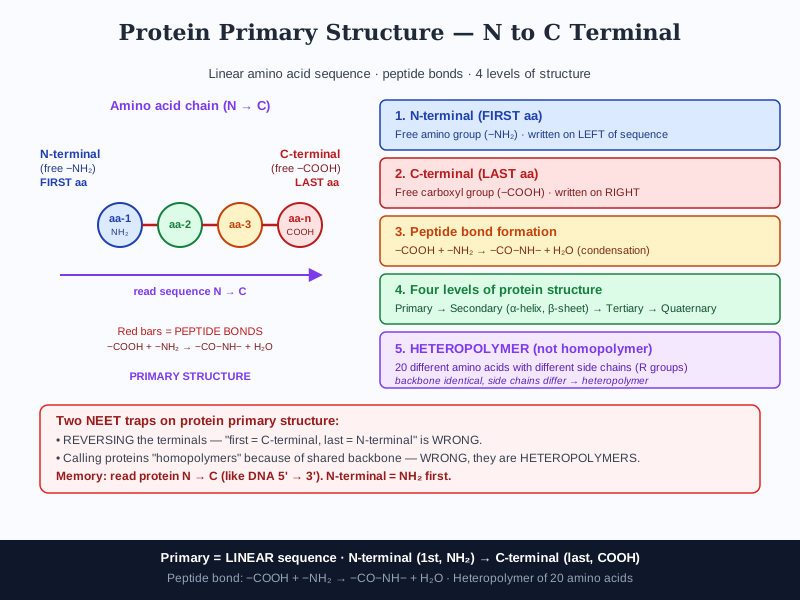
The first amino acid of a protein is the C-terminal amino acid and the last is the N-terminal.
FIRST amino acid = N-TERMINAL (free amino group, left end). LAST amino acid = C-TERMINAL (free carboxyl group, right end). Sequence is read N → C.
Read protein N → C, just like DNA 5' → 3'. N-terminal = NHfirst. C-terminal = COOH at the end. Heteropolymer (20 different side chains).
- Primary structure = LINEAR SEQUENCE of amino acids — positional information (which is 1st, which is 2nd).
- First amino acid = N-TERMINAL (free amino group); last = C-TERMINAL (free carboxyl group).
- Peptide bond: carboxyl of one amino acid + amino of next → bond + H₂O released (condensation).
- Proteins are HETEROPOLYMERS (20 different amino acids) — NOT homopolymers.
Consider the following statements about protein primary structure and polypeptide formation: S1: The linear sequence of amino acids defines the primary structure of a protein. S2: The first amino acid in a protein is called the C-terminal and the last is the N-terminal. S3: Peptide bonds form between the carboxyl group of one amino acid and the amino group of another, releasing a water molecule. S4: Proteins are homopolymers because all amino acids share the same backbone structure. S5: Primary structure alone is sufficient to guarantee full biological activity of a protein.
View bonus solution & explanation
Correct answer: A — S1 and S3 only
S1 CORRECT: Primary structure = linear sequence (positional information). S2 WRONG: REVERSED — first = N-terminal (free amino), last = C-terminal (free carboxyl). Classic swap trap. S3 CORRECT: Peptide bond is condensation: -COOH + -NH₂ → -CO-NH- + H₂O. S4 WRONG: Proteins are HETEROPOLYMERS (20 different amino acids with different R-groups), not homopolymers. S5 WRONG: Primary structure determines sequence but does NOT guarantee activity — folding into secondary/tertiary structure is required.
What is Protein Primary Structure?
What did NEET previous years ask on Protein Primary Structure?
What is the most common NEET trap on Protein Primary Structure?
How do you remember Protein Primary Structure for NEET?
What are the key components of Protein Primary Structure?
Through deep analysis of NEET and NTA, 176 of the 180 ReNEET 2026 (June 21) questions were already in the MedicNEET question bank before the exam.
176/180MedicNEET's Biology question bank is built from the same NCERT lines NTA picks repeatedly. Not random MCQs — questions crafted exactly like NTA crafts them.
You just learned this concept. The free app turns it into a daily goal built from your weak topics and brings it back just before you forget it — using active recall and spaced repetition — so it stays till exam day.