
Mitosis Animals vs Plants — Cell Plate, Cleavage Furrow, Diploid Rule
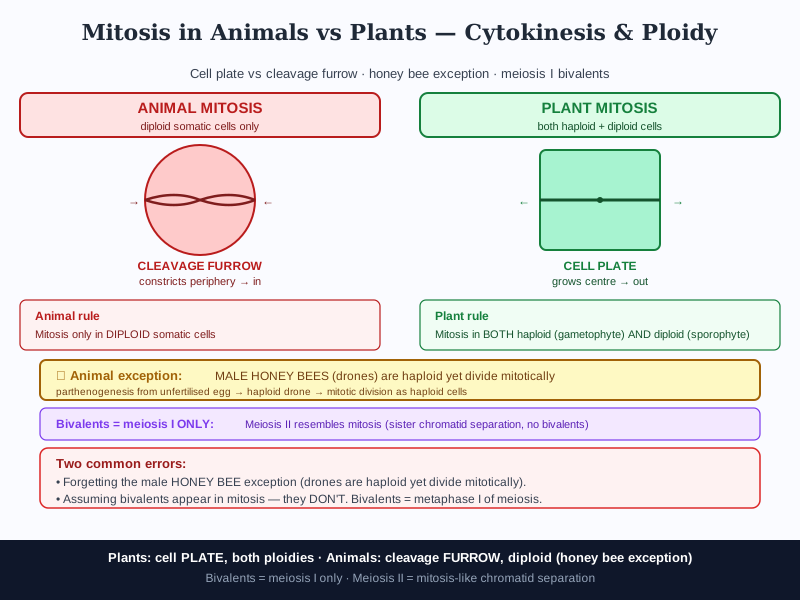
🔥 Predicted for NEET 2027In animals, mitotic cell division is only seen in the diploid somatic cells. However, there are few exceptions to this where haploid cells divide by mitosis, for example, male honey bees. Against this, the plants can show mitotic divisions in both haploid and diploid cells. From your recollection of examples of alternation of generations in plants (Chapter 3) identify plant species and stages at which mitosis is seen in haploid cells.
Adjacent to a frequently-asked paragraph in the same chapter.
Four memory points: (1) Animals: mitosis only in diploid somatic cells, except male honey bees (haploid drones). (2) Plants: mitosis in both haploid (gametophyte) and diploid (sporophyte) cells. (3) Cytokinesis: plant = cell plate (centripetal-out); animal = cleavage furrow (peripheral-in). (4) Meiosis-I-only features: bivalents (paired homologues at metaphase I), chiasmata, crossing over, synaptonemal complex. Meiosis II = mitosis-like (sister chromatid separation, no bivalents). The honey bee exception is high-yield NEET trivia.
All animal cells undergo mitosis only as diploid cells with no exceptions; plant mitosis is restricted to diploid sporophyte cells.
Animal exception: MALE HONEY BEES (haploid drones) undergo mitosis as haploid cells. Plants show mitosis in BOTH haploid (gametophyte) and diploid (sporophyte) cells.
Plants: cell PLATE, both ploidies. Animals: cleavage FURROW, diploid-only (except male honey bees). Bivalents = meiosis I only.
- Animals: mitosis only in DIPLOID somatic cells (exception: MALE HONEY BEES are haploid yet divide mitotically).
- Plants: mitosis in BOTH haploid (gametophyte) and diploid (sporophyte) cells.
- Cytokinesis: PLANT = cell plate forms centre-outward; ANIMAL = cleavage furrow constricts periphery-inward.
- Meiosis II chromosome behaviour = mitosis-like (sister chromatid separation). BIVALENTS at metaphase I = unique to meiosis.
Choose all correct statements about plant vs animal divisions across mitosis and meiosis: (I) Plant mitosis uses a cell plate; animal mitosis uses a cleavage furrow. (II) Meiosis II chromosome behaviour parallels mitotic segregation of sister chromatids. (III) Bivalents at metaphase I are unique to meiosis. (IV) In animals, mitotic division is only in diploid somatic cells (with noted exceptions like male honey bees).
View solution & NCERT explanation
Correct answer: C — I, II, III and IV
Plant cytokinesis uses cell plate; animals use furrow. Meiosis II resembles mitosis; bivalents are seen in meiosis I; animals typically show mitosis in diploid somatic cells with exceptions.
What is Mitosis Animals vs Plants?
What did NEET previous years ask on Mitosis Animals vs Plants?
What is the most common NEET trap on Mitosis Animals vs Plants?
How do you remember Mitosis Animals vs Plants for NEET?
What are the key components of Mitosis Animals vs Plants?
Through deep analysis of NEET and NTA, 176 of the 180 ReNEET 2026 (June 21) questions were already in the MedicNEET question bank before the exam.
176/180MedicNEET's Biology question bank is built from the same NCERT lines NTA picks repeatedly. Not random MCQs — questions crafted exactly like NTA crafts them.
You just learned this concept. The free app turns it into a daily goal built from your weak topics and brings it back just before you forget it — using active recall and spaced repetition — so it stays till exam day.