
Pleiotropy — Single Gene, Multiple Effects: Starch Synthesis in Pea (B/b)
✅ Asked in NEET 2018Which of the following pairs is wrongly matched? (NEET 2018)
Which of the following pairs is wrongly matched? (NEET 2018)
Answer & NCERT explanation
Correct answer: A — Starch synthesis in pea : Multiple alleles
Starch synthesis in pea is controlled by a single gene with two alleles (B for starch synthesis, b for no starch), not multiple alleles. Multiple alleles involve three or more alternative forms of a gene at the same locus, like ABO blood groups. Other options are correctly matched - ABO shows co-dominance, XO sex determination occurs in grasshopper, and T.H. Morgan discovered linkage.
Read more NCERT concept on the PYQ
Occasionally, a single gene product may produce more than one effect. For example, starch synthesis in pea seeds is controlled by one gene. It has two alleles (B and b). Starch is synthesised effectively by BB homozygotes and therefore, large starch grains are produced. In contrast, bb homozygotes have lesser efficiency in starch synthesis and produce smaller starch grains. After maturation of the seeds, BB seeds are round and the bb seeds are wrinkled. Heterozygotes produce round seeds, and so B seems to be the dominant allele. But, the starch grains produced are of intermediate size in Bb seeds. So if starch grain size is considered as the phenotype, then from this angle, the alleles show incomplete dominance.
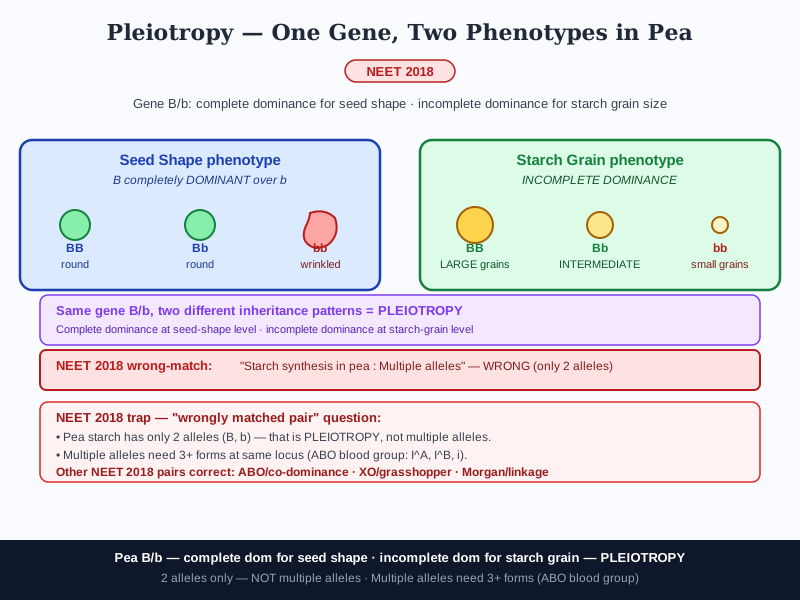
Occasionally a SINGLE GENE may produce MORE THAN ONE EFFECT — this is PLEIOTROPY. NCERT's classic example is STARCH SYNTHESIS in pea seeds, controlled by a single gene with TWO alleles (B and b). BB homozygotes efficiently synthesise starch → LARGE starch grains → ROUND seeds. bb homozygotes have lower efficiency → SMALLER starch grains → WRINKLED seeds. Bb heterozygotes produce ROUND seeds (B appears dominant for seed shape), BUT their starch grains are of INTERMEDIATE size — so at the starch-grain level the alleles show INCOMPLETE DOMINANCE. The SAME gene shows dominant-recessive inheritance at the seed-shape phenotype and incomplete dominance at the starch-grain phenotype. One gene, two phenotypic patterns — pleiotropy.
NEET 2018 trap: 'Starch synthesis in pea : Multiple alleles' was the WRONG pair. Pea starch is controlled by TWO alleles (B and b) — that is TWO alleles, NOT multiple alleles. Multiple alleles need three or more alternative forms at the same locus (e.g., ABO blood group with I^A, I^B and i). The correct categorisation for pea starch is PLEIOTROPY (or incomplete dominance at the starch-grain phenotype). Other NEET 2018 pairs were correct: ABO/co-dominance, XO/grasshopper, T.H. Morgan/linkage.
Starch synthesis in pea is an example of multiple alleles, with three or more alternative forms controlling seed phenotype.
Pea starch synthesis has only TWO alleles (B and b) — it is PLEIOTROPY (one gene, multiple effects) and shows incomplete dominance at the starch-grain level. NOT multiple alleles.
Pea B/b = 2 alleles = PLEIOTROPY (one gene, multiple phenotypes). Multiple alleles need 3+ forms (ABO blood group).
- Pea starch synthesis: single gene, TWO alleles (B, b) — not multiple alleles.
- BB → large starch grains → round seeds. bb → small starch grains → wrinkled seeds.
- Bb → ROUND seeds (B dominant for shape) but INTERMEDIATE starch grains (incomplete dominance at grain size).
- Pleiotropy = single gene with multiple phenotypic effects. Pea starch is the NCERT canonical example.
Consider the following statements about starch synthesis in pea: S1: Starch synthesis in pea is controlled by a single gene with two alleles (B and b). S2: BB homozygotes produce large starch grains and round seeds. S3: bb homozygotes produce small starch grains and wrinkled seeds. S4: Bb heterozygotes produce wrinkled seeds with intermediate-sized starch grains. S5: Starch synthesis in pea is an example of multiple alleles, with three or more alternative forms.
View bonus solution & explanation
Correct answer: A — S1, S2 and S3
S1 CORRECT: Single gene, 2 alleles (B, b) — NCERT exact. S2 CORRECT: BB → large grains → round seeds. S3 CORRECT: bb → small grains → wrinkled seeds. S4 WRONG: Bb seeds are ROUND (B is dominant for shape) — but the starch grains are INTERMEDIATE in size (incomplete dominance at the grain-size phenotype). The 'wrinkled' claim is wrong. S5 WRONG: Pea starch has only TWO alleles, NOT multiple alleles — NEET 2018 explicitly flagged this as the wrong match. Multiple alleles need 3+ forms (e.g., ABO).
What is Pleiotropy?
What did NEET 2018 ask on Pleiotropy?
What is the most common NEET trap on Pleiotropy?
How do you remember Pleiotropy for NEET?
What are the key components of Pleiotropy?
Through deep analysis of NEET and NTA, 176 of the 180 ReNEET 2026 (June 21) questions were already in the MedicNEET question bank before the exam.
176/180MedicNEET's Biology question bank is built from the same NCERT lines NTA picks repeatedly. Not random MCQs — questions crafted exactly like NTA crafts them.
You just learned this concept. The free app turns it into a daily goal built from your weak topics and brings it back just before you forget it — using active recall and spaced repetition — so it stays till exam day.