
Mendel's Discrete Genes — Why Contemporaries Rejected His Theory
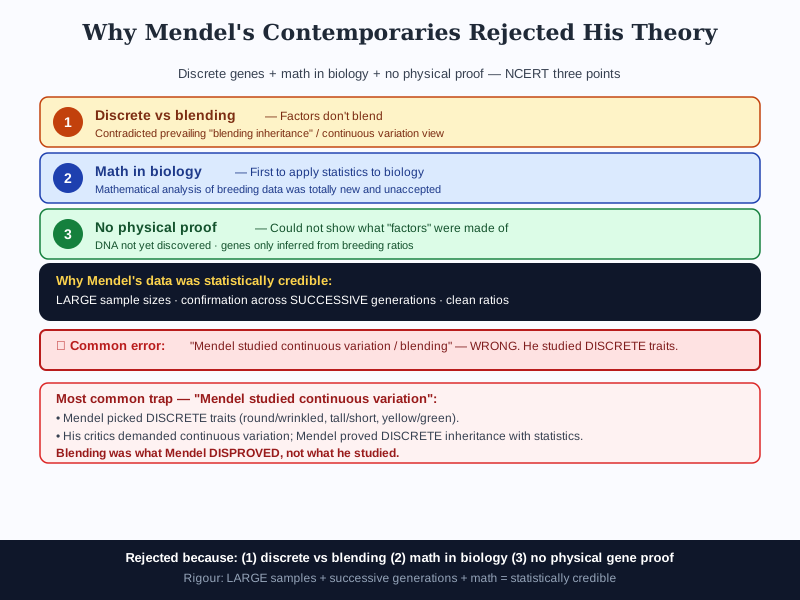
📚 Practice ConceptSecondly, his concept of genes (or factors, in Mendel's words) as stable and discrete units that controlled the expression of traits and, of the pair of alleles which did not 'blend' with each other, was not accepted by his contemporaries as an explanation for the apparently continuous variation seen in nature. Thirdly, Mendel's approach of using mathematics to explain biological phenomena was totally new and unacceptable to many of the biologists of his time. Finally, though Mendel's work suggested that factors (genes) were discrete units, he could not provide any physical proof for the existence of factors or say what they were made of.
Mendel studied traits showing continuous variation to demonstrate gradual blending of characters across generations.
Mendel studied DISCRETE (discontinuous) traits and treated genes as STABLE non-blending discrete units. His critics demanded continuous variation; Mendel's data showed discrete ratios.
Mendel = DISCRETE units, NOT blending. Math + large samples + successive generations = rigour. Contemporaries hated math in biology.
- Rejection reason 1: Discrete non-blending factors contradicted the continuous-variation / blending-inheritance view.
- Rejection reason 2: Use of mathematics in biology was totally new and unacceptable to contemporaries.
- Rejection reason 3: Mendel had no physical proof of what 'factors' were made of (DNA not yet known).
- Rigour came from: large sample sizes + confirmation across successive generations + statistical analysis.
Consider the following statements about the scientific rigour of Mendel's methodology: S1: Mendel used a large sample size, which reduced the impact of chance deviations on his progeny ratios. S2: Mendel confirmed his inferences across successive generations of test crosses. S3: Mendel was among the first to apply mathematical/statistical analysis to interpret biological problems. S4: Mendel studied traits with continuous variation to observe gradual blending of characters. S5: Mendel treated genes (factors) as discrete units that do not blend with each other.
View bonus solution & explanation
Correct answer: B — S1, S2, S3 and S5
S1 CORRECT: Large sample size gave statistical credibility (NCERT). S2 CORRECT: Successive generations confirmed the inferences as general rules. S3 CORRECT: Mendel was FIRST to apply mathematics to biology — unaccepted by contemporaries. S4 WRONG: Mendel studied DISCRETE (discontinuous) traits (round/wrinkled, tall/short) — NOT continuous variation. His critics demanded continuous variation; Mendel's data showed discrete ratios. S5 CORRECT: Factors/genes treated as discrete non-blending units — the foundational principle of Mendelian inheritance.
What is Mendel's Discrete Genes?
What did NEET previous years ask on Mendel's Discrete Genes?
What is the most common NEET trap on Mendel's Discrete Genes?
How do you remember Mendel's Discrete Genes for NEET?
What are the key components of Mendel's Discrete Genes?
Through deep analysis of NEET and NTA, 176 of the 180 ReNEET 2026 (June 21) questions were already in the MedicNEET question bank before the exam.
176/180MedicNEET's Biology question bank is built from the same NCERT lines NTA picks repeatedly. Not random MCQs — questions crafted exactly like NTA crafts them.
You just learned this concept. The free app turns it into a daily goal built from your weak topics and brings it back just before you forget it — using active recall and spaced repetition — so it stays till exam day.