
Hormonal Contraceptives — Pills, Emergency, Lactational Amenorrhea, Saheli
✅ Asked in NEET 2019Which of the following contraceptive methods involve the role of hormones? (NEET 2019)
Which of the following contraceptive methods involve the role of hormones? (NEET 2019)
Answer & NCERT explanation
Correct answer: B — Lactational amenorrhea, Pills, Emergency contraceptives
Hormonal contraceptive methods include oral pills (containing estrogen/progesterone), emergency contraceptives (high-dose hormones), and lactational amenorrhea (natural hormone suppression during breastfeeding). Barrier methods like condoms and diaphragms work mechanically without hormones. 'Cut' likely refers to surgical sterilization which doesn't involve ongoing hormone use.
Read more NCERT concept on the PYQ
Oral administration of small doses of either progestogens or progestogen–estrogen combinations is another contraceptive method used by the females. They are used in the form of tablets and hence are popularly called the pills. Pills have to be taken daily for a period of 21 days starting preferably within the first five days of menstrual cycle. After a gap of 7 days (during which menstruation occurs) it has to be repeated in the same pattern till the female desires to prevent conception. They inhibit ovulation and implantation as well as alter the quality of cervical mucus to prevent/retard entry of sperms. Pills are very effective with lesser side effects and are well accepted by the females. Saheli–the new oral contraceptive for the females contains a non-steroidal preparation. It is a 'once a week' pill with very few side effects and high contraceptive value.
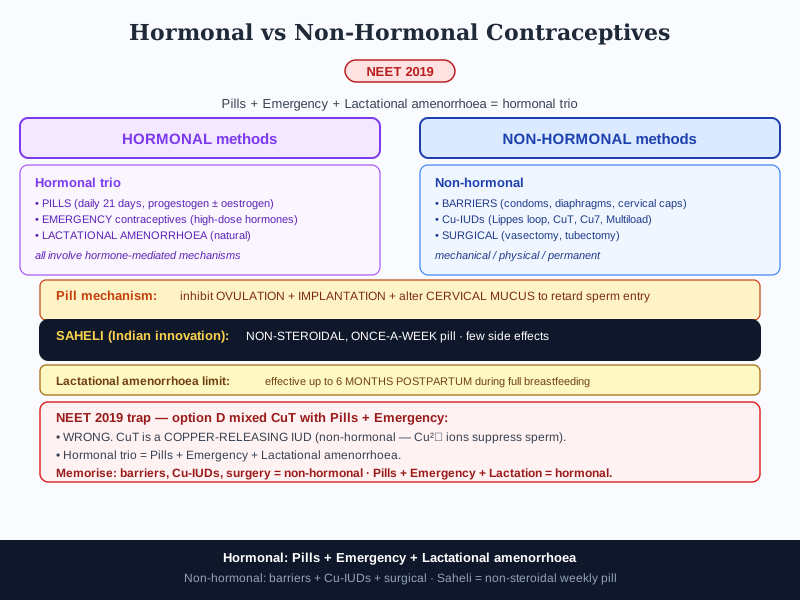
ORAL ADMINISTRATION of small doses of PROGESTOGENS or PROGESTOGEN-OESTROGEN COMBINATIONS is a popular female contraceptive — commonly called the PILL. Pills are taken DAILY for 21 DAYS starting within the first 5 days of the menstrual cycle, followed by a 7-day gap (during which menstruation occurs), and repeated. Pills work by (a) INHIBITING OVULATION, (b) inhibiting IMPLANTATION, and (c) ALTERING CERVICAL MUCUS to retard sperm entry. SAHELI is a new oral contraceptive containing a NON-STEROIDAL preparation — taken ONCE A WEEK with few side effects. EMERGENCY contraceptives (high-dose hormones) and LACTATIONAL AMENORRHOEA (natural ovulation suppression during full breastfeeding, effective up to 6 months postpartum) are also hormonal.
NEET 2019 tested the hormonal trio: Pills, Emergency contraceptives, Lactational amenorrhoea — all involve hormones. Barrier methods (condoms, diaphragms, cervical caps, vaults), IUDs (Lippes loop, CuT), and surgical methods (vasectomy, tubectomy) are NON-hormonal. Saheli's NCERT distinction = non-steroidal AND once-a-week (most pills are daily, steroidal). Lactational amenorrhoea effectiveness ceiling = 6 months postpartum.
Barrier methods (condoms, diaphragms) and IUDs involve the role of hormones in preventing conception.
Hormonal contraceptives = Pills + Emergency contraceptives + Lactational amenorrhoea. Barriers, IUDs (non-medicated/copper), and surgical methods are NON-hormonal.
Hormonal trio: PILLS + EMERGENCY + LACTATIONAL AMENORRHOEA. Saheli = non-steroidal, once-a-week. Barriers + Cu-IUDs + surgery = non-hormonal.
- Pills = progestogens or progestogen-oestrogen taken daily for 21 days; inhibit ovulation + implantation + alter cervical mucus.
- Saheli = NON-STEROIDAL preparation; ONCE-A-WEEK pill with few side effects (Indian innovation).
- Lactational amenorrhoea = natural ovulation suppression during full breastfeeding; effective up to 6 months postpartum.
- Hormonal: Pills + Emergency + Lactational amenorrhoea. Non-hormonal: barriers, Cu-IUDs, surgical methods.
What is Hormonal Contraceptives?
What did NEET 2019 ask on Hormonal Contraceptives?
What is the most common NEET trap on Hormonal Contraceptives?
How do you remember Hormonal Contraceptives for NEET?
What are the key components of Hormonal Contraceptives?
Through deep analysis of NEET and NTA, 176 of the 180 ReNEET 2026 (June 21) questions were already in the MedicNEET question bank before the exam.
176/180MedicNEET's Biology question bank is built from the same NCERT lines NTA picks repeatedly. Not random MCQs — questions crafted exactly like NTA crafts them.
You just learned this concept. The free app turns it into a daily goal built from your weak topics and brings it back just before you forget it — using active recall and spaced repetition — so it stays till exam day.