How many questions from Anatomy of Flowering Plants in NEET?
2–3 questions from Anatomy of Flowering Plants appear in NEET every year (8–12 marks, ~2% of NEET Biology). High-yield topics: tissue systems (epidermal, ground, vascular), dicot vs monocot root/stem anatomy, vascular bundle types, secondary growth via cambium. Practice all 188 Anatomy questions free in bilingual Hindi & English in the MedicNEET app.
Year-wise NEET Questions — Anatomy of Flowering Plants
| Year | Questions | Marks |
|---|---|---|
| NEET 2016 | 2 | 8 |
| NEET 2017 | 2 | 8 |
| NEET 2018 | 3 | 12 |
| NEET 2019 | 5 | 20 |
| NEET 2020 | 1 | 4 |
| NEET 2021 | 1 | 4 |
| NEET 2022 | 1 | 4 |
| NEET 2023 | 3 | 12 |
| NEET 2024 | 3 | 12 |
| NEET 2025 | 1 | 4 |
| NEET 2026 | 3 | 12 |
Practise Anatomy of Flowering Plants MCQs — Free
Every Anatomy of Flowering Plants question format NEET uses, starting with the newest ReNEET 2026-style reasoning MCQs. Tap an option for the answer + NCERT explanation.
✨ Anatomy of Flowering Plants — ReNEET 2026-Style Reasoning Questions
The newest, most exam-current format — reasoning-based questions modelled on ReNEET 2026. This is where NEET is heading; practise the pattern before the exam does.
- Q1. Why is parenchyma the most common cell type in the ground tissue system?
- Q2. Why is the vascular bundle in roots described as radial rather than conjoint?
- Q3. Why are stomata described as a stomatal apparatus?
- Q4. How does the structure of guard cells aid their function in stomatal opening and closing?
- Q5. Why are trichomes considered protective in function?
- Q6. How do bundle sheaths in monocot stems protect vascular bundles?
- Q7. Why is xylem described as exarch in roots?
- Q8. How are vascular bundles arranged in dicot roots?
- Q9. Why is pith prominent in dicot stem but absent in dicot root?
- Q10. Why are vascular bundles in dicot stems termed open and collateral?
You’ve practised 10 of 20 Anatomy of Flowering Plants questions in this set.
Practise all 20 + every chapter — free app →📑 Anatomy of Flowering Plants — NEET 2025 & 2026 Long-Form MCQs
The long, multi-statement questions that dominated NEET 2025 & 2026 — each covers 5-6 concepts at once, so they double as fast full-chapter revision.
- Q1. Match the following epidermal structures with their characteristic feature and primary role/location: Column I (Epidermal Structure) A. Cuticle B. Root hairs C. Trichomes D. Guard cells Column II (Characteristic Feature) I. Unicellular elongations II. Waxy thick layer III. Multicellular appendages IV. Bean-shaped or dumb-bell shaped Column III (Primary Role/Location) P. Aids in absorption of water and minerals from soil Q. Prevents water loss from shoot surfaces R. Regulates stomatal movement and gaseous exchange S. Reduces water loss due to transpiration in shoot system Choose the correct match from the options below:
- Q2. Match the following epidermal derivatives and cells with their appropriate descriptions: Column I (Epidermal Derivative/Cell) A. Epidermis B. Root hairs C. Trichomes D. Bulliform cells E. Stomatal pore Column II (Description/Function) 1. Large, empty, colourless cells in grasses that curl leaves during water stress 2. The aperture enclosed by guard cells facilitating gaseous exchange 3. Outermost single layer of parenchymatous cells in the primary plant body 4. Multicellular appendages on the shoot system, sometimes secretory 5. Unicellular elongations of epidermal cells involved in water absorption Choose the correct match from the options below:
- Q3. Which of the following statements about the anatomy of different plant parts are NOT correct? S1. In dicot stems, vascular bundles are typically scattered, and the pith is absent. S2. Monocot stems possess a sclerenchymatous hypodermis and conjoint, closed vascular bundles. S3. Dicot roots are characterized by a small or inconspicuous pith and usually two to four xylem and phloem patches. S4. The innermost layer of the cortex in roots, the endodermis, has tangential and radial walls with suberin deposition, forming Casparian strips. S5. Monocot roots often show a large, well-developed pith and polyarch xylem bundles, but lack secondary growth.
- Q4. Match the following plant structures with their characteristic vascular bundle arrangement: Column I (Plant Structure) A. Dicotyledonous Stem B. Monocotyledonous Stem C. Dicotyledonous Root D. Monocotyledonous Root Column II (Vascular Bundle Characteristic) I. Conjoint, open, endarch protoxylem II. Radial, polyarch, large pith III. Conjoint, closed, scattered IV. Radial, 2-4 xylem patches, small/inconspicuous pith
You’ve practised 4 of 18 Anatomy of Flowering Plants questions in this set.
Practise all 18 + every chapter — free app →🧩 Anatomy of Flowering Plants — All-Format Questions — Match, Assertion-Reason, Statement & Image-Based
Every question format NEET uses — match-the-column, assertion-reason, statement-based, and image/diagram questions — not just plain MCQs. Each with an instant NCERT-referenced solution.
- Q1. Based on the transverse sections shown in the given figure, identify them
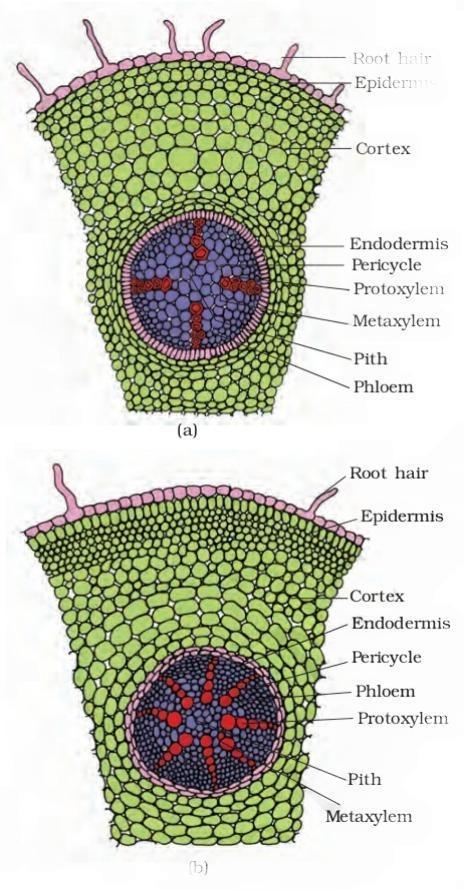
- Q2. Refer to the given Which of the following correctly identifies the stem types shown in parts (a) and (b)?
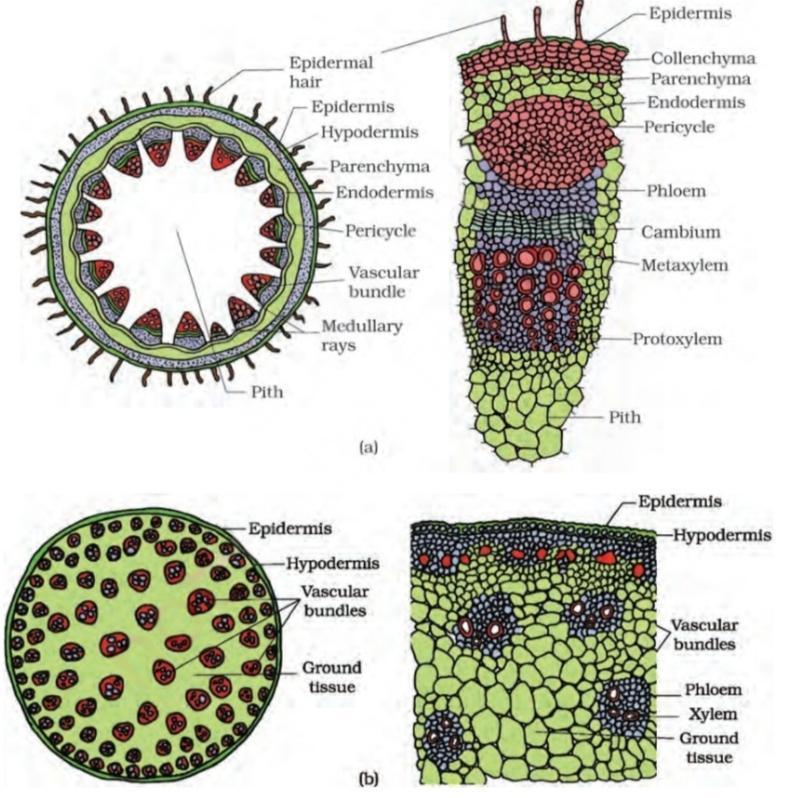
- Q3. Match the structure with its description: A. Guard cells B. Subsidiary cells C. Root hairs D. Trichomes 1. Bean-shaped cells enclosing stomatal pore 2. Unicellular extensions aiding absorption 3. Multicellular appendages on shoot 4. Specialised epidermal cells around guard cells
- Q4. Match the epidermal components with their descriptions: COLUMN I A. Root hairs B. Trichomes C. Subsidiary cells D. Stomatal pore COLUMN II 1. Surround guard cells and differ in shape 2. Unicellular elongation from epidermis 3. Site of gaseous exchange 4. Multicellular appendages of stem
- Q5. Assertion (A): Ground tissue is made of parenchyma, collenchyma, and sclerenchyma. Reason (R): These are all complex tissues.
- Q6. Assertion (A): Cuticle is usually absent in roots. Reason (R): Cuticle is a waxy layer that prevents transpiration.
- Q7. In dicot stems, what type of vascular bundle is present?
- Q8. Which of the following is NOT a part of the epidermal tissue system?
- Q9. Trichomes are primarily found on:
- Q10. What is the study of internal structure of plants called?
You’ve practised 10 of 142 Anatomy of Flowering Plants questions in this set.
Practise all 142 + every chapter — free app →Sample NEET PYQs — Anatomy of Flowering Plants
Specialized epidermal cells surrounding the guard cells are called:
- A. Complementary cells
- B. Subsidiary cells
- C. Bulliform cells
- D. Lenticels
Explanation: Answer: (B) Subsidiary cells. Solution: A few epidermal cells in the vicinity of the guard cells become specialised in shape and size; these are the subsidiary cells. Together with the guard cells and the stomatal aperture they form the stomatal apparatus. Complementary cells loosely fill a lenticel, bulliform cells are large empty cells of grass leaves, and lenticels are openings in the bark for gaseous exchange. NCERT Reference: NCERT Class XI, Ch 6 Anatomy of Flowering Plants, p.72, line ~30: "a few epidermal cells, in the vicinity of the guard cells become specialised in their shape and size and are known as subsidiary cells."
Cortex is the region found between
- A. Epidermis and stele
- B. Pericycle and endodermis
- C. Endodermis and pith
- D. Endodermis and vascular bundle
Explanation: Answer: (A) Epidermis and stele. Solution: The cortex is the multi-layered ground-tissue zone lying between the outer epidermis (epiblema) and the stele. Its innermost layer is the endodermis, and all tissues internal to the endodermis (pericycle, vascular bundles and pith) constitute the stele. Thus the cortex is the region between the epidermis and the stele. NCERT Reference: NCERT Class XI, Ch 6 Anatomy of Flowering Plants, p.74, line ~22: "All tissues on the innerside of the endodermis such as pericycle, vascular bundles and pith constitute the stele" (cortex being the layers between epidermis and this stele).
Root hairs develop from the region of
- A. Maturation
- B. Elongation
- C. Root cap
- D. Meristematic activity
Explanation: Answer: (A) Maturation. Solution: Root hairs are unicellular elongations of the epidermal (epiblema) cells and arise in the region/zone of maturation, where cells have differentiated. The meristematic and elongation zones lie below this and the root cap protects the tip, so none of them bear root hairs. NCERT Reference: NCERT Class XI, Ch 6 Anatomy of Flowering Plants, p.72, line ~3: "The root hairs are unicellular elongations of the epidermal cells and help absorb water and minerals from the soil."
Which of the following facilitates opening of stomatal aperture?
- A. Contraction of outer wall of guard cells
- B. Decrease in turgidity of guard cells
- C. Radial orientation of cellulose microfibrils in the cell wall of guard cells
- D. Longitudinal orientation of cellulose microfibrils in the cell wall of guard cells
Explanation: Answer: (C) Radial orientation of cellulose microfibrils in the cell wall of guard cells. Solution: The inner wall of the guard cell (towards the pore) is thick and the outer wall is thin; the cellulose microfibrils are arranged radially rather than longitudinally. When the guard cells become turgid, this radial orientation makes the thin outer wall bulge outward and pull the inner wall apart, opening the pore. A turgidity increase (not decrease) drives opening. NCERT Reference: NCERT Class XI, Ch 6 Anatomy of Flowering Plants, p.72, line ~26: "The outer walls of guard cells (away from the stomatal pore) are thin and the inner walls (towards the stomatal pore) are highly thickened" (radial microfibril orientation underlies this differential wall behaviour during opening).
Frequently Asked Questions — Anatomy of Flowering Plants NEET
How many questions from Anatomy of Flowering Plants come in NEET?+
How many Anatomy of Flowering Plants questions does MedicNEET have?+
What is the NEET weightage of Anatomy of Flowering Plants?+
Are Anatomy of Flowering Plants questions available in Hindi?+
Are Anatomy of Flowering Plants questions NCERT-based?+
Is there a timed test for Anatomy of Flowering Plants NEET PYQs?+
How do I score full marks in Anatomy of Flowering Plants for NEET?+
What are ReNEET 2026-style reasoning Anatomy of Flowering Plants questions?+
Are these Anatomy of Flowering Plants MCQs free to practise?+
Practise Anatomy of Flowering Plants — Free
All 180+ Anatomy of Flowering Plants questions · ReNEET 2026 reasoning + every format · Bilingual Hindi & English · NCERT-mapped explanations · No paywall
📲 Download MedicNEET App (Free)