How many questions from Animal Kingdom in NEET?
2–4 questions from Animal Kingdom appear in NEET every year (8–16 marks, ~5% of NEET Biology). High-yield: phyla classification (Porifera to Chordata), notochord presence, coelom types, vertebrate vs invertebrate characteristics, NCERT examples of each phylum. Practice all 669 Animal Kingdom questions free in bilingual Hindi & English in the MedicNEET app.
Year-wise NEET Questions — Animal Kingdom
| Year | Questions | Marks |
|---|---|---|
| NEET 2016 | 5 | 20 |
| NEET 2017 | 3 | 12 |
| NEET 2018 | 3 | 12 |
| NEET 2019 | 4 | 16 |
| NEET 2020 | 4 | 16 |
| NEET 2021 | 2 | 8 |
| NEET 2022 | 3 | 12 |
| NEET 2023 | 5 | 20 |
| NEET 2024 | 4 | 16 |
| NEET 2025 | 4 | 16 |
| NEET 2026 | 7 | 28 |
Practise Animal Kingdom MCQs — Free
Every Animal Kingdom question format NEET uses, starting with the newest ReNEET 2026-style reasoning MCQs. Tap an option for the answer + NCERT explanation.
✨ Animal Kingdom — ReNEET 2026-Style Reasoning Questions
The newest, most exam-current format — reasoning-based questions modelled on ReNEET 2026. This is where NEET is heading; practise the pattern before the exam does.
- Q1. What is the evolutionary advantage of bilateral symmetry?
- Q2. Why are Hemichordates considered closer to chordates despite their worm-like appearance?
- Q3. Why are Cyclostomes considered primitive vertebrates?
- Q4. Why is Osteichthyes considered more advanced than Chondrichthyes in terms of body composition?
- Q5. Which of the following groups belong to Amphibia?
- Q6. Why do reptiles lay shelled eggs on land, unlike amphibians?
- Q7. How do mammary glands support parental care in mammals?
- Q8. Why is Obelia considered an example of metagenesis?
- Q9. Internal fertilisation in Platyhelminthes is possible primarily because:
- Q10. How is reproduction in annelids diverse?
You’ve practised 10 of 153 Animal Kingdom questions in this set.
Practise all 153 + every chapter — free app →📑 Animal Kingdom — NEET 2025 & 2026 Long-Form MCQs
The long, multi-statement questions that dominated NEET 2025 & 2026 — each covers 5-6 concepts at once, so they double as fast full-chapter revision.
- Q1. Arrange the following descriptions of body organisation in animals in the correct sequence from simplest to most complex: I. Cells are arranged as loose cell aggregates with some division of labour. II. Organs are associated to form functional systems, each concerned with a specific physiological function. III. Tissues are grouped together to form organs, each specialized for a particular function. IV. Cells performing the same function are arranged into tissues.
- Q2. Which of the above statements about Hemichordata are correct? S1: Hemichordates are marine animals, exhibiting an organ-system level of organisation, triploblasty, and coelomate nature. S2: The circulatory system in Hemichordates is typically open, and their respiratory structures include gills. S3: The notochord, a mesodermally derived rod-like structure, is present throughout their life, extending from head to tail. S4: Excretion is primarily carried out by the proboscis gland, and development is direct, resembling the adult. S5: While possessing pharyngeal gill slits for respiration, Hemichordates are classified as non-chordates due to the absence of a true notochord.
- Q3. Match the Column I (Phylum) with Column II (Distinguishing Feature) and Column III (Representative Example): Column I (Phylum) 1. Porifera 2. Cnidaria 3. Ctenophora 4. Platyhelminthes Column II (Distinguishing Feature) P. Cnidocytes Q. Comb plates R. Water canal system S. Flame cells Column III (Representative Example) I. Pleurobrachia II. Euspongia III. Aurelia IV. Taenia
- Q4. Which of the above statements are correct regarding Phylum Aschelminthes? S1: The body of Aschelminthes is circular in cross-section, which is why they are commonly called roundworms. S2: They are bilaterally symmetrical, triploblastic, and pseudocoelomate animals. S3: Their alimentary canal is complete with a well-developed muscular pharynx, and waste removal occurs through nephridia. S4: Aschelminthes exhibit sexual dimorphism, with males and females being distinct, and females are often longer than males. S5: Development in Aschelminthes is always direct, where the young ones resemble the adult.
You’ve practised 4 of 70 Animal Kingdom questions in this set.
Practise all 70 + every chapter — free app →🧩 Animal Kingdom — All-Format Questions — Match, Assertion-Reason, Statement & Image-Based
Every question format NEET uses — match-the-column, assertion-reason, statement-based, and image/diagram questions — not just plain MCQs. Each with an instant NCERT-referenced solution.
- Q1. Identify the organism shown.
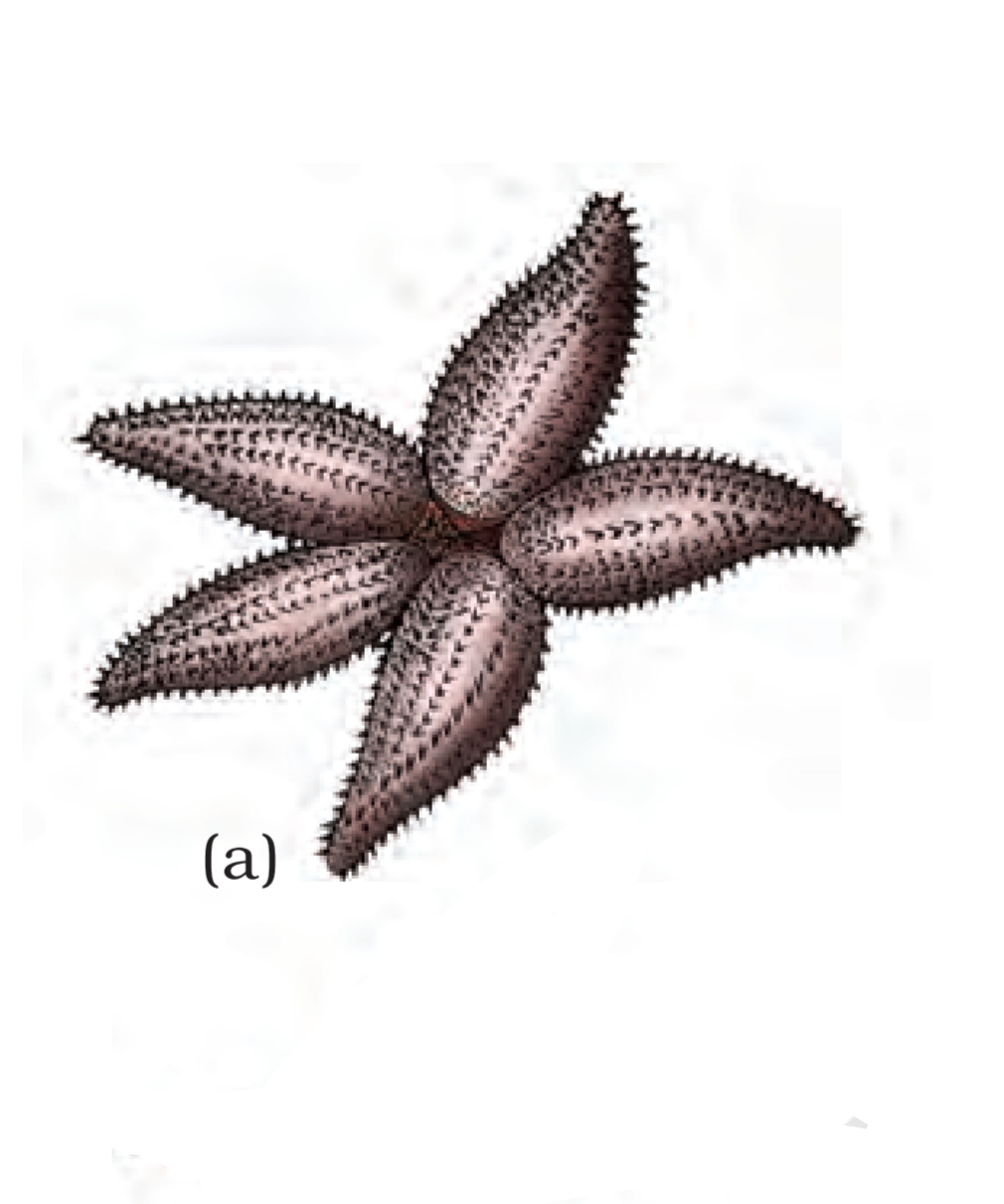
- Q2. Identify the organism.
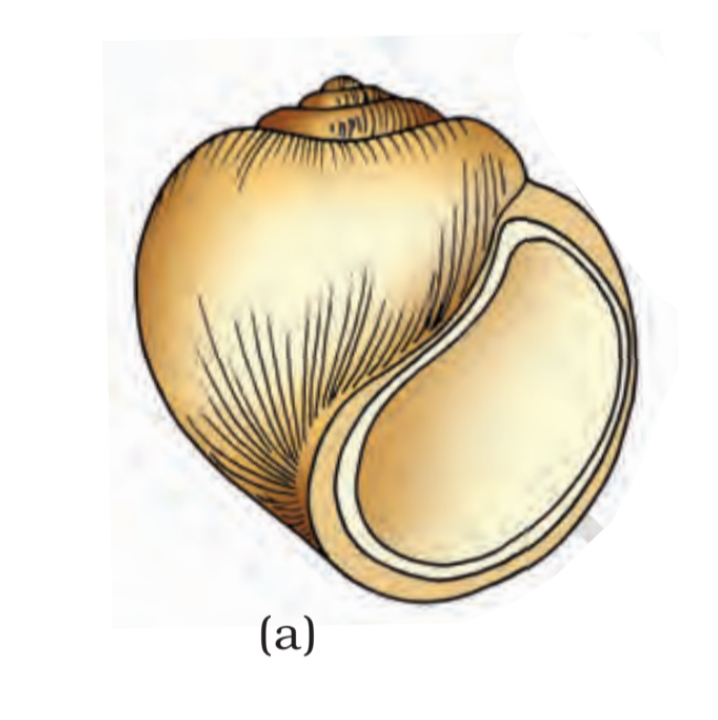
- Q3. Match the body organisation to examples: COLUMN I A. Cellular level B. Tissue level C. Organ level COLUMN II i. Platyhelminthes ii. Coelenterates iii. Porifera
- Q4. Match the following features with their corresponding symmetry: COLUMN I A. Asymmetry B. Radial symmetry C. Bilateral symmetry COLUMN II i. Coelenterata ii. Sponges iii. Annelida
- Q5. Assertion (A): Coelomates have a body cavity completely lined by mesoderm. Reason (R): In pseudocoelomates, mesoderm is present as scattered pouches.
- Q6. Assertion (A): Metameric segmentation is found in Annelids. Reason (R): Metamerism refers to segmentation of body with repetition of organs.
- Q7. Animals with a notochord are known as:
- Q8. Which of these animals exhibit radial symmetry?
- Q9. The presence of mesoglea is a characteristic of which of the following?
- Q10. Triploblastic animals have an additional germ layer called:
You’ve practised 10 of 422 Animal Kingdom questions in this set.
Practise all 422 + every chapter — free app →Sample NEET PYQs — Animal Kingdom
Which one of the following characteristics is not shared by birds and mammals?
- A. Ossified endoskeleton
- B. Breathing using lungs
- C. Viviparity
- D. Warm blooded nature
Explanation: Answer: Viviparity is not shared by birds and mammals. Solution: Birds (Aves) are oviparous, whereas most mammals are viviparous, so viviparity is not a shared feature. Both groups do share an ossified skeleton, lung breathing and a warm-blooded (homoiothermous) nature. NCERT Reference: Page 50, lines 3-4 (Aves oviparous); Page 51, line 7 (Mammals viviparous)
Which of the following features is not present in Periplaneta americana?
- A. Schizocoelom as body cavity
- B. Indeterminate and radial cleavage during embryonic development
- C. Exoskeleton composed of N-acetylglucosamine
- D. Metamerically segmented body
Explanation: Answer: Indeterminate and radial cleavage is not seen in the cockroach. Solution: Periplaneta is an arthropod and, like other protostomes, shows determinate and spiral cleavage, not indeterminate radial cleavage (the latter is a deuterostome feature). It does have a schizocoelom, a chitinous exoskeleton (chitin is a polymer of N-acetylglucosamine) and a segmented body. The cleavage detail is extension content beyond Ch4 prose; NCERT lists arthropods as segmented coelomate animals with chitinous exoskeleton. NCERT Reference: Page 44, lines 9-12 (Arthropoda: segmented, coelomate, chitinous exoskeleton)
Which of the following characteristic features always holds true for the corresponding group of animals? Each option pairs a characteristic feature with an animal group. (a) Cartilaginous endoskeleton - Chondrichthyes (b) Viviparous - Mammalia (c) Possess a mouth with an upper and a lower jaw - Chordata (d) 3-chambered heart with one incompletely divided ventricle - Reptilia Choose the pairing that is always correct.
- A. Cartilaginous endoskeleton - Chondrichthyes
- B. Viviparous - Mammalia
- C. Possess a mouth with an upper and a lower jaw - Chordata
- D. 3-chambered heart with one incompletely divided ventricle - Reptilia
Explanation: Answer: Cartilaginous endoskeleton always holds true for Chondrichthyes. Solution: All Chondrichthyes have a cartilaginous endoskeleton. The others fail: egg-laying mammals (Ornithorhynchus) are not viviparous; jawless cyclostome chordates lack jaws; and crocodilian reptiles have a four-chambered heart. NCERT Reference: Page 47, lines 38-39 (Chondrichthyes cartilaginous endoskeleton)
Choose the correct statement. (a) All mammals are viviparous (b) All cyclostomes do not possess jaws and paired fins (c) All reptiles have a three-chambered heart (d) All pisces have gills covered by an operculum
- A. All mammals are viviparous
- B. All cyclostomes do not possess jaws and paired fins
- C. All reptiles have a three-chambered heart
- D. All pisces have gills covered by an operculum
Explanation: Answer: All cyclostomes lack jaws and paired fins. Solution: Cyclostomes (Agnatha) have a jawless circular mouth and a body devoid of paired fins, so (b) is correct. (a) fails because egg-laying mammals exist; (c) fails because crocodiles have a four-chambered heart; (d) fails because only Osteichthyes have an operculum while Chondrichthyes do not. NCERT Reference: Page 47, lines 17-19 (Cyclostomes lack jaws, scales and paired fins)
Frequently Asked Questions — Animal Kingdom NEET
How many questions from Animal Kingdom come in NEET?+
How many Animal Kingdom questions does MedicNEET have?+
What is the NEET weightage of Animal Kingdom?+
Are Animal Kingdom questions available in Hindi?+
Are Animal Kingdom questions NCERT-based?+
What are ReNEET 2026-style reasoning Animal Kingdom questions?+
Are these Animal Kingdom MCQs free to practise?+
Practise Animal Kingdom — Free
All 645+ Animal Kingdom questions · ReNEET 2026 reasoning + every format · Bilingual Hindi & English · NCERT-mapped explanations · No paywall
📲 Download MedicNEET App (Free)