How many questions from Biodiversity and Conservation in NEET?
Biodiversity and Conservation is tested with approximately 2–3 questions per NEET exam (~3% of Biology, 8–12 marks). Key topics: biodiversity types (genetic/species/ecological), 34 global hotspots, in-situ conservation (national parks, biosphere reserves), ex-situ (zoos, botanical gardens), IUCN Red List, and the Evil Quartet of biodiversity loss. Practice all 284 questions free in bilingual Hindi & English in the MedicNEET app.
Year-wise NEET Questions — Biodiversity and Conservation
| Year | Questions | Marks |
|---|---|---|
| NEET 2016 | 5 | 20 |
| NEET 2017 | 3 | 12 |
| NEET 2018 | 1 | 4 |
| NEET 2019 | 6 | 24 |
| NEET 2020 | 2 | 8 |
| NEET 2022 | 4 | 16 |
| NEET 2023 | 4 | 16 |
| NEET 2024 | 4 | 16 |
| NEET 2025 | 2 | 8 |
| NEET 2026 | 8 | 32 |
Practise Biodiversity and Conservation MCQs — Free
Every Biodiversity and Conservation question format NEET uses, starting with the newest ReNEET 2026-style reasoning MCQs. Tap an option for the answer + NCERT explanation.
✨ Biodiversity and Conservation — ReNEET 2026-Style Reasoning Questions
The newest, most exam-current format — reasoning-based questions modelled on ReNEET 2026. This is where NEET is heading; practise the pattern before the exam does.
- Q1. What makes amphibians more vulnerable to extinction?
- Q2. Why are biodiversity estimates more complete in temperate regions than in tropics?
- Q3. Why is the Amazon rainforest called the “lungs of the planet”?
- Q4. Why is overexploitation considered a major driver of extinction?
- Q5. Why does David Tilman argue that diversity increases ecosystem productivity?
- Q6. Why is the Amazon forest often termed the “lungs of the planet”?
- Q7. Why are national parks and wildlife sanctuaries important?
- Q8. Why is pollination considered an ecosystem service?
- Q9. Why is it difficult to put an economic value on ecosystem services?
- Q10. Why is biodiversity important even if some species have no current use?
You’ve practised 10 of 40 Biodiversity and Conservation questions in this set.
Practise all 40 + every chapter — free app →📑 Biodiversity and Conservation — NEET 2025 & 2026 Long-Form MCQs
The long, multi-statement questions that dominated NEET 2025 & 2026 — each covers 5-6 concepts at once, so they double as fast full-chapter revision.
- Q1. Which of the following statements correctly describe the causes and examples of biodiversity loss? S1: Habitat loss and fragmentation are widely considered the most significant causes driving animals and plants to extinction. S2: The extinction of Steller’s Sea Cow was primarily due to alien species invasion, causing ecological imbalance in its habitat. S3: Co-extinction occurs when a species becomes extinct, leading to the obligatory extinction of other species associated with it, such as in a plant-pollinator mutualism. S4: The introduction of the African catfish (Clarias gariepinus) for aquaculture is a documented case of over-exploitation of natural resources. S5: The destruction of the Amazon rainforest for cultivating soya beans exemplifies habitat loss and fragmentation.
- Q2. Which of the following statements are NOT correct regarding the patterns of biodiversity and the species-area relationship? S1: Tropical regions, located between 23.5° N and 23.5° S, generally exhibit higher species diversity compared to temperate or polar areas. S2: One key reason for the high diversity in tropical latitudes is their history of frequent glaciations, which accelerated evolutionary diversification. S3: Stable and predictable tropical environments favour niche generalisation, allowing a wider range of species to coexist without intense competition. S4: The Amazonian rainforest is renowned for its immense biodiversity, including over 40,000 species of plants and 1,25,000 species of invertebrates. S5: Alexander von Humboldt observed that species richness increased with explored area, and this relationship is typically a linear function on an arithmetic scale. S6: For frugivorous birds and mammals in tropical forests across different continents, the slope (Z-value) of the species-area regression line is found to be 0.15.
- Q3. Which of the following statements are correct regarding the utilitarian arguments for biodiversity conservation, including bioprospecting? S1: Bioprospecting involves exploring species-level diversity to discover products of economic importance. S2: Nations with rich biodiversity are particularly well-positioned to benefit from bioprospecting due to their natural wealth. S3: More than 50% of drugs currently sold globally are derived from plants, highlighting the 'narrowly utilitarian' argument. S4: The broadly utilitarian argument includes the aesthetic pleasures derived from nature and ecosystem services like pollination and oxygen production. S5: Bioprospecting is primarily focused on ethical arguments, emphasizing the intrinsic value of every species.
- Q4. Which of the following statements about sacred groves and biodiversity hotspots in India is NOT correct? S1: Sacred groves are tracts of forest given total protection by religious and cultural traditions, classified as a form of in situ conservation. S2: The Khasi and Jaintia Hills in Meghalaya and Aravalli Hills of Rajasthan are examples of regions where sacred groves are found in India. S3: Sacred groves often serve as the last refuges for a large number of rare and threatened plants. S4: All 34 identified biodiversity hotspots globally are legally protected by the UN, ensuring uniform conservation measures across all regions. S5: Three biodiversity hotspots, namely Western Ghats and Sri Lanka, Indo-Burma, and Himalaya, cover India's exceptionally high biodiversity regions.
You’ve practised 4 of 36 Biodiversity and Conservation questions in this set.
Practise all 36 + every chapter — free app →🧩 Biodiversity and Conservation — All-Format Questions — Match, Assertion-Reason, Statement & Image-Based
Every question format NEET uses — match-the-column, assertion-reason, statement-based, and image/diagram questions — not just plain MCQs. Each with an instant NCERT-referenced solution.
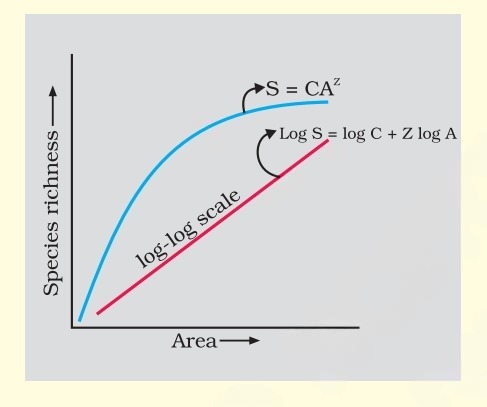
- Q1. A scientist studies two regions: Region A has Z = 0.25, Region B has Z = 1.15. Based on the species–area graph, which region likely shows continental-scale biodiversity?
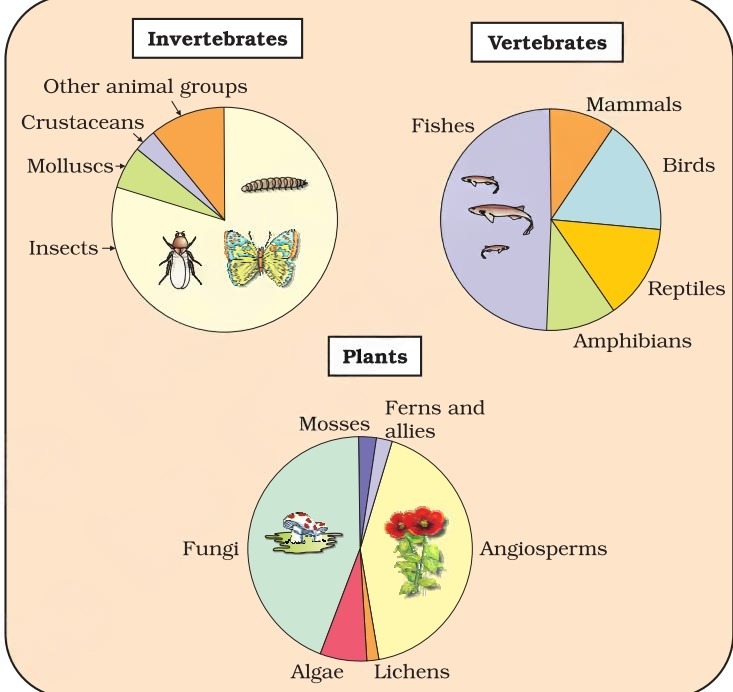
- Q2. Based on the Invertebrate pie chart, which of the following groupings correctly represents the second-largest category after insects?
- Q3. Match the column : Column I A. Global species described (2004) B. Robert May’s estimate C. Insects among animals D. Plant species in India E. India’s land vs species ratio Column II 1. 1.5 million 2. 45,000 3. 70% 4. 7 million 5. 2.4% land, 8.1% species
- Q4. Match the following : Column I A. In situ B. Ex situ C. Biosphere reserve D. Sacred groves E. Seed bank Column II 1. Zoological parks and botanical gardens 2. Forests protected due to culture 3. Genetic strains preserved long-term 4. Protection in natural habitats 5. Ecologically unique protected areas
- Q5. Assertion (A): India is one of the 12 mega-diversity countries of the world. Reason (R): India has more than 45,000 plant species and twice as many animal species.
- Q6. Assertion (A): Co-extinction results in loss of dependent species. Reason (R): In a co-evolved mutualism, the loss of one species will not cause the extinction of the other.
- Q7. Choose the correct statements: 1. Tilman showed more species meant stable biomass. 2. Productivity is higher with richer diversity. 3. Stable communities resist alien invasions. 4. Rivet popper hypothesis compares ecosystems with airplanes. 5. Rivets on seats are less critical than those on wings.
- Q8. Choose the correct statements 1. Species diversity decreases from equator to poles. 2. Amazon rainforest has the greatest biodiversity on Earth. 3. Tropical regions are more seasonal than temperate ones. 4. Tropics show high productivity due to solar energy availability. 5. Speciation in tropics has been faster due to uninterrupted evolution.
- Q9. Arrange the following aspects of biodiversity loss in the correct sequence : 1. Accelerated extinction of species due to human activities 2. Documentation of extinctions in the IUCN Red List 3. Recognition of the ongoing “Sixth Extinction” 4. Identification of four major causes, called the “Evil Quartet” 5. Historical evidence of five previous mass extinctions from fossil records
- Q10. Choose the correct statements 1. In situ preserves species in habitats. 2. Ex situ includes cryopreservation. 3. Hotspots cover less than 2% of land. 4. Sacred groves preserve rare plants. 5. India has 14 biosphere reserves and 90 national parks.
You’ve practised 10 of 183 Biodiversity and Conservation questions in this set.
Practise all 183 + every chapter — free app →Sample NEET PYQs — Biodiversity and Conservation
How many hot spots of biodiversity in the world have been identified till date by Norman Myers? (NEET 2016 Phase-2)
- A. 17
- B. 25
- C. 34
- D. 43
Explanation: Answer: (C) 34. Solution: NCERT states that initially 25 biodiversity hotspots were identified, but subsequently nine more were added, bringing the total to 34. Hence 25 (option B) is the original number, not the current count, and 17/43 do not match the chapter. (The figure 34 traces to Norman Myers' hotspots concept.) NCERT: NCERT Class XII Biology, Ch 13 Biodiversity and Conservation, p.224, lines 37–39: "Initially 25 biodiversity hotspots were identified but subsequently nine more have been added to the list, bringing the total number of biodiversity hotspots in the world to 34."
Red list contains data or information on
- A. All economically important plants
- B. Plants whose products are in international trade
- C. Threatened species
- D. Marine vertebrates only
Explanation: Answer: (C) Threatened species. Solution: The IUCN Red List is a catalogue documenting species facing the threat of extinction; NCERT cites the IUCN Red List (2004) when describing extinctions and the more than 15,500 species worldwide facing the threat of extinction. It is not a list of economically important plants, trade plants, or marine vertebrates only, so options A, B and D are incorrect. NCERT: NCERT Class XII Biology, Ch 13 Biodiversity and Conservation, p.222, lines 5–6: "more than 15,500 species world-wide are facing the threat of extinction."
Which of the following is correctly matched?
- A. Aerenchyma – Opuntia
- B. Age pyramid – Biome
- C. Parthenium hysterophorus – Threat to Biodiversity
- D. Stratification – Population
Explanation: Answer: (C) Parthenium hysterophorus – Threat to Biodiversity. Solution: Parthenium (carrot grass) is named in NCERT as an invasive alien weed that threatens native species—one of the Evil Quartet causes of biodiversity loss—so the pairing is correct. The other options are wrong pairings drawn from other chapters: aerenchyma belongs to hydrophytes (not the desert cactus Opuntia), age pyramids and stratification relate to populations/communities, not biome/population in the manner paired. NCERT: NCERT Class XII Biology, Ch 13 Biodiversity and Conservation, p.223, lines 15–17: "threat posed to our native species by invasive weed species like carrot grass (Parthenium), Lantana and water hyacinth (Eicchornia)."
Which of the following is the most important cause of animals and plants being driven to extinction?
- A. Over-exploitation
- B. Alien species invasion
- C. Habitat loss and fragmentation
- D. Co-extinctions
Explanation: Answer: (C) Habitat loss and fragmentation. Solution: Of the four causes in 'The Evil Quartet', NCERT explicitly names habitat loss and fragmentation as the most important cause driving animals and plants to extinction, with tropical rain forest destruction as the most dramatic example. Over-exploitation, alien species invasion and co-extinctions are real causes but are listed as secondary in importance, so they are incorrect here. NCERT: NCERT Class XII Biology, Ch 13 Biodiversity and Conservation, p.222, lines 30–32: "Habitat loss and fragmentation: This is the most important cause driving animals and plants to extinction."
Frequently Asked Questions — Biodiversity and Conservation NEET
How many questions from Biodiversity and Conservation come in NEET?+
How many Biodiversity and Conservation questions does MedicNEET have?+
What is the NEET weightage of Biodiversity and Conservation?+
Is there a free Hindi and English app to practice Biodiversity and Conservation for NEET?+
Are Biodiversity and Conservation questions NCERT-based?+
What are ReNEET 2026-style reasoning Biodiversity and Conservation questions?+
Are these Biodiversity and Conservation MCQs free to practise?+
Practise Biodiversity and Conservation — Free
All 259+ Biodiversity and Conservation questions · ReNEET 2026 reasoning + every format · Bilingual Hindi & English · NCERT-mapped explanations · No paywall
📲 Download MedicNEET App (Free)