How many questions from Biological Classification in NEET?
2–3 questions from Biological Classification appear in NEET every year (8–12 marks, ~3% of NEET Biology). High-yield: Whittaker's 5-Kingdom classification, characteristics of Monera/Protista/Fungi, virus structure, lichens, PPLO, mycoplasma. Practice all 298 Biological Classification questions free in bilingual Hindi & English in the MedicNEET app.
Year-wise NEET Questions — Biological Classification
| Year | Questions | Marks |
|---|---|---|
| NEET 2016 | 12 | 48 |
| NEET 2017 | 5 | 20 |
| NEET 2018 | 9 | 36 |
| NEET 2019 | 8 | 32 |
| NEET 2020 | 2 | 8 |
| NEET 2021 | 3 | 12 |
| NEET 2022 | 3 | 12 |
| NEET 2023 | 2 | 8 |
| NEET 2024 | 2 | 8 |
| NEET 2025 | 1 | 4 |
| NEET 2026 | 9 | 36 |
Practise Biological Classification MCQs — Free
Every Biological Classification question format NEET uses, starting with the newest ReNEET 2026-style reasoning MCQs. Tap an option for the answer + NCERT explanation.
✨ Biological Classification — ReNEET 2026-Style Reasoning Questions
The newest, most exam-current format — reasoning-based questions modelled on ReNEET 2026. This is where NEET is heading; practise the pattern before the exam does.
- Q1. Why are biological names italicised when printed?
- Q2. Why did R.H. Whittaker propose a five-kingdom system instead of the previous classifications?
- Q3. Why are animals not included in the kingdom Fungi despite being heterotrophic?
- Q4. Why is Mycoplasma grouped under Monera despite lacking a cell wall?
- Q5. How are flagella in dinoflagellates arranged differently than in Euglenoids?
- Q6. Why are protozoans placed in Protista and not Animalia?
- Q7. Why are Deuteromycetes called fungi imperfecti?
- Q8. Why are yeasts economically important fungi?
- Q9. Why are lichens sensitive to air pollution?
- Q10. Why do viruses crystallize unlike living organisms?
You’ve practised 10 of 42 Biological Classification questions in this set.
Practise all 42 + every chapter — free app →📑 Biological Classification — NEET 2025 & 2026 Long-Form MCQs
The long, multi-statement questions that dominated NEET 2025 & 2026 — each covers 5-6 concepts at once, so they double as fast full-chapter revision.
- Q1. Match the following organisms/groups from Kingdom Monera with their characteristic features: Column I (Organism/Group) A. Archaebacteria B. Cyanobacteria C. Mycoplasma D. Chemosynthetic autotrophic bacteria E. Heterotrophic bacteria Column II (Key Feature/Classification) 1. Lack cell wall, smallest living cells known 2. Photosynthetic autotrophs with chlorophyll a, can fix atmospheric nitrogen 3. Live in extreme habitats like hot springs and marshy areas, produce biogas 4. Majority are important decomposers, causing diseases like cholera 5. Oxidise inorganic substances for ATP production Choose the correct match from the options given below:
- Q2. Match the following bacterial groups/structures from Column I with their defining characteristics in Column II and specific examples/habitats in Column III: Column I A. Archaebacteria B. Cyanobacteria C. Mycoplasma D. Heterotrophic Column II I. Unique cell wall structure enabling survival in extreme conditions II. Lacks a cell wall and is the smallest known living cell III. Possesses chlorophyll a and can fix atmospheric nitrogen IV. Primarily decomposers, and some are pathogens causing diseases Column III a. Nostoc and Anabaena b. Hot springs and marshy areas c. Cholera and typhoid-causing bacteria d. Pathogenic in animals and plants
- Q3. Which of the following statements accurately describe the Kingdom Protista and its characteristics? S1: Protista is a highly diverse group of unicellular eukaryotes, displaying various modes of nutrition including autotrophy, heterotrophy, and mixotrophy. S2: All members of Protista are exclusively aquatic and possess a cell wall, thereby linking them closely to Kingdom Plantae. S3: Protistan cells are well-defined by the presence of a true nucleus and other membrane-bound organelles. S4: Reproduction in protists primarily occurs asexually through fission, with sexual reproduction being rare and not involving zygote formation. S5: The taxonomic boundaries of Kingdom Protista are clearly established and universally accepted among all biologists.
- Q4. Match the Fungal Class with its characteristic asexual and sexual reproduction: Column I (Fungal Class) A. Phycomycetes B. Ascomycetes C. Basidiomycetes D. Deuteromycetes Column II (Asexual Reproduction) i. Conidia (exogenously on conidiophores) ii. Zoospores (motile) or Aplanospores (non-motile) iii. Vegetative reproduction by fragmentation is common; asexual spores generally absent iv. Conidia (only asexual known) Column III (Sexual Reproduction) P. Ascospores (endogenously in sac-like asci) Q. Zygospores (formed by fusion of two gametes) R. Basidiospores (exogenously produced on basidium) S. Sexual stage absent or not yet observed
You’ve practised 4 of 43 Biological Classification questions in this set.
Practise all 43 + every chapter — free app →🧩 Biological Classification — All-Format Questions — Match, Assertion-Reason, Statement & Image-Based
Every question format NEET uses — match-the-column, assertion-reason, statement-based, and image/diagram questions — not just plain MCQs. Each with an instant NCERT-referenced solution.
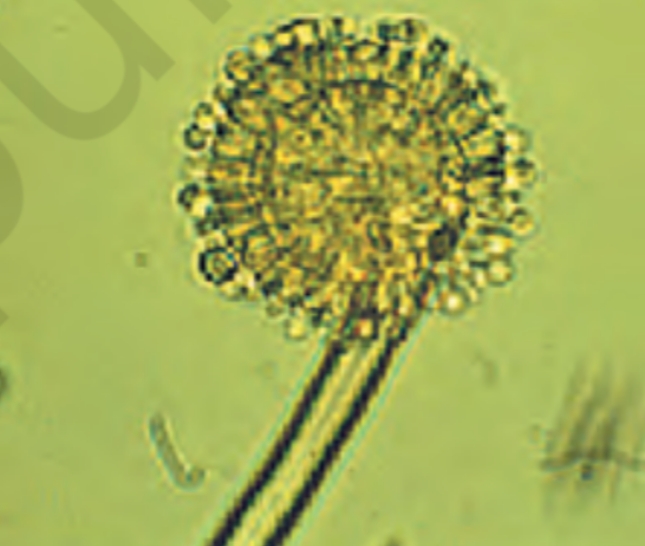
- Q1. Which class of fungi does the organism in the image belong to?
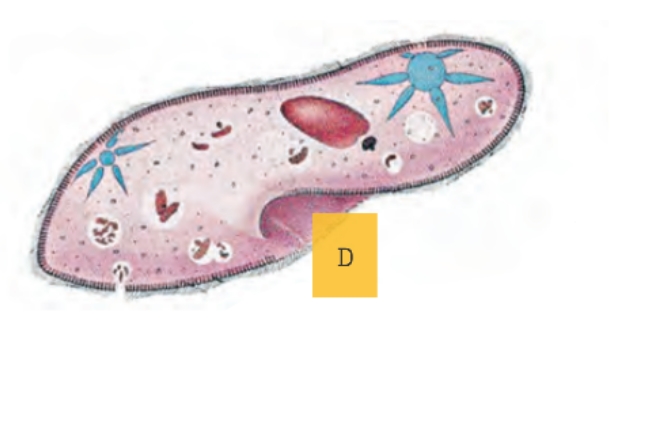
- Q2. The labeled structure ‘D’ helps in :-
- Q3. Match the bacterial types with their characteristics: Column I A. Cyanobacteria heterocysts B. Archaebacteria C. Mycoplasma D. Eubacteria Column II I. Nitrogen fixation II. Lack cell wall III. Survive in hot springs IV. Peptidoglycan cell wall
- Q4. Match the Protistan groups with their characteristics: Column I A. Diatoms B. Dinoflagellates C. Euglenoids D. Slime moulds Column II I. Mixotrophic nutrition II. Cell wall made of silica III. Red tide causing IV. Amoeboid feeding stage
- Q5. Assertion (A): All unicellular organisms are placed under Protista. Reason (R): Protista includes both prokaryotic and eukaryotic organisms.
- Q6. Assertion: Diatomaceous earth does not decompose easily. Reason: Diatoms have siliceous cell walls.
- Q7. The three-domain system divides which kingdom into two domains?
- Q8. The Five Kingdom classification was based on all of the following criteria except:
- Q9. The Two Kingdom system failed to distinguish between which of the following?
- Q10. Which two kingdoms were proposed in Linnaeus’ classification?
You’ve practised 10 of 200 Biological Classification questions in this set.
Practise all 200 + every chapter — free app →Sample NEET PYQs — Biological Classification
Which one of the following statements is wrong?
- A. Cyanobacteria are also called blue - green algae
- B. Golden algae are also called desmids
- C. Eubacteria are also called false bacteria
- D. Phycomycetes are also called algal fungi
Explanation: Answer: (C) Eubacteria are also called false bacteria Solution: Eubacteria are called 'true bacteria', not false bacteria, so this statement is wrong. The other three are correct per NCERT: cyanobacteria are blue-green algae, golden algae are desmids, and phycomycetes are algal fungi (aquatic, algae-like fungi). NCERT Reference: NCERT Class XI, Biological Classification, p.13, lines 22-24 — "different eubacteria or ‘true bacteria’"
Select the wrong statement :
- A. Pseudopodia are locomotory and feeding structures in Sporozoans
- B. Mushrooms belong to Basidiomycetes
- C. Cell wall is present in members of Fungi and Plantae
- D. Mitochondria are the powerhouse of the cell in all kingdoms except Monera
Explanation: Answer: (A) Pseudopodia are locomotory and feeding structures in Sporozoans Solution: Pseudopodia are the feeding and locomotory structures of amoeboid protozoans (e.g., Amoeba), not Sporozoans, which instead have an infectious spore-like stage — so statement A is wrong. Mushrooms are indeed Basidiomycetes, both Fungi and Plantae have cell walls, and Monera (prokaryotes) lack mitochondria, making the other three statements correct. NCERT Reference: NCERT Class XI, Biological Classification, p.16, lines 1-2 — "their prey by putting out pseudopodia (false feet) as in Amoeba"
Select the wrong statement
- A. Bacteria cell wall is made up of peptidoglycan
- B. Pili and fimbriae are mainly involved in motility of bacterial cells
- C. Cyanobacteria lack flagellated cells
- D. Mycoplasma is a wall – less microorganism
Explanation: Answer: (B) Pili and fimbriae are mainly involved in motility — WRONG Solution: Pili and fimbriae are not motility structures; bacterial motility is by flagellum. Bacterial cell walls are noncellulosic (polysaccharide + amino acid, i.e. peptidoglycan) (A correct), and Mycoplasma completely lack a cell wall (D correct). Cyanobacteria lacking flagellated cells (C) is treated as correct, making B the wrong statement. NCERT Reference: NCERT Class XI, Biological Classification, p.13, lines 24-25 — "the presence of a rigid cell wall, and if motile, a flagellum"
Methanogens belong to
- A. Eubacteria
- B. Archaebacteria
- C. Dinoflagellates
- D. Slime moulds
Explanation: Answer: (B) Archaebacteria Solution: Methanogens are archaebacteria that live in marshy areas and in the gut of ruminants like cows and buffaloes, where they produce methane (biogas) from dung. They are grouped with other extremophilic archaebacteria such as halophiles and thermoacidophiles, distinguished by a different cell wall structure. NCERT Reference: NCERT Class XI, Biological Classification, p.13, lines 11-12 — "marshy areas (methanogens)"
Frequently Asked Questions — Biological Classification NEET
How many questions from Biological Classification come in NEET?+
How many Biological Classification questions does MedicNEET have?+
What is the NEET weightage of Biological Classification?+
Are Biological Classification questions available in Hindi?+
Are Biological Classification questions NCERT-based?+
How to score full marks in Biological Classification for NEET?+
What are ReNEET 2026-style reasoning Biological Classification questions?+
Are these Biological Classification MCQs free to practise?+
Practise Biological Classification — Free
All 285+ Biological Classification questions · ReNEET 2026 reasoning + every format · Bilingual Hindi & English · NCERT-mapped explanations · No paywall
📲 Download MedicNEET App (Free)