How many questions from Biotechnology and Its Applications in NEET?
2–3 questions from Biotechnology and its Application appear in NEET every year (~3% of NEET Biology). High-yield topics: Bt toxin and Bt crops (cry genes), transgenic animals, insulin production via recombinant DNA (humulin), gene therapy, GEAC regulatory body, biopiracy, and Rosie the transgenic cow. Practise all 323 questions free in bilingual Hindi & English in the MedicNEET app.
Year-wise NEET Questions — Biotechnology and Its Applications
| Year | Questions | Marks |
|---|---|---|
| NEET 2016 | 4 | 16 |
| NEET 2017 | 1 | 4 |
| NEET 2018 | 4 | 16 |
| NEET 2019 | 5 | 20 |
| NEET 2020 | 3 | 12 |
| NEET 2021 | 6 | 24 |
| NEET 2022 | 2 | 8 |
| NEET 2023 | 4 | 16 |
| NEET 2024 | 2 | 8 |
| NEET 2025 | 1 | 4 |
| NEET 2026 | 3 | 12 |
Practise Biotechnology and Its Applications MCQs — Free
Every Biotechnology and Its Applications question format NEET uses, starting with the newest ReNEET 2026-style reasoning MCQs. Tap an option for the answer + NCERT explanation.
✨ Biotechnology and Its Applications — ReNEET 2026-Style Reasoning Questions
The newest, most exam-current format — reasoning-based questions modelled on ReNEET 2026. This is where NEET is heading; practise the pattern before the exam does.
- Q1. Why is genetically engineered crop-based agriculture preferred over agro-chemical based agriculture in developing countries?
- Q2. In somatic hybridisation, what is the rationale for using naked protoplasts instead of whole cells?
- Q3. What causes death of the insect that ingests Bt toxin?
- Q4. What is the role of Agrobacterium in developing pest-resistant plants?
- Q5. Why is PCR useful for early diagnosis of infectious diseases?
- Q6. Why is gene therapy considered a step forward in curing hereditary diseases?
- Q7. How can transgenic animals help in understanding normal physiology?
- Q8. What makes transgenic animals suitable for toxicity testing of drugs?
- Q9. What is one benefit of using traditional knowledge in developing biotech products?
- Q10. Why is it unfair to treat traditional knowledge as ‘new inventions’ in patent laws?
You’ve practised 10 of 46 Biotechnology and Its Applications questions in this set.
Practise all 46 + every chapter — free app →📑 Biotechnology and Its Applications — NEET 2025 & 2026 Long-Form MCQs
The long, multi-statement questions that dominated NEET 2025 & 2026 — each covers 5-6 concepts at once, so they double as fast full-chapter revision.
- Q1. Which of the above statements regarding Bt toxin and its pest control strategy are NOT correct? S1: Bt toxin is produced by Bacillus thuringiensis as an inactive protoxin and is activated in the insect gut by alkaline pH. S2: The primary success of Bt toxin in pest control lies in its broad-spectrum activity against all insect orders. S3: CryIAb gene is primarily effective against cotton bollworms, while CryIAc controls corn borer. S4: The activated Bt toxin binds to the surface of midgut epithelial cells, leading to pore formation and subsequent cell lysis. S5: Bt protein crystals are formed during a specific bacterial growth phase and contain the toxic insecticidal protein.
- Q2. Which of the above statements about somaclones, micropropagation, and somatic hybridisation are correct? S1: Somaclones are genetically identical plants produced through micropropagation. S2: Micropropagation is a technique that can produce thousands of plants from a single parent in a short duration. S3: Somatic hybridisation involves the direct fusion of whole plant cells from two different species. S4: The recovery of virus-free plants from diseased ones is an important application of micropropagation using meristem culture. S5: Pomato, a hybrid of potato and tomato, is an example of a successful commercial crop developed through somatic hybridisation.
- Q3. Which of the following statements accurately describes the distinctions between pro-insulin and mature human insulin? S1. Mature insulin is a pro-hormone, whereas pro-insulin is the active form. S2. Pro-insulin contains an extra polypeptide stretch called the C-peptide, which is absent in mature insulin. S3. The A and B chains in both pro-insulin and mature insulin are linked together by disulfide bridges. S4. Enzymatic removal of the C-peptide is essential for pro-insulin to become a fully functional hormone. S5. Recombinant human insulin directly synthesizes the pro-hormone in E. coli, which then matures inside the bacterial cell.
- Q4. Which of the following statements about the production of therapeutic proteins and gene manipulation is NOT correct? S1: Transgenic animals are capable of producing human therapeutic proteins such as α-1-antitrypsin for treating specific human diseases. S2: The reason transgenic animals can produce human proteins is that human DNA sequences are inserted and expressed in their somatic cells only. S3: Rosie, the transgenic cow, was engineered to produce human alpha-lactalbumin in her milk, making it nutritionally superior for human babies. S4: Therapeutic proteins like human insulin are solely produced in transgenic animals, as bacterial systems cannot properly fold complex human proteins. S5: Genetic modification for biological products in animals typically involves introducing the specific gene portion coding for the desired protein into the animal's genome.
You’ve practised 4 of 43 Biotechnology and Its Applications questions in this set.
Practise all 43 + every chapter — free app →🧩 Biotechnology and Its Applications — All-Format Questions — Match, Assertion-Reason, Statement & Image-Based
Every question format NEET uses — match-the-column, assertion-reason, statement-based, and image/diagram questions — not just plain MCQs. Each with an instant NCERT-referenced solution.
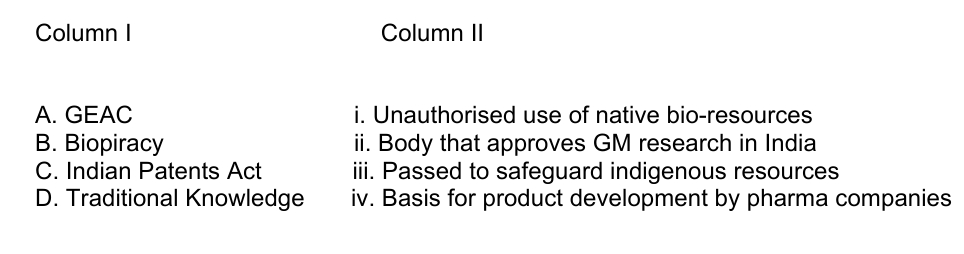
- Q1. Match the Column:
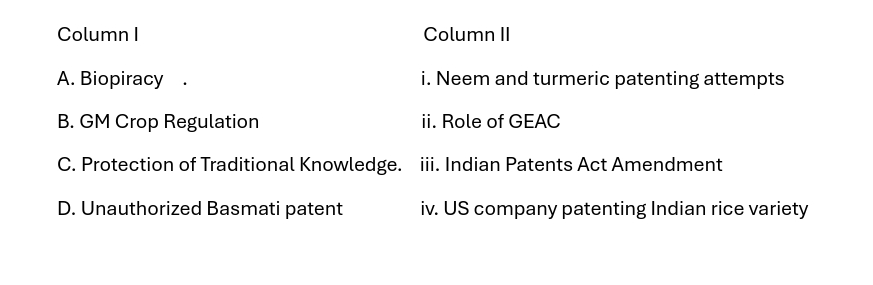
- Q2. Match the following ethical issues with their corresponding example or response:
- Q3. Match the following scientific names with their correct roles in biotechnology: Column I A. Bacillus thuringiensis B. Meloidogyne incognita C. Agrobacterium tumefaciens D. Escherichia coli E. Saccharomyces cerevisiae Column II 1. Root-knot nematode infecting tobacco roots and reducing yield 2. Host bacterium for recombinant production of human insulin 3. Source of Cry protoxin used in insect-resistant crops 4. Yeast used in recombinant DNA technology and food biotechnology 5. Vector used to deliver nematode-specific DNA into plants
- Q4. Match the following terms with their correct descriptions: Column I A. Green Revolution B. Somaclones C. Totipotency D. Explants E. Tissue culture Column I 1. Genetically identical plants obtained by micropropagation 2. Whole plant regeneration potential from any cell 3. Agricultural practice that tripled food supply using improved crop varieties and agrochemicals 4. Any part of a plant taken out and grown in nutrient media under sterile conditions 5. Technique developed in 1950s for regenerating plants in vitro using nutrient media
- Q5. Assertion (A): Somatic hybrids are produced using Agrobacterium-mediated transformation. Reason (R): Somatic hybridisation involves protoplast fusion of different plant species.
- Q6. Assertion (A): Bt cotton is resistant to bollworm pests. Reason (R): Bt cotton expresses cryIAc and cryIIAb genes which encode insecticidal proteins.
- Q7. Consider the following statements regarding biotechnology: 1. Biotechnology deals with industrial-scale production of biopharmaceuticals and biologicals using genetically modified microbes, fungi, plants, and animals. 2. Applications of biotechnology include therapeutics, diagnostics, GM crops, processed food, bioremediation, waste treatment, and energy production. 3. One critical research area of biotechnology is providing the best catalyst in the form of an improved organism or pure enzyme. 4. Engineering methods are not required to create optimal conditions for catalysts to act in biotechnology. 5. Downstream processing technologies are essential to purify proteins or organic compounds.
- Q8. Consider the following statements regarding genetically modified (GM) plants: 1. Genetic modification has helped crops tolerate abiotic stresses like cold, drought, salt, and heat. 2. GM plants increase dependence on chemical pesticides to protect against pests. 3. Golden rice is an example of a GM crop enriched with Vitamin A. 4. GM plants can reduce post-harvest losses and improve soil fertility by efficient mineral usage. 5. Genetic modification has no role in enhancing nutritional value of food.
- Q9. Consider the following statements : 1. Transgenic animals can be designed to study regulation of genes involved in normal development. 2. A radioactive DNA/RNA probe plus autoradiography can reveal clones with a mutated gene by absence of hybridisation signal. 3. GEAC regulates validity of GM research and safety of releasing GM organisms for public services in India. 4. Biopiracy denotes use of bio-resources without proper authorisation or compensatory payment. 5. Transgenic animals are created to yield biological products such as human α-1-antitrypsin.
- Q10. Arrange the following steps in the correct sequence for gene therapy in ADA (Adenosine Deaminase) deficiency: 1. Genetically engineered lymphocytes are reintroduced into the patient’s body. 2. The patient requires periodic infusion since lymphocytes are not immortal. 3. Lymphocytes are isolated from the blood of the patient. 4. The introduced gene enables lymphocytes to produce ADA enzyme. 5. A functional ADA cDNA is introduced into lymphocytes using a retroviral vector.
You’ve practised 10 of 176 Biotechnology and Its Applications questions in this set.
Practise all 176 + every chapter — free app →Sample NEET PYQs — Biotechnology and Its Applications
Which part of the tobacco plant is infected by Meloidogyne incognita?
- A. Flower
- B. Leaf
- C. Stem
- D. Root
Explanation: Answer: (4) Root Solution: The nematode Meloidogyne incognita parasitises tobacco plants by infecting their roots, causing a large reduction in yield. Resistance is engineered using RNA interference (RNAi), which silences specific nematode mRNA via dsRNA, protecting the transgenic plant. NCERT Reference: Ch 10, p.180, line 10 — "incognitia infects the roots of tobacco plants and causes a great reduction"
Which of the following statements is not correct?
- A. The functional insulin has A and B chains linked together by hydrogen bonds
- B. Genetically engineered insulin is produced in E-Coli
- C. In man insulin is synthesised as a proinsulin
- D. The proinsulin has a extra peptide called C-peptide
Explanation: Answer: (A) The functional insulin has A and B chains linked together by hydrogen bonds Solution: Insulin's A and B chains are linked by disulphide bridges, not hydrogen bonds — so statement (A) is the incorrect (not correct) one. The other statements are true: Eli Lilly produced genetically engineered insulin chains in E. coli; in humans insulin is first made as a pro-hormone (proinsulin); proinsulin carries an extra stretch called the C peptide that is removed on maturation. NCERT Reference: Ch 10, p.181, line 026 — "and chain B, that are linked together by disulphide bridges"
The two polypeptides of human insulin are linked together by:
- A. Hydrogen bonds
- B. Phosphodiester bond
- C. Covalent bond
- D. Disulphide bridges
Explanation: Answer: (4) Disulphide bridges Solution: Human insulin consists of two short polypeptide chains, chain A and chain B. NCERT states these chains are held together by disulphide bridges (disulfide bonds), not hydrogen, phosphodiester, or generic covalent bonds. During recombinant production, chains A and B are made separately in E. coli and combined by creating these disulphide bonds. NCERT Reference: Ch 10, p.181, line 26 — "Insulin consists of two short polypeptide chains: chain A"
Which kind of therapy was given in 1990 to a four-year-old girl with adenosine deaminase (ADA) deficiency? (NEET 2016 (Phase 2))
- A. Gene therapy
- B. Chemotherapy
- C. Immunotherapy
- D. Radiation therapy
Explanation: Answer: (A) Gene therapy Solution: The first clinical gene therapy was administered in 1990 to a 4-year-old girl with adenosine deaminase (ADA) deficiency. ADA is crucial for immune function; gene therapy delivers a functional ADA cDNA (via a retroviral vector) into the patient's lymphocytes to compensate for the deleted gene. NCERT Reference: Ch 10, p.182, line 25 — "The first clinical gene therapy was given in 1990 to a 4-year old girl"
Frequently Asked Questions — Biotechnology and Its Applications NEET
How many questions from Biotechnology and its Application come in NEET?+
How many Biotechnology and its Application questions does MedicNEET have?+
What is the NEET weightage of Biotechnology and its Application?+
Are Biotechnology and its Application questions available in Hindi?+
Are Biotechnology and its Application questions NCERT-based?+
What is the best app to master Biotechnology and Its Applications for NEET?+
How can I practice Biotechnology NEET PYQs in timed test mode online?+
How to score full marks in Biotechnology and Its Applications for NEET 2027?+
What are ReNEET 2026-style reasoning Biotechnology and Its Applications questions?+
Are these Biotechnology and Its Applications MCQs free to practise?+
Practise Biotechnology and Its Applications — Free
All 265+ Biotechnology and Its Applications questions · ReNEET 2026 reasoning + every format · Bilingual Hindi & English · NCERT-mapped explanations · No paywall
📲 Download MedicNEET App (Free)