How many questions from Body Fluids and Circulation in NEET?
3–4 questions from Body Fluids and Circulation appear in NEET every year (12–16 marks, ~4% of NEET Biology). High-yield topics: cardiac cycle, double circulation, blood composition (plasma vs formed elements), lymph and tissue fluid, ECG waves, and circulatory disorders (hypertension, coronary artery disease). Practise all 430 Body Fluids PYQs free in bilingual Hindi & English in the MedicNEET app.
Year-wise NEET Questions — Body Fluids and Circulation
| Year | Questions | Marks |
|---|---|---|
| NEET 2016 | 3 | 12 |
| NEET 2017 | 4 | 16 |
| NEET 2018 | 2 | 8 |
| NEET 2019 | 5 | 20 |
| NEET 2020 | 3 | 12 |
| NEET 2021 | 4 | 16 |
| NEET 2022 | 2 | 8 |
| NEET 2023 | 5 | 20 |
| NEET 2024 | 3 | 12 |
| NEET 2025 | 2 | 8 |
| NEET 2026 | 6 | 24 |
Practise Body Fluids and Circulation MCQs — Free
Every Body Fluids and Circulation question format NEET uses, starting with the newest ReNEET 2026-style reasoning MCQs. Tap an option for the answer + NCERT explanation.
✨ Body Fluids and Circulation — ReNEET 2026-Style Reasoning Questions
The newest, most exam-current format — reasoning-based questions modelled on ReNEET 2026. This is where NEET is heading; practise the pattern before the exam does.
- Q1. How do granulocytes differ from agranulocytes?
- Q2. Why does plasma help in maintaining blood pressure and volume?
- Q3. What explains the return of lymph to the main venous system?
- Q4. Which of the following best describes lacteals?
- Q5. How do semilunar valves help in circulation?
- Q6. What causes the closure of AV valves during the cardiac cycle?
- Q7. Why does systemic circulation require higher pressure than pulmonary circulation?
- Q8. What is the role of parasympathetic signals in heart regulation?
- Q9. What is the role of the neural center located in the medulla oblongata?
- Q10. Hypertension is clinically defined as blood pressure:
You’ve practised 10 of 61 Body Fluids and Circulation questions in this set.
Practise all 61 + every chapter — free app →📑 Body Fluids and Circulation — NEET 2025 & 2026 Long-Form MCQs
The long, multi-statement questions that dominated NEET 2025 & 2026 — each covers 5-6 concepts at once, so they double as fast full-chapter revision.
- Q1. Which of the following statements regarding formed elements of blood are NOT correct? S1: Erythrocytes in most mammals are nucleated and have a biconcave shape. S2: Haemoglobin, an iron-containing complex protein, is present in leucocytes and helps in oxygen transport. S3: The average lifespan of an RBC is 120 days, after which it is destroyed in the spleen. S4: Thrombocytes are cell fragments produced from megakaryocytes and are involved in blood coagulation. S5: Neutrophils are the least abundant leucocytes, comprising 0.5-1% of the total WBCs.
- Q2. Which of the following statements regarding lymph and the lymphatic system are NOT correct? S1: Lymph is a colourless fluid formed from blood plasma that has leaked out of capillaries, lacking erythrocytes but containing specialised lymphocytes. S2: The mineral distribution in lymph is significantly different from that of blood plasma, and it contains a higher concentration of proteins. S3: The lymphatic system primarily functions to drain interstitial fluid back into major veins and to absorb digested fats via lacteals. S4: Lymphocytes within the lymph are specialized cells primarily responsible for initiating coagulation and inflammatory reactions. S5: While lymph transports nutrients and hormones, it plays a major role in the direct transport of oxygen to tissues, similar to blood.
- Q3. Which of the following statements are correct regarding the human circulatory system? S1: The pulmonary circulation is responsible for transporting deoxygenated blood from the right ventricle to the lungs and returning oxygenated blood to the left atrium. S2: Systemic circulation ensures the delivery of oxygen and nutrients to body tissues, while removing carbon dioxide and other harmful substances. S3: All arteries consistently carry oxygenated blood, whereas all veins invariably transport deoxygenated blood in humans. S4: The hepatic portal system directly conveys nutrient-rich blood from the digestive tract into the right atrium of the heart. S5: Double circulation in mammals involves a single ventricle where oxygenated and deoxygenated blood partially mix.
- Q4. Which of the following statements accurately describe the intrinsic and extrinsic regulation of the human heart? S1. The human heart is characterized as myogenic because its rhythmic contractile activity is initiated by specialized nodal musculature within the heart itself. S2. While the heart is myogenic, its auto-excitability rate is entirely independent of any neural or hormonal modulation. S3. The medulla oblongata acts as the primary pacemaker of the heart, generating the intrinsic electrical impulses that regulate the heart beat. S4. Nodal tissue, essential for the heart's intrinsic activity, is distributed throughout the heart, including the sino-atrial node (SAN) located in the right upper corner of the right atrium. S5. The heart's ability to beat outside the body for a short period is a direct consequence of its auto-excitable property.
You’ve practised 4 of 60 Body Fluids and Circulation questions in this set.
Practise all 60 + every chapter — free app →🧩 Body Fluids and Circulation — All-Format Questions — Match, Assertion-Reason, Statement & Image-Based
Every question format NEET uses — match-the-column, assertion-reason, statement-based, and image/diagram questions — not just plain MCQs. Each with an instant NCERT-referenced solution.
- Q1. The figure shows four different ECG tracings (A–D). Identify the normal ECG pattern.
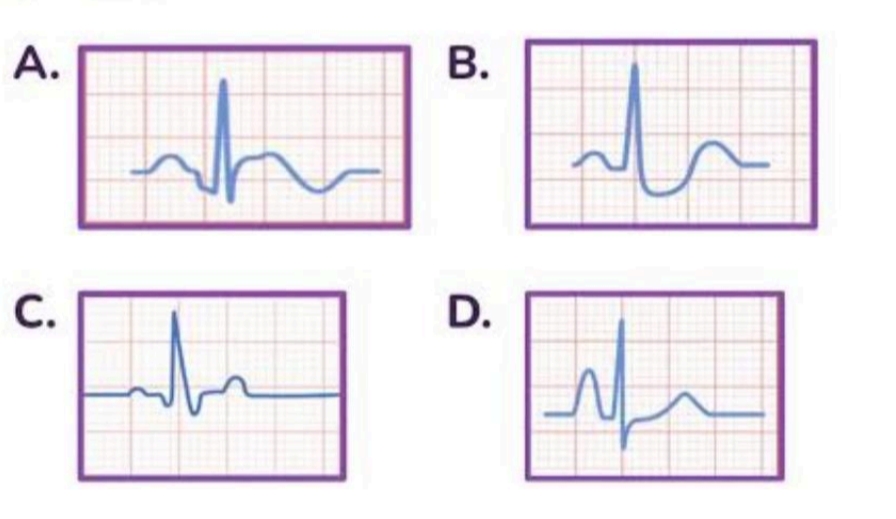
- Q2. Identify the cause of wave P in the ECG shown in Figure
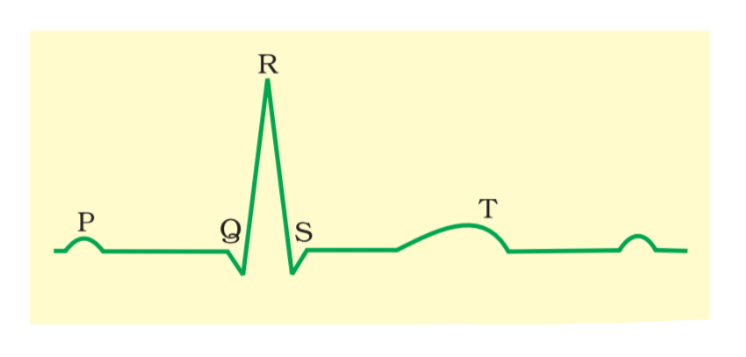
- Q3. (A) Arrange the ECG events in the correct sequence during a cardiac cycle: 1. QRS complex – ventricular depolarisation, systole begins 2. P-wave – atrial depolarisation, atrial contraction 3. T-wave – ventricular repolarisation, systole ends (B) Match the terms with their values/definitions: Column I A. Stroke Volume B. Cardiac Output Column II i. 70 mL blood pumped per ventricle per beat ii. ~5000 mL blood pumped per ventricle per minute
- Q4. Match the constituents of plasma (Column I) with their major functions (Column II): Column I A. Fibrinogen B. Globulins C. Albumins D. Minerals (Na⁺, Ca²⁺, HCO₃⁻, etc.) Column II i. Osmotic balance ii. Clotting of blood iii. Defense mechanisms iv. Maintain ionic composition
- Q5. Assertion (A): RBCs in mammals lack nuclei to accommodate more haemoglobin. Reason (R): Presence of nucleus in RBCs helps in faster oxygen transport.
- Q6. Assertion (A): Fibrinogen is converted to fibrin during clotting. Reason (R): Heparin converts fibrinogen to fibrin.
- Q7. Arrange the following events in the correct sequence to explain the mechanism of erythroblastosis foetalis: A. In a later pregnancy, maternal anti-Rh antibodies cross into the foetal circulation. B. Rh–ve mother carries an Rh⁺ foetus. C. At first delivery, small amounts of foetal Rh⁺ blood may enter maternal blood. D. Mother forms antibodies against Rh antigen. E. Foetal RBCs are destroyed, leading to anaemia/jaundice.
- Q8. Arrange the steps of blood coagulation in correct order: A. Fibrinogen → Fibrin B. Platelets release factors C. Clot forms trapping cells D. Prothrombin → Thrombin (with Ca²⁺, thrombokinase) E. Enzymatic cascade begins
- Q9. Arrange the following events of the cardiac cycle in correct sequence: A. Ventricular systole begins, AV valves close B. Joint diastole: all four chambers relaxed C. Atrial systole pushes extra blood into ventricles D. Semilunar valves open, blood flows into aorta/pulmonary artery E. Ventricular diastole, semilunar valves close
- Q10. Consider the following statements: 1. Normal activities of the heart are intrinsically regulated by specialised muscles, hence the heart is myogenic. 2. Sympathetic neural signals increase heart rate and cardiac output, while parasympathetic signals decrease them. 3. Adrenal medullary hormones can also elevate cardiac output. 4. Hypertension is diagnosed if repeated blood pressure checks show 140/90 mm Hg or higher. 5. Coronary artery disease (CAD) results from narrowing of arteries due to calcium, fat, cholesterol, and fibrous deposits. Choose the correct option:
You’ve practised 10 of 271 Body Fluids and Circulation questions in this set.
Practise all 271 + every chapter — free app →Sample NEET PYQs — Body Fluids and Circulation
Blood pressure in the pulmonary artery is:
- A. Same as that in the aorta
- B. More than that in the carotid
- C. More than that in the pulmonary vein
- D. Less than that in the venae cavae
Explanation: Answer: (c) More than that in the pulmonary vein Solution: Blood pressure always falls along the vascular route from artery to vein. The deoxygenated blood pumped by the right ventricle enters the pulmonary artery at higher pressure, passes to the lungs, and is then carried at lower pressure by the pulmonary veins to the left atrium. So pressure in the pulmonary artery is greater than in the pulmonary vein. NCERT: Ch 15, p.201, line 37 — "The deoxygenated blood pumped into the pulmonary artery is passed on to the lungs"
Name the blood cells, whose reduction in number can cause clotting disorder, leading to excessive loss of blood from the body.
- A. Erythrocytes
- B. Leucocytes
- C. Neutrophils
- D. Thrombocytes
Explanation: Answer: (d) Thrombocytes Solution: Platelets, also called thrombocytes, release substances involved in the coagulation or clotting of blood. A reduction in their number leads to clotting disorders, causing excessive loss of blood from the body. NCERT: Ch 15, p.195, line 10 — "A reduction in their number can lead to clotting disorders"
Serum differs from blood in
- A. Lacking globulins
- B. Lacking albumins
- C. Lacking clotting factors
- D. Lacking antibodies
Explanation: Answer: (c) Lacking clotting factors Solution: Plasma contains clotting (coagulation) factors in an inactive form. When these clotting factors are removed, the remaining fluid is called serum. Hence serum differs from blood (plasma) in lacking the clotting factors. NCERT: Ch 15, p.194, line 10 — "Plasma without the clotting factors is called serum."
The hepatic portal vein drains blood to liver from
- A. Heart
- B. Stomach
- C. Kidneys
- D. Intestine
Explanation: Answer: (d) Intestine Solution: The hepatic portal system is a unique vascular connection between the digestive tract and the liver. The hepatic portal vein carries blood from the intestine to the liver before it is delivered to the systemic circulation. NCERT: Ch 15, p.202, line 3 — "The hepatic portal vein carries blood from intestine to the liver"
Frequently Asked Questions — Body Fluids and Circulation NEET
How many questions from Body Fluids and Circulation come in NEET?+
How many Body Fluids and Circulation questions does MedicNEET have?+
What is the NEET weightage of Body Fluids and Circulation?+
Are Body Fluids and Circulation questions available in Hindi?+
Are Body Fluids and Circulation questions NCERT-based?+
Which animals have a 2-chambered heart?+
Which animals have a 3-chambered heart?+
Which animals have a 4-chambered heart?+
Which reptile has a 4-chambered heart?+
What are ReNEET 2026-style reasoning Body Fluids and Circulation questions?+
Are these Body Fluids and Circulation MCQs free to practise?+
Practise Body Fluids and Circulation — Free
All 392+ Body Fluids and Circulation questions · ReNEET 2026 reasoning + every format · Bilingual Hindi & English · NCERT-mapped explanations · No paywall
📲 Download MedicNEET App (Free)