How many questions from Breathing and Exchange of Gases in NEET?
3–4 questions from Breathing and Gaseous Exchange appear in NEET every year (12–16 marks, ~3% of NEET Biology). High-yield topics: respiratory organs, mechanism of breathing (tidal volume, IRV, ERV, RV), oxygen and CO₂ transport, regulation of respiration, respiratory disorders. Practice all 380 questions free in bilingual Hindi & English in the MedicNEET app.
Year-wise NEET Questions — Breathing and Exchange of Gases
| Year | Questions | Marks |
|---|---|---|
| NEET 2016 | 6 | 24 |
| NEET 2017 | 1 | 4 |
| NEET 2018 | 4 | 16 |
| NEET 2019 | 4 | 16 |
| NEET 2020 | 3 | 12 |
| NEET 2021 | 4 | 16 |
| NEET 2022 | 2 | 8 |
| NEET 2023 | 4 | 16 |
| NEET 2024 | 2 | 8 |
| NEET 2026 | 4 | 16 |
Practise Breathing and Exchange of Gases MCQs — Free
Every Breathing and Exchange of Gases question format NEET uses, starting with the newest ReNEET 2026-style reasoning MCQs. Tap an option for the answer + NCERT explanation.
✨ Breathing and Exchange of Gases — ReNEET 2026-Style Reasoning Questions
The newest, most exam-current format — reasoning-based questions modelled on ReNEET 2026. This is where NEET is heading; practise the pattern before the exam does.
- Q1. Why are respiratory organs of animals different from one another?
- Q2. How does the epiglottis prevent choking during swallowing?
- Q3. Why can a person not exhale all the air out of the lungs even with forceful expiration?
- Q4. Why is a spirometer used in clinical practice?
- Q5. Why does the diaphragm contract during inspiration?
- Q6. Why does CO₂ diffuse 20 times faster than O₂?
- Q7. The alveolar epithelium in the respiratory membrane is responsible for:
- Q8. Why does more CO₂ bind to hemoglobin in tissues than in lungs?
- Q9. Why is the oxygen dissociation curve sigmoid in shape?
- Q10. Why does emphysema decrease the surface area for gas exchange?
You’ve practised 10 of 55 Breathing and Exchange of Gases questions in this set.
Practise all 55 + every chapter — free app →📑 Breathing and Exchange of Gases — NEET 2025 & 2026 Long-Form MCQs
The long, multi-statement questions that dominated NEET 2025 & 2026 — each covers 5-6 concepts at once, so they double as fast full-chapter revision.
- Q1. Which of the following statements regarding the exchange part of the human respiratory system and the diffusion membrane are correct? S1. Alveoli and their ducts together constitute the exchange surface for diffusion of respiratory gases. S2. The diffusion membrane consists of alveolar epithelium, capillary endothelium and a basement substance between them. S3. Extremely small thickness of the diffusion membrane facilitates rapid diffusion of oxygen and carbon dioxide. S4. Increase in thickness of the basement substance enhances the rate of gaseous exchange. S5. Large surface area of alveoli contributes significantly to efficient gaseous exchange. S6. Gaseous exchange across the alveoli occurs by active transport mechanisms. Choose the correct option:
- Q2. Match the following physiological events of breathing with their descriptions: Column I (Physiological Event) A. Normal Inspiration B. Normal Expiration C. Forceful Expiration D. Air moves into lungs E. Air moves out of lungs Column II (Description) 1. Intra-pulmonary pressure becomes higher than atmospheric pressure 2. Diaphragm and external intercostal muscles contract 3. Passive relaxation of inspiratory muscles 4. Intra-pulmonary pressure becomes lower than atmospheric pressure 5. Contraction of internal intercostal and abdominal muscles
- Q3. Which of the following statements regarding the structure of the diffusion membrane are NOT correct? S1: The thin squamous epithelium of the alveoli forms the primary barrier on the alveolar side of the membrane. S2: The endothelium of alveolar capillaries consists of a single layer of cells directly lining the capillary space. S3: The basement substance is a singular, continuous membrane that physically separates the alveolar epithelium from the capillary endothelium. S4: The capillary lumen, where blood flows, is anatomically considered one of the three major layers forming the respiratory diffusion membrane. S5: The total thickness of the diffusion membrane, including all its layers, is typically less than one millimeter, aiding in efficient gas exchange.
- Q4. Which of the following statements are correct regarding carbon dioxide transport from systemic tissues? S1: At the tissue site, where partial pressure of CO₂ (pCO₂) is high due to catabolism, CO₂ diffuses into blood (RBCs and plasma). S2: The enzyme carbonic anhydrase, which facilitates the conversion of CO₂ and H₂O, is present only in minute quantities in the plasma and is absent in RBCs. S3: The binding of CO₂ to hemoglobin to form carbamino-haemoglobin is mainly promoted by low pCO₂ and high pO₂ conditions. S4: Most of the bicarbonate ions (HCO₃⁻) formed from CO₂ within the RBCs largely remain inside the RBCs, contributing to their osmotic balance. S5: Every 100 ml of deoxygenated blood delivers approximately 4 ml of CO₂ to the alveoli.
You’ve practised 4 of 55 Breathing and Exchange of Gases questions in this set.
Practise all 55 + every chapter — free app →🧩 Breathing and Exchange of Gases — All-Format Questions — Match, Assertion-Reason, Statement & Image-Based
Every question format NEET uses — match-the-column, assertion-reason, statement-based, and image/diagram questions — not just plain MCQs. Each with an instant NCERT-referenced solution.
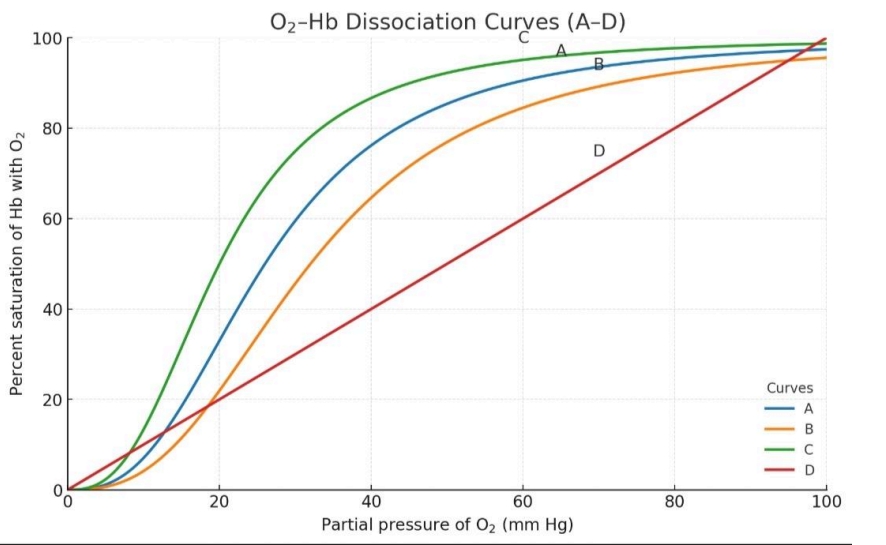
- Q1. Match the labelled O₂–Hb dissociation curves (A–D) in the given figure with the most appropriate explanations. Column I (Curves) A. Curve A B. Curve B C. Curve C D. Curve D Column II (Explanations) 1. Left-shifted curve with increased Hb–O₂ affinity (e.g., ↓pCO₂/↓H⁺/↓temperature or HbF); lower P₅₀. 2. Normal adult Hb at 37 °C, pH 7.4; standard sigmoid relation. 3. Right-shifted curve with decreased Hb–O₂ affinity (↑pCO₂/↑H⁺/↑temperature); higher P₅₀ and better unloading at tissues. 4. Linear relation without cooperativity; not physiological for haemoglobin.
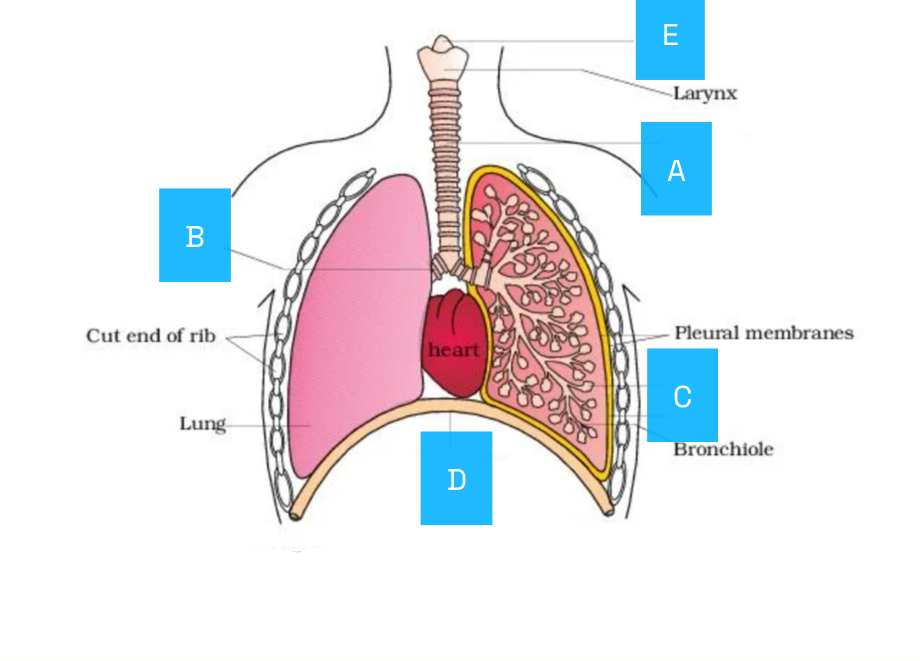
- Q2. Label e in Figure
- Q3. Match the following components of the diffusion membrane with their cell types : Column I (Layers) A. Alveolar capillaries B. Basement membrane between alveolar epithelium and capillary endothelium C. Alveoli Column II (Cell Types) 1. Non-cellular fused substance 2. Simple squamous epithelial cells 3. Endothelial cells
- Q4. Match the following respiratory volumes and capacities with their correct definitions Column I (Volumes & Capacities) A. Tidal Volume (TV) B. Residual Volume (RV) C. Inspiratory Reserve Volume (IRV) D. Vital Capacity (VC) E. Functional Residual Capacity (FRC) Column II (Descriptions) 1. Volume of air that remains in the lungs after a forcible expiration (~1100–1200 mL). 2. Additional volume of air that can be inspired by a forcible inspiration (~2500–3000 mL). 3. Volume of air inspired or expired during a normal respiration (~500 mL). 4. Volume of air that will remain in the lungs after a normal expiration; it includes ERV + RV (~2200–2400 mL). 5. Maximum volume of air a person can breathe in after a forceful expiration; includes TV + IRV + ERV (~3500–4500 mL).
- Q5. Assertion (A): The conducting part of the respiratory system conditions the air. Reason (R): It helps in sound production and excretion.
- Q6. Assertion (A): Larynx is also known as the sound box. Reason (R): It prevents the entry of food into the trachea.
- Q7. Arrange the following parts of the human respiratory system in the correct sequence for the passage of air during inspiration. 1. Bronchi 2. Nasal cavity 3. Larynx 4. Trachea 5. Bronchioles 6. Alveoli 7. Pharynx
- Q8. Which of the following statements about types of respiration in different organisms are correct? 1. In sponges and coelenterates, exchange of O₂ and CO₂ occurs directly by diffusion across their general body surface. 2. In earthworms, moist skin serves as the respiratory surface for gaseous exchange. 3. In insects, moist cuticle is used for diffusion of gases. 4. In fishes, gills are the main organs for respiration. 5. In mammals, lungs are the principal organs of respiration.
- Q9. Arrange the following steps of respiration in the correct sequence 1. Diffusion of gases (O, and CO₂) across alveolar membrane. 2. Utilisation of O, by the cells for catabolic reactions and resultant release of CO 3. Breathing or pulmonary ventilation by which atmospheric air is drawn in and CO, rich alveolar air is released out. 4. Transport of gases by the blood. 5. Diffusion of O, and CO₂ between blood and tissues.
- Q10. Which of the following sentences are part of the mechanism of inspiration? 1. “The overall increase in the thoracic volume causes a similar increase in pulmonary volume.” 2. Relaxation of the diaphragm and the inter-costal muscles reduces thoracic and pulmonary volumes; this is the first step of inspiration. 3. “Inspiration is initiated by the contraction of diaphragm which increases the volume of thoracic chamber in the antero-posterior axis.” 4. Inspiration begins when the intra-pulmonary pressure becomes higher than the atmospheric pressure, pushing air into the lungs. 5. “An increase in pulmonary volume decreases the intra-pulmonary pressure to less than the atmospheric pressure which forces the air from outside to move into the lungs, i.e., inspiration.” 6. “The contraction of external inter-costal muscles lifts up the ribs and the sternum causing an increase in the volume of the thoracic chamber in the dorso-ventral axis.”
You’ve practised 10 of 207 Breathing and Exchange of Gases questions in this set.
Practise all 207 + every chapter — free app →Sample NEET PYQs — Breathing and Exchange of Gases
The partial pressure of oxygen in the alveoli of the lungs is
- A. Equal to that in the blood
- B. More than that in the blood
- C. Less than that in the blood
- D. Less than that of carbon dioxide
Explanation: Answer: (b) More than that in the blood Solution: In Table 14.1 the pO2 at the alveoli is 104 mm Hg, whereas in the deoxygenated blood reaching the alveoli it is only 40 mm Hg. This concentration gradient (alveoli > blood) drives O2 diffusion from alveoli into blood, so alveolar pO2 is more than that in the blood. NCERT: Ch 14, p.187, line 34 — "a concentration gradient for oxygen from alveoli to blood"
Select the correct statement.
- A. Expiration occurs due to external intercostal muscles
- B. Intrapulmonary pressure is lower than the atmospheric pressure during inspiration.
- C. Inspiration occurs when atmospheric pressure is less than intrapulmonary pressure.
- D. Expiration is initiated due to contraction of diaphragm.
Explanation: Answer: (b) Intrapulmonary pressure is lower than the atmospheric pressure during inspiration. Solution: Inspiration occurs only when intra-pulmonary pressure falls below atmospheric pressure, drawing air in — so (b) is correct. Expiration is caused by relaxation of diaphragm and intercostals (not external intercostals contracting), and inspiration (not expiration) is initiated by diaphragm contraction, so the other statements are false. NCERT: Ch 14, p.185, line 37 — "Inspiration can occur if the pressure within the lungs... is less than the atmospheric pressure"
Reduction in pH of blood will:
- A. Reduce the rate of heart beat
- B. Reduce the blood supply to the brain
- C. Decrease the affinity of hemoglobin with oxygen
- D. Release bicarbonate ions by the liver
Explanation: Answer: (c) Decrease the affinity of hemoglobin with oxygen Solution: A reduction in blood pH means a rise in H+ (hydrogen ion) concentration. Higher H+ concentration shifts the oxygen dissociation curve so that oxygen is released from oxyhaemoglobin (the Bohr effect), i.e., haemoglobin's affinity for O2 decreases. NCERT lists high H+ concentration among the conditions favouring dissociation of oxygen from oxyhaemoglobin. NCERT: Ch 14, p.189, line 28 — "high pCO2, high H+ concentration and higher temperature exist"
Asthma may be attributed to:
- A. Bacterial infection of the lungs
- B. Allergic reaction of the mast cells in the lungs
- C. Inflammation of the trachea
- D. Accumulation of fluid in the lung
Explanation: Answer: (b) Allergic reaction of the mast cells in the lungs Solution: Asthma is a difficulty in breathing causing wheezing, caused by inflammation of the bronchi and bronchioles. This inflammatory narrowing is triggered by an allergic (hypersensitivity) reaction involving mast cells in the lungs, so option (b) is the underlying cause. It is not a bacterial infection, not inflammation of the trachea (it is the bronchi/bronchioles), nor fluid accumulation. NCERT: Ch 14, p.190, line 67 — "Asthma is a difficulty in breathing causing wheezing due to inflammation"
Frequently Asked Questions — Breathing and Exchange of Gases NEET
How many questions from Breathing and Gaseous Exchange come in NEET?+
How many Breathing and Gaseous Exchange questions does MedicNEET have?+
What is the NEET weightage of Breathing and Gaseous Exchange?+
Are Breathing and Gaseous Exchange questions available in Hindi?+
Are Breathing and Gaseous Exchange questions NCERT-based?+
What are ReNEET 2026-style reasoning Breathing and Exchange of Gases questions?+
Are these Breathing and Exchange of Gases MCQs free to practise?+
Practise Breathing and Exchange of Gases — Free
All 317+ Breathing and Exchange of Gases questions · ReNEET 2026 reasoning + every format · Bilingual Hindi & English · NCERT-mapped explanations · No paywall
📲 Download MedicNEET App (Free)