How many questions from Chemical Coordination and Integration in NEET?
3–4 questions from Chemical Coordination and Integration appear in NEET every year (12–16 marks, ~4% of NEET Biology). High-yield topics: endocrine glands and hormones, insulin and glucagon (pancreas), thyroxine (thyroid), adrenaline (adrenal medulla), ADH and oxytocin (hypothalamus–pituitary axis), steroid vs non-steroid hormone mechanisms, and hormone feedback loops. Practise all 488 CCI questions free in bilingual Hindi & English in the MedicNEET app. 357 MCQ Questions 40 Assertion-Reason 91 NEET 2025 Pattern 29 Previous Year Q
Year-wise NEET Questions — Chemical Coordination and Integration
| Year | Questions | Marks |
|---|---|---|
| NEET 2016 | 10 | 40 |
| NEET 2017 | 4 | 16 |
| NEET 2018 | 3 | 12 |
| NEET 2019 | 8 | 32 |
| NEET 2020 | 3 | 12 |
| NEET 2021 | 2 | 8 |
| NEET 2022 | 1 | 4 |
| NEET 2023 | 7 | 28 |
| NEET 2024 | 3 | 12 |
| NEET 2025 | 5 | 20 |
| NEET 2026 | 4 | 16 |
Practise Chemical Coordination and Integration MCQs — Free
Every Chemical Coordination and Integration question format NEET uses, starting with the newest ReNEET 2026-style reasoning MCQs. Tap an option for the answer + NCERT explanation.
✨ Chemical Coordination and Integration — ReNEET 2026-Style Reasoning Questions
The newest, most exam-current format — reasoning-based questions modelled on ReNEET 2026. This is where NEET is heading; practise the pattern before the exam does.
- Q1. What feature distinguishes modern definitions of hormones from classical ones?
- Q2. Why is neural coordination considered short-lived compared to hormonal coordination?
- Q3. How does melatonin affect the sleep-wake cycle?
- Q4. What is the primary trigger for PTH secretion?
- Q5. Why does the adrenal medulla increase heart rate during stress?
- Q6. Why is insulin therapy necessary for diabetic patients?
- Q7. How do androgens support spermatogenesis?
- Q8. Why is the testis considered a dual-function gland?
- Q9. 9. What structural features allow the ovary to perform dual functions?
- Q10. 5. Which hormone among the following promotes bicarbonate secretion and why?
You’ve practised 10 of 87 Chemical Coordination and Integration questions in this set.
Practise all 87 + every chapter — free app →📑 Chemical Coordination and Integration — NEET 2025 & 2026 Long-Form MCQs
The long, multi-statement questions that dominated NEET 2025 & 2026 — each covers 5-6 concepts at once, so they double as fast full-chapter revision.
- Q1. Match the following types of coordination/messengers with their most appropriate characteristics: Column I: Type of Coordination/Messenger A. Neural Coordination B. Classical Endocrine Hormone C. Modern Definition of Hormone D. Neurotransmitter Action Column II: Characteristic i. Relies on synaptic release for target cell interaction ii. Point-to-point, rapid but short-lived communication iii. Non-nutrient chemical, acts as intercellular messenger in trace amounts iv. Secreted by organised endocrine glands, travels via blood to distant target
- Q2. Which of the following statements regarding the posterior pituitary and its associated hormones are correct? S1: The posterior pituitary is also known as the pars distalis. S2: Vasopressin, also called ADH, is synthesized in the hypothalamus but released from the posterior pituitary. S3: Oxytocin primarily acts on the smooth muscles of the uterus and mammary glands, stimulating contraction and milk ejection, respectively. S4: An impairment in the synthesis or release of ADH results in a condition called Diabetes Mellitus. S5: The posterior pituitary is under direct neural regulation of the hypothalamus. S6: Vasopressin promotes the loss of water through urine by inhibiting the reabsorption of water and electrolytes by the renal tubules.
- Q3. Match the following pancreatic components with their secreted hormone and primary mechanism of action in glucose homeostasis: Column I (Pancreatic Cell Type) A. α-cells B. β-cells Column II (Hormone Secreted) i. Insulin ii. Glucagon Column III (Primary Action for Glucose Homeostasis) p. Enhances cellular glucose uptake and utilisation, leading to hypoglycemia q. Stimulates glycogenolysis and gluconeogenesis, leading to hyperglycemia
- Q4. Which of the following is LEAST likely a direct function of progesterone? A. Regulation of female sexual behaviour. B. Maintenance of uterine endometrium for implantation. C. Stimulation of overall mammary gland development. D. Inhibition of uterine contractions during pregnancy. E. Stimulation of milk secretion after alveoli formation.
You’ve practised 4 of 78 Chemical Coordination and Integration questions in this set.
Practise all 78 + every chapter — free app →🧩 Chemical Coordination and Integration — All-Format Questions — Match, Assertion-Reason, Statement & Image-Based
Every question format NEET uses — match-the-column, assertion-reason, statement-based, and image/diagram questions — not just plain MCQs. Each with an instant NCERT-referenced solution.
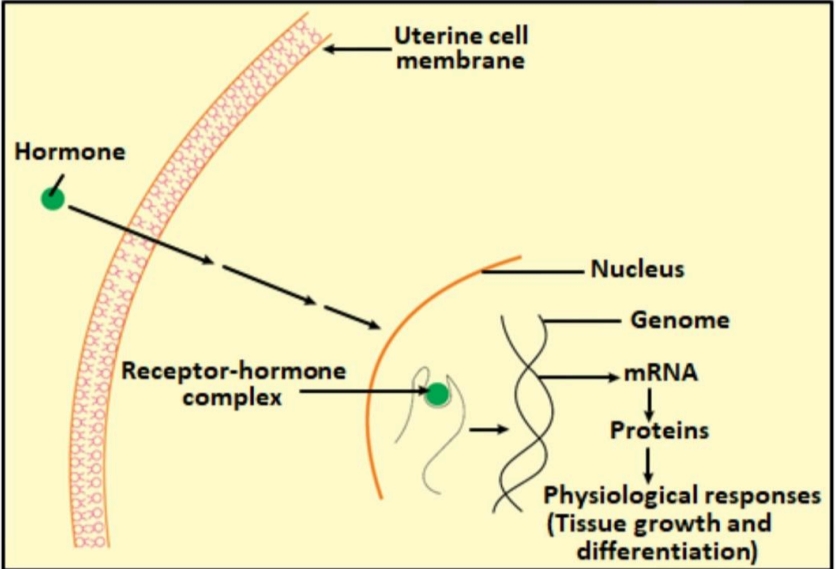
- Q1. Consider the following statements based on the given diagram of hormone action: 1. Steroid hormones cross the plasma membrane due to their lipophilic nature. 2. The receptor–hormone complex directly interacts with the genome inside the nucleus. 3. The primary effect of this mechanism is alteration in protein synthesis. 4. Physiological effects such as tissue growth and differentiation occur only after gene expression changes. 5. Peptide hormones also act through this same nuclear receptor pathway.
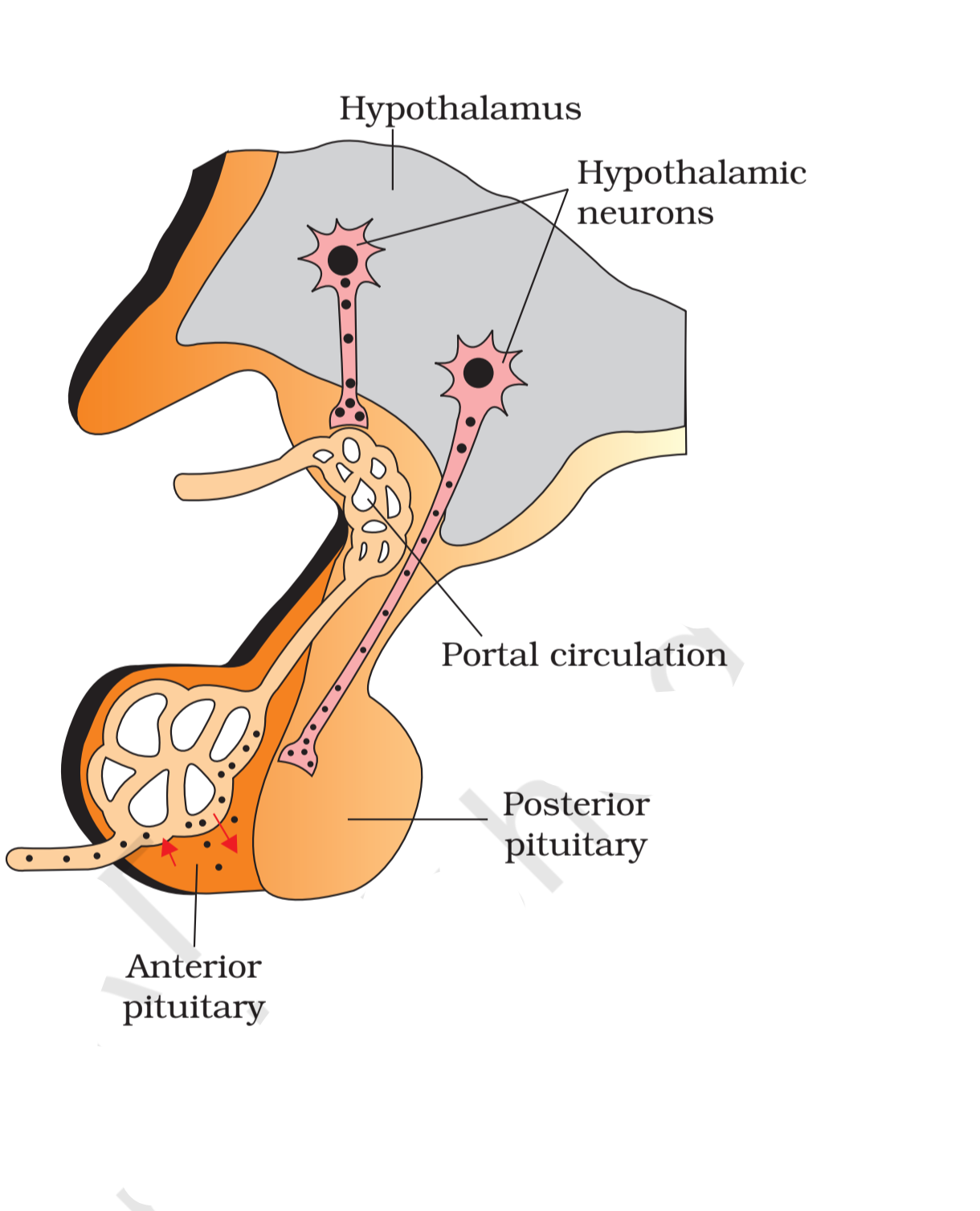
- Q2. Based on the diagram, which structure is responsible for storing oxytocin and vasopressin?
- Q3. Arrange the following in the correct sequence of regulation for Adrenaline secretion, and match each with its respective function/hormone. Column I (Organ/Step) A. Hypothalamus B. Sympathetic nerves C. Adrenal medulla D. Target tissues (heart, muscles, liver, etc.) Column II (Hormone/Action) 1. Adrenaline (epinephrine) release 2. Stress signal transmission via sympathetic nerves 3. Increased heart rate, respiration, glycogenolysis (Fight-or-Flight) 4. Stress perceived and processed
- Q4. Arrange the following in the correct sequence of hormone regulation for LH and FSH secretion, and match each with its respective hormone. Column I (Organ/Step) A. Hypothalamus B. Portal circulation C. Anterior Pituitary (Pars distalis) D. Gonads (Testis/Ovary) Column II (Hormone) 1. GnRH 2. LH & FSH 3. Androgens / Estrogens & Progesterone 4. Transport medium (no hormone secreted, but carries GnRH)
- Q5. Assertion (A): Hormones can act on organs located far from their site of secretion. Reason (R): Hormones are transported through blood.
- Q6. Assertion (A): Liver and kidney are considered part of the endocrine system. Reason (R): They produce hormones despite not being classical endocrine glands.
- Q7. Arrange the following in the correct sequence: 1. HR complex interacts with genome 2. Hormone diffuses into target cell (intracellular access) 3. Gene-expression changes → biochemical/physiological effects 4. Binding to intracellular receptor to form HR complex
- Q8. Evaluate the following statements : 1. Thymus is a lobular structure located behind sternum, between the lungs. 2. It secretes peptide hormones called thymosins. 3. Thymosins stimulate differentiation of B-lymphocytes. 4. Thymosins promote production of antibodies, supporting humoral immunity. 5. Thymus degenerates with age, reducing immune responses in older people.
- Q9. Consider the following statements on endocrine disorders and regulation: 1. Exophthalmic goitre is a manifestation of hyperthyroidism. 2. Addison’s disease results from overproduction of adrenal cortical hormones. 3. Diabetes mellitus is due to deficiency or resistance to insulin. 4. ANF secreted from the atrial wall lowers blood pressure. 5. Erythropoietin secreted by kidney stimulates RBC production.
- Q10. Arrange the following in the correct sequence: 1. Regulation of target-cell metabolism 2. Hormone binds membrane receptor 3. Formation of hormone–receptor complex 4. Activation of second messengers (cAMP/IP₃/Ca²⁺)
You’ve practised 10 of 285 Chemical Coordination and Integration questions in this set.
Practise all 285 + every chapter — free app →Sample NEET PYQs — Chemical Coordination and Integration
Select the correct statement. (A) Insulin acts on pancreatic cells and adipocytes (B) Insulin is associated with hyperglycemia (C) Glucocorticoids stimulates gluconeogenesis (D) Glucagon is associated with hypoglycemia.
- A. Insulin acts on pancreatic cells and adipocytes.
- B. Insulin is associated with hyperglycemia
- C. Glucocorticoids stimulates gluconeogenesis
- D. Glucagon is associated with hypoglycemia.
Explanation: Answer: (c) Glucocorticoids stimulates gluconeogenesis Solution: Glucocorticoids (mainly cortisol) from the adrenal cortex stimulate gluconeogenesis, so this statement is correct. Insulin acts on hepatocytes and adipocytes (not pancreatic cells) and is a hypoglycemic hormone, while glucagon is a hyperglycemic hormone — making options (a), (b) and (d) wrong. NCERT Reference: Chapter 19, Page 245, Line(s) 14 — "Glucocorticoids stimulate gluconeogenesis, lipolysis and proteolysis;"
Which of the following statements is not correct? (A) The functional insulin has A and B chains linked together by hydrogen bonds (B) Genetically engineered insulin is produced in E-Coli (C) In man insulin is synthesised as a proinsulin (D) The proinsulin has an extra peptide called C-peptide.
- A. The functional insulin has A and B chains linked together by hydrogen bonds
- B. Genetically engineered insulin is produced in E-Coli
- C. In man insulin is synthesised as a proinsulin
- D. The proinsulin has an extra peptide called C-peptide
Explanation: Answer: (a) The functional insulin has A and B chains linked together by hydrogen bonds Solution: This statement is NOT correct: in functional insulin the A and B chains are joined by covalent disulphide bridges, not hydrogen bonds. The other statements are true — in man insulin is synthesised as a single-chain proinsulin bearing an extra C-peptide that is removed during maturation, and genetically engineered (recombinant) human insulin is produced in E. coli. NCERT Reference: Chapter 19, Page 245, Line(s) 42-44 — "Insulin is a peptide hormone, which plays a major role in the regulation of glucose homeostasis. Insulin acts mainly on hepatocytes and adipocytes"
Which hormones do stimulate the production of pancreatic juice and bicarbonate?
- A. Angiotensin and epinephrine
- B. Cholecystokinin and gastrin
- C. Cholecystokinin and secretin
- D. Insulin and glucagon
Explanation: Answer: (c) Cholecystokinin and secretin Solution: Secretin acts on the exocrine pancreas and stimulates secretion of water and bicarbonate ions, while CCK acts on the pancreas and gall bladder to stimulate secretion of pancreatic enzymes and bile juice. Together they drive pancreatic juice and bicarbonate output. Gastrin acts on gastric glands (HCl/pepsinogen), not pancreas. NCERT Reference: Chapter 19, Page 247, Line(s) 25-28 — "Secretin acts on the exocrine pancreas and stimulates secretion of water and bicarbonate ions. CCK acts on both pancreas and gall bladder and stimulates the secretion of pancreatic enzymes and bile juice"
Graves' disease is caused due to
- A. Hyposecretion of thyroid gland
- B. Hypersecretion of thyroid gland
- C. Hyposecretion of adrenal gland
- D. Hypersecretion of adrenal gland
Explanation: Answer: (b) Hypersecretion of thyroid gland Solution: Graves' disease (exophthalmic goitre) is a form of hyperthyroidism, i.e. it results from hypersecretion of thyroid hormones by the thyroid gland. It is marked by enlargement of the thyroid, protrusion of the eyeballs, raised basal metabolic rate and weight loss. NCERT Reference: Chapter 19, Page 243, Line(s) 10–12 — "Exopthalmic goitre is a form of hyperthyroidism, characterised by enlargement of the thyroid gland, protrusion of the eyeballs, increased basal metabolic rate, and weight loss, also called Graves’ disease.
Frequently Asked Questions — Chemical Coordination and Integration NEET
How many questions from Chemical Coordination and Integration come in NEET?+
How many Chemical Coordination and Integration questions does MedicNEET have?+
What is the NEET weightage of Chemical Coordination and Integration?+
Are Chemical Coordination and Integration questions available in Hindi?+
Are Chemical Coordination and Integration questions NCERT-based?+
What is the best app for Chemical Coordination and Integration NEET practice?+
How to score full marks in Chemical Coordination and Integration for NEET 2027?+
What is exophthalmic goitre in NEET Biology?+
What are ReNEET 2026-style reasoning Chemical Coordination and Integration questions?+
Are these Chemical Coordination and Integration MCQs free to practise?+
Practise Chemical Coordination and Integration — Free
All 450+ Chemical Coordination and Integration questions · ReNEET 2026 reasoning + every format · Bilingual Hindi & English · NCERT-mapped explanations · No paywall
📲 Download MedicNEET App (Free)