How many questions from Evolution in NEET?
3–4 questions from Evolution appear in NEET every year (12–16 marks, ~4% of NEET Biology). High-yield: Hardy-Weinberg equilibrium, natural selection types (stabilising/directional/disruptive), origin of life (Miller-Urey), human evolution timeline, adaptive radiation, industrial melanism. Practice all 515 Evolution questions free in bilingual Hindi & English in the MedicNEET app.
Year-wise NEET Questions — Evolution
| Year | Questions | Marks |
|---|---|---|
| NEET 2016 | 8 | 32 |
| NEET 2017 | 2 | 8 |
| NEET 2018 | 3 | 12 |
| NEET 2019 | 8 | 32 |
| NEET 2020 | 6 | 24 |
| NEET 2021 | 3 | 12 |
| NEET 2022 | 1 | 4 |
| NEET 2023 | 3 | 12 |
| NEET 2024 | 4 | 16 |
| NEET 2025 | 1 | 4 |
| NEET 2026 | 9 | 36 |
Practise Evolution MCQs — Free
Every Evolution question format NEET uses, starting with the newest ReNEET 2026-style reasoning MCQs. Tap an option for the answer + NCERT explanation.
✨ Evolution — ReNEET 2026-Style Reasoning Questions
The newest, most exam-current format — reasoning-based questions modelled on ReNEET 2026. This is where NEET is heading; practise the pattern before the exam does.
- Q1. Why was Miller’s experiment considered significant in the study of origin of life?
- Q2. Which line of reasoning best explains why Pasteur’s experiment disproved spontaneous generation?
- Q3. Which of the following best supports Darwin’s idea of reproductive fitness?
- Q4. The case of industrial melanism demonstrates
- Q5. Why are placental mammals in Australia said to have evolved convergently with marsupials?
- Q6. What was Darwin’s unique insight about evolution?
- Q7. Why does gene flow alter Hardy-Weinberg equilibrium?
- Q8. Why must the sum of all allele frequencies in a population equal 1?
- Q9. How do scientists justify the claim that reptiles were once dominant before mammals?
- Q10. Why is there emphasis on tool development in human evolution?
You’ve practised 10 of 94 Evolution questions in this set.
Practise all 94 + every chapter — free app →📑 Evolution — NEET 2025 & 2026 Long-Form MCQs
The long, multi-statement questions that dominated NEET 2025 & 2026 — each covers 5-6 concepts at once, so they double as fast full-chapter revision.
- Q1. Which of the following statements accurately describes the early Earth's atmosphere and its chemical environment? S1. The early Earth's atmosphere was primarily reducing, lacking free oxygen. S2. Water vapor, methane, and ammonia were major constituents released from the molten mass. S3. UV rays caused the breakdown of water, leading to the accumulation of free oxygen. S4. Oxygen immediately combined with methane and ammonia, preventing its free accumulation. S5. The formation of the ozone layer occurred early due to abundant free oxygen.
- Q2. Which of the following statements regarding evolutionary evidences from comparative anatomy and morphology are NOT correct? S1: Homologous organs are structures that are anatomically similar but perform different functions, providing evidence for divergent evolution. S2: The eye of the octopus and the eye of mammals are examples of homologous structures, suggesting a common ancestry. S3: Wings of a butterfly and wings of a bird are analogous structures, demonstrating convergent evolution where different structures evolve for the same function. S4: The flippers of penguins and dolphins are homologous organs, as both are mammals adapting to aquatic life. S5: Sweet potato (root modification) and potato (stem modification) are analogous structures due to their similar function of food storage, representing convergent evolution.
- Q3. Which of the following statements are correct regarding the observations that form the basis of Darwinian natural selection? S1: Populations have the potential for exponential growth if reproduction occurs maximally. S2: Natural resources required for survival and growth are invariably unlimited in any environment. S3: Individuals within a population typically show slight variations, and many of these are passed on to offspring. S4: The struggle for existence in a population arises primarily due to the equal survival rates of all offspring. S5: Those individuals with heritable variations that enable better resource utilisation tend to leave more progeny.
- Q4. Which of the above statements are NOT correct regarding the Hardy-Weinberg principle and evolutionary forces? S1: The Hardy-Weinberg principle states that allele frequencies remain constant in a population in the absence of evolutionary forces. S2: A population deviating from Hardy-Weinberg equilibrium indicates the absence of any ongoing evolutionary processes. S3: Genetic drift, gene flow, mutation, and natural selection are the only four factors that can cause a deviation from Hardy-Weinberg equilibrium. S4: Random mating is a necessary condition for a population to be in Hardy-Weinberg equilibrium. S5: The sum of all allelic frequencies (p+q) in a population at genetic equilibrium is always greater than one.
You’ve practised 4 of 91 Evolution questions in this set.
Practise all 91 + every chapter — free app →🧩 Evolution — All-Format Questions — Match, Assertion-Reason, Statement & Image-Based
Every question format NEET uses — match-the-column, assertion-reason, statement-based, and image/diagram questions — not just plain MCQs. Each with an instant NCERT-referenced solution.
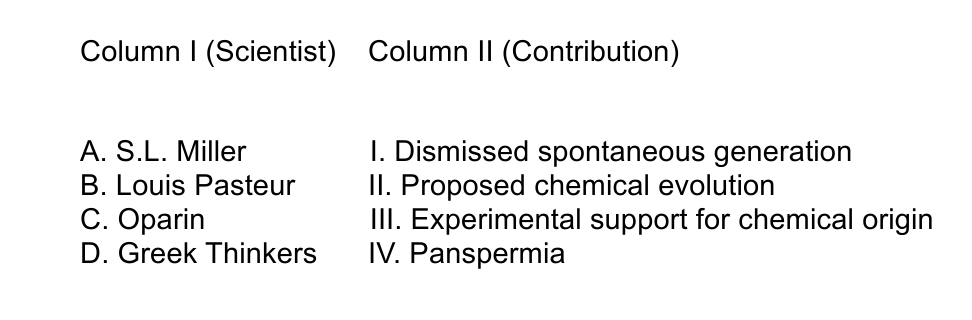
- Q1. Match the following:
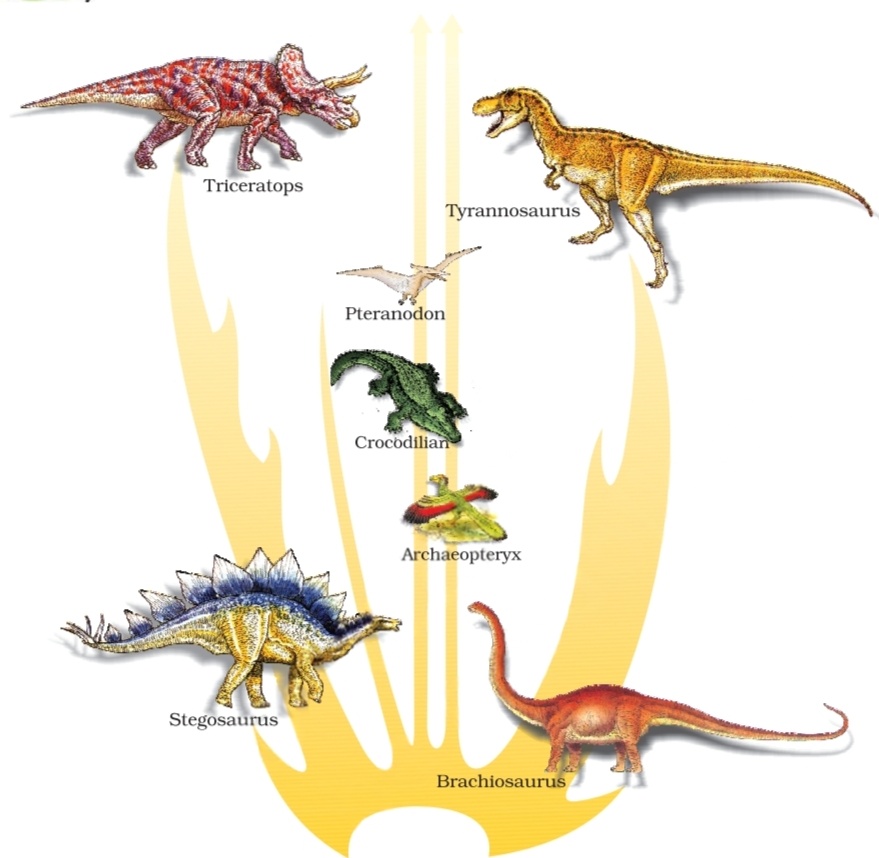
- Q2. What does the branching pattern in the given figure indicate about the relationship among the shown organisms?
- Q3. Match the following : Column I A. Big Bang Theory B. Panspermia C. Spontaneous Generation D. Louis Pasteur E. Oparin and Haldane Column II 1. Life arose from pre-existing non-living organic molecules through chemical evolution 2. Universe originated almost 13.8 billion years ago from a singular huge explosion 3. Life came out of decaying and rotting matter like straw, mud, etc. 4. Demonstrated experimentally that life comes only from pre-existing life 5. Life seeds (spores) were transferred from outer space to Earth
- Q4. Match the following examples with the correct evolutionary relationship: Column I A. Forelimbs of whale, bat, cheetah, and human B. Thorn of Bougainvillea and tendril of Cucurbita C. Wings of butterfly and bird D. Flippers of penguin and dolphin E. Sweet potato and potato Column II 1. Homology in plants 2. Homology in animals 3. Analogy in locomotion 4. Analogy in aquatic adaptation 5. Analogy in storage organ modification
- Q5. Assertion (A): Miller's experiment demonstrated formation of amino acids. Reason (R): He used an oxidising atmosphere to simulate early Earth.
- Q6. Assertion (A): Life came from decaying matter such as straw and mud. Reason (R): Theory of spontaneous generation explains origin of life from non-living matter.
- Q7. Consider the following statements regarding theories of evolution and creation: 1. The theory of special creation states that all living organisms we see today were created as such. 2. According to special creation, diversity has always remained the same since creation and will remain unchanged in future. 3. The theory of special creation also states that the Earth is about 4000 years old. 4. Charles Darwin, during his sea voyage in a ship called H.M.S. Eagle, concluded that existing living forms share similarities with those that lived millions of years ago. 5. Darwin’s conclusions challenged the theory of special creation by providing evidence of gradual evolution of life forms.
- Q8. Arrange the following events in the correct sequence regarding the study of moths in England: 1. Predators picked out white moths against dark tree trunks during industrialisation. 2. In rural areas without industrialisation, the proportion of melanic moths remained low. 3. Before industrialisation, white-winged moths predominated on trees. 4. Dark-winged moths increased in polluted industrial areas due to better camouflage. 5. Tree trunks turned dark because of soot and smoke from industries.
- Q9. Arrange the following events of Miller’s experiment in the correct sequence: 1. Electric discharge was created at 800°C in a closed flask. 2. A mixture of CH₄, H₂, NH₃, and water vapour was introduced. 3. Formation of amino acids and other organic compounds was observed. 4. High temperature, volcanic storms, and reducing atmosphere were simulated.
- Q10. Consider the following statements regarding mechanisms of evolution: 1. According to Hardy–Weinberg principle, allele frequencies in a population remain constant through generations unless disturbed. 2. Gene migration, genetic drift, mutation, genetic recombination, and natural selection can cause changes in allele frequencies. 3. Hugo de Vries proposed that speciation occurs by saltation, i.e., large mutations that are random and directionless. 4. Darwin accepted Mendel’s work on inheritable factors to explain the source of variation in natural selection. 5. Stabilising, directional, and disruptive selection are three patterns by which natural selection operates on traits.
You’ve practised 10 of 310 Evolution questions in this set.
Practise all 310 + every chapter — free app →Sample NEET PYQs — Evolution
Which of the following structures is homologous to the wing of a bird?
- A. Dorsal fin of a shark
- B. Wing of a moth
- C. Hind limb of rabbit
- D. Flipper of whale
Explanation: Answer: (D) Flipper of whale. The wing of a bird and the flipper of a whale are both forelimbs built on the same underlying bone pattern (humerus, radius, ulna, carpals, metacarpals, phalanges); structures with the same anatomical plan inherited from a common ancestor are homologous, regardless of differing function. The moth's wing is an insect structure that only performs a similar function (analogous), the shark's dorsal fin is not a forelimb, and a rabbit's hind limb is a different (posterior) limb. So only the whale flipper is homologous to the bird wing. NCERT Reference: Ch 6 Evolution, p.114, lines 7–13: "share similarities in the pattern of bones of forelimbs ... they have similar anatomical structure – all of them have humerus, radius, ulna, carpals, metacarpals and phalanges in their forelimbs. ... This is divergent evolution and these structures are homologous."
Genetic drift operates in
- A. Small isolated population
- B. Large isolated population
- C. Non-reproductive population
- D. Slow reproductive population
Explanation: Answer: (A) Small isolated population. Genetic drift is random change in allele frequencies by chance, and chance fluctuations have a large effect only when the population (sample) is small and isolated; in large populations such random changes average out. NCERT links genetic drift to chance change and to the founder effect, both of which involve small samples of a population. NCERT Reference: Ch 6 Evolution, p.121, lines 21–24: "If the same change occurs by chance, it is called genetic drift. Sometimes the change in allele frequency is so different in the new sample of population that they become a different species."
Which of the following statements is not true ?
- A. Analogous structures are a result of convergent evolution
- B. Sweet potato and potato is an example of analogy
- C. Homology indicates common ancestry
- D. Flippers of penguins and dolphins are a pair of homologous organs
Explanation: Answer: (D) Flippers of penguins and dolphins are a pair of homologous organs. This statement is the one that is NOT true: flippers of penguins (a bird) and dolphins (a mammal) are anatomically dissimilar structures evolved for the same function in a similar habitat, so they are ANALOGOUS (convergent evolution), not homologous. Options (a), (b) and (c) are all correct: analogous structures result from convergent evolution, sweet potato and potato are an example of analogy, and homology indicates common ancestry. NCERT Reference: Ch 6 Evolution, p.115, lines 11–17: "analogous structures are a result of convergent evolution - different structures evolving for the same function and hence having similarity. Other examples of analogy are the eye of the octopus and of mammals or the flippers of Penguins and Dolphins."
Which of the following is the correct sequence of events in the origin of life? (i) Formation of protobionts (ii) Synthesis of organic monomers (iii) Synthesis of organic polymers (iv) Formation of DNA-based genetic systems
- A. (i), (ii), (iii), (iv)
- B. (i), (iii), (ii), (iv)
- C. (ii), (iii), (i), (iv)
- D. (ii), (iii), (iv), (i)
Explanation: Answer: (C) (ii), (iii), (i), (iv). Chemical evolution proceeds from simple to complex: first organic monomers (amino acids, sugars, nitrogen bases) form from inorganic constituents (Miller's experiment), then these join into organic polymers (proteins, nucleic acids), which aggregate into protobionts (the first self-replicating non-cellular capsules), and finally DNA-based genetic systems arise. So the order is (ii) → (iii) → (i) → (iv). NCERT Reference: Ch 6 Evolution, p.111, lines 30–33: "the first form of life could have come from pre-existing non-living organic molecules ... and that formation of life was preceded by chemical evolution, i.e., formation of diverse organic molecules from inorganic constituents."
Frequently Asked Questions — Evolution NEET
How many questions from Evolution come in NEET?+
How many Evolution questions does MedicNEET have?+
What is the NEET weightage of Evolution?+
Are Evolution questions available in Hindi?+
Are Evolution questions NCERT-based?+
What are ReNEET 2026-style reasoning Evolution questions?+
Are these Evolution MCQs free to practise?+
Practise Evolution — Free
All 495+ Evolution questions · ReNEET 2026 reasoning + every format · Bilingual Hindi & English · NCERT-mapped explanations · No paywall
📲 Download MedicNEET App (Free)