How many questions from Excretory Products and Their Elimination in NEET?
Excretory Products & Their Elimination contributes approximately 3–4 questions per NEET exam (~3% of Biology, 12–16 marks). Must-know topics: nephron structure, GFR (180 L/day filtered), tubular reabsorption/secretion, countercurrent mechanism (loop of Henle + vasa recta), ADH and aldosterone regulation, dialysis, and excretory disorders (renal calculi, glomerulonephritis, uremia). Practice all 440 questions free in bilingual Hindi & English in the MedicNEET app.
Year-wise NEET Questions — Excretory Products and Their Elimination
| Year | Questions | Marks |
|---|---|---|
| NEET 2016 | 1 | 4 |
| NEET 2017 | 2 | 8 |
| NEET 2018 | 3 | 12 |
| NEET 2019 | 5 | 20 |
| NEET 2020 | 4 | 16 |
| NEET 2021 | 1 | 4 |
| NEET 2022 | 1 | 4 |
| NEET 2023 | 8 | 32 |
| NEET 2024 | 2 | 8 |
| NEET 2025 | 2 | 8 |
| NEET 2026 | 2 | 8 |
Practise Excretory Products and Their Elimination MCQs — Free
Every Excretory Products and Their Elimination question format NEET uses, starting with the newest ReNEET 2026-style reasoning MCQs. Tap an option for the answer + NCERT explanation.
✨ Excretory Products and Their Elimination — ReNEET 2026-Style Reasoning Questions
The newest, most exam-current format — reasoning-based questions modelled on ReNEET 2026. This is where NEET is heading; practise the pattern before the exam does.
- Q1. Why is the presence of two kidneys advantageous in humans?
- Q2. Why is the medulla of the kidney important in urine formation?
- Q3. Why is GFR used as a measure of kidney function?
- Q4. 7. What is the consequence of the ascending limb of Henle’s loop being impermeable to water?
- Q5. Why is the descending limb of Henle’s loop crucial in the counter-current system?
- Q6. Which of the following indicates abnormal kidney function when detected in urine?
- Q7. Which of the following would not be useful in diagnosing diabetes mellitus via urine test?
- Q8. Why can micturition be voluntarily delayed for some time despite being a reflex?
- Q9. Which glands eliminate sterols, hydrocarbons, and waxes through sebum?
- Q10. Which of the following is a limitation of hemodialysis compared to natural kidney function?
You’ve practised 10 of 80 Excretory Products and Their Elimination questions in this set.
Practise all 80 + every chapter — free app →📑 Excretory Products and Their Elimination — NEET 2025 & 2026 Long-Form MCQs
The long, multi-statement questions that dominated NEET 2025 & 2026 — each covers 5-6 concepts at once, so they double as fast full-chapter revision.
- Q1. Arrange the following events of the Renin-Angiotensin-Aldosterone System (RAAS) in the correct sequence, starting from a stimulus that initiates the pathway: I. Activation of adrenal cortex II. Fall in glomerular blood pressure III. Release of renin by JG cells IV. Vasoconstriction of afferent arterioles V. Conversion of angiotensinogen to angiotensin I VI. Conversion of angiotensin I to angiotensin II VII. Increased reabsorption of Na+ and water in distal tubule
- Q2. A patient exhibits symptoms of polyuria (excessive urination) and polydipsia (excessive thirst) due to a deficiency in ADH secretion. Which of the following statements correctly describe the physiological consequences in this patient? S1: Water reabsorption in the collecting duct and DCT would be significantly reduced. S2: The individual would produce a large volume of hypertonic urine. S3: Plasma osmolarity would increase, stimulating osmoreceptors and causing thirst. S4: The kidneys would compensate by increasing the glomerular filtration rate (GFR). S5: The counter-current mechanism for establishing the medullary gradient would be completely abolished.
- Q3. Match the following clinical findings/disorders in Column I with their correct characteristics/indications in Column II: Column I (Clinical Finding/Disorder) (a) Glycosuria (b) Ketonuria (c) Uremia (d) Renal calculi (e) Glomerulonephritis Column II (Characteristic/Indication) (i) Stone or insoluble mass of crystallised salts formed within the kidney (ii) Inflammation of glomeruli of kidney (iii) Accumulation of urea in blood (iv) Presence of glucose in urine (v) Presence of ketone bodies in urine Which of the following options correctly matches the columns?
- Q4. Match the following organs with their primary excretory contribution and the potential consequences of their impaired function: Column I: Organ A. Liver B. Kidneys C. Lungs D. Skin (Sweat glands) Column II: Primary Excretory Contribution i. Secretion of bile containing bilirubin, cholesterol, degraded steroid hormones ii. Elimination of nitrogenous wastes like urea and regulation of ionic/water balance iii. Removal of CO2 and water vapour iv. Excretion of NaCl, small amounts of urea, lactic acid Column III: Potential Accumulation if Function is Impaired p. Jaundice, accumulation of degraded steroid hormones q. Hypercapnia, respiratory acidosis r. Uremia, electrolyte imbalance, fluid overload s. Excessive body heat, accumulation of small amounts of urea and salts Choose the correct match:
You’ve practised 4 of 78 Excretory Products and Their Elimination questions in this set.
Practise all 78 + every chapter — free app →🧩 Excretory Products and Their Elimination — All-Format Questions — Match, Assertion-Reason, Statement & Image-Based
Every question format NEET uses — match-the-column, assertion-reason, statement-based, and image/diagram questions — not just plain MCQs. Each with an instant NCERT-referenced solution.
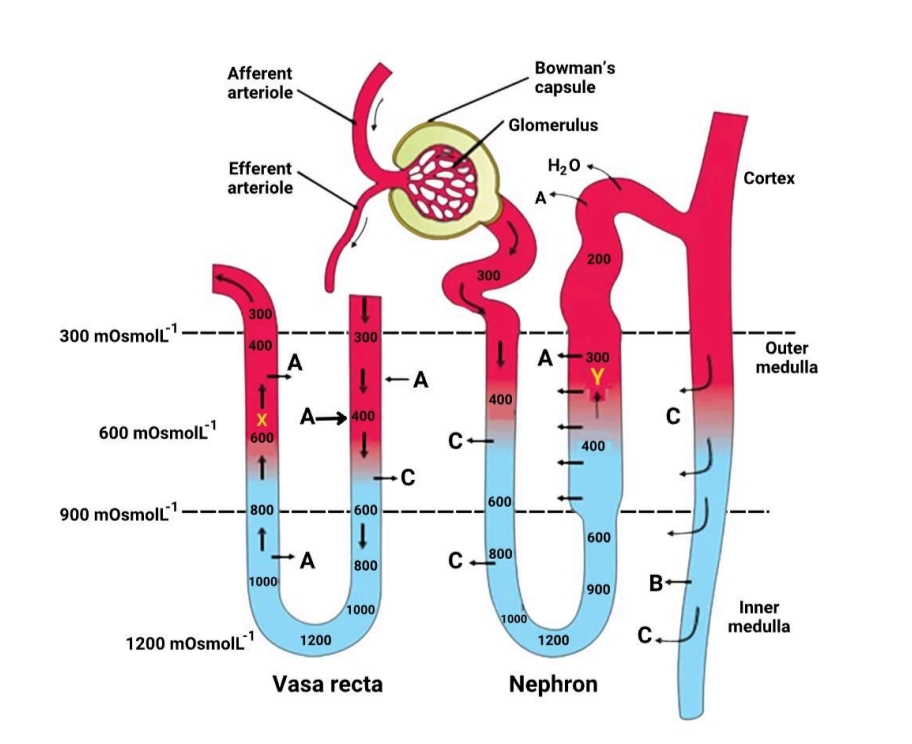
- Q1. In the given figure of counter-current mechanism between nephron and vasa recta, the labels A, B and C indicate movement of certain substances. Identify them correctly
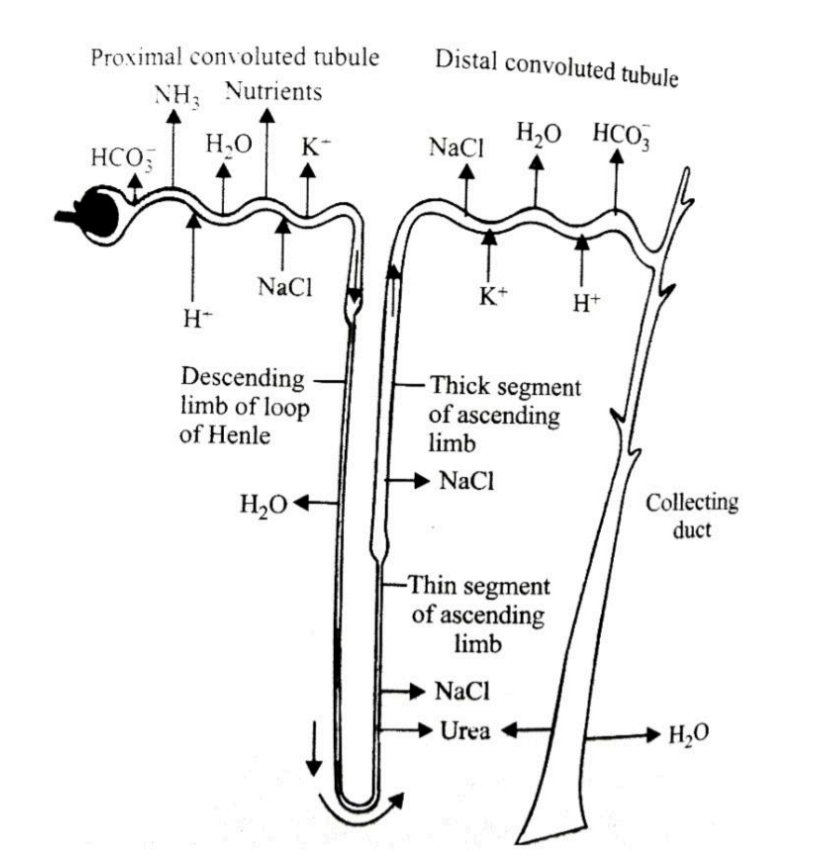
- Q2. The given figure shows reabsorption and secretion of major substances at different parts of the nephron. The movement of which of the following substances is wrongly depicted?
- Q3. Match the excretory disorders with their correct descriptions: Column I A. Uremia B. Renal calculi C. Glomerulonephritis D. Diabetes insipidus Column II i. Presence of urea in blood due to kidney failure ii. Inflammation of glomeruli of kidney iii. Formation of stone or insoluble mass of salts in kidney iv. Excretion of large volumes of dilute urine due to ADH deficiency
- Q4. Match the parts of an artificial kidney with their functions: Column I A. Dialysing fluid B. Cellophane membrane C. Heparin injection D. Shunt Column II i. Maintains osmotic concentration similar to plasma but free of nitrogenous wastes ii. Prevents blood clotting during dialysis iii. Provides semipermeable surface for diffusion iv. Connects patient’s artery to dialyzer
- Q5. Assertion (A): Renin release occurs in response to low glomerular filtration rate (GFR). Reason (R): Renin increases water excretion.
- Q6. Assertion (A): Antidiuretic hormone (ADH) increases reabsorption of water in the kidney. Reason (R): ADH decreases the permeability of the collecting duct.
- Q7. Arrange the following structures of the kidney in correct sequence from outermost to innermost: 1. Cortex 2. Capsule 3. Medulla 4. Renal pelvis
- Q8. Which of the following statements regarding urine formation are correct? 1. On average, 1100–1200 ml of blood is filtered per minute by the kidneys. 2. Glomerular filtration occurs through three layers – endothelium, basement membrane, and podocyte epithelium. 3. GFR in a healthy human is approximately 250 ml/min (~360 L/day). 4. Juxta glomerular apparatus (JGA) can release renin to restore GFR during a fall. 5. Nearly 99% of the filtrate is reabsorbed, while tubular secretion helps maintain ionic and acid-base balance.
- Q9. Arrange the following events in the correct sequence of their occurrence during urine formation in a nephron: 1. Selective secretion of H⁺ and K⁺ ions into the filtrate in the distal convoluted tubule. 2. Small amounts of urea diffuse into the medullary interstitium from the collecting duct to maintain osmolarity. 3. Active reabsorption of glucose, amino acids, Na⁺ and majority of electrolytes in the proximal convoluted tubule. 4. Passive reabsorption of water in the descending limb of Henle’s loop. 5. Active reabsorption of NaCl in the thick ascending limb of Henle’s loop (impermeable to water).
- Q10. Which of the following statements about counter-current mechanism are correct? 1. The osmolarity of medullary interstitium rises from 300 mOsmol L⁻¹ in the cortex to 1200 mOsmol L⁻¹ in the inner medulla. 2. NaCl is actively transported out of the ascending limb of Henle’s loop into medullary interstitium. 3. The descending limb is permeable to electrolytes but impermeable to water. 4. Urea from the collecting duct diffuses into the medullary interstitium and helps maintain osmolarity. 5. Vasa recta maintains the medullary gradient by counter-current exchange of solutes and water.
You’ve practised 10 of 242 Excretory Products and Their Elimination questions in this set.
Practise all 242 + every chapter — free app →Sample NEET PYQs — Excretory Products and Their Elimination
The part of nephron involved in active reabsorption of sodium is
- A. Distal convoluted tubule
- B. Proximal convoluted tubule
- C. Bowman's capsule
- D. Descending limb of Henle's loop
Explanation: Answer: (B) Proximal convoluted tubule (PCT). Solution: Reabsorption of Na+ (sodium) by active transport is a key function of the PCT, which is lined by a brush-border epithelium that increases surface area. The PCT reabsorbs nearly all essential nutrients and 70-80% of electrolytes and water. The descending/ascending limbs of Henle's loop and Bowman's capsule are not the primary site of active Na+ reabsorption. NCERT Reference: Ch 16, p.209, lines 28-31 — "Proximal Convoluted Tubule (PCT): PCT is lined by simple cuboidal brush border epithelium which increases the surface area for reabsorption. Nearly all of the essential nutrients, and 70-80 per cent of electrolytes and water are reabsorbed by this segment."
A decrease in blood pressure/volume will not cause the release of
- A. Renin
- B. Atrial Natriuretic Factor
- C. Aldosterone
- D. ADH
Explanation: Answer: (B) Atrial Natriuretic Factor (ANF). Solution: A fall in blood pressure/volume triggers the renin-angiotensin system (renin from JG cells, then angiotensin II, then aldosterone) and ADH release to conserve water and raise BP. ANF works oppositely: it is released when blood flow/volume to the atria INCREASES, causing vasodilation to lower BP. Hence a DECREASE in BP/volume will not cause ANF release. NCERT Reference: Ch 16, p.212, lines 33-35 — "An increase in blood flow to the atria of the heart can cause the release of Atrial Natriuretic Factor (ANF). ANF can cause vasodilation (dilation of blood vessels) and thereby decrease the blood pressure."
Which of the following statements is correct?
- A. The ascending limb of loop of Henle is impermeable to water
- B. The descending limb of loop of Henle is impermeable to water
- C. The ascending limb of loop of Henle is permeable to water
- D. The descending limb of loop of Henle is permeable to electrolytes
Explanation: Answer: (A) The ascending limb of loop of Henle is impermeable to water. Solution: In the loop of Henle, the descending limb is permeable to water but almost impermeable to electrolytes, so the filtrate concentrates moving down. The ascending limb is the reverse — impermeable to water but allows transport of electrolytes, so the filtrate gets diluted moving up. This makes only option A correct. NCERT Reference: Ch 16, p.209, lines 38-41 — "The descending limb of loop of Henle is permeable to water but almost impermeable to electrolytes... The ascending limb is impermeable to water but allows transport of electrolytes actively or passively."
Match the items given in Column I with those in Column II and select the correct option given below: Column I (Function) a. Ultrafiltration b. Concentration of urine c. Transport of urine d. Storage of urine Column II (Part of Excretory system) i. Henle's loop ii. Ureter iii. Urinary bladder iv. Malpighian corpuscle v. Proximal convoluted tubule
- A. a-v, b-iv, c-i, d-ii
- B. a-iv, b-i, c-ii, d-iii
- C. a-iv, b-v, c-ii, d-iii
- D. a-v, b-iv, c-i, d-iii
Explanation: Answer: (B) a-iv, b-i, c-ii, d-iii. Solution: Ultrafiltration (a) occurs at the Malpighian corpuscle/renal corpuscle (iv) where blood is finely filtered through the glomerulus and Bowman's capsule. Concentration of urine (b) involves Henle's loop (i). Transport of urine (c) is by the ureter (ii), and storage of urine (d) is in the urinary bladder (iii). NCERT Reference: Ch 16, p.208, lines 41-46 — "The epithelial cells of Bowman’s capsule called podocytes... Therefore, it is considered as a process of ultra filtration."; p.212, lines 39-41 — "Urine formed by the nephrons is ultimately carried to the urinary bladder where it is stored".
Frequently Asked Questions — Excretory Products and Their Elimination NEET
How many questions come from Excretory Products in NEET?+
How many Excretory Products questions does MedicNEET have?+
What is the NEET weightage of Excretory Products and Their Elimination?+
Are Excretory Products questions NCERT-based?+
Can I practice Excretory Products questions in Hindi?+
What are ReNEET 2026-style reasoning Excretory Products and Their Elimination questions?+
Are these Excretory Products and Their Elimination MCQs free to practise?+
Practise Excretory Products and Their Elimination — Free
All 400+ Excretory Products and Their Elimination questions · ReNEET 2026 reasoning + every format · Bilingual Hindi & English · NCERT-mapped explanations · No paywall
📲 Download MedicNEET App (Free)