Year-wise NEET Questions — Human Health and Diseases
| Year | Questions | Marks |
|---|---|---|
| NEET 2016 | 6 | 24 |
| NEET 2017 | 2 | 8 |
| NEET 2018 | 3 | 12 |
| NEET 2019 | 7 | 28 |
| NEET 2020 | 3 | 12 |
| NEET 2021 | 3 | 12 |
| NEET 2022 | 2 | 8 |
| NEET 2023 | 6 | 24 |
| NEET 2024 | 6 | 24 |
| NEET 2025 | 5 | 20 |
| NEET 2026 | 7 | 28 |
Practise Human Health and Diseases MCQs — Free
Every Human Health and Diseases question format NEET uses, starting with the newest ReNEET 2026-style reasoning MCQs. Tap an option for the answer + NCERT explanation.
✨ Human Health and Diseases — ReNEET 2026-Style Reasoning Questions
The newest, most exam-current format — reasoning-based questions modelled on ReNEET 2026. This is where NEET is heading; practise the pattern before the exam does.
- Q1. Why is it essential to use wire meshes on windows and doors in mosquito-prone areas?
- Q2. Why is it dangerous for food to be exposed in fly-infested areas?
- Q3. Why is malaria associated with periodic high fever and chills rather than continuous fever?
- Q4. What explains the increasing cases of asthma in urban children?
- Q5. Why is secondary immune response more intense than primary response?
- Q6. Why does passive immunity act faster than active immunity?
- Q7. What is the reason for using awareness campaigns as a primary control strategy in India?
- Q8. Why is chemotherapy often combined with surgery or radiotherapy?
- Q9. Why are benign tumours less harmful than malignant tumours?
- Q10. Why is needle sharing among drug addicts highly discouraged?
You’ve practised 10 of 74 Human Health and Diseases questions in this set.
Practise all 74 + every chapter — free app →📑 Human Health and Diseases — NEET 2025 & 2026 Long-Form MCQs
The long, multi-statement questions that dominated NEET 2025 & 2026 — each covers 5-6 concepts at once, so they double as fast full-chapter revision.
- Q1. Which of the following statements are correct regarding ringworm infections? S1: Ringworms are caused by certain helminths belonging to genera like Microsporum, Trichophyton, and Epidermophyton. S2: They produce dry, scaly lesions on various parts of the body such as skin, nails, and scalp, accompanied by intense itching. S3: Conditions like heat and moisture favour the growth of these pathogens, making skin folds like the groin and between the toes common sites of infection. S4: Transmission typically occurs through airborne droplets released by infected individuals. S5: Maintaining personal hygiene, including keeping the body clean and dry, is essential for prevention and control of ringworm.
- Q2. Match the following types of immunity in Column I with their mechanism/characteristic in Column II and a suitable example in Column III. Column I A. Natural Active Immunity B. Artificial Active Immunity C. Natural Passive Immunity D. Artificial Passive Immunity Column II i. Immediate, short-lived protection without memory cell formation ii. Long-term protection involving the host's immune system after natural exposure iii. Long-term protection involving host's immune system after deliberate antigen introduction iv. Immediate, temporary protection acquired from maternal antibodies Column III p. Administration of Hepatitis B vaccine q. Recovery from a natural viral infection like chickenpox r. Transplacental transfer of IgG antibodies from mother to foetus s. Injection of anti-tetanus serum after an injury
- Q3. Which of the following statements about retroviruses, specifically HIV, are correct? S1: Retroviruses possess a DNA genome that directly integrates into the host's nuclear DNA. S2: The enzyme reverse transcriptase is unique to retroviruses and is crucial for their replication cycle. S3: All retroviruses primarily infect helper T-lymphocytes, causing immunodeficiency. S4: The replication of HIV involves the formation of viral particles by the host cell's machinery after viral DNA integration. S5: Retroviruses like HIV are characterized by having an envelope around their genetic material.
- Q4. Match the following diagnostic and treatment methods (Column I) with their key principles or applications (Column II). Column I (Method/Technique) A. Biopsy B. Computed Tomography (CT) C. Alpha-interferon D. Chemotherapy E. Radiotherapy F. ELISA Column II (Key Principle/Application) i. Detection of specific antigens or antibodies in serum. ii. Use of X-rays to generate a three-dimensional image of internal organs. iii. Microscopic examination of thin sections of suspected tissue. iv. Administration of biological response modifiers to activate the immune system. v. Utilisation of ionising radiations to lethally damage tumor cells. vi. Systemic use of drugs that preferentially kill rapidly dividing cells.
You’ve practised 4 of 55 Human Health and Diseases questions in this set.
Practise all 55 + every chapter — free app →🧩 Human Health and Diseases — All-Format Questions — Match, Assertion-Reason, Statement & Image-Based
Every question format NEET uses — match-the-column, assertion-reason, statement-based, and image/diagram questions — not just plain MCQs. Each with an instant NCERT-referenced solution.
- Q1. Which diagram correctly depicts the structure of an antibody?
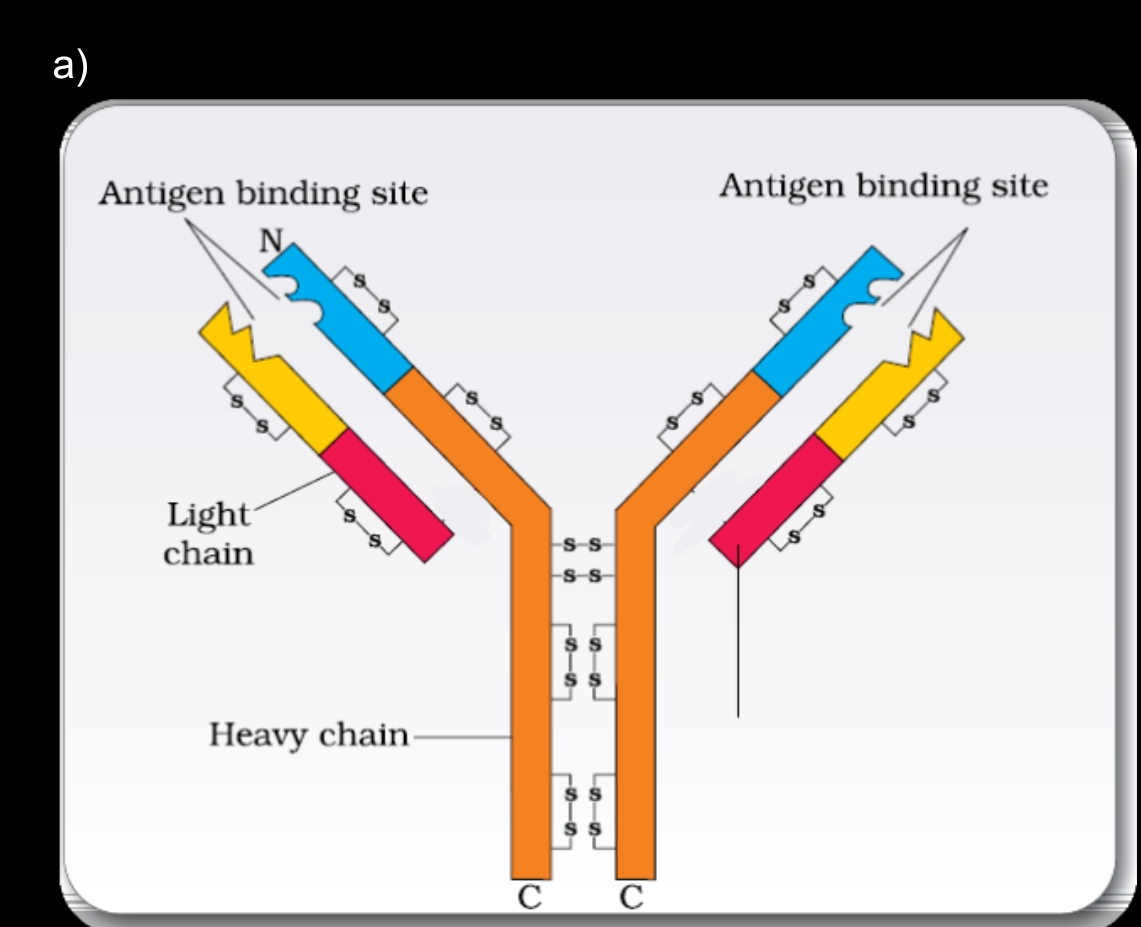
- Q2. Match the diseases with their corresponding causative agents:
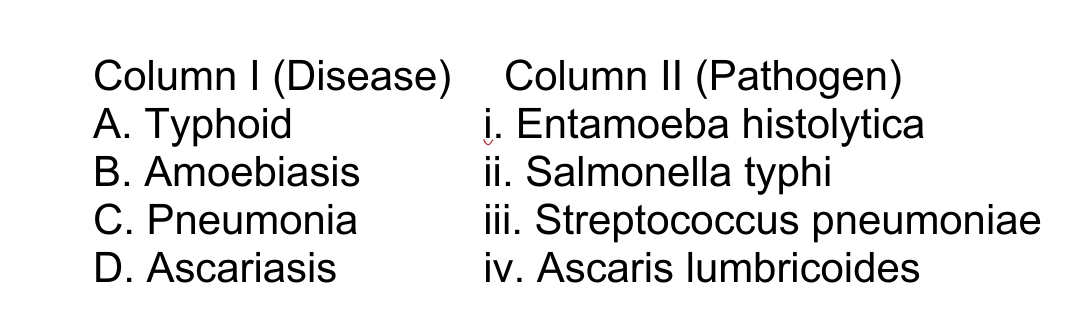
- Q3. Match the following pathogens with the diseases or diagnostic tests associated with them: Column I A. Salmonella typhi B. Streptococcus pneumoniae C. Plasmodium falciparum D. Entamoeba histolytica E. Haemophilus influenzae Column II 1. Pneumonia with fluid-filled alveoli, lips and nails turning bluish 2. Amoebic dysentery with blood and mucous in stools, transmitted by houseflies 3. Malignant malaria with periodic chills and fever 4. Infection confirmed by Widal test 5. Respiratory infection acquired by sharing glasses and utensils
- Q4. Match the following: Column I A. Health definition B. Yoga C. Vaccination and hygiene D. Infectious diseases E. Non-infectious diseases Column II 1. Achieve physical and mental well-being since ancient times 2. State of complete physical, mental, and social well-being 3. Transmitted easily from one person to another; e.g., AIDS 4. Cancer, drug, and alcohol abuse as major causes of death 5. Awareness, immunisation, waste disposal, vector control
- Q5. Assertion (A): Ascariasis can cause blockage in the intestinal passage. Reason (R): Ascaris is a flatworm that absorbs host's nutrients rapidly.
- Q6. Assertion (A): Filarial worms can survive in human lymphatic vessels for years. Reason (R): Their larvae feed on human RBCs and multiply in blood plasma.
- Q7. Consider the following statements about acquired immunity: 1. It is pathogen-specific and characterised by memory. 2. Primary immune response is of high intensity while secondary response is weaker. 3. T-lymphocytes mediate cell-mediated immunity (CMI). 4. Antibody structure consists of two light and two heavy peptide chains, represented as H₂L₂. 5. Antibody-mediated response is also called humoral immune response. Which of the above statements are correct?
- Q8. Consider the following statements: 1. Biology progressed slower than physics and chemistry in terms of formalised scientific development. 2. Discoveries like antibiotics, plant-derived drugs, and anaesthetics improved both medical practice and human health. 3. Twentieth and twenty-first centuries showed reduced utility of biological knowledge compared to earlier times. 4. Agricultural practices, food processing, and diagnostics brought socio-cultural changes in communities. 5. M.S. Swaminathan collaborated with Norman Borlaug to introduce Mexican varieties of wheat in India, initiating the Green Revolution. Which of the above statements are correct?
- Q9. Consider the following: 1. Morphine derived from Papaver somniferum latex is a strong analgesic. 2. Cocaine interferes with dopamine transport and causes hallucinations at high doses. 3. Biological response modifiers like α-interferon are used in cancer therapy. 4. Adolescents are less vulnerable to drug addiction due to strong mental resilience. 5. Anabolic steroid abuse may cause masculinisation in females and testicular shrinkage in males. Which of the above are correct?
- Q10. 1. Colostrum provides IgA antibodies to infants, an example of passive immunity. 2. ELISA test is commonly used for detection of cancer in early stages. 3. Anti-histamines, adrenaline, and steroids reduce symptoms of allergic reactions. 4. Lymphoid organs such as thymus and bone marrow are primary sites for lymphocyte maturation. 5. Smoking increases CO in blood, reducing haemoglobin’s oxygen-carrying capacity. Which are correct?
You’ve practised 10 of 260 Human Health and Diseases questions in this set.
Practise all 260 + every chapter — free app →Sample NEET PYQs — Human Health and Diseases
Asthma may be attributed to:
- A. Bacterial infection of the lungs
- B. Allergic reaction of the mast cells in the lungs
- C. Inflammation of the trachea
- D. Accumulation of fluid in the lung
Explanation: Answer: (B) Allergic reaction of the mast cells in the lungs Solution: Asthma is an allergic/hypersensitivity condition. NCERT states that allergy is due to the release of chemicals like histamine and serotonin from the mast cells, and that more and more children in metro cities suffer from allergies and asthma due to sensitivity to the environment. The exaggerated immune response to environmental allergens (with IgE antibodies) acting on mast cells in the airways causes the wheezing/breathing difficulty of asthma. Why not the others: It is not a bacterial infection of the lungs (that would be pneumonia), nor inflammation of the trachea, nor fluid accumulation (which describes pneumonia where alveoli fill with fluid). NCERT Reference: NCERT Ch7, p.137, lines 16, 22-23: "Allergy is due to the release of chemicals like histamine and serotonin from the mast cells"
In higher vertebrates, the immune system can distinguish self-cells and non-self. If this property is lost due to genetic abnormality and it attacks self-cells, then it leads to:
- A. Allergic response
- B. Graft rejection
- C. Auto-immune disease
- D. Active immunity
Explanation: Answer: (C) Auto-immune disease Solution: NCERT explains that memory-based acquired immunity in higher vertebrates is based on the ability to differentiate self-cells from foreign organisms. When, due to genetic and other unknown reasons, the body attacks self-cells, it results in damage and is called auto-immune disease (e.g., rheumatoid arthritis). Why not the others: An allergic response is an exaggerated reaction to external antigens, not self-cells; graft rejection is a cell-mediated response against non-self transplanted tissue; active immunity is protection developed after exposure to antigens. NCERT Reference: NCERT Ch7, p.137, lines 31-33: "the body attacks self-cells. This results in damage to the body and is called auto-immune disease"
Antivenom injection contains preformed antibodies while polio drops that are administered into the body contain:
- A. Activated pathogens
- B. Harvested antibodies
- C. Gamma globulin
- D. Attenuated pathogens
Explanation: Answer: (D) Attenuated pathogens Solution: Antivenom contains ready-made (preformed) antibodies, giving passive immunity. In contrast, a vaccine such as the oral polio drops introduces a preparation of antigenic proteins or an inactivated/weakened (attenuated) pathogen into the body, so the body itself produces antibodies and memory cells — this is active immunity. Why not the others: They are not activated/virulent live pathogens (the vaccine strain is weakened); harvested antibodies and gamma globulin describe passive immunity (like the antivenom), which is exactly what polio drops are NOT. NCERT Reference: NCERT Ch7, p.136, lines 27-28: "a preparation of antigenic proteins of pathogen or inactivated/weakened pathogen (vaccine) are introduced into the body"
Which of the following statements is not true for cancer cells in relation to mutations?
- A. Mutations in proto-oncogenes accelerate the cell cycle
- B. Mutations destroy telomerase inhibitor
- C. Mutations inactivate the cell control
- D. Mutations inhibit production of telomerase
Explanation: Answer: (D) Mutations inhibit production of telomerase Solution: The question asks which statement is NOT true. Cancer cells become 'immortal' by reactivating/overexpressing telomerase, which keeps telomeres long and lets the cells divide endlessly; mutations therefore INCREASE (not inhibit) telomerase production. So option D is the false statement and is the correct answer. NCERT notes that in cancer cells there is a breakdown of growth-regulatory mechanisms and that proto-oncogenes, when activated, lead to oncogenic transformation. Why the others are true: mutations activating proto-oncogenes accelerate the cell cycle; loss of cell-cycle control (regulation) is a hallmark of cancer; destruction of a telomerase inhibitor would also raise telomerase activity. These are all true of cancer cells, making D the exception. NCERT Reference: NCERT Ch7, p.141, lines 8, 30-33: "proto oncogenes have been identified in normal cells which, when activated under certain conditions, could lead to oncogenic transformation"
Frequently Asked Questions — Human Health and Diseases NEET
How many Human Health and Disease questions does MedicNEET have?+
What is the NEET weightage of Human Health and Disease?+
Are Human Health and Disease questions NCERT-based?+
What are ReNEET 2026-style reasoning Human Health and Diseases questions?+
Are these Human Health and Diseases MCQs free to practise?+
Practise Human Health and Diseases — Free
All 389+ Human Health and Diseases questions · ReNEET 2026 reasoning + every format · Bilingual Hindi & English · NCERT-mapped explanations · No paywall
📲 Download MedicNEET App (Free)