How many questions from Human Reproduction in NEET?
3–4 questions from Human Reproduction appear in NEET every year (12–16 marks, ~5% of NEET Biology). Key topics: gametogenesis (spermatogenesis & oogenesis), menstrual cycle, fertilisation and embryo development, pregnancy and parturition. MedicNEET is the only app with all Human Reproduction PYQs in bilingual Hindi & English — practice free in timed exam mode.
Year-wise NEET Questions — Human Reproduction
| Year | Questions | Marks |
|---|---|---|
| NEET 2016 | 6 | 24 |
| NEET 2017 | 3 | 12 |
| NEET 2018 | 4 | 16 |
| NEET 2019 | 6 | 24 |
| NEET 2020 | 3 | 12 |
| NEET 2021 | 3 | 12 |
| NEET 2022 | 3 | 12 |
| NEET 2023 | 4 | 16 |
| NEET 2024 | 3 | 12 |
| NEET 2025 | 4 | 16 |
| NEET 2026 | 7 | 28 |
Practise Human Reproduction MCQs — Free
Every Human Reproduction question format NEET uses, starting with the newest ReNEET 2026-style reasoning MCQs. Tap an option for the answer + NCERT explanation.
✨ Human Reproduction — ReNEET 2026-Style Reasoning Questions
The newest, most exam-current format — reasoning-based questions modelled on ReNEET 2026. This is where NEET is heading; practise the pattern before the exam does.
- Q1. Why does the urethra serve dual functions in males?
- Q2. How does the prostate gland aid in male reproduction?
- Q3. Why do mammary glands open externally through nipples?
- Q4. Why is the endometrium important in reproduction?
- Q5. Why is it correct to say that female gamete development is completed after fertilisation?
- Q6. Why does spermatogenesis begin only at puberty in males?
- Q7. Why does the endometrium undergo breakdown at the end of the menstrual cycle?
- Q8. Why must the blastocyst implant in the uterus and not elsewhere?
- Q9. Why does the foetal heart develop as early as the end of the first month?
- Q10. Why is it important for newborns to be breastfed in the first few days after birth?
You’ve practised 10 of 93 Human Reproduction questions in this set.
Practise all 93 + every chapter — free app →📑 Human Reproduction — NEET 2025 & 2026 Long-Form MCQs
The long, multi-statement questions that dominated NEET 2025 & 2026 — each covers 5-6 concepts at once, so they double as fast full-chapter revision.
- Q1. Arrange the following structures in the correct sequence of sperm transport from their site of production to the external opening. 1. Vas deferens 2. Rete testis 3. Ejaculatory duct 4. Seminiferous tubules 5. Epididymis 6. Urethral meatus
- Q2. Which statements are true regarding the female reproductive system and its processes? S1. Fimbriae are finger-like projections directly attached to the ovarian surface to firmly hold the ovum. S2. The endometrium, being the inner glandular layer of the uterus, is responsible for undergoing cyclical changes during the menstrual cycle. S3. The cervical canal, formed by the cervix, serves as a passage connecting the uterus to the vagina, thus forming part of the birth canal. S4. The uterus is a self-supporting organ that does not require external ligamentous attachments to maintain its position in the pelvic cavity. S5. The corpus luteum's secretion of estrogen is primarily responsible for maintaining the endometrium during pregnancy.
- Q3. Which of the following statements accurately describe the events and hormonal profile during the luteal phase of the menstrual cycle? S1: The luteal phase begins immediately after the LH surge, marking the transformation of the primary follicle into the Graafian follicle. S2: The corpus luteum, formed from the ruptured Graafian follicle, primarily secretes high levels of progesterone. S3: Progesterone secreted during this phase prepares the uterine endometrium for potential implantation of a fertilised ovum. S4: In the absence of fertilisation, the corpus luteum degenerates, leading to a drop in progesterone levels and subsequent disintegration of the endometrium. S5: Both LH and FSH levels remain at their peak throughout the luteal phase to sustain the activity of the corpus luteum.
- Q4. Which of the following statements are correct regarding the process and requirements of fertilisation in humans? S1: Fertilisation typically occurs in the infundibulum of the fallopian tube. S2: For successful fertilisation, sperms and ovum must be transported simultaneously to the ampullary region. S3: The acrosome of the sperm contains enzymes that facilitate the entry of sperm into the ovum. S4: After fertilisation, the zygote immediately undergoes meiotic divisions to form a morula. S5: The zona pellucida of the ovum plays a crucial role in preventing polyspermy.
You’ve practised 4 of 89 Human Reproduction questions in this set.
Practise all 89 + every chapter — free app →🧩 Human Reproduction — All-Format Questions — Match, Assertion-Reason, Statement & Image-Based
Every question format NEET uses — match-the-column, assertion-reason, statement-based, and image/diagram questions — not just plain MCQs. Each with an instant NCERT-referenced solution.
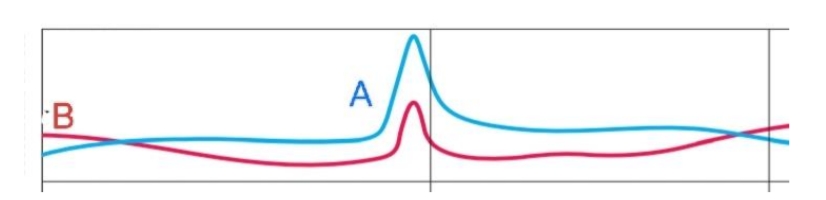
- Q1. The given graph shows the levels of two pituitary hormones (A and B) during the menstrual cycle. Identify them and match correctly with their functions. Column I (Hormone) A. LH B. FSH C. Estrogen D. Progesterone Column II (Function) 1. Maintains endometrium in luteal phase 2. Stimulates growth of ovarian follicles and secretion of estrogen 3. Causes proliferation of endometrium during follicular phase 4. Induces ovulation and formation of corpus luteum
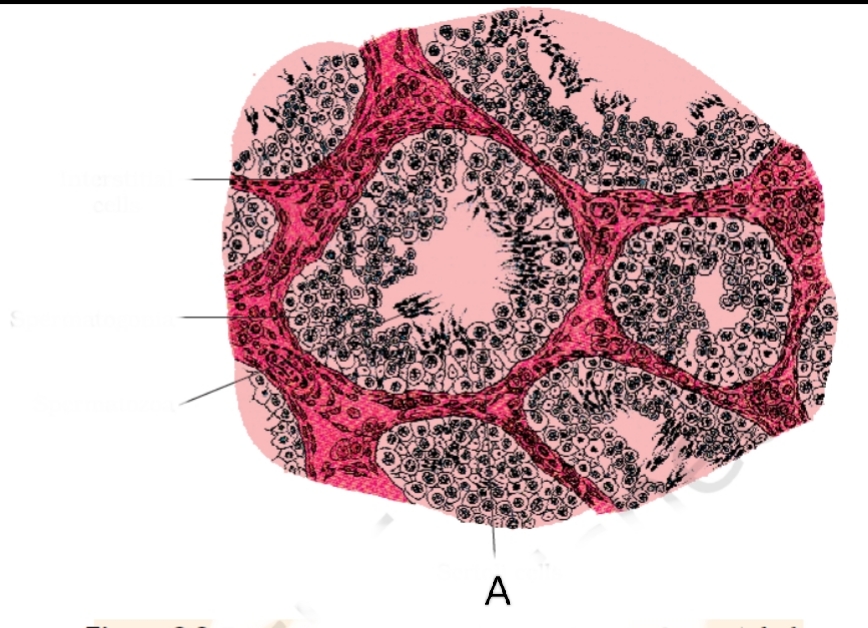
- Q2. In the diagram shown which cells are labeled as A?
- Q3. Match the columns Column I A. Ovarian epithelium B. Cortex C. Medulla D. Ligaments E. Graafian follicle Column II 1. Peripheral stroma zone 2. Inner stroma zone 3. Encloses ovarian stroma 4. Connects ovary to uterus & pelvic wall 5. Mature follicle releasing secondary oocyte
- Q4. Match the columns Column I A. Infundibulum B. Fimbriae C. Ampulla D. Isthmus E. Uterus Column II 1. Finger-like projections collecting ovum 2. Funnel-shaped part near ovary 3. Wider region of tube 4. Narrow lumen joining uterus 5. Pear-shaped organ supported by ligaments
- Q5. Assertion (A): Sertoli cells are found in the lumen of seminiferous tubules. Reason (R): Sertoli cells secrete testosterone in response to LH.
- Q6. Assertion (A): Leydig cells are responsible for synthesising androgens. Reason (R): Leydig cells are located inside the seminiferous tubules.
- Q7. Which of the following statements are correct? 1. Occurs in female primates 2. Menarche = first menstruation 3. Avg interval = 28/29 days 4. Ovulation occurs at beginning of cycle 5. Cycle is from one menstruation to next
- Q8. Which of the following statements are correct? 1. No oogonia added after birth 2. At puberty ~60,000–80,000 primary follicles remain in each ovary 3. Tertiary follicle has antrum; theca interna & externa 4. First meiotic division produces two equal haploid cells 5. Zona pellucida forms around secondary oocyte before ovulation
- Q9. Classify the following structures of the female reproductive system into their correct groups: Ovaries, oviducts, uterus, cervix, vagina, mons pubis, labia majora, labia minora, hymen, clitoris, mammary glands Groups: A. Primary sex organs B. Accessory ducts C. External genitalia D. Secondary sexual characters
- Q10. Arrange the following structures in the correct sequence for the passage of sperms from the testis to the external opening in humans: A. Rete testis B. Vas deferens C. Epididymis D. Vasa efferentia E. Urethral meatus F. Seminiferous tubules
You’ve practised 10 of 323 Human Reproduction questions in this set.
Practise all 323 + every chapter — free app →Sample NEET PYQs — Human Reproduction
Identify the correct statement on 'inhibin':
- A. Inhibits the secretion of LH, FSH and Prolactin
- B. Is produced by granulose cells in ovary and inhibits the secretion of FSH
- C. Is produced by granulose cells in ovary and inhibits the secretion of LH
- D. Is produced by nurse cells in testes and inhibits the secretion of LH
Explanation: Answer: (B) Is produced by granulose cells in ovary and inhibits the secretion of FSH Solution: Inhibin is a hormone secreted by the granulosa cells of the ovary (and by Sertoli cells in males) and it specifically suppresses FSH secretion as part of feedback control. The NCERT chapter prose introduces granulosa cells surrounding the oocyte; the inhibin-FSH feedback detail is a NEET-extension point built on this, and option B alone correctly pairs the source (granulosa cells) with the target hormone (FSH). NCERT Reference: Ch 2, p.32, line 36 — "Each primary oocyte then gets surrounded by a"
Fertilization in humans is practically feasible only if:
- A. The sperms are transported into vagina just after the release of ovum in fallopian tube
- B. The ovum and sperms are transported simultaneously to ampullary - isthmic junction of the fallopian tube
- C. The ovum and sperms are transported simultaneously to ampullary - isthmic junction of the cervix
- D. The sperms are transported into cervix within 48 hrs. of release of ovum in uterus
Explanation: Answer: (B) The ovum and sperms are transported simultaneously to ampullary - isthmic junction of the fallopian tube Solution: Both the ovum and the motile sperms must reach the ampullary region of the fallopian tube at the same time for fusion to occur; this is why not every copulation results in fertilisation. Options naming the cervix or uterus as the fertilisation site are wrong, since fertilisation occurs at the ampullary-isthmic junction of the fallopian tube. NCERT Reference: Ch 2, p.35, line 28 — "Fertilisation can only occur if the ovum and sperms are transported simultaneously to the ampullary region."
Several hormones like hCG, hPL, estrogen, progesterone are produced by
- A. Ovary
- B. Placenta
- C. Fallopian tube
- D. Pituitary
Explanation: Answer: (B) Placenta Solution: After implantation the placenta acts as an endocrine tissue and produces hormones including human chorionic gonadotropin (hCG), human placental lactogen (hPL), estrogens and progestogens. Hence all the listed hormones are produced by the placenta, not the ovary, fallopian tube or pituitary. NCERT Reference: Ch 2, p.37, line 23 — "Placenta also acts as an endocrine tissue and produces"
Which of the following depicts the correct pathway of transport of sperms? (NEET 2016 Phase-2)
- A. Rete testis → Efferent ductules → Epididymis → Vas deferens
- B. Rete testis → Epididymis → Efferent ductules → Vas deferens
- C. Rete testis → Vas deferens → Efferent ductules → Epididymis
- D. Efferent ductules → Rete testis → Vas deferens → Epididymis
Explanation: Answer: (A) Rete testis → Efferent ductules → Epididymis → Vas deferens Solution: Sperms made in the seminiferous tubules open into the vasa efferentia (efferent ductules) through the rete testis; the vasa efferentia open into the epididymis, which then leads to the vas deferens. This fixes the order as rete testis → efferent ductules → epididymis → vas deferens. NCERT Reference: Ch 2, p.27, line 42 — "the testis open into the vasa efferentia through rete testis. The vasa efferentia"
Frequently Asked Questions — Human Reproduction NEET
How many questions from Human Reproduction appear in NEET?+
How many Human Reproduction questions does MedicNEET have?+
Is there a Hindi and English app for Human Reproduction NEET practice?+
What is the NEET weightage of Human Reproduction?+
How to prepare for Human Reproduction in NEET 2027?+
What are ReNEET 2026-style reasoning Human Reproduction questions?+
Are these Human Reproduction MCQs free to practise?+
Practise Human Reproduction — Free
All 505+ Human Reproduction questions · ReNEET 2026 reasoning + every format · Bilingual Hindi & English · NCERT-mapped explanations · No paywall
📲 Download MedicNEET App (Free)