How many questions from Locomotion and Movement in NEET?
2–3 questions from Locomotion and Movement appear in NEET every year (8–12 marks, ~3% of NEET Biology). High-yield topics: mechanism of muscle contraction (sarcomere, actin, myosin, cross-bridge cycle), muscle fibre types (red vs white), skeletal system bones count (206 bones), joints (ball-and-socket, hinge, pivot), and disorders (gout, tetany, arthritis, osteoporosis). Practise all 333 Locomotion questions free in bilingual Hindi & English in the MedicNEET app. 237 MCQ Questions 40 Assertion-Reason 56 NEET 2025 Pattern 26 Previous Year Q
Year-wise NEET Questions — Locomotion and Movement
| Year | Questions | Marks |
|---|---|---|
| NEET 2016 | 4 | 16 |
| NEET 2017 | 2 | 8 |
| NEET 2018 | 1 | 4 |
| NEET 2019 | 4 | 16 |
| NEET 2020 | 1 | 4 |
| NEET 2021 | 4 | 16 |
| NEET 2022 | 4 | 16 |
| NEET 2023 | 3 | 12 |
| NEET 2024 | 2 | 8 |
| NEET 2026 | 8 | 32 |
Practise Locomotion and Movement MCQs — Free
Every Locomotion and Movement question format NEET uses, starting with the newest ReNEET 2026-style reasoning MCQs. Tap an option for the answer + NCERT explanation.
✨ Locomotion and Movement — ReNEET 2026-Style Reasoning Questions
The newest, most exam-current format — reasoning-based questions modelled on ReNEET 2026. This is where NEET is heading; practise the pattern before the exam does.
- Q1. What enables voluntary control in skeletal muscles?
- Q2. Why do smooth muscles sustain contraction longer than skeletal muscles?
- Q3. Why does the I-band reduce while the A-band remains unchanged during contraction?
- Q4. Why is ATPase activity significant in muscle contraction?
- Q5. The vertebral column protects which of the following?
- Q6. The skeletal system provides support, protection, and ___.
- Q7. What is the significance of synovial fluid in joints?
- Q8. Which of the following explains the functional difference between fibrous and cartilaginous joints?
- Q9. Why are skeletal muscles progressively degenerated in muscular dystrophy?
- Q10. Why does tetany occur in individuals with low calcium ion levels?
You’ve practised 10 of 50 Locomotion and Movement questions in this set.
Practise all 50 + every chapter — free app →📑 Locomotion and Movement — NEET 2025 & 2026 Long-Form MCQs
The long, multi-statement questions that dominated NEET 2025 & 2026 — each covers 5-6 concepts at once, so they double as fast full-chapter revision.
- Q1. Which of the following statements regarding muscle types are NOT correct? S1: Skeletal muscles, also known as striated muscles, are primarily associated with the skeletal components of the body. S2: Each muscle fibre of skeletal muscle is typically uninucleated, unlike cardiac muscle cells which are multinucleated. S3: Skeletal muscle activities are under voluntary control, thus regulated by the somatic nervous system. S4: Skeletal muscles are involved in locomotory actions and changes of body postures. S5: The smooth (nonstriated) appearance under the microscope is a characteristic feature of skeletal muscles. S6: Cardiac muscles are found in the inner walls of hollow visceral organs.
- Q2. Arrange the following events in the correct sequence during skeletal muscle contraction after an action potential is generated in the sarcolemma: (a) Hydrolysis of ATP by the myosin head. (b) Binding of Ca²⁺ to a subunit of troponin. (c) Pulling of attached actin filaments towards the centre of the 'A' band. (d) Release of calcium ions into the sarcoplasm. (e) Unmasking of active binding sites for myosin on actin filaments. (f) Formation of cross-bridge by myosin head binding to actin.
- Q3. Match the following joint types with their characteristic examples and primary movements: Column I: Joint Type A. Ball and Socket Joint B. Hinge Joint C. Pivot Joint D. Gliding Joint E. Saddle Joint Column II: Example i. Between carpals ii. Between atlas and axis iii. Knee joint iv. Between humerus and pectoral girdle v. Between carpal and metacarpal of thumb Column III: Primary Movement x. Allows movement in all planes y. Movement primarily in one plane z. Permits rotation w. Slight sliding movement a. Greater freedom than hinge, less than ball and socket Which of the following options correctly matches Column I, Column II, and Column III?
- Q4. Which of the following statements about synovial joints are correct? S1: Synovial joints are characterized by a fluid-filled cavity between the articulating surfaces of bones, enabling considerable movement. S2: The articular cartilage covering the ends of bones within a synovial joint helps to reduce friction and absorb shock during movement. S3: All types of synovial joints allow for multi-axial movement, facilitating complex actions like circumduction. S4: The stability of synovial joints is solely dependent on the strong fibrous capsule surrounding the joint, rendering ligaments unnecessary. S5: Gliding joints, hinge joints, and pivot joints are all categories of synovial joints that primarily permit movement in a single plane or around a single axis.
You’ve practised 4 of 45 Locomotion and Movement questions in this set.
Practise all 45 + every chapter — free app →🧩 Locomotion and Movement — All-Format Questions — Match, Assertion-Reason, Statement & Image-Based
Every question format NEET uses — match-the-column, assertion-reason, statement-based, and image/diagram questions — not just plain MCQs. Each with an instant NCERT-referenced solution.
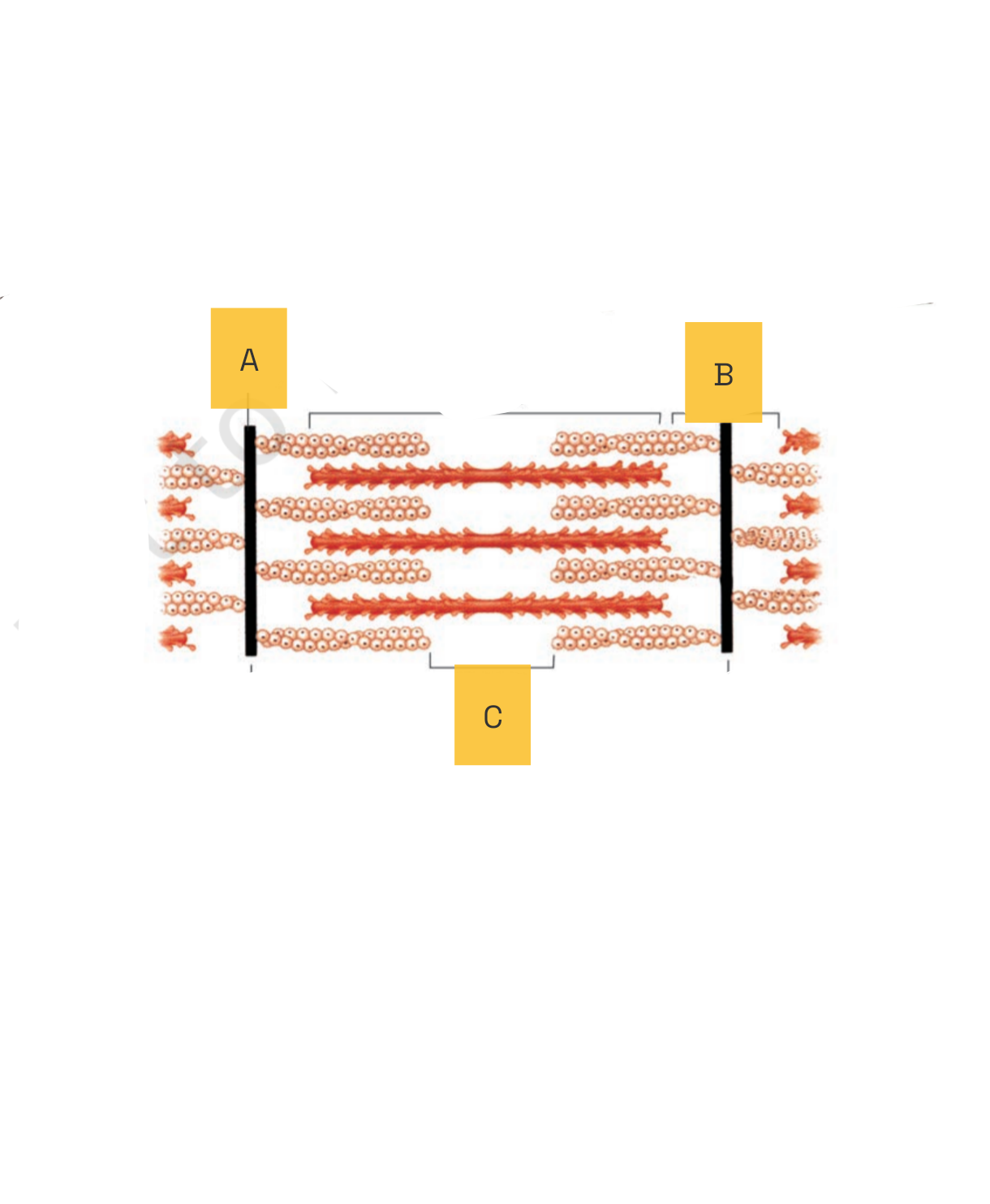
- Q1. Region ‘C’ is the:
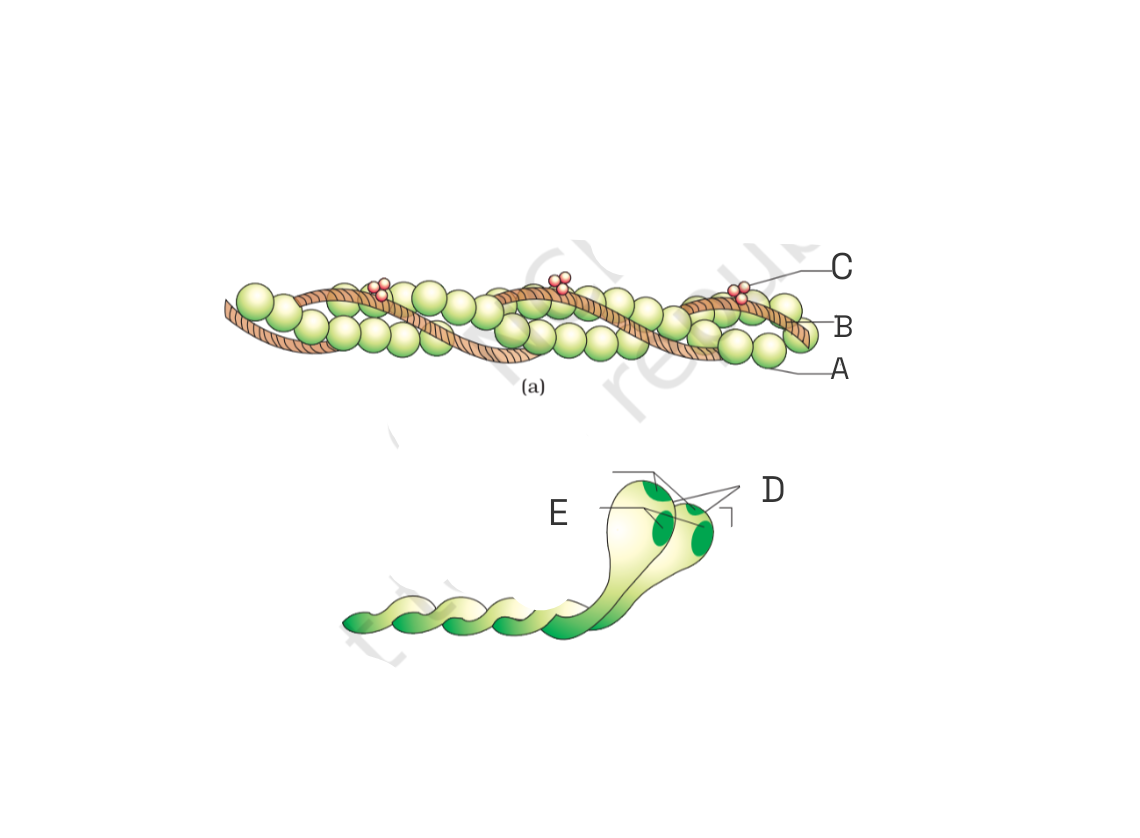
- Q2. Which molecule docks on structure labelled ‘E’ first during the recovery stroke?
- Q3. Match Column I with Column II : Column I a) Cardiac muscle b) Visceral muscle c) Skeletal muscle d) Fascia Column II i) Connective tissue covering a skeletal muscle ii) Involuntary, non-striated, found in walls of visceral organs iii) Striated, branched, involuntary iv) Voluntary, striated, associated with skeletal elements
- Q4. Match Column I with Column II : Column I a) Z line b) A band c) H zone d) I band e) Sarcomere Column II i) Functional unit of contraction between two Z lines ii) Dark band containing thick filaments (myosin) iii) Elastic fibre bisecting the I band, attachment point for actin iv) Central part of A band not overlapped by thin filaments v) Light band containing thin filaments (actin)
- Q5. Assertion (A): Skeletal muscles are striated and voluntary in nature. Reason (R): They are regulated by the somatic nervous system.
- Q6. Assertion (A): Calcium ions bind to actin filaments directly. Reason (R): This binding unmasks the active site for myosin.
- Q7. Consider the following statements : 1. Facial bones are 14 in number. 2. Cranial bones are 10 in number and form the cranium. 3. Skull is made of cranial and facial bones, totaling 22 bones. 4. Each middle ear contains three tiny bones called ear ossicles. 5. Hyoid bone is U-shaped and present at the base of buccal cavity.
- Q8. Consider the following statements : 1. Skeletal muscles are voluntary and associated with skeletal components of the body. 2. Visceral muscles are involuntary, smooth in appearance, and present in walls of hollow organs. 3. Cardiac muscles are voluntary and striated, forming the muscles of the heart. 4. Skeletal muscles are primarily involved in locomotion and posture changes. 5. Cardiac muscles assemble in a branching pattern and are involuntary in nature.
- Q9. Consider the following statements : 1. Each actin filament is made of two ‘F’ actins helically wound to each other, with tropomyosin running close along its length. 2. Troponin complex regulates the masking and unmasking of myosin-binding sites on actin. 3. The globular head of myosin has ATPase activity and binding sites for ATP and actin. 4. Human skeletal system is made up of 306 bones and a few cartilages. 5. Axial skeleton consists of skull, vertebral column, sternum, and ribs.
- Q10. Consider the following statements regarding types of movement in humans: 1. Muscular movement is responsible for the passage of ova through the female reproductive tract. 2. Microfilaments of the cytoskeleton are involved in amoeboid movement. 3. Ciliary movement in the trachea helps in the removal of dust and foreign particles from inhaled air. 4. Macrophages and leucocytes exhibit amoeboid movement using pseudopodia and streaming of protoplasm. 5. Passage of ova through the female reproductive tract is facilitated by ciliary movement.
You’ve practised 10 of 201 Locomotion and Movement questions in this set.
Practise all 201 + every chapter — free app →Sample NEET PYQs — Locomotion and Movement
Osteoporosis, an age-related disease of skeletal system, may occur due to
- A. Immune disorder affecting neuromuscular junction leading to fatigue
- B. High concentration of Ca$^{2+}$ and Na$^{+}$
- C. Decreased level of estrogen
- D. Accumulation of uric acid leading to inflammation of joints
Explanation: Answer: C. Osteoporosis is an age-related disorder of decreased bone mass and increased fracture risk, and a decreased level of estrogen is a common cause. (Option A describes myasthenia gravis and option D describes gout.) NCERT Ch 17, p.227, line 31: "increased chances of fractures. Decreased levels of estrogen is a".
Lack of relaxation between successive stimuli in sustained muscle contraction is known as:
- A. Spasm
- B. Fatigue
- C. Tetanus
- D. Tonus
Explanation: Answer: C. Tetanus (tetanic contraction) is the sustained, continuous contraction that results when stimuli arrive so rapidly that the muscle cannot relax between successive stimuli, so the twitches fuse. (Spasm is a single sudden involuntary contraction, tonus is the resting low-level activity that maintains posture, and fatigue is the decline in activity from lactic-acid accumulation — all distractors here.) This is NCERT-extension terminology; the chapter's relaxation/repeated-activation discussion is the closest grounding. NCERT Ch 17, p.223, line 7: "Repeated activation of the muscles can lead".
Name the ion responsible for unmasking of active sites for myosin for cross-bridge activity during muscle contraction.
- A. Calcium
- B. Magnesium
- C. Sodium
- D. Potassium
Explanation: Answer: A. A rise in Ca$^{2+}$ binds to a subunit of troponin on the actin filaments, which removes the masking of the myosin active sites so the myosin heads can form cross-bridges. NCERT Ch 17, p.222, line 15: "Ca++ level leads to the binding of calcium with a subunit of troponin on".
Smooth muscles are
- A. Involuntary, fusiform, non-striated
- B. Voluntary, multinucleate, cylindrical
- C. Involuntary, cylindrical, striated
- D. Voluntary, spindle-shaped, uninucleate
Explanation: Answer: A. Smooth (visceral) muscles are non-striated, spindle-shaped (fusiform) cells in the walls of hollow visceral organs, and their activity is not under voluntary nervous control, hence involuntary. NCERT Ch 17, p.218, line 41: "smooth muscles (nonstriated muscle). Their activities are not under the".
Frequently Asked Questions — Locomotion and Movement NEET
How many questions from Locomotion and Movement come in NEET?+
How many Locomotion and movement questions does MedicNEET have?+
What is the NEET weightage of Locomotion and movement?+
Are Locomotion and movement questions available in Hindi?+
Are Locomotion and movement questions NCERT-based?+
What is the best app for Locomotion and Movement NEET practice?+
How to score full marks in Locomotion and Movement for NEET 2027?+
What are ReNEET 2026-style reasoning Locomotion and Movement questions?+
Are these Locomotion and Movement MCQs free to practise?+
Practise Locomotion and Movement — Free
All 296+ Locomotion and Movement questions · ReNEET 2026 reasoning + every format · Bilingual Hindi & English · NCERT-mapped explanations · No paywall
📲 Download MedicNEET App (Free)