How many questions from Morphology of Flowering Plants in NEET?
5–6 questions from Morphology of Flowering Plants appear in NEET every year (20–24 marks, ~6% of NEET Biology) — one of the highest-weightage Class 11 chapters. High-yield topics: root modifications, leaf venation, inflorescence types (racemose vs cymose), floral formula, aestivation, and placentation. Practise all Morphology PYQs free in bilingual Hindi & English in the MedicNEET app.
Year-wise NEET Questions — Morphology of Flowering Plants
| Year | Questions | Marks |
|---|---|---|
| NEET 2016 | 10 | 40 |
| NEET 2017 | 4 | 16 |
| NEET 2018 | 2 | 8 |
| NEET 2019 | 4 | 16 |
| NEET 2020 | 3 | 12 |
| NEET 2021 | 2 | 8 |
| NEET 2022 | 4 | 16 |
| NEET 2023 | 5 | 20 |
| NEET 2024 | 6 | 24 |
| NEET 2025 | 5 | 20 |
| NEET 2026 | 5 | 20 |
Practise Morphology of Flowering Plants MCQs — Free
Every Morphology of Flowering Plants question format NEET uses, starting with the newest ReNEET 2026-style reasoning MCQs. Tap an option for the answer + NCERT explanation.
✨ Morphology of Flowering Plants — ReNEET 2026-Style Reasoning Questions
The newest, most exam-current format — reasoning-based questions modelled on ReNEET 2026. This is where NEET is heading; practise the pattern before the exam does.
- Q1. Why is the root system essential for providing proper anchorage to plants?
- Q2. Why do root hairs significantly increase the efficiency of water absorption?
- Q3. How does the structure of internodes help in plant growth?
- Q4. Why is alternate phyllotaxy advantageous to some plants?
- Q5. What adaptive advantage does acropetal succession offer in racemose inflorescence?
- Q6. Why are calyx and corolla termed accessory organs?
- Q7. Why is the ovary called superior in hypogynous flowers?
- Q8. Why are fruits considered unique to angiosperms?
- Q9. Why do some seeds remain dormant for long periods?
- Q10. Why is the family Solanaceae economically important?
You’ve practised 10 of 83 Morphology of Flowering Plants questions in this set.
Practise all 83 + every chapter — free app →📑 Morphology of Flowering Plants — NEET 2025 & 2026 Long-Form MCQs
The long, multi-statement questions that dominated NEET 2025 & 2026 — each covers 5-6 concepts at once, so they double as fast full-chapter revision.
- Q1. Match the following root types with their characteristic and examples: COLUMN I (Root Type) (i) Taproot system (ii) Fibrous root system (iii) Adventitious root system COLUMN II (Characteristic) (a) Direct elongation of the radicle forming a primary root (b) Primary root is short-lived and replaced by numerous roots from the stem base (c) Roots arise from parts of the plant other than the radicle COLUMN III (Example) (p) Banyan tree (q) Mustard plant (r) Wheat plant
- Q2. Which of the following statements about the stem are NOT correct? S1: The stem develops from the plumule of the embryo and characteristically bears nodes and internodes. S2: The main function of the stem includes spreading out branches bearing leaves, flowers, and fruits, as well as conduction of water, minerals, and photosynthates. S3: Stems are always aerial and erect, but can be modified for food storage, support, protection, and vegetative propagation in specific plants. S4: Young stems are generally green, performing photosynthesis, but mature stems invariably become woody and dark brown, losing all photosynthetic activity. S5: While terminal buds primarily contribute to the elongation of the stem, axillary buds are responsible for the formation of new roots and root hairs.
- Q3. Match the following inflorescence features in Column I with their correct descriptions in Column II: Column I (Inflorescence Feature) a. Racemose inflorescence b. Cymose inflorescence c. Flower as a modified shoot d. Basipetal arrangement e. Acropetal arrangement Column II (Description) (i) Main axis continues to grow without terminating in a flower (ii) Oldest flowers located at the apex, youngest at the base (iii) Internodes do not elongate, and the axis gets condensed (iv) Main axis terminates in a flower, limiting its growth (v) Youngest flowers located at the apex, oldest at the base
- Q4. Which of the following statements concerning the position of floral parts relative to the ovary are NOT correct? S1: In hypogynous flowers, the gynoecium is positioned at the highest point, with other floral parts originating below the ovary. S2: The ovary in perigynous flowers is described as half-inferior, as the gynoecium is situated centrally and other parts are on the rim of the thalamus at the same level. S3: Epigynous flowers are characterized by a superior ovary, where the thalamus grows upward, completely enclosing it. S4: Mustard and China rose are examples of flowers with superior ovaries, characteristic of hypogynous conditions. S5: Guava and cucumber typically exhibit inferior ovaries, a feature associated with perigynous flower types.
You’ve practised 4 of 76 Morphology of Flowering Plants questions in this set.
Practise all 76 + every chapter — free app →🧩 Morphology of Flowering Plants — All-Format Questions — Match, Assertion-Reason, Statement & Image-Based
Every question format NEET uses — match-the-column, assertion-reason, statement-based, and image/diagram questions — not just plain MCQs. Each with an instant NCERT-referenced solution.
- Q1. The floral diagram shown represents which one of the following families? [NEET -2022]

- Q2. The diagrams (a–d) represent different types of aestivation in the corolla. Which diagram corresponds to the aestivation found in pea flower?
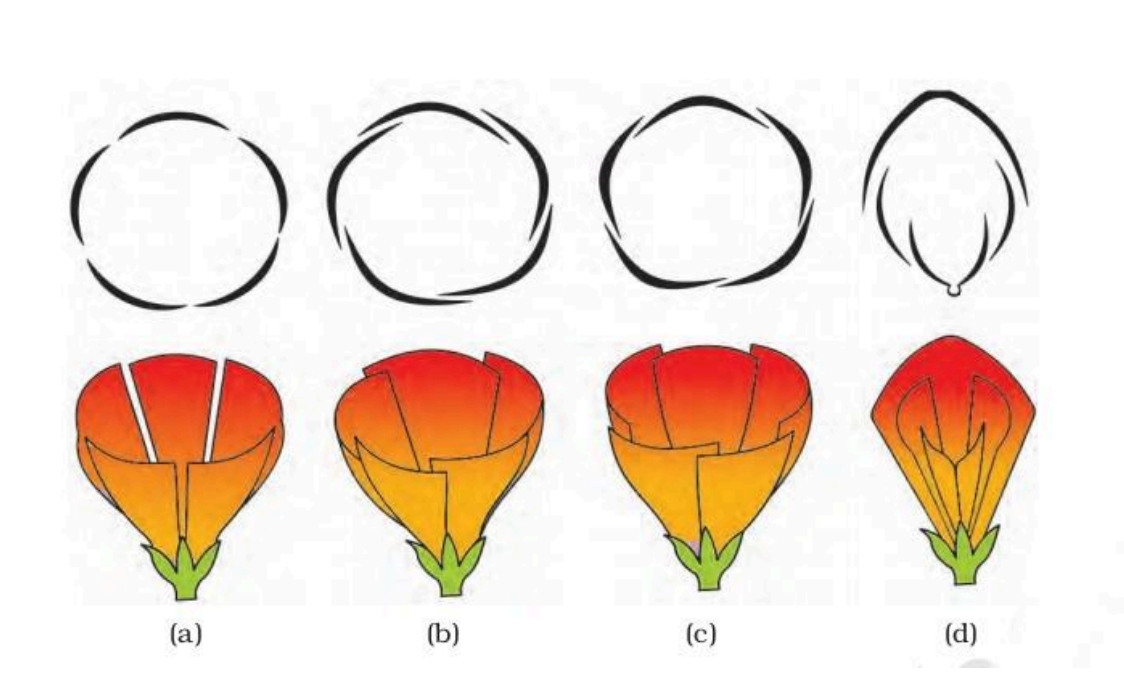
- Q3. Match the type of root with its example: COLUMN I (i) Taproot (ii) Fibrous root (iii) Adventitious root COLUMN II (a) Banyan tree (b) Mustard plant (c) Wheat plant
- Q4. Match the tropism with its stimulus : COLUMN I (i) Hydrotropism (ii) Geotropism (iii) Phototropism COLUMN II (a) Growth away from light (b) Growth towards water (c) Growth towards gravity
- Q5. Assertion (A): Fibrous roots are more efficient in preventing soil erosion. Reason (R): They form a deep network from the primary root.
- Q6. Assertion (A): The root cap protects the apical meristem from mechanical stress. Reason (R): Roots secrete plant growth regulators
- Q7. In majority of dicotyledonous plants, the primary root is formed by:
- Q8. The cells in the region of meristematic activity are characterized by:
- Q9. what is the sequence of regions from apex to base in root tip?
- Q10. In monocotyledonous plants, what happens to the primary root?
You’ve practised 10 of 306 Morphology of Flowering Plants questions in this set.
Practise all 306 + every chapter — free app →Sample NEET PYQs — Morphology of Flowering Plants
The standard petal of papilionaceous corolla is also called: (NEET 2016 (Phase I))
- A. Carina
- B. Pappus
- C. Vexillum
- D. Corona
Explanation: In a papilionaceous (pea/bean) corolla the largest petal is the standard, which is also called the vexillum (hence the aestivation is termed vexillary). The two lateral petals are wings (alae) and the two fused anterior petals form the keel (carina). Pappus (modified calyx hairs of Asteraceae) and corona (an outgrowth of the corolla/perianth) are unrelated, so vexillum is correct. NCERT Reference: Ch 5, p.64, lines 9-12 — "the largest (standard) overlaps the two lateral petals (wings) which in turn overlap the two smallest anterior petals (keel); this type of aestivation is known as vexillary or papilionaceous."
How many plants among Indigofera, Sesbania, Salvia, Allium, Aloe, mustard, groundnut, radish, gram and turnip have stamens with different lengths in their flowers? (NEET 2016 (Phase II))
- A. Three
- B. Four
- C. Five
- D. Six
Explanation: Stamens of unequal length occur as didynamous (2 long + 2 short, Lamiaceae) and tetradynamous (4 long + 2 short, Brassicaceae). From the list: Salvia (didynamous) plus mustard, radish and turnip (all tetradynamous Brassicaceae) = four plants. The legumes (Indigofera, Sesbania, groundnut, gram) are diadelphous and the Liliaceae members (Allium, Aloe) have equal stamens, so the count is four. NCERT Reference: Ch 5, p.64, lines 35-36 — "There may be a variation in the length of filaments within a flower, as in Salvia and mustard."
Radial symmetry is found in the flowers of (NEET 2016 (Phase II))
- A. Brassica
- B. Trifolium
- C. Pisum
- D. Cassia
Explanation: Radial (actinomorphic) symmetry means the flower can be divided into two equal halves in any radial plane through the centre — NCERT gives mustard (Brassica) as an example. Trifolium, Pisum and Cassia are leguminous flowers that are zygomorphic (bilaterally symmetrical), so only Brassica shows radial symmetry. NCERT Reference: Ch 5, p.62, lines 18-23 — "the flower may be actinomorphic (radial symmetry)" ... "it is said to be actinomorphic, e.g., mustard, datura, chilli. When it can be divided into two similar halves only in one particular vertical plane, it is zygomorphic, e.g., pea, gulmohur, bean, Cassia."
Proximal end of the filament of stamen is attached to the: (NEET 2016 (Phase I))
- A. Anther
- B. Connective
- C. Placenta
- D. Thalamus or petal
Explanation: A stamen is a stalk (filament) bearing an anther; the distal end of the filament carries the anther while its proximal (basal) end is inserted onto the thalamus, or onto the petals when the stamen is epipetalous (as in brinjal). The connective merely joins the two anther lobes, and the placenta belongs to the gynoecium, so the proximal attachment is to the thalamus or petal. NCERT Reference: Ch 5, p.64, lines 23-30 — "Each stamen which represents the male reproductive organ consists of a stalk or a filament and an anther." ... "When stamens are attached to the petals, they are epipetalous as in brinjal"
Frequently Asked Questions — Morphology of Flowering Plants NEET
How many questions from Morphology of Flowering Plants come in NEET?+
How many Morphology of Flowering Plants questions does MedicNEET have?+
What is the NEET weightage of Morphology of Flowering Plants?+
Are Morphology of Flowering Plants questions available in Hindi?+
Are Morphology of Flowering Plants questions NCERT-based?+
What are ReNEET 2026-style reasoning Morphology of Flowering Plants questions?+
Are these Morphology of Flowering Plants MCQs free to practise?+
Practise Morphology of Flowering Plants — Free
All 465+ Morphology of Flowering Plants questions · ReNEET 2026 reasoning + every format · Bilingual Hindi & English · NCERT-mapped explanations · No paywall
📲 Download MedicNEET App (Free)