How many questions from Photosynthesis in Higher Plants in NEET?
3–4 questions from Photosynthesis in Higher Plants appear in NEET every year (12–16 marks, ~3% of NEET Biology). High-yield topics: light reactions (PS I & PS II, Z-scheme), Calvin cycle (RuBisCO, C3 cycle), C4 pathway, photorespiration, and photosynthetic pigments. Practise all 580 Photosynthesis PYQs free in bilingual Hindi & English in the MedicNEET app.
Year-wise NEET Questions — Photosynthesis in Higher Plants
| Year | Questions | Marks |
|---|---|---|
| NEET 2016 | 4 | 16 |
| NEET 2017 | 2 | 8 |
| NEET 2018 | 2 | 8 |
| NEET 2019 | 4 | 16 |
| NEET 2020 | 2 | 8 |
| NEET 2021 | 3 | 12 |
| NEET 2022 | 3 | 12 |
| NEET 2023 | 6 | 24 |
| NEET 2024 | 3 | 12 |
| NEET 2025 | 2 | 8 |
| NEET 2026 | 10 | 40 |
Practise Photosynthesis in Higher Plants MCQs — Free
Every Photosynthesis in Higher Plants question format NEET uses, starting with the newest ReNEET 2026-style reasoning MCQs. Tap an option for the answer + NCERT explanation.
✨ Photosynthesis in Higher Plants — ReNEET 2026-Style Reasoning Questions
The newest, most exam-current format — reasoning-based questions modelled on ReNEET 2026. This is where NEET is heading; practise the pattern before the exam does.
- Q1. How does the test with the black-paper-covered leaf portion support the light requirement in photosynthesis?
- Q2. Why does photosynthesis slow down if sugar produced is not transported out of the leaf?
- Q3. What role did aerobic bacteria play in Engelmann's experiment?
- Q4. How does chloroplast compartmentalization enhance photosynthesis efficiency?
- Q5. Which structural feature of chlorophyll a enables it to act as a reaction center?
- Q6. Why does the light reaction take place only in the grana of chloroplasts?
- Q7. Why is plastocyanin important in the ETC?
- Q8. Why does Calvin cycle operate in the stroma?
- Q9. Why is the presence of chloroplasts in both mesophyll and bundle sheath cells significant in C₄ plants?
- Q10. How does the presence of O₂ at the RuBisCO site affect photosynthetic efficiency?
You’ve practised 10 of 100 Photosynthesis in Higher Plants questions in this set.
Practise all 100 + every chapter — free app →📑 Photosynthesis in Higher Plants — NEET 2025 & 2026 Long-Form MCQs
The long, multi-statement questions that dominated NEET 2025 & 2026 — each covers 5-6 concepts at once, so they double as fast full-chapter revision.
- Q1. Arrange the following steps of the Calvin cycle in the correct sequential order as they occur in a typical C3 plant: (a) Regeneration of Ribulose-1,5-bisphosphate (RuBP) (b) Formation of two molecules of 3-Phosphoglyceric acid (3-PGA) (c) Carboxylation of RuBP catalyzed by RuBisCO (d) Reduction of 3-PGA utilizing ATP and NADPH (e) Synthesis of sucrose/starch from triose phosphate (f) Formation of triose phosphate
- Q2. Which of the following statements correctly describe the process of water splitting in photosynthesis? S1: Cornelius van Niel hypothesized that O₂ is released from water, a concept later proved by radioisotopic studies. S2: Water splitting, or photolysis, is associated with Photosystem I and takes place on the outer side of the thylakoid membrane. S3: The splitting of water produces electrons, protons (H+), and molecular oxygen. S4: The electrons released from water splitting continuously replace the electrons removed from the reaction centre of Photosystem II. S5: The protons generated from water splitting accumulate in the stroma, contributing to the proton gradient.
- Q3. Which of the above statements regarding the products of the light reaction and their fate/use are correct? S1: ATP and NADPH, the products of the light reaction, are directly utilized in the reduction phase of the Calvin cycle. S2: Oxygen, released from the photolysis of water during the light reaction, diffuses out of the chloroplast. S3: The biosynthetic phase of photosynthesis, also known as the dark reaction, directly depends on the presence of light for its enzymatic reactions. S4: The primary function of the light reaction is the direct synthesis of glucose to provide energy for the plant. S5: Both ATP and NADPH + H+ are consistently produced during cyclic photophosphorylation.
- Q4. Which of the above statements are correct? S1: RuBisCO is the most abundant enzyme globally and is unique due to its active site binding to both CO₂ and O₂. S2: The competitive binding of CO₂ and O₂ to RuBisCO is primarily determined by light intensity, with higher light favoring oxygenase activity. S3: Photorespiration, which occurs when RuBP binds with O₂, results in the formation of one molecule of phosphoglycerate and one molecule of phosphoglycolate. S4: The photorespiratory pathway leads to the synthesis of sugars and ATP, providing an alternative energy source under conditions of high oxygen. S5: C₄ plants effectively minimise photorespiration by increasing the intracellular concentration of CO₂ at the RuBisCO enzyme site in bundle sheath cells.
You’ve practised 4 of 95 Photosynthesis in Higher Plants questions in this set.
Practise all 95 + every chapter — free app →🧩 Photosynthesis in Higher Plants — All-Format Questions — Match, Assertion-Reason, Statement & Image-Based
Every question format NEET uses — match-the-column, assertion-reason, statement-based, and image/diagram questions — not just plain MCQs. Each with an instant NCERT-referenced solution.
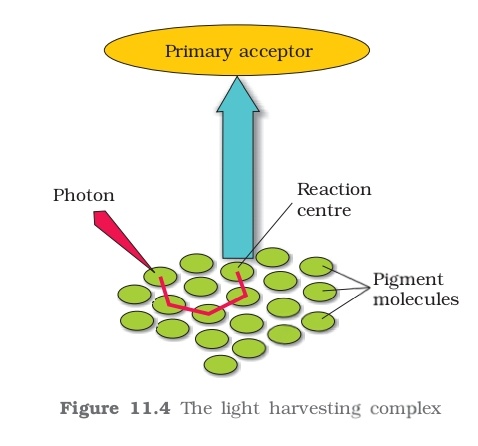
- Q1. Observe the figure. If the photon arrow enters from the left, what is the correct directional sequence of components involved in energy/electron flow?
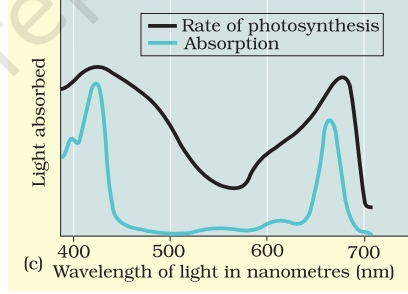
- Q2. In the figure, which peak corresponds to the maximum absorption of chlorophyll a?
- Q3. Match the following characteristics of C₃ and C₄ plants (arrange correctly): COLUMN I a) Site of Calvin cycle b) Primary CO₂ acceptor c) Presence of PEP carboxylase d) First stable product e) Photorespiration COLUMN II i. 3-PGA ii. Mesophyll cells iii. High iv. Absent v. RuBP COLUMN III 1. OAA 2. Bundle sheath cells 3. Present 4. Negligible 5. PEP
- Q4. Match the following (Column I with Column II): COLUMN I a) Biosynthetic phase (Dark reactions) b) C₃ pathway c) C₄ pathway d) Primary CO₂ acceptor in C₄ plants e) First stable product in C₃ plants COLUMN II (Feature / Product) 1. ATP and NADPH from light reactions are used for CO₂ fixation 2. First stable product is 3-phosphoglyceric acid (3-PGA) 3. First stable product is oxaloacetic acid (OAA) 4. Ribulose-1,5-bisphosphate (RuBP) is the primary CO₂ acceptor 5. Phosphoenolpyruvate (PEP) is the primary CO₂ acceptor
- Q5. Assertion (A): Oxygen released during photosynthesis is vital for all living beings. Reason (R): Oxygen is used in respiration by plants only.
- Q6. Assertion (A): Presence of light is essential for starch formation in leaves. Reason (R): Light triggers protein synthesis in guard cells.
- Q7. Consider the following statements : 1. The organismic level of organisation gave rise to sociology and related disciplines. 2. The cellular and molecular level of organisation led to physiology and biochemistry. 3. Melvin Calvin studied photosynthesis using radioactive carbon dioxide labelled with C¹⁴. 4. Calvin demonstrated that plants release oxygen from carbon dioxide during photosynthesis. 5. Mapping the pathway of oxygen assimilation in photosynthesis earned Calvin the Nobel Prize in 1961.
- Q8. Consider the following statements : 1. Chlorophyll b, xanthophylls and carotenoids are accessory pigments that transfer energy to chlorophyll a. 2. The reaction centre of Photosystem I is called P700, absorbing light of 700 nm. 3. Splitting of water associated with PS II provides electrons, protons, and molecular oxygen. 4. The first stable product of the Calvin cycle is a 3-carbon compound, 3-phosphoglyceric acid (PGA). 5. In C₄ plants, bundle sheath cells are large, with many chloroplasts, thick walls, and Kranz anatomy.
- Q9. Arrange the following events of the Calvin cycle in the correct sequence: 1. ATP phosphorylates 3-phosphoglyceric acid (3-PGA) to 1,3-bisphosphoglycerate 2. ATP is used to regenerate RuBP from ribulose-5-phosphate 3. NADPH reduces 1,3-bisphosphoglycerate to glyceraldehyde-3-phosphate (G3P) 4. RuBP is carboxylated by RuBisCO to form 3-PGA 5. Part of G3P is converted into glucose and other carbohydrates
- Q10. Consider the following statements : 1. ATP and NADPH formed in light reactions are consumed during the reduction phase of the Calvin cycle. 2. For every CO₂ fixed, 3 ATP and 2 NADPH molecules are required. 3. Ribulose bisphosphate (RuBP), a 5-carbon ketose sugar, is the primary CO₂ acceptor. 4. The first stable product of RuBP carboxylation is a 2-carbon compound. 5. Regeneration of RuBP requires ATP molecules.
You’ve practised 10 of 319 Photosynthesis in Higher Plants questions in this set.
Practise all 319 + every chapter — free app →Sample NEET PYQs — Photosynthesis in Higher Plants
In a chloroplast the highest number of protons are found in:
- A. Stroma
- B. Lumen of thylakoids
- C. Inter membrane space
- D. Antennae complex
Explanation: During the light reaction the splitting of water occurs on the inner side of the thylakoid membrane, so the protons released accumulate within the thylakoid lumen; additional protons are also pumped into the lumen and removed from the stroma during electron transport and NADP+ reduction. This makes the lumen the compartment with the highest proton concentration (lowest pH). Therefore the highest number of protons is found in the lumen of thylakoids (B), not the stroma. NCERT: Class 11 Ch 11, p.140 [140:040–140:042]: "the splitting of water accumulate within the lumen of the thylakoids."
A plant in your garden avoids photorespiratory losses, has improved water use efficiency, shows high rates of photosynthesis at high temperatures and has improved efficiency of nitrogen utilization. In which of the following physiological groups would you assign this plant?
- A. C3
- B. C4
- C. CAM
- D. Nitrogen fixer
Explanation: A plant that lacks photorespiration, tolerates and photosynthesises rapidly at high temperatures, and uses water and nitrogen efficiently is a C4 plant. NCERT notes C4 plants tolerate higher temperatures, respond to high light intensities, lack photorespiration and have greater biomass productivity. C3 plants (A) show photorespiratory losses, so the correct group is C4 (B). NCERT: Class 11 Ch 11, p.145 [145:027–145:029]: "they lack a process called photorespiration and have greater productivity"
Emerson's enhancement effect and Red drop have been instrumental in the discovery of:
- A. Photophosphorylation and non – cyclic electron transport
- B. Two photosystems operating simultaneously
- C. Photophosphorylation and cyclic electron transport
- D. Oxidative phosphorylation
Explanation: Emerson's enhancement effect and the Red drop revealed that photosynthesis is driven by two distinct photochemical systems acting together. NCERT states the pigments are organised into two discrete light-harvesting complexes within Photosystem I (P700) and Photosystem II (P680), which work in series; quantum yield is enhanced when both operate simultaneously rather than PS II alone beyond 680 nm. Hence the discovery is of two photosystems (B), not merely a single phosphorylation mode. NCERT: Class 11 Ch 11, p.138 [138:019–138:022]: "The pigments are organised into two"
The process which makes major difference between C3 and C4 plants is
- A. Glycolysis
- B. Calvin cycle
- C. Photorespiration
- D. Respiration
Explanation: NCERT explicitly identifies photorespiration as the process that creates an important difference between C3 and C4 plants: it occurs in C3 plants (where O2 binds RuBisCO) but does not occur in C4 plants because their CO2-concentrating mechanism keeps RuBisCO carboxylating. The Calvin cycle (B) operates in both C3 and C4 plants, so it cannot be the distinguishing process. Hence the answer is photorespiration (C). NCERT: Class 11 Ch 11, p.147 [147:012–147:013]: "difference between C3 and C4 plants – Photorespiration."
Frequently Asked Questions — Photosynthesis in Higher Plants NEET
How many questions from Photosynthesis come in NEET every year?+
How many Photosynthesis questions does MedicNEET have?+
What is the NEET weightage of Photosynthesis in higher plants?+
Are Photosynthesis questions available in Hindi?+
Are Photosynthesis questions NCERT-based?+
What are ReNEET 2026-style reasoning Photosynthesis in Higher Plants questions?+
Are these Photosynthesis in Higher Plants MCQs free to practise?+
Practise Photosynthesis in Higher Plants — Free
All 514+ Photosynthesis in Higher Plants questions · ReNEET 2026 reasoning + every format · Bilingual Hindi & English · NCERT-mapped explanations · No paywall
📲 Download MedicNEET App (Free)