How many questions from Plant Growth and Development in NEET?
2–3 questions from Plant Growth and Development appear in NEET every year (8–12 marks, ~3% of NEET Biology). High-yield topics: plant growth regulators (auxins, gibberellins, cytokinins, ethylene, ABA), photoperiodism (SDP vs LDP), vernalization, seed dormancy, apical dominance, and differentiation/dedifferentiation. Practise all 366 Plant Growth questions free in bilingual Hindi & English in the MedicNEET app. 264 MCQ Questions 35 Assertion-Reason 67 NEET 2025 Pattern 32 Previous Year Q
Year-wise NEET Questions — Plant Growth and Development
| Year | Questions | Marks |
|---|---|---|
| NEET 2016 | 3 | 12 |
| NEET 2017 | 2 | 8 |
| NEET 2019 | 2 | 8 |
| NEET 2020 | 4 | 16 |
| NEET 2021 | 3 | 12 |
| NEET 2022 | 3 | 12 |
| NEET 2023 | 8 | 32 |
| NEET 2024 | 4 | 16 |
| NEET 2025 | 2 | 8 |
| NEET 2026 | 6 | 24 |
Practise Plant Growth and Development MCQs — Free
Every Plant Growth and Development question format NEET uses, starting with the newest ReNEET 2026-style reasoning MCQs. Tap an option for the answer + NCERT explanation.
✨ Plant Growth and Development — ReNEET 2026-Style Reasoning Questions
The newest, most exam-current format — reasoning-based questions modelled on ReNEET 2026. This is where NEET is heading; practise the pattern before the exam does.
- Q1. What primarily causes the growth to slow down in the stationary phase of a sigmoid growth curve?
- Q2. Why does swelling of wood in water not qualify as growth?
- Q3. How does meristematic activity explain indeterminate growth in plants?
- Q4. Why is differentiation in plants referred to as “open”?
- Q5. How does dedifferentiation contribute to secondary growth?
- Q6. How is plant development influenced by oxygen?
- Q7. Why is the term "phytohormone" interchangeable with plant growth regulator?
- Q8. What is the reason for spraying gibberellins on sugarcane?
- Q9. What is the primary reason ABA is called the stress hormone?
- Q10. Why do gibberellins promote seed germination in barley during malting?
You’ve practised 10 of 57 Plant Growth and Development questions in this set.
Practise all 57 + every chapter — free app →📑 Plant Growth and Development — NEET 2025 & 2026 Long-Form MCQs
The long, multi-statement questions that dominated NEET 2025 & 2026 — each covers 5-6 concepts at once, so they double as fast full-chapter revision.
- Q1. Match the following Plant Growth Regulators (PGRs) with their primary physiological effects or applications in plants. Column I (Plant Growth Regulator) A. Auxins B. Gibberellins C. Cytokinins D. Ethylene E. Abscisic acid Column II (Key Physiological Effect/Application) 1. Delay of senescence and promotion of nutrient mobilization 2. Induces rooting in stem cuttings and promotes flowering in pineapples 3. Promotes bolting in beet and increases sugarcane yield 4. Stimulation of stomatal closure during water stress 5. Hastens fruit ripening and promotes horizontal growth of seedlings
- Q2. Which of the following statements regarding the developmental processes in plants are NOT correct? S1: Plant growth is described as an open form of growth, implying it is strictly determinate. S2: The phenomenon of heterophylly in cotton is a clear manifestation of plant development being a fixed and rigid process. S3: Development in plants is a sum of only two processes: growth and differentiation, independent of any external factors. S4: The final structure at maturity of a plant cell or tissue is significantly determined by its location within the plant body. S5: Plasticity in plants allows them to form different kinds of structures in response to environment or phases of life.
- Q3. Match the following developmental processes with their key event/change and a relevant example/context: COLUMN I (Process) A. Growth B. Differentiation C. Dedifferentiation D. Redifferentiation E. Senescence COLUMN II (Key Event/Change) 1. Cells regain capacity to divide 2. Irreversible increase in size 3. Cell specialization and structural changes 4. Ageing, decline, and eventual death 5. Products lose capacity to divide but mature to specific functions COLUMN III (Example/Context) X. Formation of secondary xylem from vascular cambium Y. Elongation of a root at a constant rate Z. Formation of interfascicular cambium from parenchyma W. Formation of tracheary elements losing protoplasm V. Final stage of plant life cycle Options:
- Q4. Which of the following statements about the control of plant growth and development are correct? S1. Intrinsic factors include both intracellular (genetic) and intercellular factors (plant growth regulators). S2. Extrinsic factors affecting plant development are solely temperature and light. S3. Development is the sum of only growth, excluding differentiation. S4. Plant growth regulators (PGRs) represent one type of intrinsic control over plant development. S5. Water, oxygen, and nutrition are examples of extrinsic factors influencing plant growth. S6. Many extrinsic factors like temperature control plant growth and development via PGRs.
You’ve practised 4 of 57 Plant Growth and Development questions in this set.
Practise all 57 + every chapter — free app →🧩 Plant Growth and Development — All-Format Questions — Match, Assertion-Reason, Statement & Image-Based
Every question format NEET uses — match-the-column, assertion-reason, statement-based, and image/diagram questions — not just plain MCQs. Each with an instant NCERT-referenced solution.
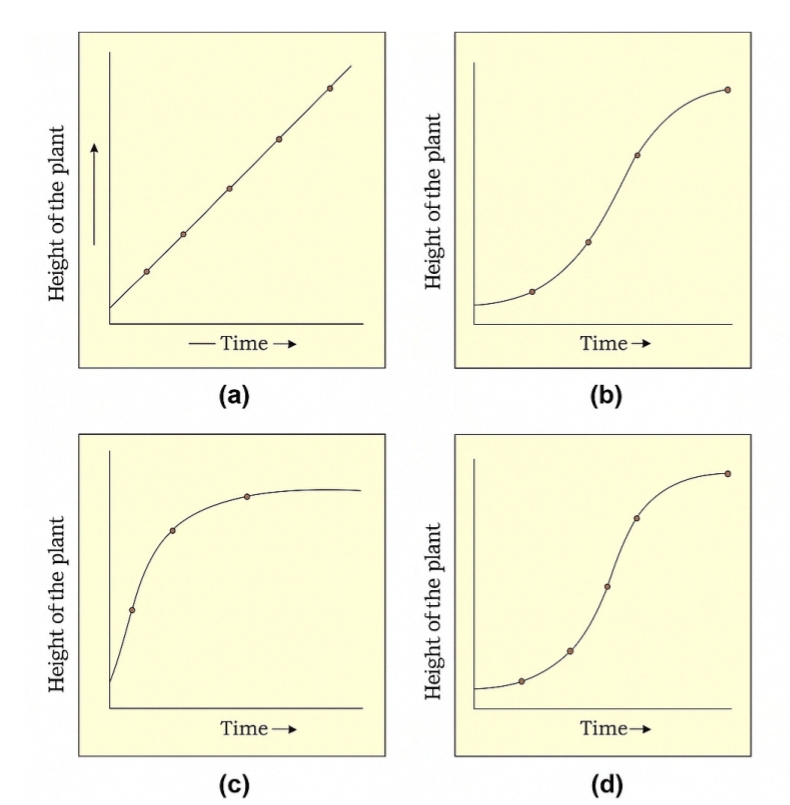
- Q1. Observe the four graphs (a–d) given below. Which one correctly represents growth following mitotic cell division exemplified by a root elongating at a constant rate ?
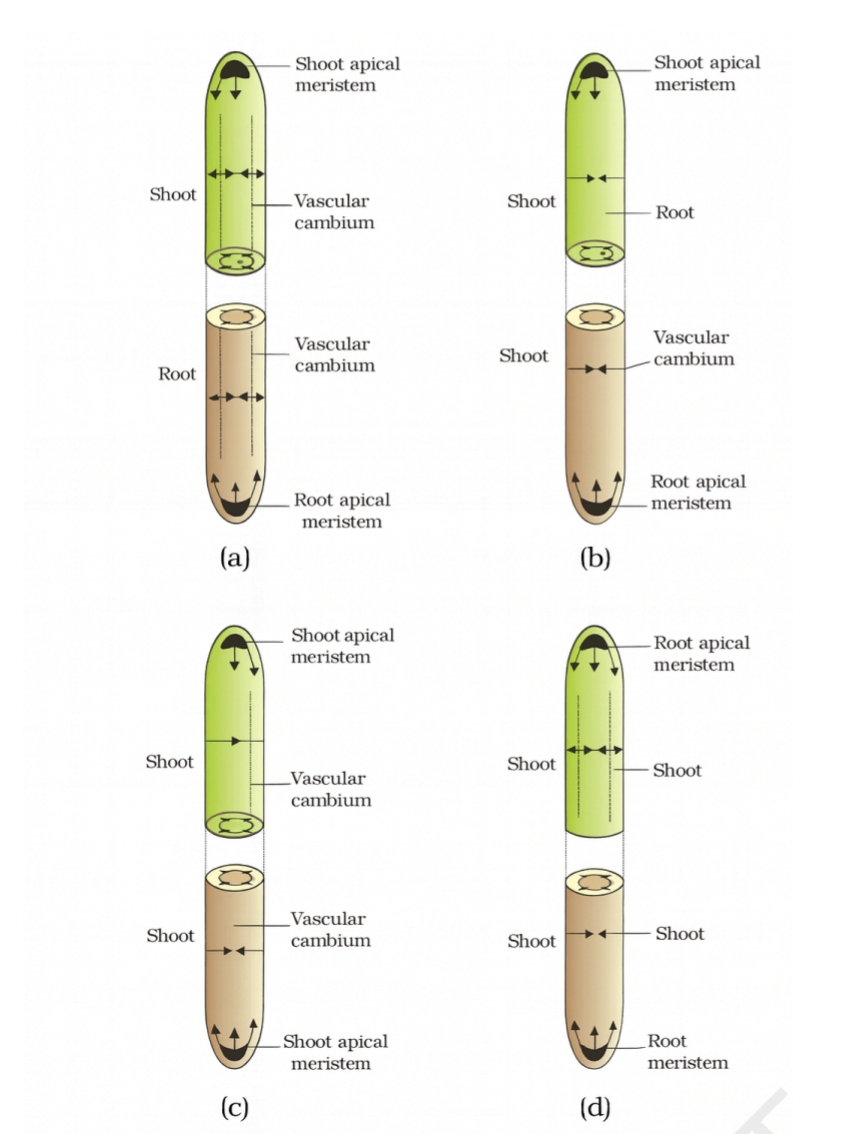
- Q2. Observe the four diagrams (a, b, c, d) showing shoot and root meristems with vascular cambium. Only one diagram is labelled correctly. Identify the correct diagram.
- Q3. Match the terms in Column I with their most appropriate descriptions in Column II: Column I 1. Differentiation 2. Dedifferentiation 3. Redifferentiation 4. Open differentiation 5. Plasticity Column II a) Formation of interfascicular cambium from fully differentiated parenchyma b) Development of root-cap cells from cells positioned away from the root apical meristem c) Juvenile and mature leaves of cotton plant differing in shape d) Mature cells regain the ability to divide under certain conditions e) Maturation of cells with structural and functional specialization
- Q4. Match the items in Column I with their correct counterparts in Column II: Column I 1. Discovery of Auxin 2. Bakanae (foolish seedling) disease 3. Heterophylly in buttercup 4. Formula for arithmetic growth 5. Sigmoid growth curve phases Column II a) Caused by Gibberella fujikuroi (E. Kurosawa, 1926) b) Lt= L0 + r·t c) Charles Darwin & F. Darwin, coleoptile tip experiment d) Different shaped leaves in air and water due to environment e) Lag phase → Log phase → Stationary phase
- Q5. Assertion (A): Cells with large conspicuous nuclei and abundant plasmodesmata are in elongation phase. Reason (R): These features are exclusive to maturation phase cells.
- Q6. Assertion (A): Relative growth rate is a better indicator of efficiency than absolute growth rate. Reason (R): Relative growth rate considers initial size of the organ
- Q7. Consider the following statements regarding plant growth regulators (PGRs): 1. Gibberellins can delay senescence in fruits (like apples) and also induce bolting in rosette plants such as cabbage. 2. Auxins such as 2,4-D are widely used to kill monocot weeds in lawns while sparing dicot plants. 3. Cytokinins help overcome apical dominance and promote chloroplast formation in leaves. 4. Ethylene promotes root hair formation and induces flowering in pineapples and mango. 5. Abscisic acid (ABA) stimulates stomatal closure, helps seeds withstand desiccation, and acts antagonistically to gibberellins. Which of the above statements are correct ?
- Q8. Consider the following statements : 1. Development in plants is the sum of growth and differentiation. 2. All plant organs arise in a precise, ordered sequence from the zygote. 3. Leaves, flowers, and fruits of a tree continue to grow indefinitely like stems and roots. 4. In absence of favourable conditions, seeds enter a period of suspended growth or rest. 5. Intrinsic and extrinsic factors together govern plant growth and development. Which of the above statements are correct?
- Q9. Arrange the following events in the correct chronological sequence: 1. Differentiation 2. Plasmatic growth 3. Senescence 4. Expansion (Elongation) 5. Maturation
- Q10. Consider the following statements : 1. Arithmetic growth produces a straight-line curve when length is plotted against time. 2. In geometric growth, both daughter cells after mitosis retain the ability to divide. 3. Relative growth rate is expressed on the basis of the initial parameter, while absolute growth rate is the total growth per unit time. 4. The sigmoid growth curve has three phases: lag, exponential (log), and stationary. 5. In arithmetic growth, both daughter cells retain the ability to divide. Which of the above statements are correct?
You’ve practised 10 of 221 Plant Growth and Development questions in this set.
Practise all 221 + every chapter — free app →Sample NEET PYQs — Plant Growth and Development
You are given a tissue with its potential for differentiation in an artificial culture. Which of the following pairs of hormones would you add to the medium to secure shoots as well as roots?
- A. IAA and gibberellin
- B. Auxin and cytokinin
- C. Auxin and abscisic acid
- D. Gibberellin and abscisic acid
Explanation: Answer: (B) Auxin and cytokinin. Solution: In plant tissue culture, the auxin-to-cytokinin ratio decides organ formation: a balanced/appropriate combination of auxin and cytokinin induces both shoot and root differentiation from the callus. Gibberellin, abscisic acid and ethylene are not the regulators used to secure shoots plus roots in culture, so the other pairs are wrong; ABA in particular is an inhibitor. NCERT: Ch 13, p.175, line ~9: "the callus (a mass of undifferentiated cells) proliferated only if, in addition to auxins".
The avena curvature is used for bioassay of:
- A. ABA
- B. GA3
- C. IAA
- D. Ethylene
Explanation: Answer: (C) IAA. Solution: The Avena (oat) coleoptile curvature test is the classic bioassay for auxin (IAA), since auxin diffusing from a tip applied off-centre causes measurable curvature. Auxin was historically isolated from oat coleoptile tips by Went, linking the assay to IAA; ABA, GA3 and ethylene are assayed by other methods, so they are wrong. NCERT: Ch 13, p.174, line ~47: "Auxin was isolated by F.W. Went from tips of coleoptiles of oat seedlings.".
Which of the following statements is not correct?
- A. Plant growth is generally determinate.
- B. Plant growth is measurable.
- C. Phase of cell elongation of plant cells is characterized by increased vacuolation.
- D. Cells in the meristematic phase of growth exhibit abundant plasmodesmatal connections.
Explanation: Answer: (A) Plant growth is generally determinate. Solution: This statement is NOT correct: plant growth is generally indeterminate because meristems give plants the capacity for unlimited (open) growth throughout life. The other statements are correct: growth is measurable, the elongation phase shows increased vacuolation, and meristematic cells have abundant plasmodesmatal connections. NCERT: Ch 13, p.167, line ~12: "Plant Growth Generally is Indeterminate".
Fruit and leaf drop at early stages can be prevented by the application of
- A. Cytokinins
- B. Ethylene
- C. Auxins
- D. Gibberellic acid
Explanation: Answer: (C) Auxins. Solution: Auxins prevent fruit and leaf drop at early stages, although they promote abscission of older mature organs. Cytokinins delay senescence and ethyline/GA do not perform this early-drop prevention, so they are incorrect. NCERT: Ch 13, p.175, line ~37: "They help to prevent fruit and leaf drop at early stages".
Frequently Asked Questions — Plant Growth and Development NEET
How many questions from Plant Growth and Development come in NEET?+
How many Plant growth and development questions does MedicNEET have?+
What is the NEET weightage of Plant growth and development?+
Are Plant growth and development questions available in Hindi?+
Are Plant growth and development questions NCERT-based?+
What are ReNEET 2026-style reasoning Plant Growth and Development questions?+
Are these Plant Growth and Development MCQs free to practise?+
Practise Plant Growth and Development — Free
All 335+ Plant Growth and Development questions · ReNEET 2026 reasoning + every format · Bilingual Hindi & English · NCERT-mapped explanations · No paywall
📲 Download MedicNEET App (Free)