How many questions from Principles of Inheritance and Variation in NEET?
4–5 questions from Principles of Inheritance & Variation appear in NEET every year (16–20 marks, ~5% of NEET Biology). High-yield topics: Mendelian genetics, dihybrid cross, codominance, sex determination (XO, ZW, XY systems), mutations, and pleiotropy. Practise all 50 PIV PYQs free in bilingual Hindi & English in the MedicNEET app.
Year-wise NEET Questions — Principles of Inheritance and Variation
| Year | Questions | Marks |
|---|---|---|
| NEET 2016 | 9 | 36 |
| NEET 2017 | 6 | 24 |
| NEET 2018 | 4 | 16 |
| NEET 2019 | 9 | 36 |
| NEET 2020 | 4 | 16 |
| NEET 2021 | 4 | 16 |
| NEET 2022 | 7 | 28 |
| NEET 2023 | 11 | 44 |
| NEET 2024 | 6 | 24 |
| NEET 2025 | 2 | 8 |
| NEET 2026 | 9 | 36 |
Practise Principles of Inheritance and Variation MCQs — Free
Every Principles of Inheritance and Variation question format NEET uses, starting with the newest ReNEET 2026-style reasoning MCQs. Tap an option for the answer + NCERT explanation.
✨ Principles of Inheritance and Variation — ReNEET 2026-Style Reasoning Questions
The newest, most exam-current format — reasoning-based questions modelled on ReNEET 2026. This is where NEET is heading; practise the pattern before the exam does.
- Q1. Mendel chose only those pea traits that manifested as two contrasting forms. Which advantage did this confer?
- Q2. True-breeding lines ensured stable trait inheritance. What would be the effect of using non–true-breeding parents in Mendel’s monohybrid cross?
- Q3. In the snapdragon cross (RR × rr), why do F₁ plants appear pink rather than red?
- Q4. If in a dihybrid F₂ generation, the observed ratio deviates from 9:3:3:1, what could be a likely reason?
- Q5. Which of the following scenarios supports polygenic inheritance the most?
- Q6. Why do polygenic traits like skin color show continuous variation in a population?
- Q7. Why is it incorrect to blame women for the birth of a girl child?
- Q8. Which of the following best explains how sex is determined in birds?
- Q9. Why is the phenotypic effect of Klinefelter’s syndrome different from Turner’s syndrome?
- Q10. Why are Mendelian disorders like haemophilia and thalassemia considered predictable across generations?
You’ve practised 10 of 73 Principles of Inheritance and Variation questions in this set.
Practise all 73 + every chapter — free app →📑 Principles of Inheritance and Variation — NEET 2025 & 2026 Long-Form MCQs
The long, multi-statement questions that dominated NEET 2025 & 2026 — each covers 5-6 concepts at once, so they double as fast full-chapter revision.
- Q1. Which of the following statements regarding Mendel's experiments and laws of inheritance are correct? S1: Mendel studied seven pairs of contrasting traits in pea plants, including pod shape (inflated/constricted) and seed colour (yellow/green). S2: Leaf colour (red/green) and seed texture (rough/smooth) were among the specific traits investigated by Mendel in pea plants. S3: In a monohybrid cross between a true-breeding tall plant and a true-breeding dwarf plant, all F1 progeny express the dwarf phenotype, demonstrating the recessive nature of tallness. S4: The Law of Segregation states that during gamete formation, the alleles of a pair segregate from each other, ensuring each gamete receives only one allele with equal proportion. S5: A test cross involves crossing an organism showing a dominant phenotype (whose genotype is to be determined) with a heterozygous recessive parent. S6: Mendel's significant contribution included the application of statistical analysis and mathematical logic to biological problems, which was novel for his time.
- Q2. Which of the following statements are correct regarding the F₂ generation of a dihybrid cross involving two independently assorting genes with complete dominance? S1: In the F2 generation of a dihybrid cross (e.g., RrYy x RrYy), there are 9 different genotypes. S2: The genotype Rryy appears with a frequency of 1/8 in the F2 generation. S3: The probability of obtaining an offspring with at least one dominant allele for both traits (R_Y_) in the F2 generation is 9/16. S4: The genotypic ratio of the F2 generation can be expressed as a product of two independent monohybrid genotypic ratios (1:2:1) * (1:2:1). S5: The genotype rrYY appears twice as frequently as RRYY in the F2 generation.
- Q3. Which of the following statements accurately describe the phenotypic distribution of polygenic traits in a population? S1: The phenotypic expression of polygenic traits typically shows continuous variation, often resulting in a bell-shaped curve when plotted. S2: Environmental factors significantly contribute to the smooth, continuous spectrum of phenotypes observed in polygenic inheritance. S3: Traits such as human height and skin colour, which exhibit a bell-shaped distribution, are primarily governed by a single gene locus with simple dominant-recessive alleles. S4: The additive effect of multiple alleles, each contributing to the phenotype, is the primary cause for the discrete, step-wise nature of polygenic trait distribution. S5: Increasing the number of genes that control a polygenic trait usually leads to a less pronounced bell-shaped curve with a narrower range of intermediate phenotypes.
- Q4. Which of the following statements are NOT correct with respect to chromosomal mutation leading to Klinefelter’s syndrome? S1. The chromosomal constitution in Klinefelter’s syndrome is 44 autosomes with XXY sex chromosomes. S2. Individuals with this condition are usually sterile due to underdeveloped testes. S3. Presence of an additional X chromosome leads to reduced testosterone secretion. S4. The condition arises due to the absence of one X chromosome during gamete formation. S5. Gynaecomastia and poorly developed secondary sexual characters may be observed. S6. The syndrome results exclusively from mutations occurring at the gene level.
You’ve practised 4 of 70 Principles of Inheritance and Variation questions in this set.
Practise all 70 + every chapter — free app →🧩 Principles of Inheritance and Variation — All-Format Questions — Match, Assertion-Reason, Statement & Image-Based
Every question format NEET uses — match-the-column, assertion-reason, statement-based, and image/diagram questions — not just plain MCQs. Each with an instant NCERT-referenced solution.
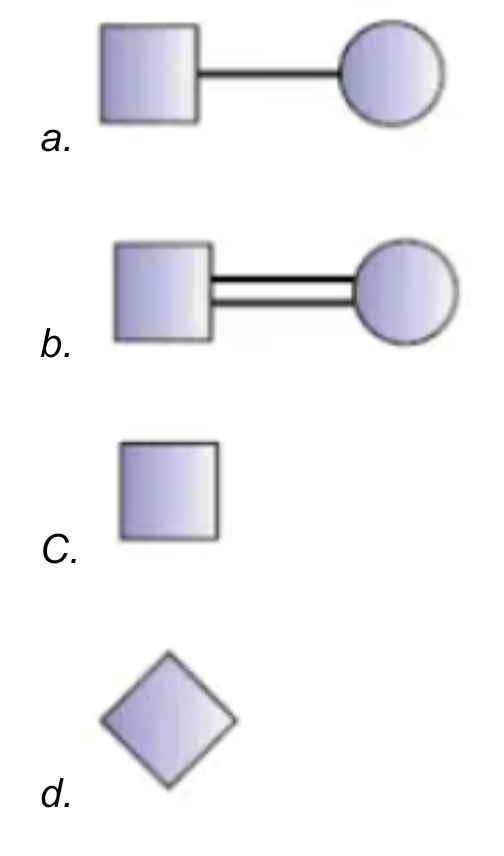
- Q1. Which of the following pedigree symbols represents a mating between relatives (consanguineous marriage)? (NEET 2025)
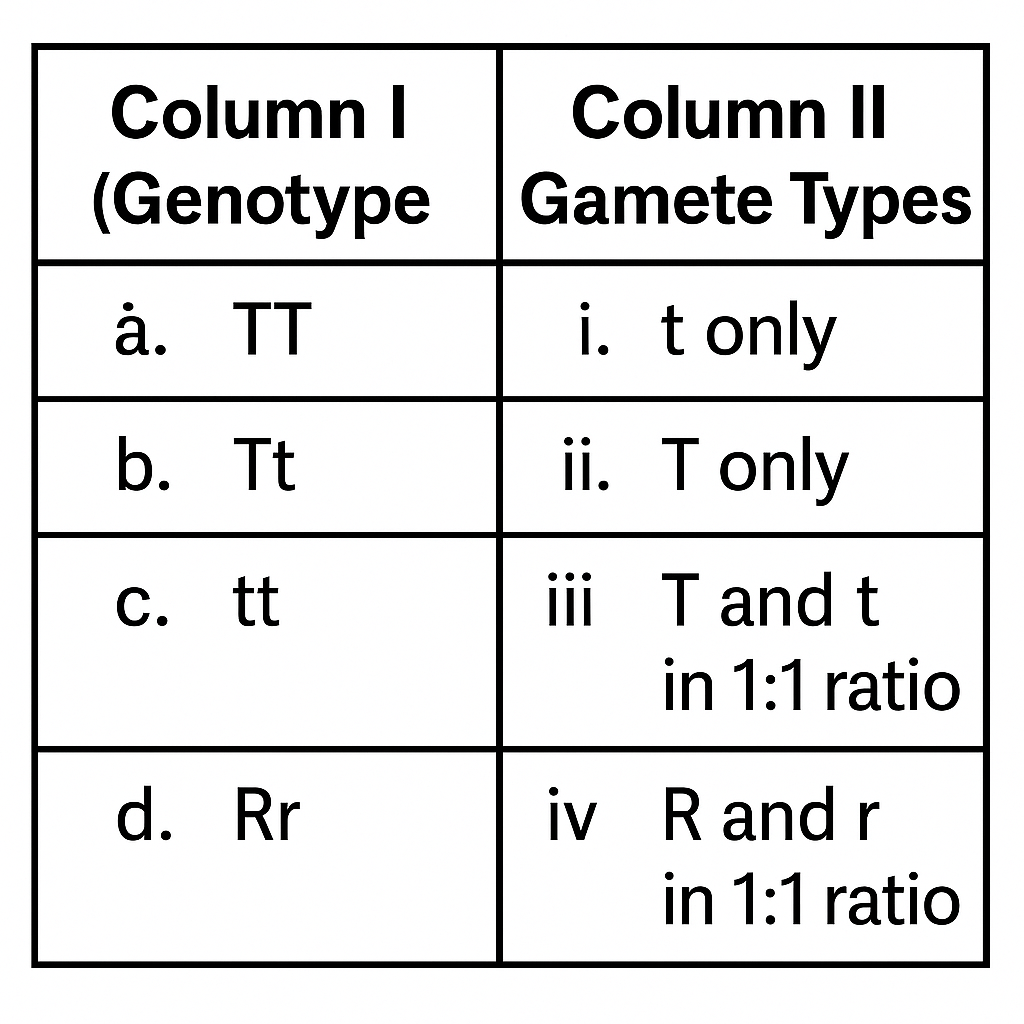
- Q2. Match the Column:
- Q3. Match the Column Match phenomena to their precise features. Column I A. Law of Segregation B. Incomplete dominance C. Codominance (ABO) D. Test cross E. Phenotype vs Genotype Column II (i) “F₁ was pink… phenotype ratios… changed from 3:1” (ii) “Alleles… segregate… a gamete receives only one” (iii) “IA and IB… both express their own types of sugars” (iv) “Cross… dominant phenotype… with the recessive parent” (v) “TT/tt = genotype; tall/dwarf = phenotype”
- Q4. Match the pea plant traits with their nature (Dominant or Recessive): Column I (Traits) 1. Yellow seed 2. Green seed 3. Round seed 4. Wrinkled seed 5. Purple flower 6. White flower 7. Tall stem 8. Dwarf stem Column II A. Dominant B. Recessive
- Q5. Assertion–Reason Assertion (A): Mendel confirmed his conclusions by studying successive generations of pea plants. Reason (R): Confirmation across generations rules out parental somatic mutations as the basis of observed ratios.
- Q6. Assertion–Reason Assertion (A): Mendel employed a large sample size in his pea-plant experiments. Reason (R): Large samples reduce the impact of chance deviations on progeny ratios.
- Q7. Evaluate dominance: (1) Dominance depends on gene product and phenotype we examine. (2) Recessive phenotype results when non-functional enzyme produced. (3) Equivalent alleles can produce same genotype despite sequence changes. (4) In starch synthesis, heterozygotes show intermediate grain size if measured. (5) Therefore, dominance is autonomous property of a gene. Which statements are correct?
- Q8. A counsellor analyses blood groups in a pedigree: (1) IA and IB, when together, both express their sugars (codominance). (2) Gene I has three alleles (IA, IB, i); i produces no sugar. (3) IAIB × ii can produce A, B, and O phenotypes. (4) IAi × IBi can produce AB phenotype. (5) Multiple alleles exist at the population level though an individual has only two. Which of the statements are correct?
- Q9. Consider chromosomal interpretation of Mendel’s results: (1) Chromosomes and genes both occur in pairs and segregate during gametogenesis. (2) Independent assortment arises from independent alignment of bivalents in meiosis I. (3) Morgan observed deviation from 9:3:3:1 when genes were on the same chromosome. (4) Such deviation is due to physical association (linkage) increasing parental combinations. (5) Therefore, independent assortment applies equally to linked genes. Which statements are correct?
- Q10. Steps to F₂ in monohybrid cross: 1. Self-pollinate F₁ (Tt). 2. Select TT and tt parents. 3. Observe F₂ segregation 3:1, genotypes 1:2:1. 4. Cross TT × tt to obtain F₁ (Tt). 5. Recognise TT/Tt tall, tt dwarf.
You’ve practised 10 of 313 Principles of Inheritance and Variation questions in this set.
Practise all 313 + every chapter — free app →Sample NEET PYQs — Principles of Inheritance and Variation
If a colour-blind man marries a woman who is homozygous for normal colour vision, the probability of their son being colour-blind is
- A. 0
- B. 0.5
- C. 0.75
- D. 1
Explanation: Answer: (A) 0 Solution: Colour blindness is X-linked recessive. A colour-blind man is XcY; a woman homozygous for normal vision is XX. Sons get their single X from the mother, who carries only normal alleles, so every son is XY (normal) — the father's Xc passes only to daughters (who become carriers). Hence the probability of a colour-blind son is 0. NCERT Reference: NCERT Class XII, Ch 4, p.73, lines 30-32: "Colour Blindness : It is a sex-linked recessive disorder due to defect in either red or green cone of eye resulting in failure to discriminate between red and green colour."
In a testcross involving F1 dihybrid flies, more parental – type offspring were produced than the recombinant – type offspring. This indicates:
- A. The two genes are located on two different chromosomes
- B. Chromosomes failed to separate during meiosis
- C. The two genes are linked and present on the same chromosome
- D. Both of the characters are controlled by more than one gene
Explanation: Answer: (C) The two genes are linked and present on the same chromosome Solution: When two genes lie on the same chromosome they tend to be inherited together (linkage), so a testcross of an F1 dihybrid yields more parental-type than recombinant-type offspring. Morgan called this physical association of genes on a chromosome 'linkage', and the higher proportion of parental combinations is its signature. NCERT Reference: NCERT Class XII, Ch 4, p.67, lines 34-39: "when the two genes in a dihybrid cross were situated on the same chromosome, the proportion of parental gene combinations were much higher than the non-parental type. Morgan attributed this due to the physical association or linkage of the two genes and coined the term linkage"
Pick out the correct statements: (i) Hemophilia is a sex – linked recessive disease (ii) Down's syndrome is due to aneuploidy (iii) Phenylketonuria is an autosomal recessive gene disorder (iv) Sickle cell anaemia is an autosomal recessive gene disorder
- A. (i) and (iv) are correct
- B. (ii) and (iv) are correct
- C. (i), (iii) and (iv) are correct
- D. (i), (ii) and (iii) are correct
Explanation: Answer: (D) (i), (ii) and (iii) are correct Solution: Haemophilia is a sex-linked (X-linked) recessive disease (i correct); Down's syndrome is caused by aneuploidy (trisomy of chromosome 21) (ii correct); phenylketonuria is inherited as an autosomal recessive trait (iii correct). Statement (iv) is also true (sickle-cell anaemia is autosome-linked recessive), so strictly more than one option is defensible; per the official key, option (D) is taken as correct. NCERT Reference: NCERT Class XII, Ch 4, p.75, lines 36-41: "Failure of segregation of chromatids during cell division cycle results in the gain or loss of a chromosome(s), called aneuploidy. For example, Down’s syndrome results in the gain of extra copy of chromosome 21." and p.75, lines 10-11: "Phenylketonuria : This inborn error of metabolism is also inherited as the autosomal recessive trait."
A true breeding plant is
- A. One that is able to breed on its own
- B. Produced due to cross-pollination among unrelated plants
- C. Near homozygous and produces offspring of its own kind
- D. Always homozygous recessive in its genetic constitution
Explanation: Answer: (C) Near homozygous and produces offspring of its own kind Solution: A true-breeding line, after continuous self-pollination, shows stable inheritance and expression of a trait for several generations, i.e., it is essentially homozygous and gives offspring identical to itself. It need not be homozygous recessive (it can be homozygous dominant), ruling out option (D). NCERT Reference: NCERT Class XII, Ch 4, p.54, lines 38-40: "breeding line is one that, having undergone continuous self-pollination, shows the stable trait inheritance and"
Frequently Asked Questions — Principles of Inheritance and Variation NEET
How many questions from Principles of Inheritance and Variation come in NEET?+
How many Principles of inheritance and variation questions does MedicNEET have?+
What is the NEET weightage of Principles of inheritance and variation?+
Are Principles of Inheritance and Variation questions available in Hindi?+
Are Principles of inheritance and variation questions NCERT-based?+
What are ReNEET 2026-style reasoning Principles of Inheritance and Variation questions?+
Are these Principles of Inheritance and Variation MCQs free to practise?+
Practise Principles of Inheritance and Variation — Free
All 456+ Principles of Inheritance and Variation questions · ReNEET 2026 reasoning + every format · Bilingual Hindi & English · NCERT-mapped explanations · No paywall
📲 Download MedicNEET App (Free)