How many questions from Respiration in Plants in NEET?
2–3 questions from Respiration in Plants appear in NEET every year (8–12 marks, ~3% of NEET Biology). High-yield: glycolysis (net ATP gain 2), Krebs cycle (citric acid cycle), ETC (ATP synthase), fermentation (ethanol/lactic acid), RQ values (1 for carbohydrates), aerobic vs anaerobic pathways. Practice all 397 questions free in bilingual Hindi & English in the MedicNEET app.
Year-wise NEET Questions — Respiration in Plants
| Year | Questions | Marks |
|---|---|---|
| NEET 2016 | 2 | 8 |
| NEET 2017 | 2 | 8 |
| NEET 2018 | 2 | 8 |
| NEET 2019 | 4 | 16 |
| NEET 2020 | 1 | 4 |
| NEET 2021 | 1 | 4 |
| NEET 2022 | 2 | 8 |
| NEET 2023 | 5 | 20 |
| NEET 2024 | 1 | 4 |
| NEET 2025 | 1 | 4 |
| NEET 2026 | 4 | 16 |
Practise Respiration in Plants MCQs — Free
Every Respiration in Plants question format NEET uses, starting with the newest ReNEET 2026-style reasoning MCQs. Tap an option for the answer + NCERT explanation.
✨ Respiration in Plants — ReNEET 2026-Style Reasoning Questions
The newest, most exam-current format — reasoning-based questions modelled on ReNEET 2026. This is where NEET is heading; practise the pattern before the exam does.
- Q1. How does photosynthesis indirectly help in meeting the oxygen demand for respiration?
- Q2. Facultative anaerobes can survive in the absence of oxygen because:
- Q3. Why do organisms retain glycolytic enzymes even if they are aerobic?
- Q4. Why is fermentation said to be an ancient pathway retained by many organisms?
- Q5. Why is less ATP generated in fermentation compared to aerobic respiration?
- Q6. Why is oxygen crucial only at the terminal step of aerobic respiration?
- Q7. Why must we assume no alternative substrates enter the respiratory pathway when calculating ATP yield?
- Q8. Why can ATP gain be less than 38 in a real cell?
- Q9. Why is glycerol used in respiration but not fatty acids during glycolysis?
- Q10. Why is RQ undefined or infinite under anaerobic conditions?
You’ve practised 10 of 71 Respiration in Plants questions in this set.
Practise all 71 + every chapter — free app →📑 Respiration in Plants — NEET 2025 & 2026 Long-Form MCQs
The long, multi-statement questions that dominated NEET 2025 & 2026 — each covers 5-6 concepts at once, so they double as fast full-chapter revision.
- Q1. Match Column I (Aspect of Plant Respiration) with Column II (Characteristic/Reason): Column I A. Absence of specialized respiratory organs B. Location of stomata C. Location of lenticels D. Metabolic demands of plants E. Oxygen availability in photosynthesizing cells Column II I. Far lower than animals II. Primarily on leaf epidermis III. Occurs within the cell during photosynthesis IV. Each plant part handles its own gas exchange needs V. On the surface of woody stems Options:
- Q2. Which of the following statements concerning the general features and significance of glycolysis are correct? S1: Glycolysis is exclusively an aerobic process, requiring oxygen for the breakdown of glucose. S2: The scheme of glycolysis was elucidated by Gustav Embden, Otto Meyerhof, and J. Parnas. S3: In anaerobic organisms, glycolysis represents the only process in respiration for partial oxidation of glucose. S4: Both glucose and fructose are phosphorylated by hexokinase before they enter the common glycolytic pathway. S5: Glycolysis occurs in the cytoplasm and serves as a universal pathway across all living organisms.
- Q3. Which of the following statements correctly describe the aerobic nature of the TCA cycle and the role of oxygen in cellular respiration? S1: Oxygen is directly consumed during the formation of succinyl-CoA from α-ketoglutaric acid in the TCA cycle. S2: The Electron Transport System (ETS) can function effectively to regenerate NAD⁺ and FAD⁺ even in the absence of molecular oxygen. S3: The reduced coenzymes (NADH+H⁺ and FADH₂) generated during glycolysis and the TCA cycle must be reoxidized by oxygen in the ETS for the continuous operation of the TCA cycle. S4: Oxygen acts as the terminal hydrogen acceptor, driving the entire process of oxidative phosphorylation by removing electrons from the system. S5: Without the availability of oxygen, the accumulation of reduced coenzymes would feedback inhibit enzymes of both glycolysis and the TCA cycle, thus halting the complete oxidation of glucose.
- Q4. Match the following components of protein respiration with their corresponding characteristics: Column I (Process/Molecule) a. Proteases b. Deamination c. Entry points for amino acids in respiration d. Proteins as respiratory substrates Column II (Description/Characteristic) i. Enzymes that degrade proteins into amino acids ii. The process required for amino acids to enter the respiratory pathway iii. Pyruvate, acetyl CoA, or TCA intermediates iv. Used as respiratory substances under certain conditions when carbohydrates and fats are depleted v. Exclusively utilized during anaerobic fermentation
You’ve practised 4 of 67 Respiration in Plants questions in this set.
Practise all 67 + every chapter — free app →🧩 Respiration in Plants — All-Format Questions — Match, Assertion-Reason, Statement & Image-Based
Every question format NEET uses — match-the-column, assertion-reason, statement-based, and image/diagram questions — not just plain MCQs. Each with an instant NCERT-referenced solution.
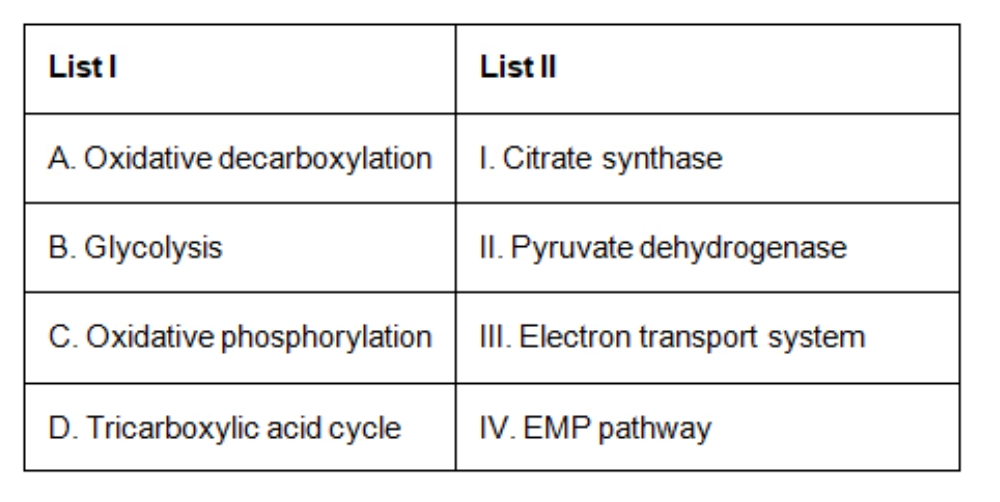
- Q1. Match List I with List II : (NEET 2023)
- Q2. What is the RQ value when glucose is used as the sole respiratory substrate?

- Q3. Match the respiratory substrate with its RQ value: COLUMN I a) Carbohydrate (e.g., glucose) b) Fat (e.g., tripalmitin) c) Protein d) Organic acid (e.g., oxalic acid) COLUMN II 1. 1.0 2. < 1 (around 0.7) 3. ~0.9 4. > 1
- Q4. Match Column I (concepts) with Column II (descriptions): COLUMN I a) Photosynthesis in plants b) Respiration c) Respiratory substrates d) ATP e) Stomata and lenticels COLUMN II 1. Breaking of C–C bonds of complex compounds through oxidation, releasing energy 2. Occurs only in chloroplast-containing superficial cells 3. Energy currency of the cell, produced step-wise 4. Proteins, fats, carbohydrates, organic acids 5. Structures ensuring gaseous exchange in plants
- Q5. Assertion (A): ATP acts as the energy currency in cells. Reason (R): Energy released during respiration is directly used by cellular enzymes.
- Q6. Assertion (A): Plants do not require a specialized respiratory organ like lungs. Reason (R): Each plant part meets its own gas exchange needs via diffusion.
- Q7. Consider the following statements: 1. Some organisms like yeast can produce ethanol and CO₂ during anaerobic respiration. 2. Pyruvate dehydrogenase is the key regulatory enzyme of glycolysis. 3. Alternative respiratory pathways exist in plants that are insensitive to cyanide. 4. Respiratory pathways are regulated by the need for ATP in the cell. 5. In anaerobic respiration, oxygen acts as the terminal electron acceptor.
- Q8. Consider the following statements: 1. Each NADH yields 3 ATP and each FADH₂ yields 2 ATP in the conventional balance sheet. 2. The complete oxidation of one glucose molecule produces 38 ATP in eukaryotes. 3. Actual ATP yield in eukaryotic cells is usually lower than the theoretical maximum. 4. The balance sheet calculation assumes complete oxidation without any losses. 5. In prokaryotes, ATP yield may differ from eukaryotes as transport of reducing equivalents is not required.
- Q9. Arrange the following steps of glycolysis in the correct order: 1. Splitting of fructose-1,6-bisphosphate into DHAP and PGAL 2. Formation of phosphoenolpyruvate (PEP) and its conversion to pyruvate with ATP production 3. Conversion of glucose into glucose-6-phosphate by hexokinase (ATP used) 4. Isomerisation of glucose-6-phosphate into fructose-6-phosphate 5. Oxidation of PGAL to 1,3-bisphosphoglycerate with NADH + H⁺ formation
- Q10. Arrange the following intermediates of the TCA cycle in the correct order: 1. Citrate 2. Oxaloacetate 3. Malate 4. α-ketoglutarate 5. Succinyl-CoA 6. Fumarate 7. Isocitrate 8. Succinate 9. Acetyl CoA
You’ve practised 10 of 223 Respiration in Plants questions in this set.
Practise all 223 + every chapter — free app →Sample NEET PYQs — Respiration in Plants
Which of the following biomolecules is common to respiration-mediated breakdown of fats, carbohydrates and proteins?
- A. Glucose-6-phosphate
- B. Fructose 1,6-bisphosphate
- C. Pyruvic acid
- D. Acetyl CoA
Explanation: Answer: (D) Acetyl CoA. Solution: Acetyl CoA is the common convergence point of all three substrate types: carbohydrates yield pyruvate (glycolysis) which is oxidatively decarboxylated to acetyl CoA, fatty acids are degraded directly to acetyl CoA, and amino acids (after deamination) enter as pyruvate or acetyl CoA. Glucose-6-phosphate and fructose 1,6-bisphosphate are exclusive to carbohydrate glycolysis, and although pyruvic acid is shared by carbs and some proteins, fats bypass it and enter only at acetyl CoA. NCERT: Ch 12, p.162, line ~20: "acetyl CoA and enter the pathway".
Oxidative phosphorylation is
- A. Formation of ATP by transfer of phosphate group from a substrate to ADP
- B. Oxidation of phosphate group in ATP
- C. Addition of phosphate group to ATP
- D. Formation of ATP by energy released from electrons removed during substrate oxidation
Explanation: Answer: (D) Formation of ATP by energy released from electrons removed during substrate oxidation. Solution: In oxidative phosphorylation the energy of oxidation-reduction (released as electrons from NADH/FADH2 pass down the ETS to O2) drives ATP synthesis via ATP synthase, so option D is correct. Option A actually describes substrate-level phosphorylation (direct phosphate transfer from a substrate to ADP), while B and C misstate the chemistry (ATP is formed, not oxidised, and not made by simply adding phosphate to ATP). NCERT: Ch 12, p.160, line ~43: "the energy of oxidation-reduction utilised for the same process".
Which of the following cell organelles is responsible for extracting energy from carbohydrates to form ATP?
- A. Lysosome
- B. Ribosome
- C. Chloroplast
- D. Mitochondrion
Explanation: Answer: (D) Mitochondrion. Solution: Aerobic oxidation of carbohydrates to extract energy and synthesise ATP (TCA cycle, ETS and oxidative phosphorylation) occurs in the mitochondria, making it the energy-extracting organelle. The chloroplast traps light energy in photosynthesis (it builds, not breaks down, carbohydrate), the ribosome synthesises protein, and the lysosome carries out intracellular digestion. NCERT: Ch 12, p.154, line ~10: "breakdown of complex molecules to yield energy takes place in the cytoplasm and in the mitochondria".
Which statement is wrong for Krebs' cycle?
- A. There are three points in the cycle where NAD+ is reduced to NADH + H+
- B. There is one point in the cycle where FAD+ is reduced to FADH2
- C. During conversion of succinyl CoA to succinic acid, a molecule of GTP is synthesised
- D. The cycle starts with condensation of acetyl group (acetyl CoA) with pyruvic acid to yield citric acid
Explanation: Answer: (D) The cycle starts with condensation of acetyl group (acetyl CoA) with pyruvic acid to yield citric acid. Solution: This statement is WRONG: the TCA cycle begins with condensation of the acetyl group with oxaloacetic acid (OAA), not pyruvic acid, to form citric acid. The other statements are correct per NCERT, three points generate NADH, one point generates FADH2, and GTP is made during the succinyl CoA to succinic acid step (substrate-level phosphorylation). NCERT: Ch 12, p.158, line ~59: "The TCA cycle starts with the condensation of acetyl group with oxaloacetic".
Frequently Asked Questions — Respiration in Plants NEET
How many questions from Respiration in Plants come in NEET?+
How many Respiration in Plants questions does MedicNEET have?+
What is the NEET weightage of Respiration in Plants?+
Are Respiration in Plants questions available in Hindi?+
Are Respiration in Plants questions NCERT-based?+
What are ReNEET 2026-style reasoning Respiration in Plants questions?+
Are these Respiration in Plants MCQs free to practise?+
Practise Respiration in Plants — Free
All 361+ Respiration in Plants questions · ReNEET 2026 reasoning + every format · Bilingual Hindi & English · NCERT-mapped explanations · No paywall
📲 Download MedicNEET App (Free)