How many questions from Sexual Reproduction in Flowering Plants in NEET?
4–6 questions from Sexual Reproduction in Flowering Plants appear in NEET every year (~6% of NEET Biology) — one of the top-3 most-tested chapters. High-yield topics: embryo sac structure (7-celled, 8-nucleate, Polygonum type), double fertilisation (syngamy + triple fusion), sporopollenin in pollen wall, tapetum function, apomixis, and parthenocarpy. Practise all 509 questions free in bilingual Hindi & English in the MedicNEET app.
Year-wise NEET Questions — Sexual Reproduction in Flowering Plants
| Year | Questions | Marks |
|---|---|---|
| NEET 2016 | 7 | 28 |
| NEET 2017 | 5 | 20 |
| NEET 2018 | 4 | 16 |
| NEET 2019 | 7 | 28 |
| NEET 2020 | 3 | 12 |
| NEET 2021 | 3 | 12 |
| NEET 2022 | 4 | 16 |
| NEET 2023 | 8 | 32 |
| NEET 2024 | 4 | 16 |
| NEET 2025 | 6 | 24 |
| NEET 2026 | 8 | 32 |
Practise Sexual Reproduction in Flowering Plants MCQs — Free
Every Sexual Reproduction in Flowering Plants question format NEET uses, starting with the newest ReNEET 2026-style reasoning MCQs. Tap an option for the answer + NCERT explanation.
✨ Sexual Reproduction in Flowering Plants — ReNEET 2026-Style Reasoning Questions
The newest, most exam-current format — reasoning-based questions modelled on ReNEET 2026. This is where NEET is heading; practise the pattern before the exam does.
- Q1. Why might a biologist find it important to observe floral structures of different species?
- Q2. What do the aesthetic uses of flowers suggest about the link between plant biology and human culture?
- Q3. What is the biological reason for the hilum's position in the ovule?
- Q4. Why does the generative cell float inside the vegetative cell's cytoplasm?
- Q5. What does the presence of a well-developed ovary in the pistil indicate?
- Q6. What is the ploidy of embryo and endosperm after fertilisation?
- Q7. Choose the correct chronological sequence after fertilisation:
- Q8. Why are cotyledons described as “fleshy and full of reserve food” in dicots?
- Q9. Why is the embryo of a monocot described as “small and situated in a groove”?
- Q10. In which case would a plant form a fruit, but the resulting fruit be non-functional in seed dispersal?
You’ve practised 10 of 78 Sexual Reproduction in Flowering Plants questions in this set.
Practise all 78 + every chapter — free app →📑 Sexual Reproduction in Flowering Plants — NEET 2025 & 2026 Long-Form MCQs
The long, multi-statement questions that dominated NEET 2025 & 2026 — each covers 5-6 concepts at once, so they double as fast full-chapter revision.
- Q1. Match the following reproductive structures/processes with their primary characteristic and biological significance: Column I (Structure/Process) A. Microsporangium B. Tapetum C. Functional megaspore D. Sporopollenin Column II (Primary Characteristic) I. Contains sporogenous tissue II. Innermost wall layer, multinucleate III. Haploid cell, product of meiosis IV. Highly resistant organic material Column III (Biological Significance) P. Site of pollen grain development Q. Provides nutrition to developing microspores R. Develops into female gametophyte (embryo sac) S. Constitutes the protective exine of pollen grain
- Q2. Which of the following statements are correct? S1: The tapetum is the innermost layer of the microsporangial wall, composed of cells with dense cytoplasm and often multiple nuclei, which nourish developing pollen grains. S2: The exine of pollen grains is a thin, continuous layer made of cellulose and pectin, and is resistant to degradation by most enzymes. S3: Microsporogenesis results in the formation of four functional microspores from a single microspore mother cell through mitotic divisions. S4: The development of the female gametophyte in angiosperms is predominantly monosporic, involving three successive free nuclear mitotic divisions of the functional megaspore. S5: In a mature embryo sac, the egg apparatus is located at the chalazal end and consists of one egg cell and two synergids. S6: The filiform apparatus, located in the antipodal cells, plays an important role in guiding pollen tubes into the embryo sac.
- Q3. Match the following events/structures with their outcomes/ploidy: Column I (Event / Structure) A. Syngamy B. Primary Endosperm Nucleus C. Ovary wall D. Ovule E. Functional Megaspore F. Zygote Column II (Outcome / Ploidy) I. Pericarp II. Seed III. Triploid (3n) IV. Diploid (2n) V. Embryo VI. Embryo sac
- Q4. Which of the following statements regarding the monocot embryo are correct? S1: In monocotyledonous seeds like maize, the scutellum is the single cotyledon, and endosperm is typically persistent. S2: The portion of the embryonal axis above the level of attachment of scutellum is the hypocotyl, which terminates with the plumule. S3: The radicle and root cap in monocot embryos are enclosed by an undifferentiated sheath called coleorrhiza. S4: The coleoptile is a hollow foliar structure that covers the root tip and protects it. S5: The scutellum lies adjacent to the persistent endosperm in most monocot seeds, facilitating nutrient transfer.
You’ve practised 4 of 77 Sexual Reproduction in Flowering Plants questions in this set.
Practise all 77 + every chapter — free app →🧩 Sexual Reproduction in Flowering Plants — All-Format Questions — Match, Assertion-Reason, Statement & Image-Based
Every question format NEET uses — match-the-column, assertion-reason, statement-based, and image/diagram questions — not just plain MCQs. Each with an instant NCERT-referenced solution.
- Q1. Match the flower-related features with their correct category:
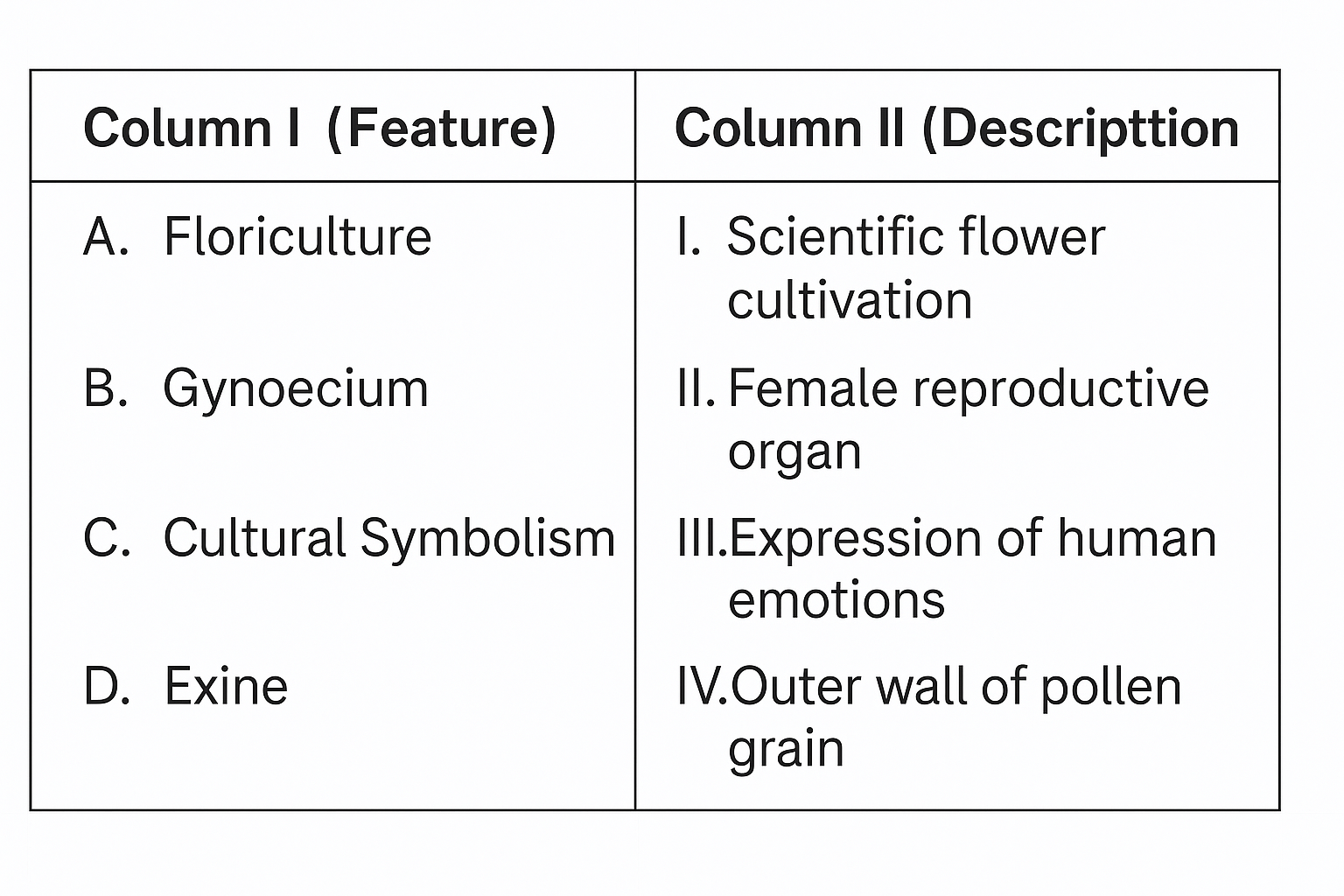
- Q2. Match the Column
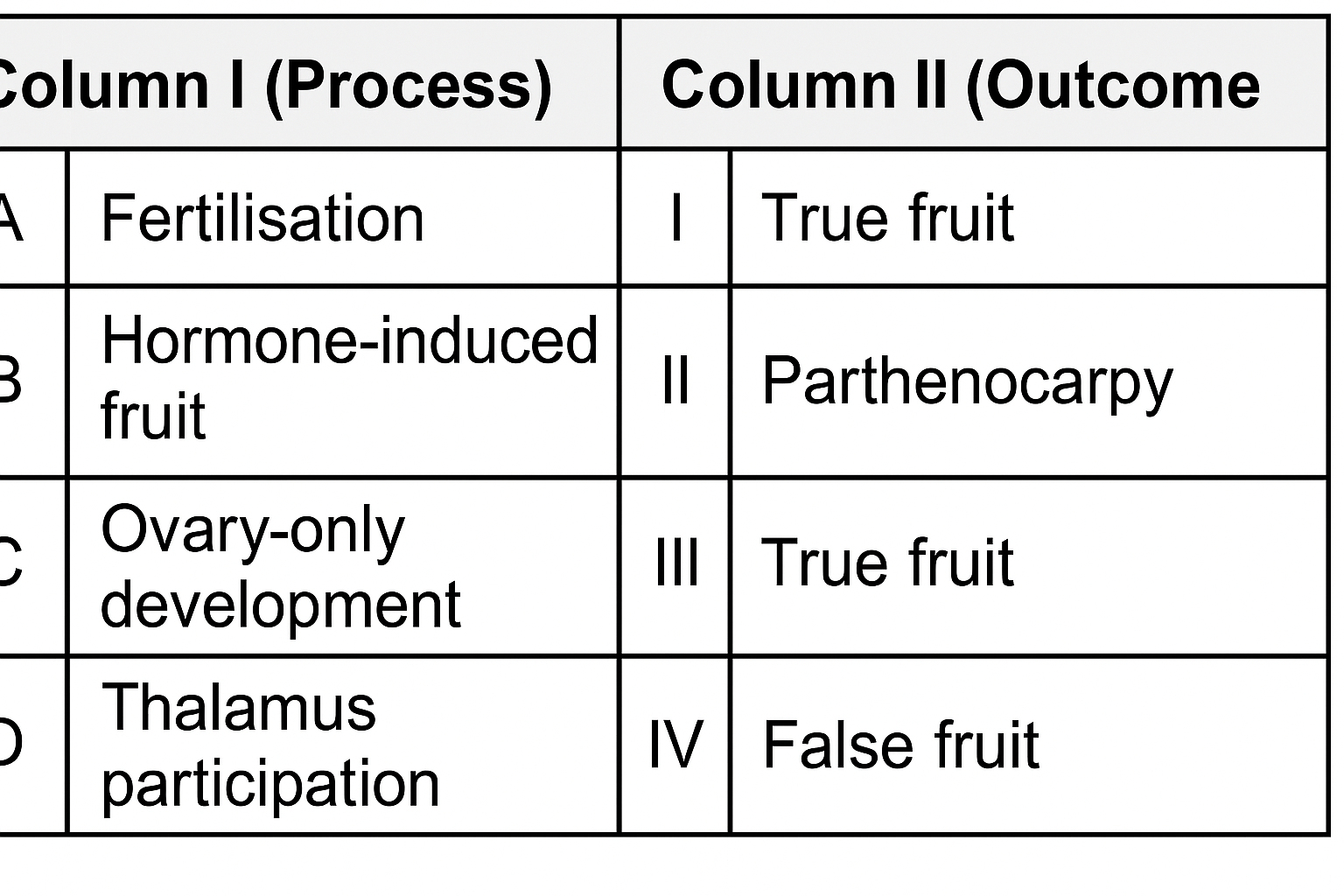
- Q3. Match the Column Column I A. Citrus and Mango B. Apomixis C. Asexual reproduction mimicking sexual reproduction D. Polyembryony Column II i. Seed formation without fertilisation ii. More than one embryo in a seed iii. Examples of polyembryony iv. Apomixis
- Q4. Match the following types of pollination / floral conditions with their correct description: Column I (Types) 1. Autogamy 2. Geitonogamy 3. Xenogamy 4. Cleistogamy 5. Chasmogamy Column II (Description) A. Flowers remain closed; ensures obligate self-pollination without external agents B. Pollen transfer within the same flower; requires synchrony of anther and stigma C. Cross-pollination between two genetically different plants D. Flowers open; expose anthers and stigma, permitting self or cross-pollination E. Pollen transfer from one flower to another flower of the same plant
- Q5. Assertion (A): Tapetum is a reproductive layer for developing microspores. Reason (R): Tapetal cells are diploid and have dense cytoplasm.
- Q6. Assertion (A): The pollen grain wall shows prominent apertures. Reason (R): Apertures lack sporopollenin.
- Q7. Arrange the following post-fertilisation events in the correct order: 1. Primary endosperm nucleus divides to form free-nuclear endosperm. 2. Ovules mature into seeds with seed coats. 3. Zygote undergoes embryogeny forming proembryo, globular, heart-shaped and mature embryo. 4. Endosperm becomes cellular after wall formation and stores food. 5. Ovary wall transforms into pericarp, forming fruit.
- Q8. Consider the following statements : 1. Pollen grains are marketed as nutrient-rich supplements in the form of energy shakes and extracts. 2. Bee pollen cream is a commercial cosmetic prepared from pollen grains. 3. In cereals such as rice and wheat, pollen grains lose viability within 30 minutes of release. 4. In members of Leguminosae, Rosaceae, and Solanaceae, pollen grains may remain viable for months. 5. Western countries have popularised the use of pollen products like tablets and syrups, claimed to boost the performance of athletes and race horses.
- Q9. Arrange the following events of double fertilisation in the correct sequence: 1. The pollen tube enters one of the synergids of the embryo sac. 2. The second male gamete fuses with two polar nuclei forming the primary endosperm nucleus (PEN). 3. One male gamete fuses with the egg cell nucleus, resulting in the diploid zygote. 4. The PEN undergoes triple fusion as it involves fusion of three haploid nuclei. 5. Both syngamy (fusion of male gamete with egg) and triple fusion together constitute double fertilisation.
- Q10. Arrange the following structures of a microsporangium from innermost to outermost: 1. Epidermis 2. Microspore mother cells 3. Tapetum 4. Endothecium 5. Middle layers
You’ve practised 10 of 302 Sexual Reproduction in Flowering Plants questions in this set.
Practise all 302 + every chapter — free app →Sample NEET PYQs — Sexual Reproduction in Flowering Plants
Which one of the following statements is not true? (1) Tapetum helps in the dehiscence of anther (2) Exine of pollen grains is made up of sporopollenin (3) Pollen grains of many species cause severe allegies (4) Stored pollen in liquid nitrogen can be used in the crop breeding programmes (NEET 2016)
- A. (1) Tapetum helps in the dehiscence of anther
- B. (2) Exine of pollen grains is made up of sporopollenin
- C. (3) Pollen grains of many species cause severe allegies
- D. (4) Stored pollen in liquid nitrogen can be used in the crop breeding programmes
Explanation: Answer: A. The statement that the tapetum helps in dehiscence of the anther is NOT true — the tapetum is the innermost wall layer that nourishes developing pollen grains, while the outer three layers (epidermis, endothecium, middle layers) protect and help in dehiscence. The other three statements are correct: exine is sporopollenin, pollen causes allergies, and pollen stored in liquid nitrogen is used in crop breeding (pollen banks). NCERT: Ch 1, p.5, lines 36-39 — "The outer three wall layers perform the function of protection and help in dehiscence of anther to release the pollen. The innermost wall layer is the tapetum. It nourishes the developing pollen grains"
Which of the following statements is not correct? (1) Pollen grains of many species can germinate on the stigma of a flower, but only one pollen tube of the same species grows into the style. (2) Insects that consume pollen or nectar without bringing about pollination are called pollen/nectar robbers. (3) Pollen germination and pollen tube growth are regulated by chemical components of pollen interacting with those of the pistil. (4) Some reptiles have also been reported as pollinators in some plant species. (NEET 2016)
- A. (1) Pollen grains of many species can germinate on the stigma of a flower, but only one pollen tube of the same species grows into the style.
- B. (2) Insects that consume pollen or nectar without bringing about pollination are called pollen/nectar robbers.
- C. (3) Pollen germination and pollen tube growth are regulated by chemical components of pollen interacting with those of the pistil.
- D. (4) Some reptiles have also been reported as pollinators in some plant species.
Explanation: Answer: A. Statement (1) is incorrect: pollen of many species germinate on a stigma, but the pistil promotes growth of only compatible pollen of the SAME species (not 'only one pollen tube') — the original NCERT idea is that the pistil recognises and accepts the right (compatible) type, not that a single tube of the same species grows. Statements (2) pollen/nectar robbers, (3) chemical pollen-pistil dialogue, and (4) reptiles as pollinators are all correct per NCERT. NCERT: Ch 1, p.16, lines 12-14 — "following compatible pollination, the pollen grain germinates on the stigma to produce a pollen tube through one of the germ pores"
Seed formation without fertilization in flowering plants involves the process of:
- A. (1) Sporulation
- B. (2) Budding
- C. (3) Somatic hybridization
- D. (4) Apomixis
Explanation: Answer: D. Production of seeds without fertilisation is apomixis, a form of asexual reproduction that mimics sexual reproduction, found in some Asteraceae and grasses. Sporulation and budding are asexual modes not involving seeds; somatic hybridisation is cell fusion in tissue culture, not seed formation. NCERT: Ch 1, p.22, lines 39-42 — "a few flowering plants ... have evolved a special mechanism, to produce seeds without fertilisation, called apomixis"
The ovule of an angiosperm is technically equivalent to
- A. (A) Megasporangium
- B. (B) Megasporophyll
- C. (C) Megaspore mother cell
- D. (D) Megaspore
Explanation: Answer: A. The ovule of an angiosperm is technically the megasporangium — NCERT explicitly equates the two. The megaspore mother cell and megaspore are cells inside the ovule, and megasporophyll is the carpel/structure bearing ovules, not the ovule itself. NCERT: Ch 1, p.9, lines 4-5 — "Arising from the placenta are the megasporangia, commonly called ovules"
Frequently Asked Questions — Sexual Reproduction in Flowering Plants NEET
How many questions from Sexual Reproduction in Flowering Plants come in NEET?+
How many Sexual Reproduction in Flowering Plants questions does MedicNEET have?+
What is the NEET weightage of Sexual Reproduction in Flowering Plants?+
Are Sexual Reproduction in Flowering Plants questions available in Hindi?+
Are Sexual Reproduction in Flowering Plants questions NCERT-based?+
What are ReNEET 2026-style reasoning Sexual Reproduction in Flowering Plants questions?+
Are these Sexual Reproduction in Flowering Plants MCQs free to practise?+
Practise Sexual Reproduction in Flowering Plants — Free
All 457+ Sexual Reproduction in Flowering Plants questions · ReNEET 2026 reasoning + every format · Bilingual Hindi & English · NCERT-mapped explanations · No paywall
📲 Download MedicNEET App (Free)