How many questions from Structural Organisation in Animals in NEET?
1–2 questions from Structural Organisation in Animals appear in NEET every year (4–8 marks, ~2% of NEET Biology). High-yield: four tissue types (epithelial/connective/muscular/neural), cockroach digestive/reproductive system, earthworm body plan, NCERT morphology diagrams. Practice all 224 questions free in bilingual Hindi & English in the MedicNEET app.
Year-wise NEET Questions — Structural Organisation in Animals
| Year | Questions | Marks |
|---|---|---|
| NEET 2016 | 2 | 8 |
| NEET 2017 | 3 | 12 |
| NEET 2018 | 1 | 4 |
| NEET 2019 | 3 | 12 |
| NEET 2020 | 2 | 8 |
| NEET 2021 | 2 | 8 |
| NEET 2022 | 2 | 8 |
| NEET 2023 | 4 | 16 |
| NEET 2024 | 2 | 8 |
| NEET 2025 | 4 | 16 |
| NEET 2026 | 2 | 8 |
Practise Structural Organisation in Animals MCQs — Free
Every Structural Organisation in Animals question format NEET uses, starting with the newest ReNEET 2026-style reasoning MCQs. Tap an option for the answer + NCERT explanation.
✨ Structural Organisation in Animals — ReNEET 2026-Style Reasoning Questions
The newest, most exam-current format — reasoning-based questions modelled on ReNEET 2026. This is where NEET is heading; practise the pattern before the exam does.
- Q1. Which among the following best explains the reason for only four basic tissue types in complex animals?
- Q2. Which of the following best describes the relationship between tissues and organs?
- Q3. Why is a group of organs like liver and intestine considered an organ system?
- Q4. Why do multicellular organisms need tissues and organ systems?
- Q5. Why is the dorsal side of the frog olive green with dark spots while the ventral side is pale yellow?
- Q6. Which structural feature allows frogs to effectively hide from predators in grassy or dry land areas?
- Q7. Frogs take shelter in deep burrows during aestivation and hibernation because:
- Q8. How does the skin of frog aid in respiration?
- Q9. How does the cloaca help in maintaining a common outlet in frogs?
- Q10. Why is respiration in frogs considered dual in nature?
You’ve practised 10 of 28 Structural Organisation in Animals questions in this set.
Practise all 28 + every chapter — free app →📑 Structural Organisation in Animals — NEET 2025 & 2026 Long-Form MCQs
The long, multi-statement questions that dominated NEET 2025 & 2026 — each covers 5-6 concepts at once, so they double as fast full-chapter revision.
- Q1. Which of the following statements are correct concerning the structural organization of multicellular animals? S1: In unicellular organisms, specialized groups of cells are responsible for performing functions like digestion and respiration. S2: All complex animals are exclusively composed of four fundamental tissue types. S3: The formation of organs from tissues and organ systems from organs facilitates more efficient and coordinated biological activities. S4: The study of the external appearance of organs or parts of the body in animals is referred to as Anatomy. S5: The heart is an exemplary organ comprising all four basic tissue types: epithelial, connective, muscular, and neural. S6: Organ systems function independently without physical or chemical interaction, showcasing their specialized roles.
- Q2. Which of the following statements are NOT correct regarding the structural organisation in animals? S1: Morphology in animals solely refers to the study of the internal arrangement of organs. S2: Anatomy is the conventional term used for the study of the external appearance of the body or its parts in animals. S3: The complexity in organ and organ systems across different animal groups does not show a discernable evolutionary trend. S4: A tissue is defined as a group of dissimilar cells that perform various unrelated functions in the body. S5: All complex animals are composed of only four basic types of tissues which are organised into organs and organ systems.
- Q3. Which of the following statements regarding the sense organs and feeding in frogs are NOT correct? S1: The tympanum in frogs is an external structure that functions only for receiving sound signals. S2: Nictitating membrane covers the bulged eyes, providing protection while the frog is in water. S3: Frogs possess well-organized internal ears, but external ears are absent. S4: The organs of touch, taste, and smell in frogs are simple cellular aggregations around nerve endings, unlike eyes and internal ears which are well-organized structures. S5: Maxillary teeth in frogs are primarily used for masticating food before swallowing.
- Q4. Match the following frog organs with their primary functions as described in the NCERT text: Column I (Organs) Kidneys Hind limbs Liver Heart Pancreas Vocal sacs Column II (Primary Function) i. Bile production ii. Filtering nitrogenous waste iii. Pumping blood iv. Swimming, walking, leaping, burrowing v. Sound production in males vi. Produces pancreatic juice containing digestive enzymes
You’ve practised 4 of 27 Structural Organisation in Animals questions in this set.
Practise all 27 + every chapter — free app →🧩 Structural Organisation in Animals — All-Format Questions — Match, Assertion-Reason, Statement & Image-Based
Every question format NEET uses — match-the-column, assertion-reason, statement-based, and image/diagram questions — not just plain MCQs. Each with an instant NCERT-referenced solution.
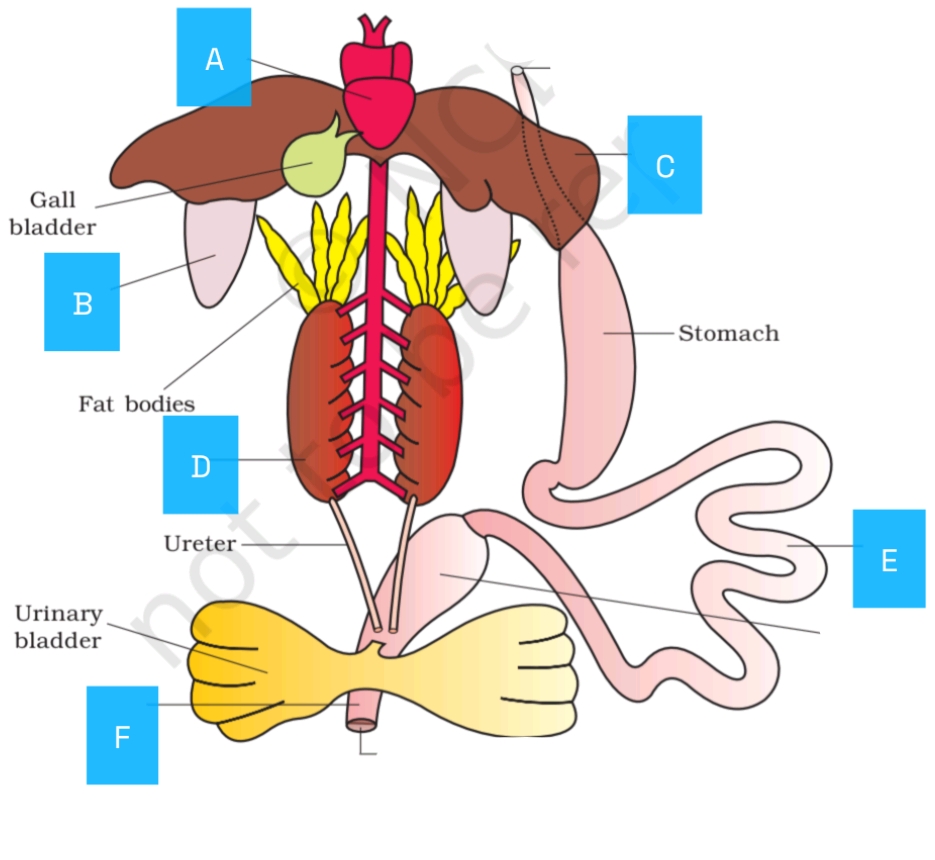
- Q1. Identify the organ labeled d in Figure
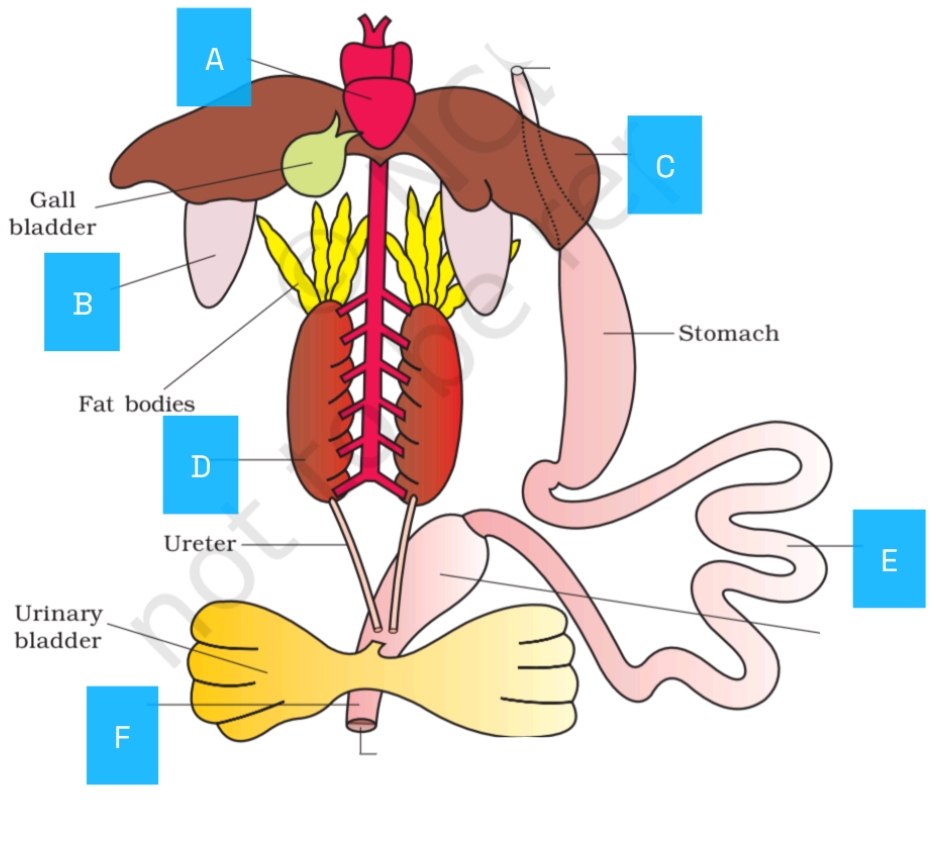
- Q2. Identify the structure labeled b in Figure
- Q3. Match the tissue with its characteristic: COLUMN I: A. Epithelial tissue B. Connective tissue C. Muscular tissue D. Neural tissue COLUMN II: i. Transmits impulses ii. Responsible for contraction iii. Binds and supports tissues iv. Forms lining and coverings
- Q4. Match the following structures of frog morphology with their respective functions: A. Nictitating membrane B. Webbed hindlimbs C. Skin D. Cloaca
- Q5. Assertion (A): Morphology refers to the external features of the body. Reason (R): Anatomy describes the shape of the body seen from outside.
- Q6. Assertion (A): Tissues are essential in multicellular organisms for specialised functions. Reason (R): Each cell in a multicellular organism performs all functions independently.
- Q7. What is the conventional meaning of the word ‘anatomy’ in animals?
- Q8. What forms an organ system in animals?
- Q9. In multicellular animals, specific functions are carried out by:
- Q10. How many basic types of tissues are present in all complex animals?
You’ve practised 10 of 182 Structural Organisation in Animals questions in this set.
Practise all 182 + every chapter — free app →Sample NEET PYQs — Structural Organisation in Animals
Which type of tissue correctly matches with its location?
- A. Tissue: Smooth muscle, Location: Wall of intestine
- B. Tissue: Areolar tissue, Location: Tendons
- C. Tissue: Transitional epithelium, Location: Tip of nose
- D. Tissue: Cuboidal epithelium, Location: Lining of stomach
Explanation: Answer: (1) Smooth muscle — Wall of intestine. Solution: The wall of the intestine (and other visceral organs) is lined by smooth (non-striated, involuntary) muscle, so (1) is the correct match. Tendons are made of dense regular connective tissue, not areolar (loose connective) tissue; the tip of the nose is supported by elastic cartilage, not transitional epithelium; and the inner lining of the stomach is columnar epithelium, not cuboidal epithelium — hence (2), (3) and (4) are wrong. NCERT (Class XI, Structural Organisation in Animals — Animal Tissues, pre-2023 rationalisation text): muscular tissue (smooth muscle) and connective/epithelial tissue locations.
Smooth muscles are
- A. Involuntary, fusiform, non-striated
- B. Voluntary, multinucleate, cylindrical
- C. Involuntary, cylindrical, striated
- D. Voluntary, spindle-shaped, uninucleate
Explanation: Answer: (1) Involuntary, fusiform, non-striated. Solution: Smooth (visceral) muscle cells are spindle-shaped (fusiform), have a single central nucleus, lack striations, and are not under voluntary control — they are found in the walls of internal hollow organs such as the alimentary canal and blood vessels. The other options describe skeletal muscle (voluntary, multinucleate, cylindrical, striated) and are therefore incorrect. NCERT (Class XI, Structural Organisation in Animals — Animal Tissues, pre-2023 rationalisation text): muscular tissue, smooth (visceral) muscle.
Frog's heart when taken out of the body continues to beat for some time. Select the best option from the following statements: (a) Frog is a poikilotherm (b) Frog does not have any coronary circulation (c) Heart is "myogenic" in nature (d) Heart is autoexcitable Options
- A. Only (c)
- B. Only (d)
- C. & (b)
- D. & (d)
Explanation: Answer: (D) (c) & (d). The vertebrate (frog) heart is myogenic — the heartbeat originates within the cardiac muscle itself — and it is autoexcitable, so the isolated heart keeps contracting rhythmically for some time even after removal from the body, because it does not depend on external nerve stimulation. Statements (a) and (b), though factually about frogs, do not explain the continued beating. NCERT (Class XI, Ch 7 Structural Organisation in Animals): p.82, lines 41-42 — "The circulation of blood is achieved by the pumping action of the muscular heart."
Select the correct route for the passage of sperms in male frogs:
- A. Testes → Bidder's canal → Kidney → Vasa efferentia → Urinogenital duct → Cloaca
- B. Testes → Vasa efferentia → Kidney → Seminal Vesicle → Urinogenital duct → Cloaca
- C. Testes → Vasa efferentia → Bidder's canal → Ureter → Cloaca
- D. Testes → Vasa efferentia → Kidney → Bidder's canal → Urinogenital duct → Cloaca
Explanation: Answer: (D) Testes → Vasa efferentia → Kidney → Bidder's canal → Urinogenital duct → Cloaca. Vasa efferentia (10-12) arise from the testes, enter the kidneys and open into Bidder's canal, which then communicates with the urinogenital duct that comes out of the kidneys and opens into the cloaca. NCERT (Class XI, Ch 7 Structural Organisation in Animals): p.83-84, lines 51-4 — "Vasa efferentia are 10-12 in number that arise from testes. They enter the kidneys on their side and open into Bidder’s canal. Finally it communicates with the urinogenital duct that comes out of the kidneys and opens into the cloaca."
Frequently Asked Questions — Structural Organisation in Animals NEET
How many questions from Structural Organisation in Animals come in NEET?+
How many Structural Organisation in Animals questions does MedicNEET have?+
What is the NEET weightage of Structural Organisation in Animals?+
Are Structural Organisation in Animals questions available in Hindi?+
Are Structural Organisation in Animals questions NCERT-based?+
What are ReNEET 2026-style reasoning Structural Organisation in Animals questions?+
Are these Structural Organisation in Animals MCQs free to practise?+
Practise Structural Organisation in Animals — Free
All 237+ Structural Organisation in Animals questions · ReNEET 2026 reasoning + every format · Bilingual Hindi & English · NCERT-mapped explanations · No paywall
📲 Download MedicNEET App (Free)