Friction Questions for NEET 2027All 35 problems — MCQs, numericals & ReNEET 2026-style reasoning, with worked solutions
Every Friction question NEET has asked and the newest exam-style ones — free, no login. Tap an option for an instant worked solution.
✨ Practise all 35 Friction Questions
Friction is a high-yield part of Laws of Motion. This is the complete set — real NEET PYQs plus ReNEET 2026-style reasoning, each with an instant worked solution.
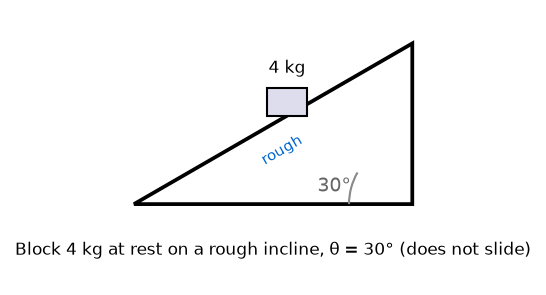
- Q1. A block of mass 4 kg is placed at rest on a rough inclined plane of inclination 30° and does not slide. The force of friction acting on the block is (g = 10 m/s²):
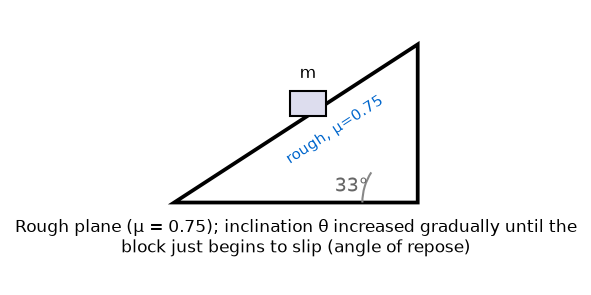
- Q2. A block is placed on a rough plane whose inclination is increased gradually. The coefficient of static friction is μ = 0.75. The maximum angle of inclination (angle of repose) for which the block remains at rest is approximately:
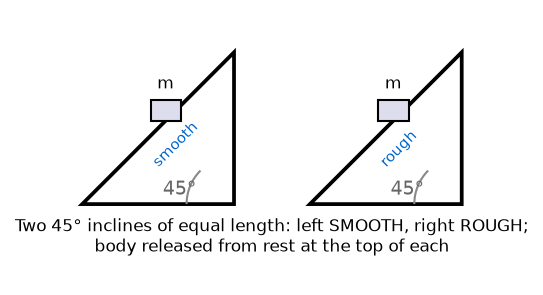
- Q3. Two inclined planes of equal length have the same inclination of 45°; one is perfectly smooth, the other rough. A body released from rest at the top takes twice as long to slide down the rough incline as down the smooth one. The coefficient of kinetic friction for the rough incline is:
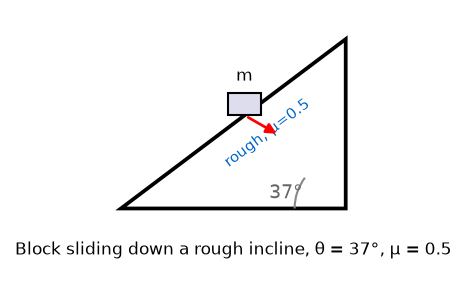
- Q4. A block slides down a rough inclined plane of inclination 37° with coefficient of kinetic friction μ = 0.5. Its acceleration down the incline is (sin37° = 0.6, cos37° = 0.8, g = 10 m/s²):
- Q5. A block of mass 2 kg moving at 8 m/s on a rough horizontal surface (μ = 0.2) is brought to rest by friction. The distance travelled before stopping is (g = 10 m/s²):
- Q6. A block rests on the floor of a truck. The coefficient of static friction between the block and the floor is 0.4. The maximum acceleration with which the truck can move so that the block does not slip is (g = 10 m/s²):
- Q7. A 10 kg block rests on a rough floor with μ_s = 0.5 and μ_k = 0.4. A horizontal force of 60 N is applied. The acceleration of the block is (g = 10 m/s²):
- Q8. A body of mass 5 kg rests on a rough horizontal surface (μ = 0.75). When it is on the verge of moving, the resultant of the normal reaction and the limiting friction force exerted by the surface on the body is (g = 10 m/s²):
- Q9. A block rests on an inclined plane. The coefficient of static friction between the block and the plane is 1/√3. What is the maximum angle of inclination θ_max with the horizontal at which the block will just begin to slide?
- Q10. A block of mass 5 kg rests on a horizontal surface with coefficient of static friction μₛ = 0.3. A horizontal force of 12 N is applied to the block, but it remains stationary. What is the magnitude of the frictional force acting on the block? (Take g = 10 m/s²)
- Q11. A horizontal conveyor belt moves at a constant speed of 3 m/s. A small package of mass 2 kg is gently placed on the moving belt. If the coefficient of kinetic friction between the package and the belt is 0.3, how long will it take for the package to stop sliding relative to the belt? (Take g = 10 m/s²)
- Q12. A block of mass 5 kg rests on a horizontal surface. The coefficient of static friction between the block and the surface is 0.4. What is the minimum horizontal force required to just start moving the block? (Take g = 10 m/s²)
- Q13. A block of weight rests on a rough horizontal floor for which . A horizontal push of is applied, but the block stays still. The friction force on the block is:
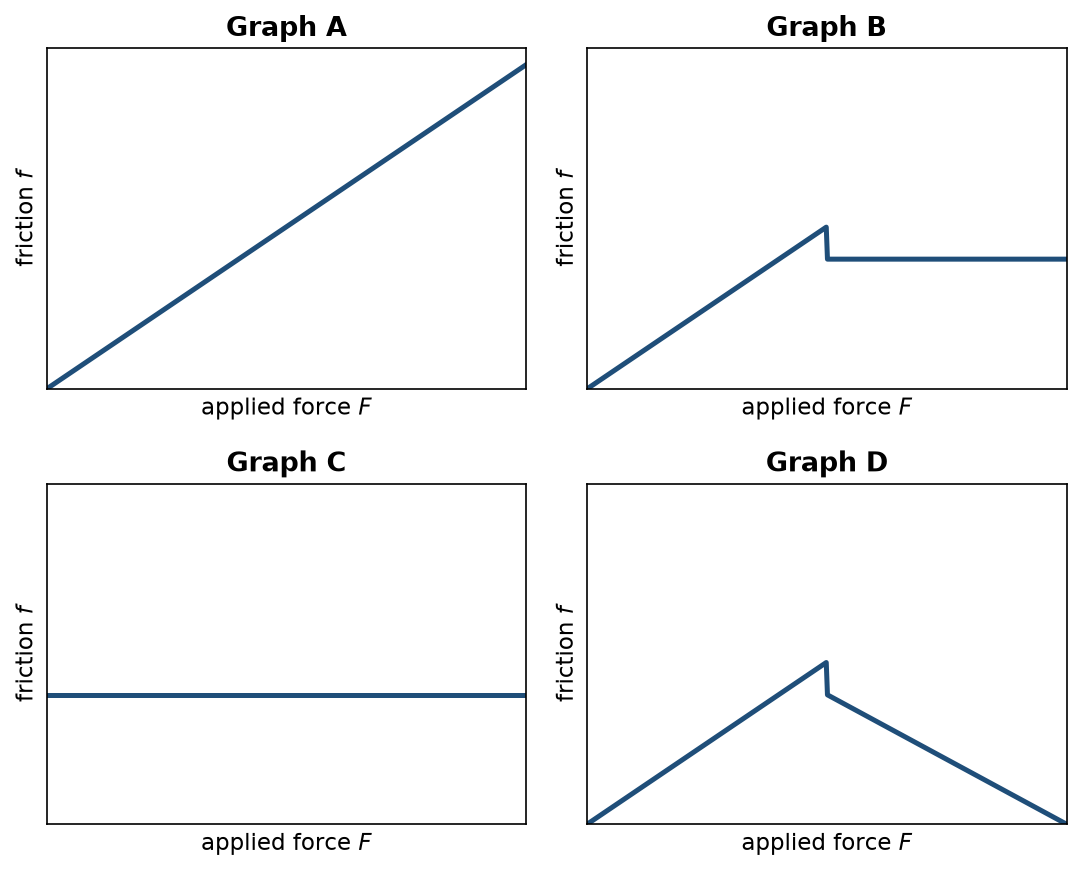
- Q14. A block sits on a rough floor. A horizontal force on it is increased slowly from zero until the block slides and then keeps increasing. Which graph correctly shows the friction force on the block versus the applied force ?
- Q15. A block rests on a rough floor with and (). The horizontal pull is slowly raised. Just after the block starts to slide (the pull equal to the maximum static friction), its acceleration is:
- Q16. Two identical blocks rest on the same rough floor. Block is pulled by a horizontal force equal to HALF its limiting friction; block by a force equal to TWICE its limiting friction. Which statement is correct?
- Q17. A box lies on the floor of a truck. The truck accelerates forward at and the box does not slip. The minimum coefficient of static friction between the box and the floor must be (with the acceleration due to gravity):
- Q18. A block slides down a rough incline of angle () for which . Taking , the acceleration of the block is:
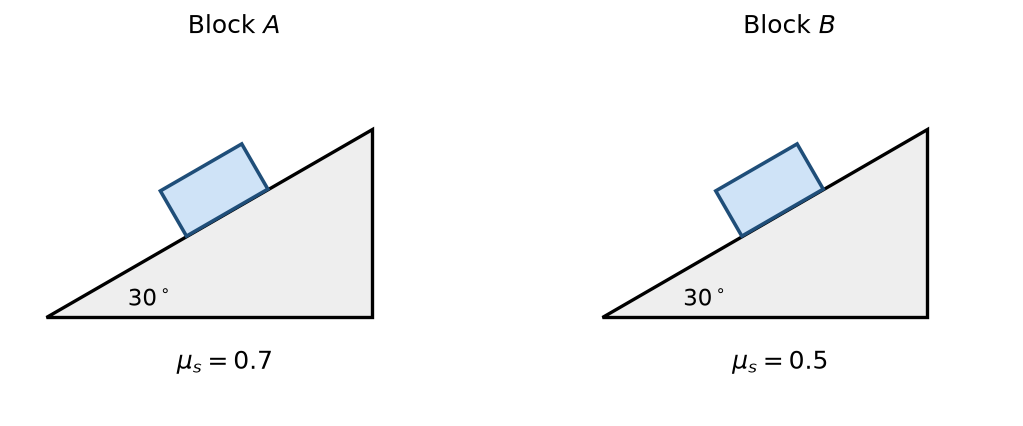
- Q19. Two blocks rest on two inclines that have the SAME angle (). The surface under block has and that under block has . Which block stays at rest?
- Q20. A block rests in equilibrium on a rough incline whose angle is less than the angle at which the block would begin to slide. The friction force on the block is:
- Q21. A light wooden block and a heavy wooden block of the SAME material are placed on a rough plank, and the plank is slowly tilted. Which block begins to slide first?
- Q22. Static friction is called a 'self-adjusting' force because:
- Q23. A block on a plane just begins to slide when the plane is tilted to an angle . The coefficient of static friction is then:
- Q24. A block is projected UP a rough incline of angle with kinetic friction coefficient . While the block moves up, its deceleration (retardation) is:
- Q25. A block is projected up a rough incline of angle with coefficient of kinetic friction . The ratio of its retardation while moving up to its acceleration while sliding back down is:
- Q26. A block of mass is pulled along a horizontal floor by a rope inclined at angle above the horizontal with tension . The normal force exerted by the floor on the block is:
- Q27. A block on a rough horizontal floor () is pushed by a force of directed at BELOW the horizontal (). The acceleration of the block is:
- Q28. A block of mass rests on a rough horizontal floor with coefficient of static friction . It is pulled by a rope making above the horizontal (). The tension at which the block is just about to start moving is:
- Q29. Which of the following statements about friction is INCORRECT? (1) The coefficient of friction μ is a dimensionless quantity. (2) The force of limiting static friction is directly proportional to the normal reaction. (3) The force of kinetic friction depends strongly on the area of contact between the surfaces. (4) Friction opposes the relative motion (or its tendency) between surfaces in contact.
- Q30. Which of the following statements about friction is CORRECT?
- Q31. A block just begins to slide down a rough inclined plane when the inclination equals the angle of repose θ. The coefficient of friction is μ. The correct relation is:
- Q32. Given below are two statements: Statement I: Static friction always opposes the APPLIED tangential force (or impending motion), not the eventual motion. Statement II: Once a block has been set in motion by a small applied force, the kinetic friction force has a constant magnitude μ_k · N, independent of the applied force. In the light of the above statements, choose the correct answer from the options given below.
- Q33. For the same pair of surfaces, the coefficients of static (μs), kinetic (μk) and rolling (μr) friction are compared. Which ordering is correct, with the right reason?
- Q34. A horizontal force F is applied to a block resting on a rough horizontal surface. The applied force is gradually increased from zero. Which of the following correctly describes the graph of the friction force f on the block versus the applied force F?
Struggling with the tough-level Friction questions? The ReNEET 2026 question paper changed — it’s harder than ever. Download the free MedicNEET app to climb from the easiest level to the toughest in Friction and every concept.
Download the app — climb every level →Friction — FAQs
How many Friction questions are on this page?
All 35 — this is a complete Friction question set for NEET 2027, covering MCQs, numericals and problems drawn from real previous-year questions and ReNEET 2026-style reasoning. Every question shows a worked solution the moment you answer.
Are these Friction questions free?
Yes — practise all 35 here free, no login. Friction is part of the Laws of Motion chapter; the free MedicNEET app then lets you practise it the way it actually raises your score — adaptively.
What is the best way to master Friction for NEET?
Practising every Friction problem once (as you can here) fixes the patterns; retaining them till the exam needs spaced repetition. The MedicNEET app's Predicted Batch schedules Friction and every other topic one step ahead of where you are, so you revise exactly when you're about to forget — that's what converts practice into marks.