A car is negotiating a curved road of radius R. The road is banked at an angle θ and the coefficient of friction between the tyres and the road is μs. The maximum safe velocity on this road is:
What is the minimum velocity with which a body of mass m must enter a vertical loop of radius R so that it can complete the loop?
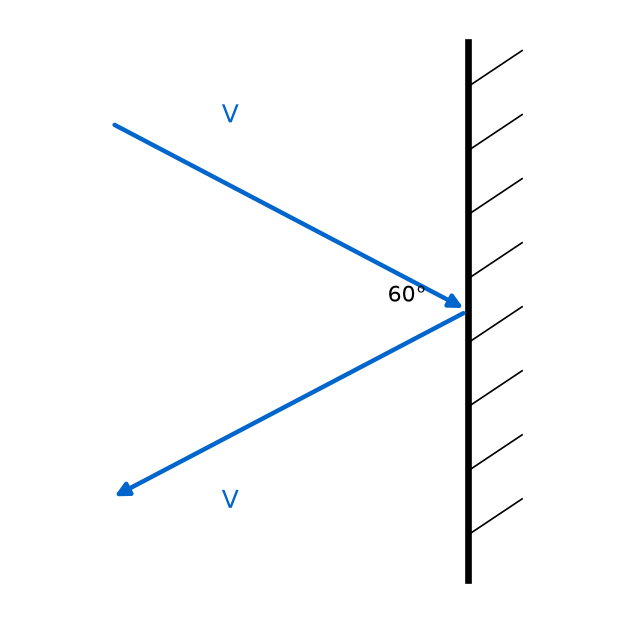
A rigid ball of mass m strikes a rigid wall at 60° and gets reflected without loss of speed, as shown in the figure. The value of the impulse imparted by the wall on the ball is:
Two identical balls A and B having velocities 0.5 m/s and −0.3 m/s respectively collide elastically in one dimension. The velocities of B and A after the collision, respectively, will be:
A bullet of mass 10 g moving horizontally at 400 m/s strikes a wooden block of mass 2 kg suspended by a light inextensible string of length 5 m. The centre of gravity of the block is found to rise a vertical distance of 10 cm. The speed of the bullet after it emerges horizontally from the block is:
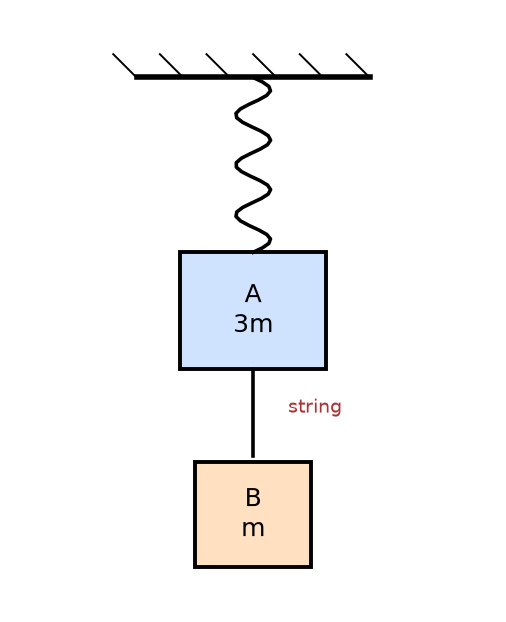
Two blocks A and B of masses 3m and m respectively are connected by a massless inextensible string. The whole system is suspended from a massless spring as shown. The magnitudes of the accelerations of A and B immediately after the string is cut are, respectively:
Two ways to go deeper on this chapter
Choose your next step
One end of a string of length l is connected to a particle of mass m and the other end to a small peg on a smooth horizontal table. If the particle moves in a circle with speed v, the net force on the particle (directed towards the centre) is (T = tension in the string):
A moving block of mass m collides with a stationary block of mass 4m. The lighter block comes to rest after the collision. If the initial velocity of the lighter block is v, the coefficient of restitution (e) is:
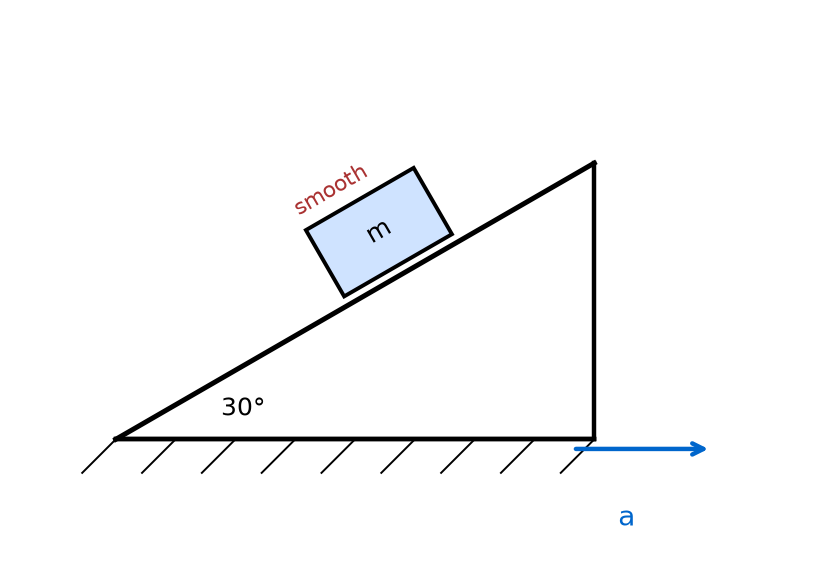
A block of mass m is placed on a smooth inclined wedge ABC of inclination θ. The wedge is given a horizontal acceleration 'a' towards the right. The relation between a and θ for the block to remain stationary on the wedge is:
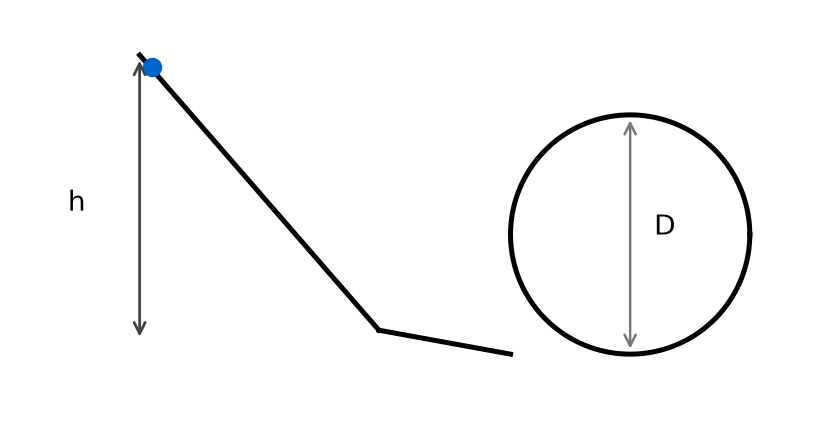
A body, initially at rest, slides down a frictionless track from a height h (as shown) and just completes a vertical circle of diameter AB = D. The height h is equal to:
Which one of the following statements is incorrect?
A mass m is attached to a thin wire and whirled in a vertical circle. The wire is most likely to break when:
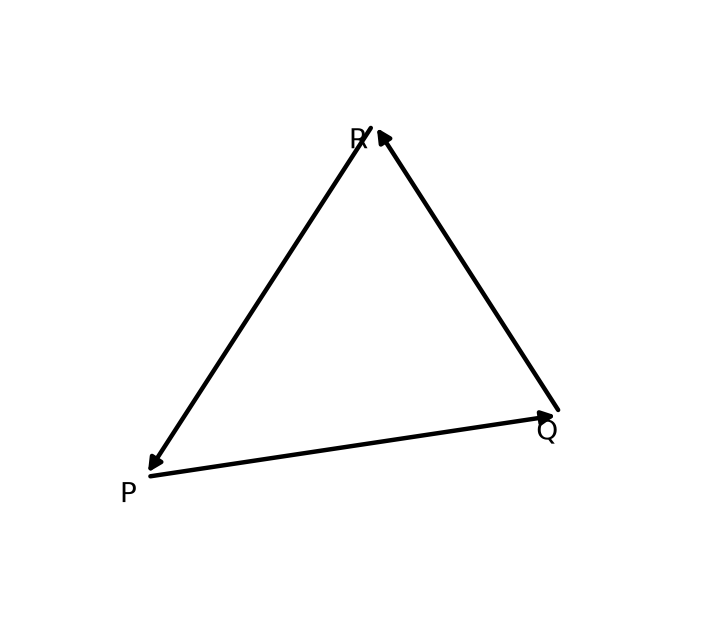
A particle moving with velocity V is acted upon by three forces represented by the sides of a triangle PQR (taken in order). The velocity of the particle will:
A particle of mass 5m at rest suddenly breaks on its own into three fragments. Two fragments, of mass m each, move along mutually perpendicular directions with speed v each. The energy released during the process is:
A block of mass 10 kg is in contact with the inner wall of a hollow cylindrical drum of radius 1 m. The coefficient of friction between the block and the wall is 0.1. The minimum angular velocity of the drum (rotating about its vertical axis) needed to keep the block stationary is (g = 10 m/s²):
A ball of mass 0.15 kg is dropped from a height of 10 m, strikes the ground and rebounds to the same height. The magnitude of the impulse imparted to the ball is nearly (g = 10 m/s²):
A shell of mass m is initially at rest. It explodes into three fragments having masses in the ratio 2 : 2 : 1. The two equal fragments fly off along mutually perpendicular directions, each with speed v. The speed of the third (lighter) fragment is:
A 1 kg object strikes a wall with a velocity of 1 m/s at an angle of 60° with the wall and reflects at the same angle. If it remains in contact with the wall for 0.1 s, the force exerted on the wall is:
Calculate the maximum acceleration of a moving car so that a body lying on the floor of the car remains stationary. The coefficient of static friction between the body and the floor is 0.15 (g = 10 m/s²):
A football player moving southward suddenly turns eastward with the same speed to avoid an opponent. The force that acts on the player while turning is directed:
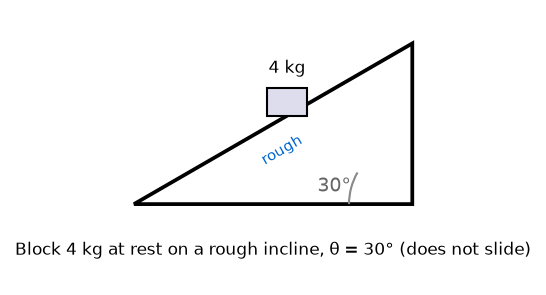
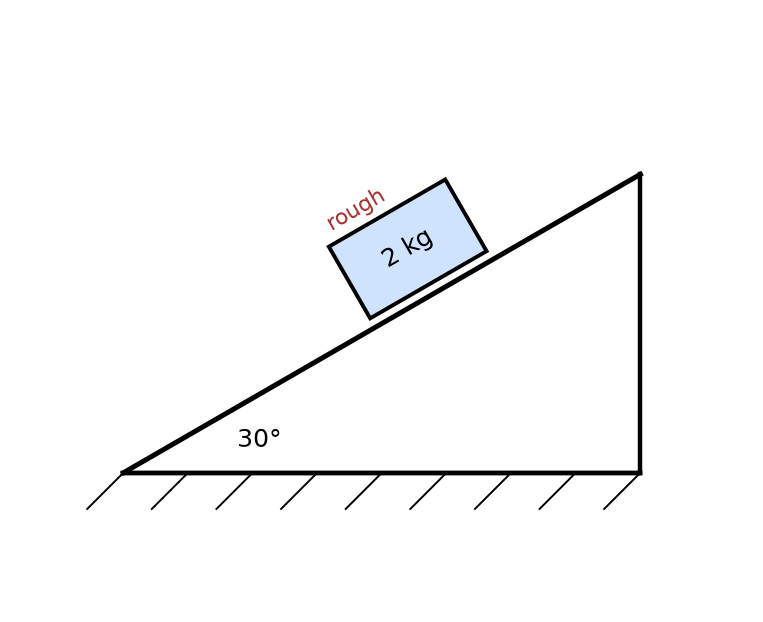
A block of mass 2 kg is placed on a rough inclined surface AC (as shown) of coefficient of friction μ. It remains at rest. Taking g = 10 m/s², the net force on the block is:
A bob is suspended by a light string from the roof of a truck. The truck, initially stationary, suddenly moves to the right with acceleration a. The pendulum will tilt:
Two bodies A and B of the same mass undergo a completely inelastic one-dimensional collision. A moves with velocity v₁ while B is at rest before the collision. The velocity of the combined system after collision is v₂. The ratio v₁ : v₂ is:
An object flying in air with velocity (20î + 25ĵ + 12k̂) suddenly breaks into two pieces whose masses are in the ratio 1 : 5. The smaller mass flies off with a velocity (100î + 35ĵ + 8k̂). The velocity of the larger piece will be:
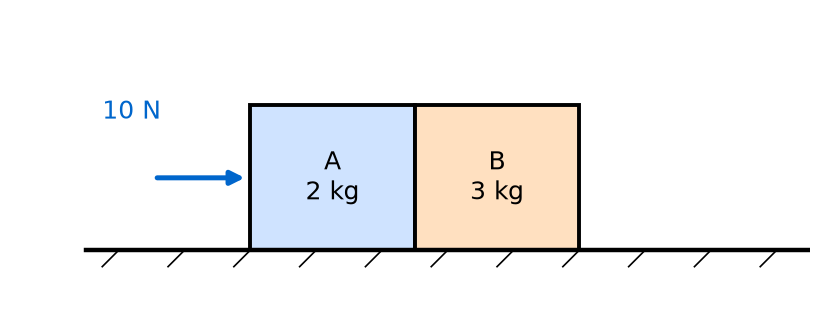
A horizontal force of 10 N is applied to block A, which is in contact with and pushes block B on a frictionless horizontal surface. The masses of A and B are 2 kg and 3 kg respectively. The force exerted by block A on block B is:
A bob is whirled in a horizontal circle by a string at an initial angular speed ω, and the tension in the string is T. If the angular speed becomes 2ω at the same radius, the tension becomes:
A body of mass m is kept on a rough horizontal surface (coefficient of friction μ). A horizontal force is applied but the body does not move. The magnitude of the resultant F of the normal reaction and the frictional force satisfies:
A person standing on the floor of an elevator drops a coin. The coin reaches the floor in time t₁ if the elevator is at rest, and in time t₂ if the elevator is moving uniformly. Then:
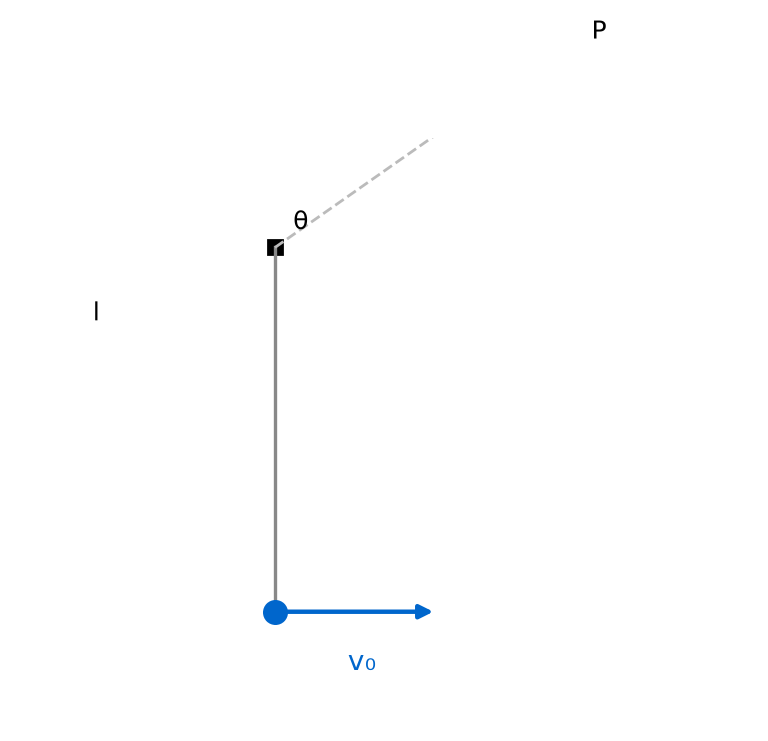
A bob of mass m is suspended by a light string of length l and given a horizontal velocity v₀ at the lowest point. The string goes slack at a point P where it makes an angle θ above the horizontal. The ratio of the speed v at P to the initial speed v₀ is:
A ball of mass 0.5 kg is dropped from a height of 40 m. It hits the ground and rebounds to a height of 10 m. The impulse imparted to the ball during its collision with the ground is (g = 9.8 m/s²):
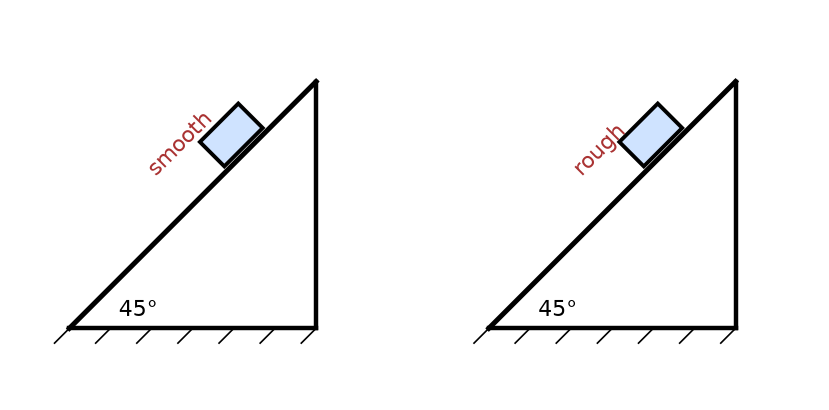
There are two inclined surfaces of equal length L and the same inclination 45° with the horizontal; one is rough and the other perfectly smooth. A given body takes 2 times as much time to slide down the rough surface as the smooth surface. The coefficient of kinetic friction (μk) between the body and the rough surface is close to:
A box of mass 15 kg is kept on the floor of a stationary trolley. The coefficient of static friction between the box and the trolley is 0.12. Keeping the box stationary relative to the trolley, the maximum horizontal acceleration with which the trolley can be moved is (g = 10 m/s²):
A car travels on a circular racetrack of radius $50\,$m, banked at angle $\theta$. If the car travels at a speed $10\,\text{ms}^{-1}$, the wear and tear on its tyres is minimum. Taking $g=10\,\text{ms}^{-2}$, the value of $\theta$ is:
The magnitude and direction of the acceleration produced in a body of mass 5 kg when two mutually perpendicular forces 8 N and 6 N act on it are, respectively:
Want more Laws Of Motion questions?
MedicNEET has 43,000+ NEET-style questions across Physics, Chemistry & Biology with detailed NCERT-based explanations — including the long, tricky questions that actually come in the exam.
Download MedicNEET App — Free