Year-wise Weightage (2016–2026)

YearQuestions AskedMarks
2026416
202528
202428
2023312
202214
Show earlier years (2016–2021)
202128
2020
2019520
201828
201714
2016624
Q1
NEET 2016 Phase 2

A bullet of mass 10 g moving horizontally with a velocity of 400 m/s strikes a wooden block of mass 2 kg suspended by a light inextensible string of length 5 m. As a result the centre of gravity of the block rises a vertical distance of 10 cm. The speed of the bullet after it emerges horizontally from the block is

Q2
NEET 2016 Phase 1

A body of mass 1 kg begins to move under the action of a time-dependent force F=(2t î+3t² ĵ) N, where î and ĵ are unit vectors along the x and y axes. What power will be developed by the force at time t?

Q3
NEET 2016 Phase 1

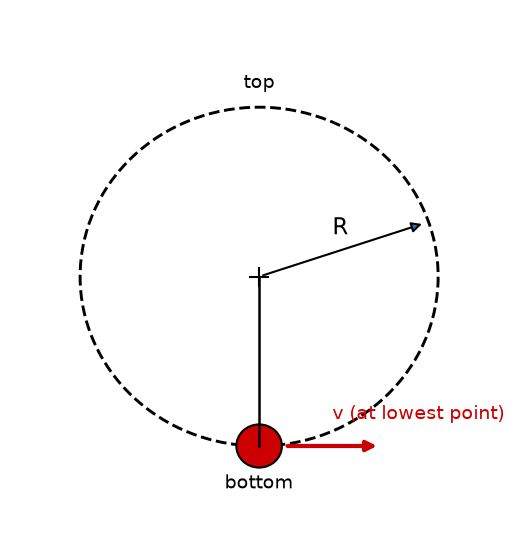
What is the minimum velocity with which a body of mass m must enter a vertical loop of radius R at the lowest point so that it can complete the loop?

Q4
NEET 2016 Phase 2

Two identical balls A and B having velocities of 0.5 m/s and -0.3 m/s respectively collide elastically in one dimension. The velocities of B and A after the collision will respectively be

Q5
NEET 2016 Phase 1

A particle of mass 10 g moves along a circle of radius 6.4 cm with a constant tangential acceleration. The magnitude of this acceleration, if the kinetic energy of the particle becomes equal to 8×10⁻⁴ J by the end of the second revolution after the beginning of the motion, is

Q6
NEET 2016 Phase 2

A particle moves from a point (-2î+5ĵ) to (4ĵ+3k̂) when a force of (4î+3ĵ) N is applied. How much work is done by the force?

Q7
NEET 2017

Consider a drop of rain water having mass 1 g falling from a height of 1 km. It hits the ground with a speed of 50 m/s. Take g constant with a value 10 m/s². The work done by the (i) gravitational force and the (ii) resistive force of air is

Q8
NEET 2018

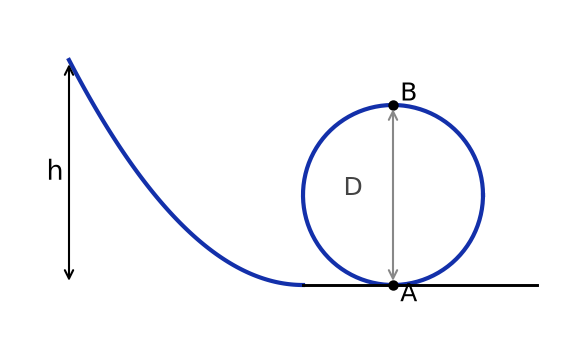
A body initially at rest, sliding along a frictionless track from a height h, just completes a vertical circle of diameter AB=D. The height h is equal to
Work, Energy And Power NEET PYQ diagram
Q9
NEET 2018

A moving block of mass m collides with another stationary block of mass 4m. The lighter block comes to rest after the collision. When the initial velocity of the lighter block is v, the value of the coefficient of restitution (e) is

Q10
NEET 2019 Odisha

A particle of mass 5m at rest suddenly breaks on its own into three fragments. Two fragments of mass m each move along mutually perpendicular directions with speed v each. The energy released during the process is

Q11
NEET 2019

When an object is shot up a long smooth inclined plane kept at 60^° with the horizontal, it travels a distance x₁ along the plane. When the inclination is decreased to 30^° and the same object is shot with the same velocity, it travels a distance x₂. Then x₁:x₂ will be

Q12
NEET 2019

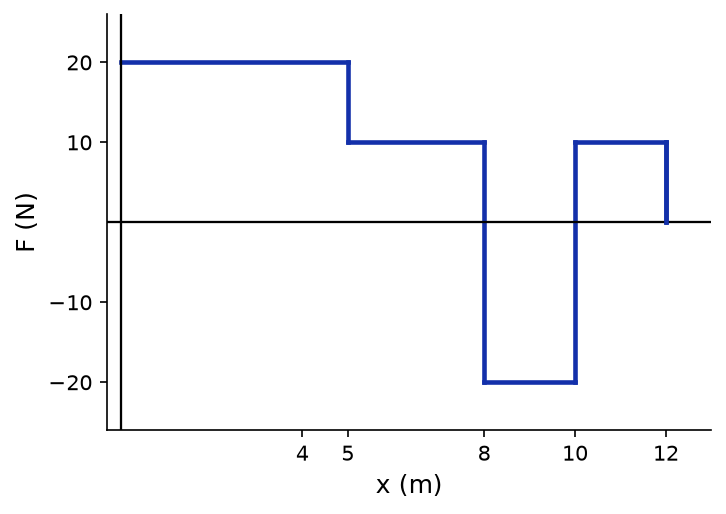
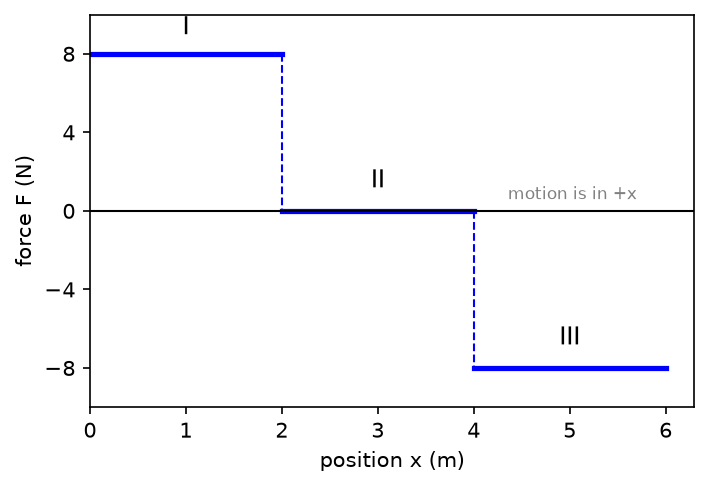
An object of mass 500 g, initially at rest, is acted upon by a variable force whose X-component varies with X as shown in the graph. The velocities of the object at the points X = 8 m and X = 12 m would be, respectively (nearly)
Work, Energy And Power NEET PYQ diagram
Q13
NEET 2019

A force F=20+10y acts on a particle in the y-direction, where F is in newton and y in metre. The work done by this force to move the particle from y=0 to y=1 m is

Q14
NEET 2019

Body A of mass 4m moving with speed u collides with another body B of mass 2m at rest. The collision is head-on and elastic in nature. After the collision the fraction of energy lost by the colliding body A is

Q15
NEET 2021

Water falls from a height of 60 m at the rate of 15 kg/s to operate a turbine. The losses due to frictional force are 10% of the input energy. How much power is generated by the turbine? (g=10 m/s²)

Q16
NEET 2021

A particle is released from height S from the surface of the Earth. At a certain height its kinetic energy is three times its potential energy. The height from the surface of the Earth and the speed of the particle at that instant are respectively

Q17
NEET 2022

An electric lift with a maximum load of 2000 kg (lift + passengers) is moving up with a constant speed of 1.5 m/s. The frictional force opposing the motion is 3000 N. The minimum power delivered by the motor to the lift (in watts) is (g=10 m/s²)

Q18
NEET 2023 Phase 2

A particle moves with a velocity (6î-4ĵ+3k̂) m/s under the action of a constant force F=(10î+10ĵ+20k̂) N. The instantaneous power applied to the particle is

Q19
NEET 2023 Phase 2

A bullet of mass m hits a block of mass M elastically. The transfer of energy is maximum when

Q20
NEET 2023 Phase 2

The potential energy of a spring when stretched by 2 cm is U. If the spring is stretched by 8 cm, the potential energy stored in it will be

Q21
NEET 2024

Two bodies A and B of the same mass undergo a completely inelastic one-dimensional collision. Body A moves with velocity v₁ while body B is at rest before the collision. The velocity of the system after collision is v₂. The ratio v₁:v₂ is

Q22
NEET 2024

At any instant of time t, the displacement of a particle is given by x=2t-1 (SI units), under the influence of a force of 5 N. The value of the instantaneous power is (in SI units)

Q23
NEET 2025

The kinetic energies of two similar cars A and B are 100 J and 225 J respectively. On applying brakes, car A stops after 1000 m and car B stops after 1500 m. If F_A and F_B are the braking forces on cars A and B respectively, then the ratio F_A/F_B is

Q24
NEET 2025

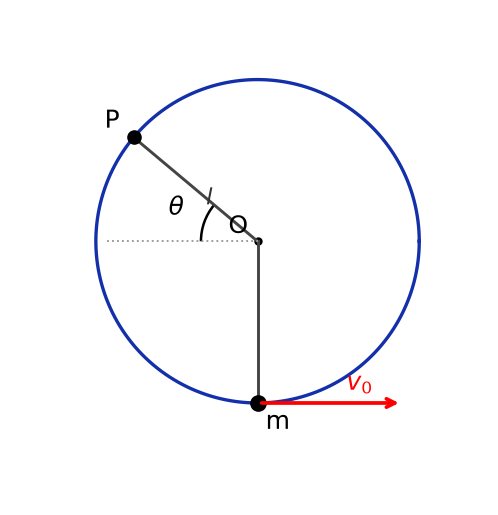
A bob of heavy mass m is suspended by a light string of length l. The bob is given a horizontal velocity v₀ at the lowest point. If the string goes slack at some point P making an angle θ from the horizontal, the ratio of the speed v of the bob at P to its initial speed v₀ is
Work, Energy And Power NEET PYQ diagram
Q25
ReNEET 2026

A particle of mass $M$ moves along a horizontal $x$-axis from $x=0$ to $x=L$. The coefficient of kinetic friction varies as $\mu_k(x)=\mu_0-\alpha x$, where $\mu_0,\alpha$ are constants of appropriate dimensions, so that $\mu_k(L)=0$. The total work done by the frictional force during the motion is $n\mu_0 MgL$. The value of $n$ is:

Q26
ReNEET 2026

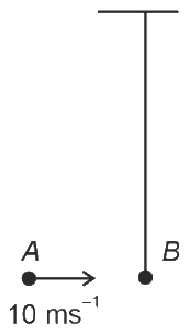
A bob $B$ of mass $m$ hangs at rest vertically from the ceiling by a massless string of length $10\,$m. A point mass $A$ of mass $m$ travelling horizontally with speed $10\,\text{ms}^{-1}$ hits bob $B$ elastically. The bob $B$ rises $h$ metre after the collision. Taking $g=10\,\text{ms}^{-2}$ and neglecting the size of the bob, the value of $h$ is:
Work, Energy And Power NEET PYQ diagram
Q27
NEET 2026 (1)

The sum of the kinetic energy and potential energy of a simple pendulum bob is 0.02 J. The speed of the bob at the equilibrium position is approximately (mass of the bob = 20 g)

Q28
NEET 2026 (1)

The power of a crane, which lifts a mass of 1000 kg to a height of 20 m in 10 s, is (g=9.8 m/s²)

Want more Work, Energy And Power questions?

MedicNEET has 14,000+ NEET-style Biology questions with detailed NCERT-based explanations — including long, tricky questions that actually come in the exam.

Download MedicNEET App — Free
Practise Work, Energy And Power MCQs — Free

Beyond the PYQs above — every Physics question format NEET now uses, starting with the newest ReNEET 2026-style reasoning MCQs. Tap an option for the answer and a worked solution. Free, no login.

🔢 Work, Energy And PowerNumericals — PYQ-Based

Exam-style numericals seeded from real NEET previous-year questions, kept inside the NEET syllabus boundary. Each with a worked solution.

  1. Q1. A body of mass 2 kg, initially at rest, moves along the x-axis under a position-dependent force F=(3x²-6) N. Its speed at x=3 m is
  2. Q2. A force acting on a particle along the x-axis varies as F=5x N (with x in metre). The work done in moving the particle from x=2 m to x=4 m is
  3. Q3. A particle of mass m moving with speed u makes a head-on elastic collision with a stationary particle of mass 2m. The fraction of the initial kinetic energy lost by the incident particle is
  4. Q4. A particle of mass 2 kg starts from rest at the origin and moves under the action of a time-dependent force F = (4t î + 6t² ĵ) N, where î and ĵ are unit vectors along the x and y axes, respectively. The particle also experiences a constant resistive force f = (−2 î − 2 ĵ) N throughout its motion. What is the instantaneous power delivered by the net force at time t = 2 s?
  5. Q5. A block of mass 2 kg is pulled along a frictionless horizontal surface by a time-dependent force F = (6t) N, where t is in seconds. The block starts from rest at t = 0. What is the instantaneous power delivered to the block at t = 3 seconds?
  6. Q6. A ball of mass 2m moving with speed u undergoes a head-on elastic collision with another ball of mass m at rest. After the collision, the fraction of kinetic energy retained by the first ball is:
  7. Q7. A particle is released from rest at a height of 40 m above the ground. At a certain point during its fall, its kinetic energy is found to be twice its potential energy at that point. The height of the particle from the ground at this instant and its speed are respectively:
  8. Q8. Two identical balls each of mass m undergo a completely inelastic collision. Ball A is moving with velocity 12 m/s while ball B is at rest. After collision, they move together. What is the ratio of total kinetic energy before collision to total kinetic energy after collision?
  9. Q9. A particle is projected vertically upward with an initial speed of 20 m/s from ground level. At what height above the ground will its kinetic energy be equal to its potential energy? (Take g = 10 m/s²)
  10. Q10. A water pump lifts 200 kg of water per minute to a height of 15 m. If 20% of the electrical energy supplied is lost as heat, what is the electrical power input required? (Take g = 10 m/s²)

You’ve practised 10 of 81 Work, Energy And Power questions in this set.

Practise all 81 + every chapter — free app →

📘 Work, Energy And PowerConceptual Theory MCQs

Theory MCQs — assertion-reason, statement and standard — for the part of the physics paper that isn't numericals.

  1. Q1. For a collision between two bodies, the coefficient of restitution e is defined as the ratio of the relative velocity of separation after the collision to the relative velocity of approach before the collision. Which of the following statements is correct?
  2. Q2. A projectile is launched from ground level with initial speed v and angle θ above the horizontal. Ignoring air resistance, what is its speed when it returns to the same height (ground level) on the way down?
  3. Q3. A body moves in a vertical circle with the minimum speed required to just complete the loop. At the highest point, the centripetal force on the body is provided by
  4. Q4. A moving body undergoes a two-dimensional elastic collision with another body of equal mass that is initially at rest. After the collision, the angle between the velocities of the two bodies is
  5. Q5. A particle moves in a potential U(x) and is at a point where dU/dx = 0. Which condition on U(x) at this point corresponds to STABLE equilibrium?
  6. Q6. A collision in which the kinetic energy of the colliding bodies is conserved but the bodies do not stick together is called:
  7. Q7. Which of the following statements relating kinetic energy K and momentum p of a body of mass m is CORRECT?
  8. Q8. A body at rest explodes into two fragments of unequal mass. The two fragments always move
  9. Q9. An electric motor pulls a load up an incline at constant speed v. The motor delivers a constant force F (along the direction of motion) just sufficient to balance gravity and friction. The power delivered by the motor is:
  10. Q10. Given below are two statements: Statement I: Two bodies have the same kinetic energy. If they also have different masses, the body with the smaller mass has the higher linear momentum. Statement II: Two bodies have the same linear momentum. If they have different masses, the body with the smaller mass has the higher kinetic energy. In the light of the above statements, choose the correct answer from the options given below.

You’ve practised 10 of 43 Work, Energy And Power questions in this set.

Practise all 43 + every chapter — free app →

Work, Energy And Power — NEET PYQ Analysis

Work, Energy And Power is a Class 11 NEET Physics chapter consistently tested from 2016 to ReNEET 2026. This page has all 28 authentic previous year questions from real NEET papers — with answers and detailed solutions, not model questions.

For full chapter-wise practice in timed test mode, download the MedicNEET app — 22,000+ questions across the full NEET syllabus. Back to the NEET Physics PYQ index.