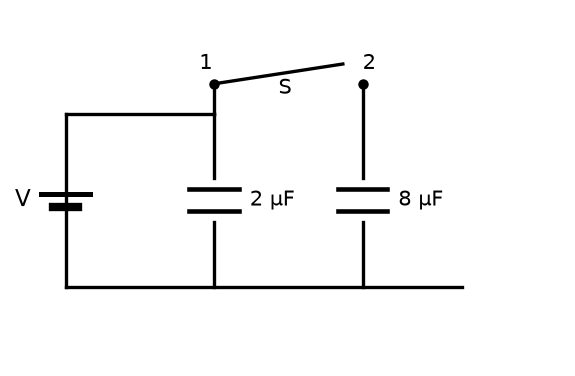
A capacitor of 2 μF is charged as shown in the diagram. When the switch S is turned to position 2, the percentage of its stored energy dissipated is:
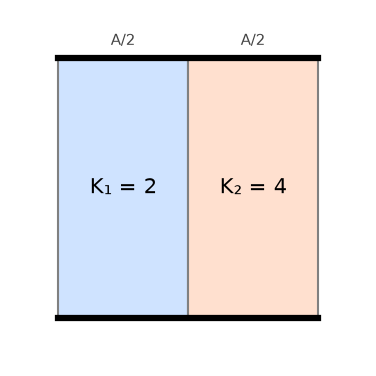
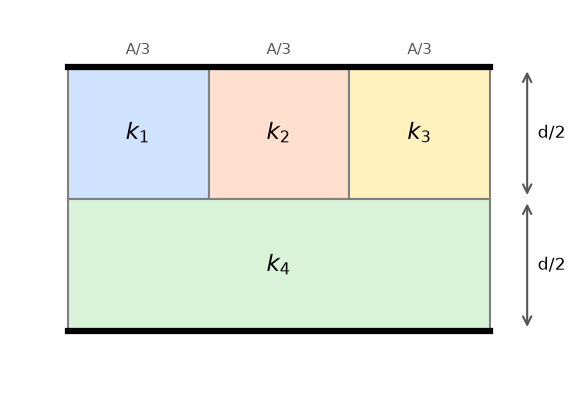
A parallel-plate capacitor of area A, plate separation d and capacitance C is filled with four dielectric materials having dielectric constants k1, k2, k3 and k4 as shown in the figure below. If a single dielectric material is to be used to have the same capacitance C in this capacitor, then its dielectric constant k is given by
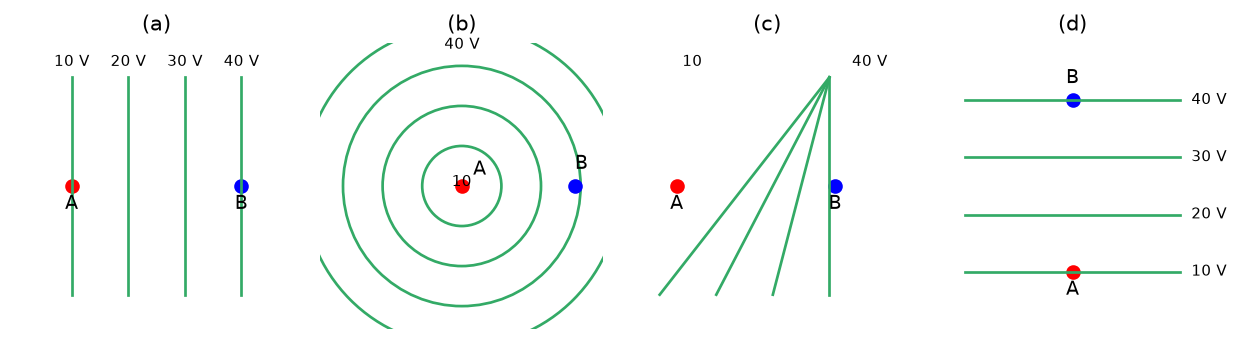
The diagrams (a), (b), (c), (d) below show regions of equipotentials (with values 10 V, 20 V, 30 V, 40 V arranged differently). A positive charge is moved from A to B in each diagram. Which statement is correct?
A capacitor is charged by a battery. The battery is removed and another identical uncharged capacitor is connected in parallel. The total electrostatic energy of resulting system
The electrostatic force between the metal plates of an isolated parallel plate capacitor C having a charge Q and area A, is
Two metal spheres, one of radius R and the other of radius 2R respectively have the same surface charge density σ. They are brought in contact and separated. What will be the new surface charge densities on them?
Two ways to go deeper on this chapter
Choose your next step
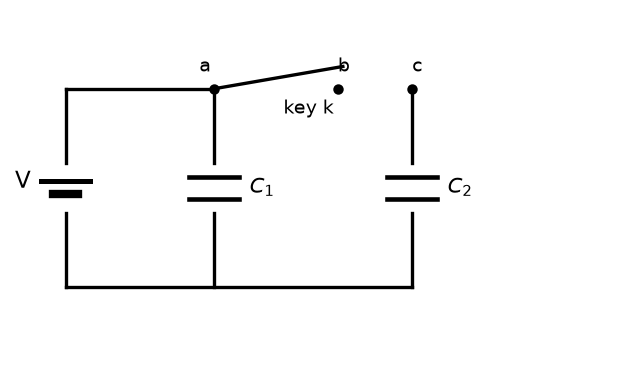
Two identical capacitors C1 and C² of equal capacitance are connected as shown. Terminals a and b of key k are connected to charge capacitor C1 using a battery of emf V. Now disconnecting a and b, the terminals b and c are connected. Due to this, what will be the percentage loss of energy?
The capacitance of a parallel plate capacitor with air as medium is 6 microF. With the introduction of a dielectric medium, the capacitance becomes 30 microF. The permittivity of the medium is: (eps0 = 8.85 × 10⁻¹² C² N⁻¹ m⁻²)
A short electric dipole has a dipole moment of 16 × 10⁻⁹ Cm. The electric potential due to the dipole at a point at a distance of 0.6 m from the centre of the dipole, situated on a line making an angle of 60 degrees with the dipole axis is: (1/4*π*eps0 = 9 × 10⁹ N M² / C²)
A parallel plate capacitor has a uniform electric field 'E' in the space between the plates. If the distance between the plates is 'd' and the area of each plate is 'A' the energy stored in the capacitor is: (ε₀ = permittivity of free space)
Two charged spherical conductors of radius R1 and R2 are connected by a wire. Then the ratio of surface charge densities of the sphere (sigma1/sigma2) is:
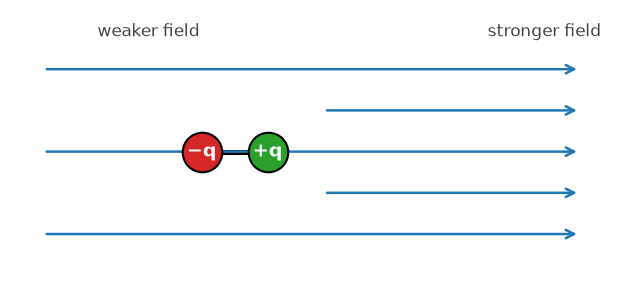
A dipole is placed in an electric field as shown. In which direction will it move?
Twenty seven drops of same size are charged at 220 V each. They combine to form a bigger drop. Calculate the potential of the bigger drop.
Polar molecules are the molecules:
The equivalent capacitance of the combination shown in the figure is:
Two hollow conducting spheres of radii R1 and R2 (R1 >> R2) have equal charges. The potential would be:
The angle between the electric lines of force and the equipotential surface is:
A capacitor of capacitance C = 900 pF is charged fully by 100 V battery B. Then B is disconnected and connected to another uncharged capacitor of capacitance C = 900 pF. The electrostatic energy stored by the system (b) is:
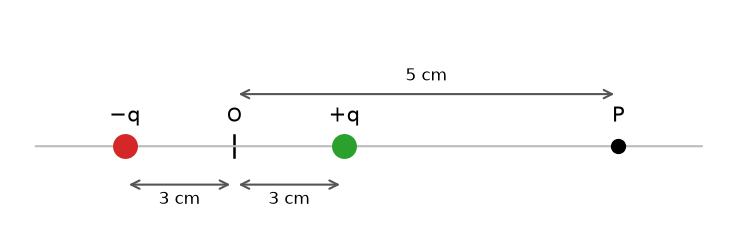
An electric dipole is placed as shown in the figure. The electric potential (in 10² V) at point P due to the dipole is (ε₀ = permittivity of free space and K = 1/(4πε₀)):
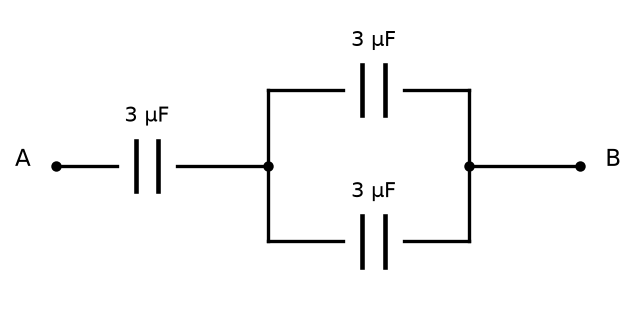
The equivalent capacitance of the system shown in the following circuit is:
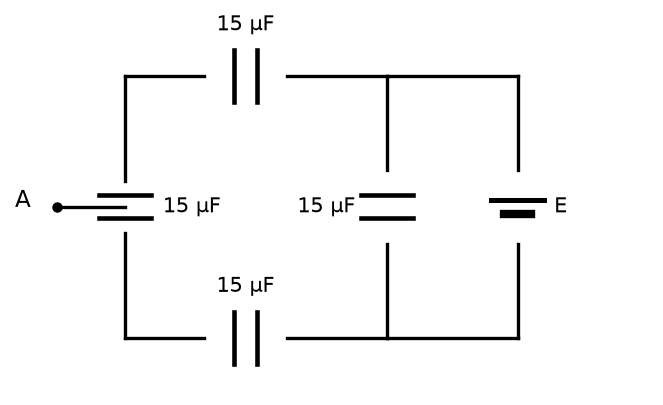
The equivalent capacitance of the arrangement shown in figure is
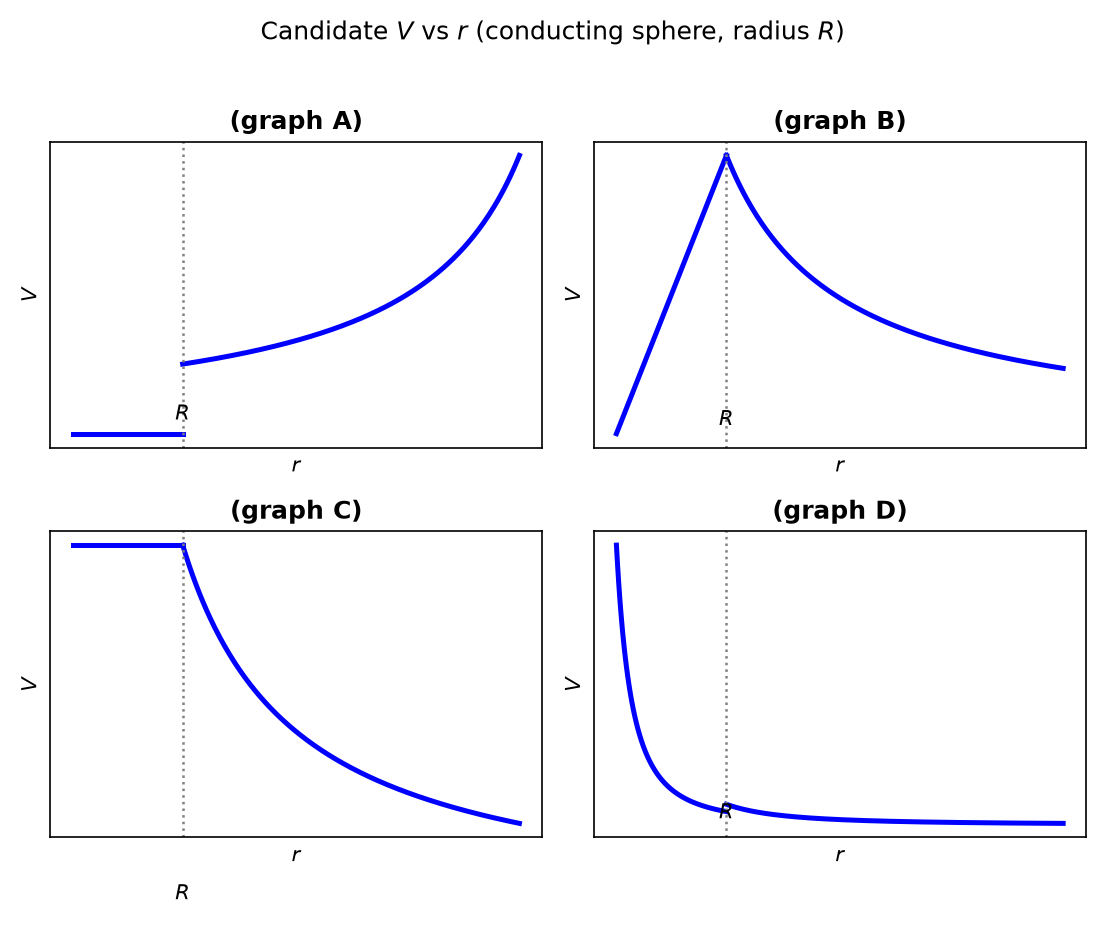
If a conducting sphere of radius R is charged. Then the electric field at a distance r (r > R) from the centre of the sphere would be, (V = potential on the surface of the sphere)
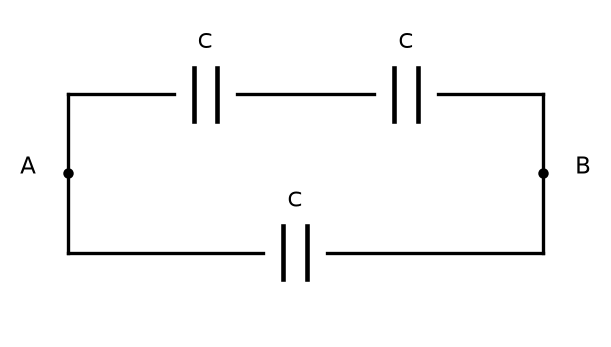
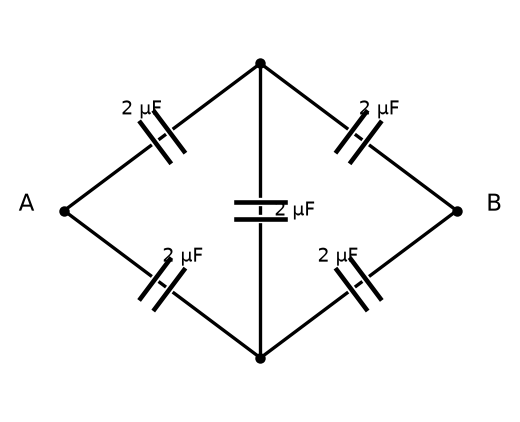
In the following circuit, the equivalent capacitance between terminal A and terminal B is:
Assertion A: The potential (V) at any axial point, at 2m distance (r) from the centre of the dipole of dipole moment vector P of magnitude 4 × 10⁻⁶ Cm, is ±9 × 10³ V (Take 1/4πε₀ = 9 × 10⁹ SI units). Reason R: V = ±2P/(4πε₀ r²), where r is the distance of any axial point situated at 2m from the centre of the dipole.
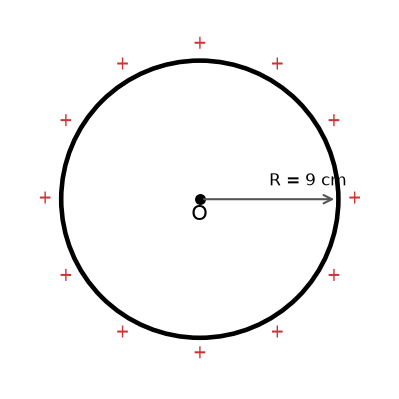
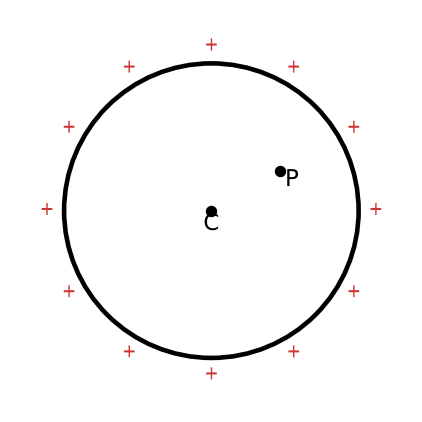
A thin spherical shell is charged by some source. The potential difference between the two points C and P (in V) shown in the figure is (Take 1/4πε₀ = 9 × 10⁹ SI units).
If the plates of a parallel plate capacitor connected to a battery are moved close to each other, then: A. The charge stored in it increases. B. The energy stored in it decreases. C. Its capacitance increases. D. The ratio of charge to its potential remains the same. E. The product of charge and voltage increases. Choose the most appropriate answer.
An electric dipole with dipole moment 5 × 10⁻⁶ C·m is aligned with the direction of a uniform electric field of magnitude 4 × 10⁵ N/C. The dipole is then rotated through an angle of 60° with respect to the electric field. The change in the potential energy of the dipole is:
Two identical charged conducting spheres A and B have their centres separated by a certain distance. Charge on each sphere is q and the force of repulsion between them is F. A third identical uncharged conducting sphere is brought in contact with sphere A first and then with B and finally removed from both. New force of repulsion between spheres A and B (radii negligible vs separation, treated as point charges) is best given as:
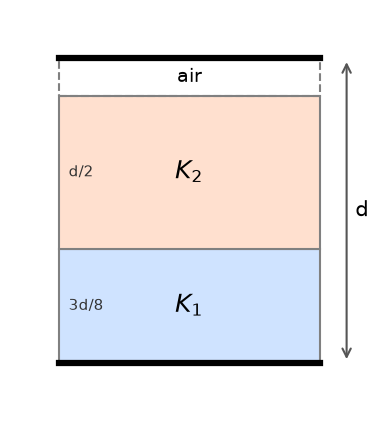
The plates of a parallel plate capacitor are separated by d. Two slabs of different dielectric constant K1 and K2 with thickness 3d/8 and d/2 respectively are inserted in the capacitor. Due to this, the capacitance becomes two times larger than when there is nothing between the plates. If K1/K2 = 1.25, the value of K1 is:
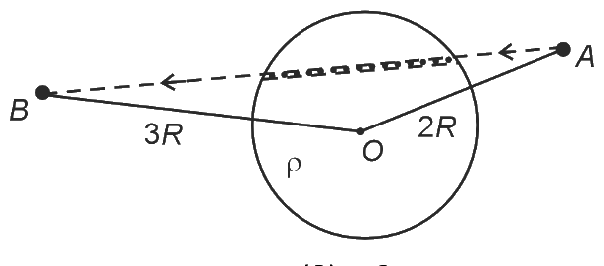
A unit positive point charge is taken slowly through an infinitesimally thin tube inside a charged dielectric sphere of radius $R$ having uniform positive charge density $\rho$. The initial and final positions $A$ and $B$ are at distances $2R$ and $3R$ from the centre. In this process the magnitude of the total work done on the point charge is $\dfrac{\rho R^2}{n\varepsilon_0}$. The value of $n$ is: ($\varepsilon_0$ = permittivity of vacuum)
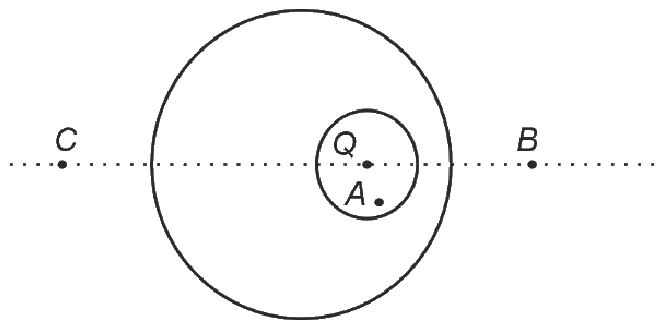
A point charge $Q$ is placed inside a cavity within a solid isolated conducting sphere. Consider points $A$ (inside cavity), $B$ and $C$ (outside the sphere, equidistant from its centre) with field magnitudes $E_A,E_B,E_C$. The correct option is:
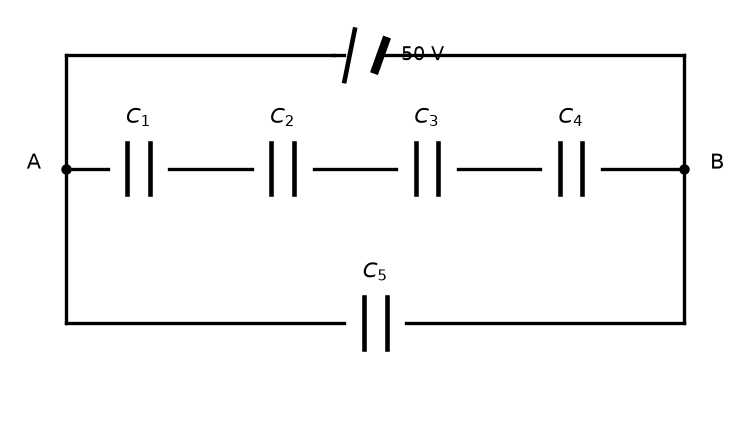
Five capacitors of capacitances C1 = C² = C3 = C4 = 10 uF and C5 = 2.5 uF are connected as shown, along with a battery of 50 V. The equivalent capacitance and the charges on each capacitor respectively are:
Which of the following statements are correct? A. Inside a conductor, the electrostatic field is zero. B. Electric field at the surface of a charged conductor does not depend on its surface charge density. C. The interior of a charged conductor can have no excess charge in the static situation. D. At the surface of a charged conductor, the electrostatic field must be normal to the surface at every point. E. The electrostatic potential is zero everywhere inside a charged conductor.
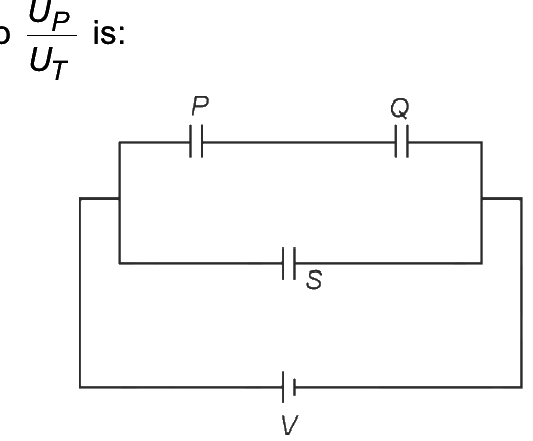
Three identical capacitors $P$, $Q$ and $S$, each of capacitance $C$, are connected to a battery of voltage $V$ as shown. If the energy stored in capacitor $P$ is $U_P$ and the total energy stored in the system is $U_T$, then the ratio $\tfrac{U_P}{U_T}$ is:
A fixed uniformly charged insulating sphere of radius $R$ has total charge $+Q$. A point charge $-q$ ($q\ll Q$, mass $m$) is released from rest at a distance $3R$ from the centre. When it reaches the surface of the sphere, its speed is: ($\varepsilon_0$ = permittivity of vacuum; neglect gravity)
Consider two uncharged capacitors of equal capacitance 200 pF. One of them is charged by a 100 V supply and disconnected. Now this capacitor is connected to the uncharged capacitor. The amount of electrostatic energy lost in the process is:
Want more Electrostatic Potential And Capacitance questions?
MedicNEET has 43,000+ NEET-style questions across Physics, Chemistry & Biology with detailed NCERT-based explanations — including the long, tricky questions that actually come in the exam.
Download MedicNEET App — Free