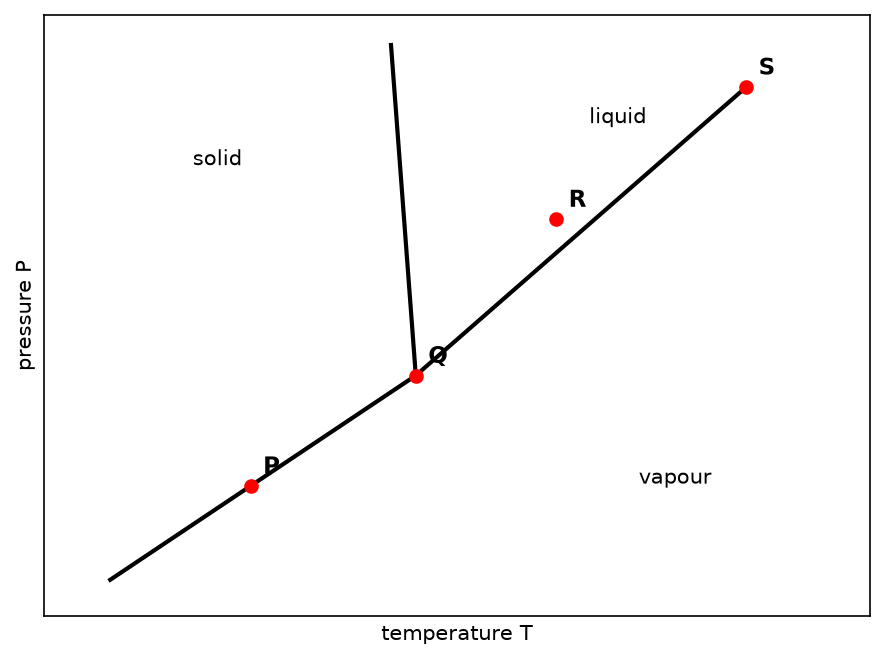
A black body is at a temperature of 5760 K. The energy of the radiation emitted by the body at wavelength 250 nm is U₁, at 500 nm is U₂ and at 1000 nm is U₃. Wien's constant b = 2.88 × 10⁶ nm·K. Which of the following is correct?
The coefficients of linear expansion of brass and steel rods are α₁ and α₂; their lengths are l₁ and l₂ respectively. If (l₂ − l₁) is to remain the same at all temperatures, the required condition is:
A piece of ice falls from a height h so that it melts completely. Only one-quarter of the heat produced is absorbed by the ice, and all the gravitational energy is converted into heat. The value of h is: (latent heat of ice = 3.4 × 10⁵ J kg⁻¹, g = 10 N kg⁻¹)
Two bodies have different thermal (heat) capacities. One of them is at 100 °C and the other at 0 °C. If the two are brought into contact in an isolated system (no heat loss to surroundings), the final common temperature will be:
A body cools from a temperature 3T to 2T in 10 minutes. The surroundings are at temperature T. Assuming Newton's law of cooling holds, the temperature of the body at the end of the next 10 minutes will be:
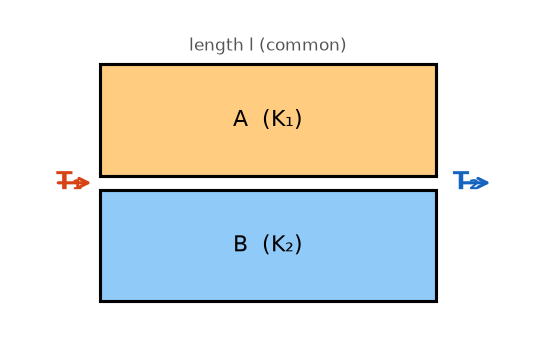
Two rods A and B of different materials are welded together side by side as shown in the figure. Their thermal conductivities are K₁ and K₂. The effective thermal conductivity of the composite rod (for heat flowing from the left face at T₁ to the right face at T₂) will be:
Two ways to go deeper on this chapter
Choose your next step
A spherical black body of radius 12 cm radiates 450 W power at 500 K. If the radius were halved and the temperature doubled, the power radiated (in watt) would be:
The power radiated by a black body is P and it radiates maximum energy at wavelength λ₀. If the temperature is changed so that it now radiates maximum energy at wavelength (3/4)λ₀, the power radiated becomes nP. The value of n is:
A copper rod of length 88 cm and an aluminium rod of unknown length have their increase in length independent of the increase in temperature. The length of the aluminium rod is: (α_Cu = 1.7 × 10⁻⁵ K⁻¹, α_Al = 2.2 × 10⁻⁵ K⁻¹)
The SI unit of thermal conductivity is:
An object kept in a large room (air temperature 25 °C) takes 12 minutes to cool from 80 °C to 70 °C. The time taken by the same object to cool from 70 °C to 60 °C would be nearly:
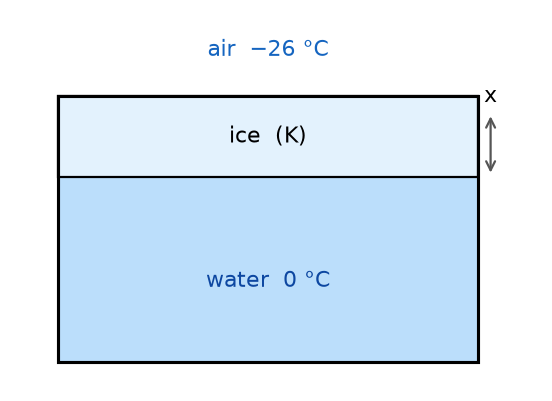
A deep pond is covered by a frozen ice layer of thickness x while the outside air is at a steady −26 °C (water below is at 0 °C). The ice has thermal conductivity K, density ρ and specific latent heat of fusion L. The rate of increase of the thickness of the ice layer at this instant is:
The quantities of heat required to raise the temperature of two solid copper spheres of radii r₁ and r₂ (r₁ = 1.5 r₂) through 1 K are in the ratio Q₁ : Q₂ equal to:
A cup of coffee cools from 90 °C to 80 °C in t minutes when the room temperature is 20 °C. The time taken by a similar cup of coffee to cool from 80 °C to 60 °C at the same room temperature (20 °C) is:
A metallic bar (Young's modulus Y = 0.5 × 10¹¹ N m⁻², coefficient of linear expansion α = 10⁻⁵ °C⁻¹, length 1 m, area of cross-section 10⁻³ m²) is heated from 0 °C to 100 °C while clamped so it cannot expand or bend. The compressive force developed in it is:
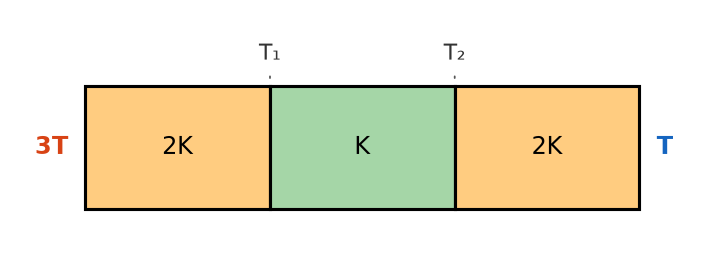
Three identical heat-conducting rods are connected in series as shown. The two side rods have thermal conductivity 2K and the middle rod has thermal conductivity K. The left end is maintained at 3T and the right end at T; the rods are insulated from the sides. In steady state the left junction is at T₁ and the right junction is at T₂. The ratio T₁ : T₂ is:
The temperature of a metallic sphere of radius $R$ is increased by a small amount $\Delta T$. If the linear coefficient of thermal expansion of the metal is $\alpha$, the approximate increase in the volume of the sphere is:
Want more Thermal Properties Of Matter questions?
MedicNEET has 43,000+ NEET-style questions across Physics, Chemistry & Biology with detailed NCERT-based explanations — including the long, tricky questions that actually come in the exam.
Download MedicNEET App — Free