Year-wise Weightage (2016–2026)

YearQuestions AskedMarks
2026312
2025312
2024312
202328
202214
Show earlier years (2016–2021)
202114
202014
201928
201814
201714
201628
Q1
NEET 2016 Phase 1RMS speed

The molecules of a given mass of a gas have r.m.s. velocity of 200 ms⁻¹ at 27 °C and 1.0 × 10⁵ Nm⁻² pressure. When the temperature and pressure of the gas are respectively 127 °C and 0.05 × 10⁵ Nm⁻², the r.m.s. velocity of its molecules in ms⁻¹ is:

Q2
NEET 2016 Phase 2Ideal gas

A given sample of an ideal gas occupies a volume V at a pressure P and absolute temperature T. The mass of each molecule of the gas is m. Which of the following gives the density of the gas?

Q3
NEET 2017Internal energy

A gas mixture consists of 2 moles of O₂ and 4 moles of Ar at temperature T. Neglecting all vibrational modes, the total internal energy of the system is:

Q4
NEET 2018RMS speed

At what temperature will the rms speed of oxygen molecules become just sufficient for escaping from the Earth's atmosphere? (Given: mass of an oxygen molecule m = 2.76 × 10⁻²⁶ kg, Boltzmann constant k_B = 1.38 × 10⁻²³ J K⁻¹, escape speed = 11200 ms⁻¹)

Q5
NEET 2019 Odisha

An ideal gas expands isothermally from 10⁻³ m³ to 10⁻² m³ at 300 K against a constant external pressure of 10⁵ N m⁻². The work done on the gas is:

Q6
NEET 2019Mean KE

Increase in temperature of a gas filled in a container would lead to:

Q7
NEET 2020Mean KE

The average thermal energy for a mono-atomic gas is: (k_B is the Boltzmann constant and T the absolute temperature)

Q8
NEET 2021Gas pressure

Match Column-I with Column-II and choose the correct match from the given choices: Column-I (A) Root mean square speed of gas molecules (B) Pressure exerted by ideal gas (C) Average kinetic energy of a molecule (D) Total internal energy of 1 mole of a diatomic gas Column-II (i) ⅓ n m v²_rms (ii) √(3RT/M) (iii) (5/2) RT (iv) (3/2) k_B T Choose the correct match:

Q9
NEET 2022

The volume occupied by the molecules contained in 4.5 kg of water at STP, if the intermolecular forces vanish away, is:

Q10
NEET 2023 Phase 2Ideal gas

A container of volume 200 cm³ contains 0.2 mole of hydrogen gas and 0.3 mole of argon gas. The pressure of the system at temperature 200 K (R = 8.3 J K⁻¹ mol⁻¹) will be:

Q11
NEET 2023 Phase 1RMS speed

The temperature of a gas is −50 °C. To what temperature should the gas be heated so that the rms speed is increased by 3 times?

Q12
NEET 2024Specific heat

The values of Cp/Cv for hydrogen, helium and another ideal diatomic gas X (whose molecules are not rigid but have an additional vibrational mode) are respectively equal to:

Q13
NEET 2024Ideal gas

The volume occupied by 1.8 g of water vapour at 374 °C and 1 bar pressure will be: [Use R = 0.083 bar L K⁻¹ mol⁻¹]

Q14
NEET 2024Ideal gas

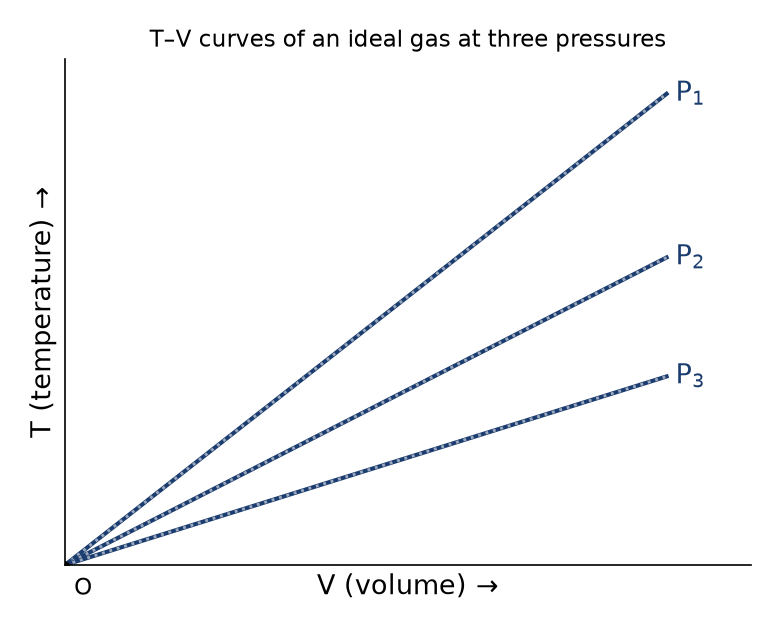
The following graph represents the T–V curves of an ideal gas (where T is the temperature and V the volume) at three pressures P₁, P₂ and P₃, compared with those of Charles's law represented as dotted lines. Then the correct relation is:
Kinetic Theory NEET PYQ diagram
Q15
NEET 2025Ideal gas

A container has two chambers of volumes V₁ = 2 litres and V₂ = 3 litres separated by a partition made of a thermal insulator. The chambers contain n₁ = 5 and n₂ = 4 moles of ideal gas at pressures p₁ = 1 atm and p₂ = 2 atm, respectively. When the partition is removed, the mixture attains an equilibrium pressure of:

Q16
NEET 2025Specific heat

Two gases A and B are filled at the same pressure in separate cylinders with movable pistons of radius r_A and r_B, respectively. On supplying an equal amount of heat to both systems reversibly under constant pressure, the pistons of gas A and gas B are displaced by 16 cm and 9 cm, respectively. If the change in their internal energy is the same, then the ratio r_A/r_B is equal to:

Q17
NEET 2025Ideal gas

An oxygen cylinder of volume 30 litre has 18.20 moles of oxygen. After some oxygen is withdrawn from the cylinder, its pressure drops to 11 atmospheric pressure at temperature 27 °C. The mass of the oxygen withdrawn from the cylinder is nearly equal to: [Given R = 100/12 J mol⁻¹ K⁻¹, molecular mass of O₂ = 32, 1 atm = 1.01 × 10⁵ N m⁻²]

Q18
ReNEET 2026Free path

The mean free path of molecules in an ideal gas $A$ is half that of another ideal gas $B$. The diameter of the spherical molecules of gas $A$ is twice the diameter of the molecules of $B$. If the number densities of gases $A$ and $B$ are $n_A$ and $n_B$ respectively, the correct option is:

Q19
ReNEET 2026Specific heat

An ideal gas is made of polyatomic molecules. Each molecule has three translational, three rotational and $f$ vibrational modes. If the ratio of heat capacities $C_P/C_V$ of the gas is $8/7$, then the value of $f$ is:

Q20
NEET 2026 (1)RMS speed

A flask contains argon and chlorine in the ratio of 2 : 1 by mass. The temperature of the mixture is 27 °C. The ratio of root mean square speeds of the molecules of the two gases (v_rms^Ar / v_rms^Cl) is: (Atomic mass of argon = 40.0 u and molecular mass of chlorine = 70.0 u)

Want more Kinetic Theory questions?

MedicNEET has 14,000+ NEET-style Biology questions with detailed NCERT-based explanations — including long, tricky questions that actually come in the exam.

Download MedicNEET App — Free

Practise Kinetic Theory MCQs — Free

Beyond the PYQs above — every Physics question format NEET now uses, starting with the newest ReNEET 2026-style reasoning MCQs. Tap an option for the answer and a worked solution. Free, no login.

🔢 Kinetic TheoryNumericals — PYQ-Based

Exam-style numericals seeded from real NEET previous-year questions, kept inside the NEET syllabus boundary. Each with a worked solution.

  1. Q1. The average translational kinetic energy of a molecule of an ideal gas at 27 °C is approximately (k_B = 1.38 × 10⁻²³ J K⁻¹):
  2. Q2. Three moles of an ideal monatomic gas are at a temperature of 400 K. The total translational kinetic energy of all the molecules in the sample is (R = 8.31 J mol⁻¹ K⁻¹):
  3. Q3. A container of fixed volume contains an ideal gas. The pressure of the gas molecules is P when each molecule has mass m and root mean square speed v_rms. If the mass of each molecule is doubled and the rms speed is also doubled while keeping the number density constant, what will be the new pressure?
  4. Q4. A rigid container of fixed volume 10 L contains a mixture of two ideal gases: argon (Ar, molar mass 40 g/mol) and nitrogen (N₂, molar mass 28 g/mol) at thermal equilibrium at 600 K. The partial pressure of argon is 4 atm and the partial pressure of nitrogen is 6 atm. If the temperature is suddenly lowered to 300 K while keeping the volume constant, and then argon is selectively removed using a permeable membrane until its partial pressure becomes 1 atm at this new temperature, what is the final total pressure in the container? (R = 0.082 L·atm·mol⁻¹·K⁻¹)
  5. Q5. A rigid container of fixed volume V contains n moles of an ideal diatomic gas at temperature T₁ = 300 K. The gas is heated until its pressure doubles. Subsequently, the container develops a leak and exactly half the molecules escape while the temperature is maintained constant at the new value T₂. What is the final pressure in the container in terms of the initial pressure P₁?
  6. Q6. A gas mixture contains equal moles of neon (monatomic) and nitrogen (diatomic, rigid molecules). What is the effective heat capacity ratio (γ_eff = C_p,eff / C_v,eff) of this mixture?
  7. Q7. An ideal gas undergoes a process in which its pressure is doubled while its volume is halved. If the initial temperature of the gas is 300 K, what is the final temperature of the gas?
  8. Q8. A rigid container holds a mixture of two ideal gases at thermal equilibrium at temperature T. Gas A is monoatomic with n moles, and Gas B is diatomic (rigid rotor, no vibration) with 2n moles. The container is then heated such that the temperature increases to 2T. What is the ratio of the final total internal energy to the initial total internal energy of the entire mixture?
  9. Q9. A rigid diatomic gas is heated at constant volume. If the temperature increases by 100 K, what is the increase in internal energy per mole of the gas? (R = 8.314 J mol⁻¹ K⁻¹)
  10. Q10. An ideal gas has molecules of mass 5.0 × 10⁻²⁶ kg. The gas exerts a pressure of 1.5 × 10⁵ Pa at a temperature of 300 K. The density of the gas is: (Given: Boltzmann constant k = 1.38 × 10⁻²³ J K⁻¹)

You’ve practised 10 of 56 Kinetic Theory questions in this set.

Practise all 56 + every chapter — free app →

📘 Kinetic TheoryConceptual Theory MCQs

Theory MCQs — assertion-reason, statement and standard — for the part of the physics paper that isn't numericals.

  1. Q1. Given below are two statements: Statement I: At fixed pressure and temperature, equal volumes of all ideal gases contain equal numbers of molecules. Statement II: One mole of any ideal gas at standard temperature and pressure (273.15 K, 1 atm) occupies the same volume, approximately 22.4 litres. In the light of the above statements, choose the correct answer from the options given below.
  2. Q2. Which of the following statements about the law of equipartition of energy is INCORRECT?
  3. Q3. According to the kinetic theory of an ideal gas, the pressure P exerted by the gas on the walls of its container is given by P = (1/3) ρ ⟨v²⟩, where ρ is the density of the gas and ⟨v²⟩ is the mean of the squares of the molecular speeds. The factor of 1/3 arises because:
  4. Q4. Which of the following statements relating the pressure of an ideal gas to molecular properties is INCORRECT?
  5. Q5. Given below are two statements: Statement I: At constant volume, the mean free path of a gas decreases as the temperature is increased. Statement II: At constant pressure, the mean free path of an ideal gas is directly proportional to the absolute temperature. In the light of the above statements, choose the correct answer from the options given below.
  6. Q6. Two non-interacting ideal gases A and B are placed in the same container of volume V at temperature T. The number of moles of gas A is n_A and the number of moles of gas B is n_B. The total pressure exerted by the mixture is:
  7. Q7. An ideal gas is taken from an initial state to a final state having a larger volume. Which of the following statements about the work done BY the gas is correct?
  8. Q8. Two ideal gases, helium (monatomic) and oxygen (diatomic), are kept at the same temperature. Which statement about the average translational kinetic energy per molecule is correct?
  9. Q9. The mean free path λ of molecules of a gas is given by λ = 1/(√2 π d² n), where d is the molecular diameter and n is the number density of molecules. If the number density of the gas is doubled while the diameter remains the same, the mean free path becomes:
  10. Q10. According to the kinetic interpretation of temperature, the absolute temperature T of an ideal gas is proportional to:

You’ve practised 10 of 27 Kinetic Theory questions in this set.

Practise all 27 + every chapter — free app →

Kinetic Theory — NEET PYQ Analysis

Kinetic Theory is a Class 11 NEET Physics chapter consistently tested from 2016 to ReNEET 2026. This page has all 20 authentic previous year questions from real NEET papers — with answers and detailed solutions, not model questions.

For full chapter-wise practice in timed test mode, download the MedicNEET app — 22,000+ questions across the full NEET syllabus. Back to the NEET Physics PYQ index.