Year-wise Weightage (2016–2026)

YearQuestions AskedMarks
2026
2025
2024416
202328
2022
Show earlier years (2016–2021)
2021
202014
2019
201814
201714
201628
Q1
NEET 2016 Phase 1Susceptibility classes

The magnetic susceptibility is negative for:

Q2
NEET 2016 Phase 2Dipole energy

A bar magnet is hung by a thin cotton thread in a uniform horizontal magnetic field and is in equilibrium. The energy required to rotate it by 60° is W. The torque required to keep the magnet in this new (60°) position is:

Q3
NEET 2017

A 250-turn rectangular coil of length 2.1 cm and width 1.25 cm carries a current of 85 A and is in a magnetic field of strength 0.85 T. The work done in rotating the coil by 180° against the torque is:

Q4
NEET 2018

A thin diamagnetic rod is placed vertically between the poles of an electromagnet. When the current is switched on, the diamagnetic rod is pushed up, out of the horizontal magnetic field, gaining gravitational potential energy. The work required to do this comes from:

Q5
NEET 2020Susceptibility

An iron rod of susceptibility 599 is subjected to a magnetising field of 1200 A m⁻¹. The permeability of the material of the rod is (μ₀ = 4π × 10⁻⁷ T m A⁻¹):

Q6
NEET 2023 Phase 2

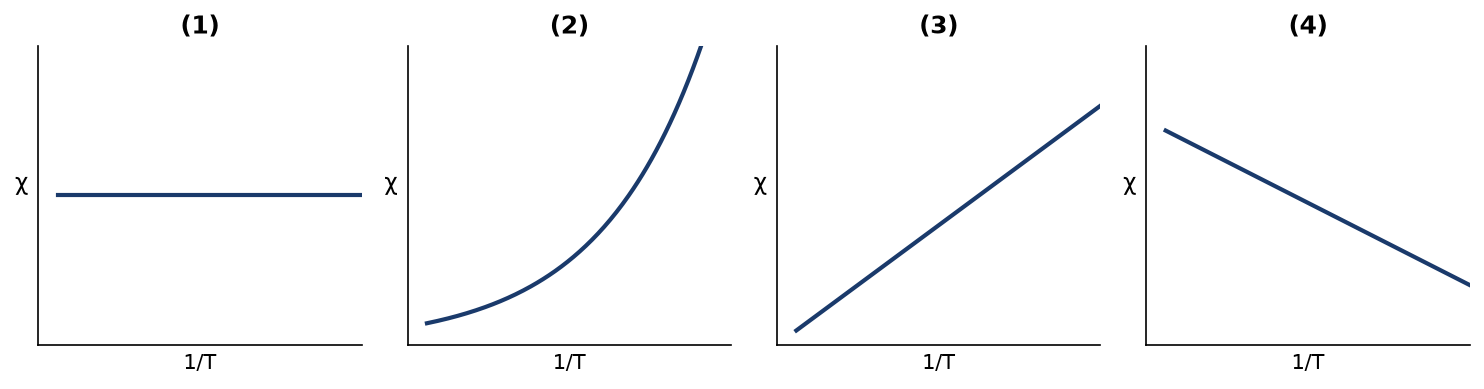
The variation of susceptibility (χ) with absolute temperature (T) for a paramagnetic material is represented as: [the four options plot χ against 1/T]
Magnetism And Matter NEET PYQ diagram
Q7
NEET 2023 Phase 1Gauss magnetism

The net magnetic flux through any closed surface is:

Q8
NEET 2024

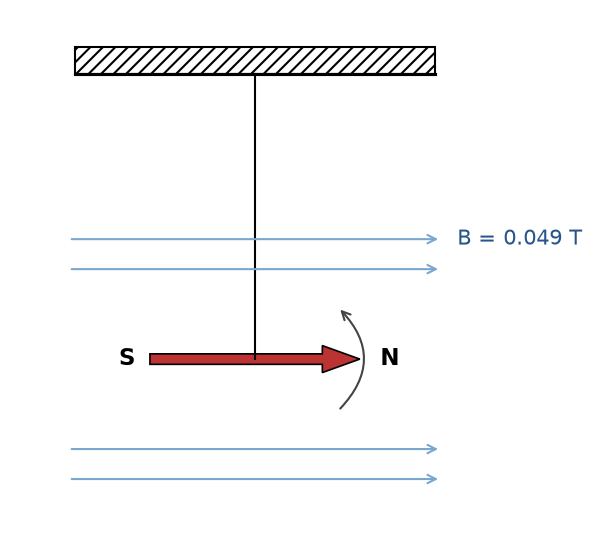
In a uniform magnetic field of 0.049 T, a magnetic needle performs 20 complete oscillations in 5 seconds. The moment of inertia of the needle is 9.8 × 10⁻⁶ kg m². If the magnetic moment of the needle is x × 10⁻⁵ A m², the value of x is:
Magnetism And Matter NEET PYQ diagram
Q9
NEET 2024

An iron bar of length L has magnetic moment M. It is bent at the middle of its length such that the two arms make an angle 60° with each other. The magnetic moment of this new magnet is:

Q10
NEET 2024Susceptibility classes

Match List-I with List-II: List-I (Material) A. Diamagnetic B. Ferromagnetic C. Paramagnetic D. Non-magnetic List-II (Susceptibility χ) I. χ = 0 II. 0 > χ ≥ −1 III. χ >> 1 IV. 0 < χ < ε (a small positive number) Choose the correct answer:

Q11
NEET 2024

A sheet is placed on a horizontal surface in front of a strong magnetic pole. A force is needed to: A. hold the sheet there if it is magnetic B. hold the sheet there if it is non-magnetic C. move the sheet away from the pole with uniform velocity if it is conducting D. move the sheet away from the pole with uniform velocity if it is both non-conducting and non-polar Choose the correct statement(s):

Want more Magnetism And Matter questions?

MedicNEET has 14,000+ NEET-style Biology questions with detailed NCERT-based explanations — including long, tricky questions that actually come in the exam.

Download MedicNEET App — Free
Practise Magnetism And Matter MCQs — Free

Beyond the PYQs above — every Physics question format NEET now uses, starting with the newest ReNEET 2026-style reasoning MCQs. Tap an option for the answer and a worked solution. Free, no login.

🔢 Magnetism And MatterNumericals — PYQ-Based

Exam-style numericals seeded from real NEET previous-year questions, kept inside the NEET syllabus boundary. Each with a worked solution.

  1. Q1. A paramagnetic material is placed in a magnetic field of 0.2 T at 300 K and acquires magnetisation M. If the field is changed to 0.6 T and the temperature to 450 K, the magnetisation becomes (use Curie law M ∝ B/T):
  2. Q2. A short bar magnet of magnetic moment m = 4.0 A·m² is placed in vacuum. The magnitude of the magnetic field at a point on its equatorial (broadside-on) line at a distance r = 0.5 m from the centre is (μ₀/4π = 10⁻⁷ T m A⁻¹)
  3. Q3. The magnetic field on the axis of a short bar magnet at a distance r = 0.1 m from its centre is measured to be 4.0 × 10⁻⁵ T. The magnetic moment m of the magnet is (μ₀/4π = 10⁻⁷ T m A⁻¹)
  4. Q4. A bar magnet of magnetic moment M is initially aligned with a uniform horizontal magnetic field B. An external agent performs work W to rotate the magnet to a position making 30° with the field direction. The magnet is then released and it oscillates. At the instant when the magnet passes through the angle 60° from the field direction (while returning toward equilibrium), the instantaneous torque acting on it is:
  5. Q5. A toroidal solenoid with mean radius 10 cm and 2000 turns carries a current of 5 A. Without any core material, the magnetic field inside is B₀. When a paramagnetic material rod is inserted into the core, the magnetic field inside increases to 1.005 B₀. A second experiment is performed with a diamagnetic material rod under identical conditions, and the magnetic field is measured to be 0.995 B₀. What is the ratio of the magnitude of magnetic susceptibility of the paramagnetic material to that of the diamagnetic material?
  6. Q6. A bar magnet of length 20 cm and pole strength 10 A·m is placed in a uniform magnetic field of 0.5 T. If the magnet makes an angle of 30° with the field direction, what is the magnitude of the torque experienced by the magnet?
  7. Q7. A bar magnet of magnetic moment 2.0 A·m² is initially aligned perpendicular to a uniform magnetic field of 0.5 T. It is then rotated to align parallel to the field. The change in magnetic potential energy of the magnet is:
  8. Q8. A ferromagnetic core has a relative permeability of 250. When this core is placed in a solenoid, the absolute permeability of the material is: (Take μ₀ = 4π × 10⁻⁷ T m A⁻¹)
  9. Q9. Two steel balls P and Q of equal mass are moving on a frictionless horizontal surface. Ball P moves with velocity 8 m/s and collides elastically with ball Q moving at 2 m/s in the same direction. What are the velocities of balls P and Q respectively after the collision?
  10. Q10. A material has magnetic susceptibility χ = -0.00004. What is the relative magnetic permeability (μᵣ) of this material?

You’ve practised 10 of 33 Magnetism And Matter questions in this set.

Practise all 33 + every chapter — free app →

📘 Magnetism And MatterConceptual Theory MCQs

Theory MCQs — assertion-reason, statement and standard — for the part of the physics paper that isn't numericals.

  1. Q1. Match Column I with Column II based on the magnetic properties of materials. Here, χ represents magnetic susceptibility. | Column I | Column II | |---------------------------|---------------------------| | a. Diamagnetic materials | i. χ is positive and large | | b. Paramagnetic materials | ii. χ is small and negative | | c. Ferromagnetic materials| iii. χ is positive and small| | d. Superconductors | iv. χ = -1 |
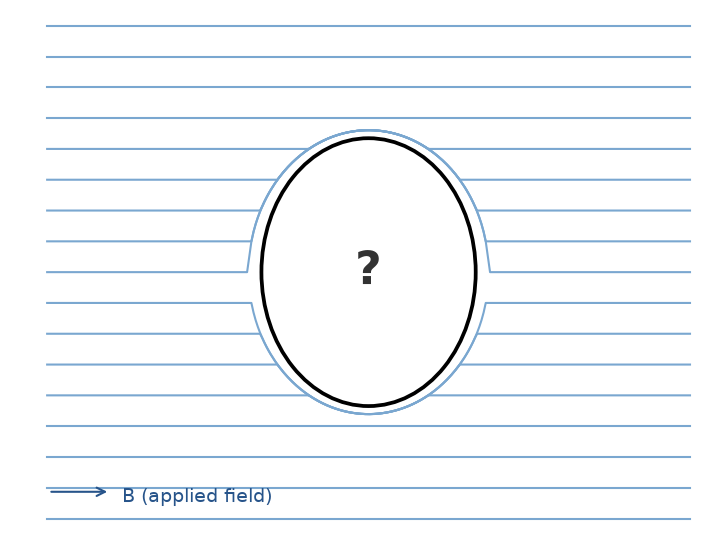
  2. Q2. When the specimen shown is placed in a uniform magnetic field, the field lines are expelled from its interior, so that the field inside the specimen is weaker than the applied field (see figure). The specimen is made of a:
    NEET question diagram
  3. Q3. Which of the following statements about magnetism is INCORRECT?
  4. Q4. Given below are two statements: Statement I: The net magnetic flux through any closed surface is always non-zero because magnetic field lines have distinct starting and ending points at isolated poles. Statement II: The net electric flux through a closed surface is always zero, regardless of the enclosed charge, because electric field lines always start and end on the same charge. In the light of the above statements, choose the correct answer from the options given below.
  5. Q5. Which of the following statements is CORRECT regarding magnets and magnetic fields?
  6. Q6. Match the magnetic quantities/materials in Column I with their correct defining relation or value in Column II. Column I (P) Intensity of magnetisation, M (Q) Magnetic susceptibility, χ (R) Relative permeability, μ_r (S) Permeability of medium, μ Column II (1) 1 + χ (2) μ₀(1 + χ) (3) magnetic moment per unit volume (4) M / H
  7. Q7. A bar magnet is broken into two pieces transverse to its length. Which of the following observations is correct for the pieces?
  8. Q8. Consider the following two statements: Statement I: Diamagnetism is present in all substances. Statement II: In paramagnetic substances, the diamagnetic effect is absent. Which of the following is correct?
  9. Q9. Which of the following statements is CORRECT regarding the comparison between a bar magnet and an electric dipole?
  10. Q10. Which one of the following statements about magnetic field lines is INCORRECT?

You’ve practised 10 of 29 Magnetism And Matter questions in this set.

Practise all 29 + every chapter — free app →

Magnetism And Matter — NEET PYQ Analysis

Magnetism And Matter is a Class 12 NEET Physics chapter consistently tested from 2016 to ReNEET 2026. This page has all 11 authentic previous year questions from real NEET papers — with answers and detailed solutions, not model questions.

For full chapter-wise practice in timed test mode, download the MedicNEET app — 22,000+ questions across the full NEET syllabus. Back to the NEET Physics PYQ index.