Year-wise Weightage (2016–2026)

YearQuestions AskedMarks
2026520
2025312
202428
2023416
202228
Show earlier years (2016–2021)
202128
202028
2019312
201828
201728
2016416
Q1
NEET 2016 Phase 2Photon energy

Electrons of mass m with de Broglie wavelength λ fall on the target in an X-ray tube. The cutoff wavelength (λ₀) of the emitted X-ray is:

Q2
NEET 2016 Phase 1Electron-photon

An electron of mass m and a photon have the same energy E. The ratio of the de Broglie wavelengths associated with them is (c being the velocity of light):

Q3
NEET 2016 Phase 1Stopping pot.

When a metallic surface is illuminated with radiation of wavelength λ, the stopping potential is V. If the same surface is illuminated with radiation of wavelength 2λ, the stopping potential is V/4. The threshold wavelength for the metallic surface is:

Q4
NEET 2016 Phase 2Einstein eq.

Photons with energy 5 eV are incident on a cathode C in a photoelectric cell. The maximum energy of emitted photoelectrons is 2 eV. When photons of energy 6 eV are incident on C, no photoelectrons will reach the anode A if the stopping potential of A relative to C is:

Q5
NEET 2017Einstein eq.

The photoelectric threshold wavelength of silver is 3250 × 10⁻¹⁰ m. The velocity of the electron ejected from a silver surface by ultraviolet light of wavelength 2536 × 10⁻¹⁰ m is (Given h = 4.14 × 10⁻¹⁵ eV·s and c = 3 × 10⁸ m/s):

Q6
NEET 2017Matter wave

The de Broglie wavelength of a neutron in thermal equilibrium with heavy water at a temperature T (kelvin) and mass m is:

Q7
NEET 2018Einstein eq.

When the light of frequency 2ν₀ (where ν₀ is the threshold frequency) is incident on a metal plate, the maximum velocity of electrons emitted is v₁. When the frequency of the incident radiation is increased to 5ν₀, the maximum velocity of electrons emitted from the same plate is v₂. The ratio of v₁ to v₂ is:

Q8
NEET 2018Electron λ

An electron of mass m with an initial velocity v = v₀ î (v₀ > 0) enters an electric field E = −E₀ î (E₀ = constant > 0) at t = 0. If λ₀ is its de Broglie wavelength initially, then its de Broglie wavelength at time t is:

Q9
NEET 2019 OdishaMatter wave

A proton and an α-particle are accelerated from rest to the same energy. The de Broglie wavelengths λ_p and λ_α are in the ratio:

Q10
NEET 2019 OdishaThreshold

The work function of a photosensitive material is 4.0 eV. The longest wavelength of light that can cause photoemission from the substance is (approximately):

Q11
NEET 2019Electron λ

An electron is accelerated through a potential difference of 10000 V. Its de Broglie wavelength is, (nearly): (mₑ = 9 × 10⁻³¹ kg)

Q12
NEET 2020Electron λ

An electron is accelerated from rest through a potential difference of V volt. If the de Broglie wavelength of the electron is 1.227 × 10⁻² nm, the potential difference is:

Q13
NEET 2020Photocurrent

Light of frequency 1.5 times the threshold frequency is incident on a photosensitive material. What will be the photoelectric current if the frequency is halved and intensity is doubled?

Q14
NEET 2021Photon energy

The number of photons per second on an average emitted by the source of monochromatic light of wavelength 600 nm, when it delivers the power of 3.3 × 10⁻³ W will be: (h = 6.6 × 10⁻³⁴ J·s)

Q15
NEET 2021Matter wave

An electromagnetic wave of wavelength λ is incident on a photosensitive surface of negligible work function. If a photoelectron of mass m emitted from the surface has de Broglie wavelength λ_d, then:

Q16
NEET 2022Stopping pot.

When two monochromatic lights of frequency ν and ν/2 are incident on a photoelectric metal, their stopping potentials become V_s/2 and V_s respectively. The threshold frequency for this metal is:

Q17
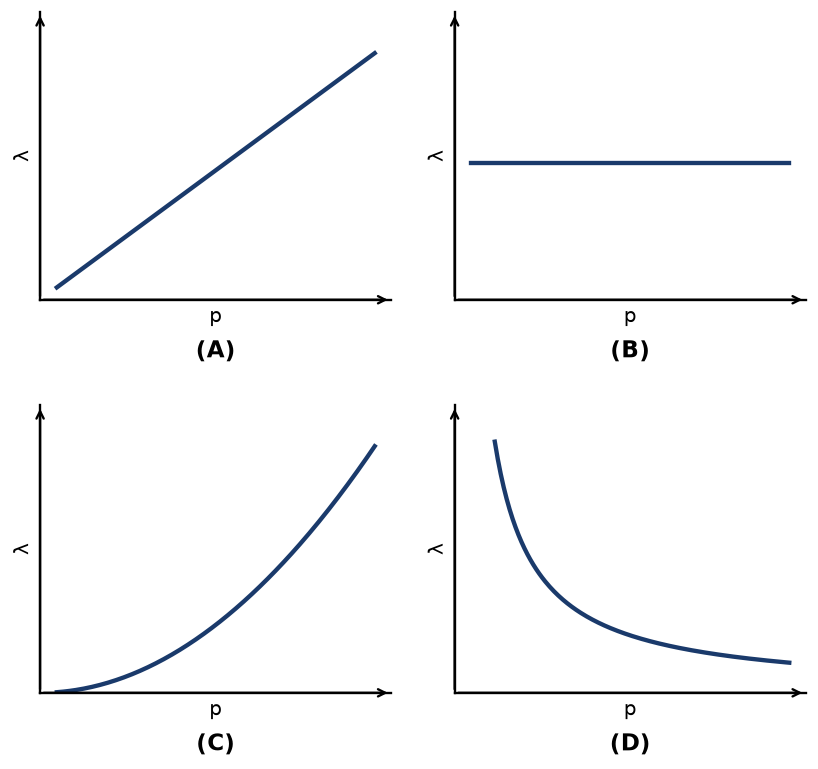
NEET 2022de Broglie

The graph which shows the variation of the de Broglie wavelength (λ) of a particle and its associated momentum (p) is:
Dual Nature Of Radiation And Matter NEET PYQ diagram
Q18
NEET 2023 Phase 1Photon energy

The minimum wavelength of X-rays produced by an electron accelerated through a potential difference of V volts is proportional to:

Q19
NEET 2023 Phase 2Photocurrent

The maximum kinetic energy of the emitted photoelectrons in the photoelectric effect is independent of:

Q20
NEET 2023 Phase 2Electron λ

The de Broglie wavelength associated with an electron, accelerated by a potential difference of 81 V, is given by:

Q21
NEET 2023 Phase 1Work function

The work functions of Caesium (Cs), Potassium (K) and Sodium (Na) are 2.14 eV, 2.30 eV and 2.75 eV respectively. If incident electromagnetic radiation has an energy of 2.20 eV, which of these photosensitive surfaces may emit photoelectrons?

Q22
NEET 2024Photon mass

If c is the velocity of light in free space, the correct statements about a photon among the following are: A. The energy of a photon is E = hν. B. The velocity of a photon is c. C. The momentum of a photon, p = hν/c. D. In a photon–electron collision, both total energy and total momentum are conserved. E. A photon possesses positive charge. Choose the correct answer from the options given below:

Q23
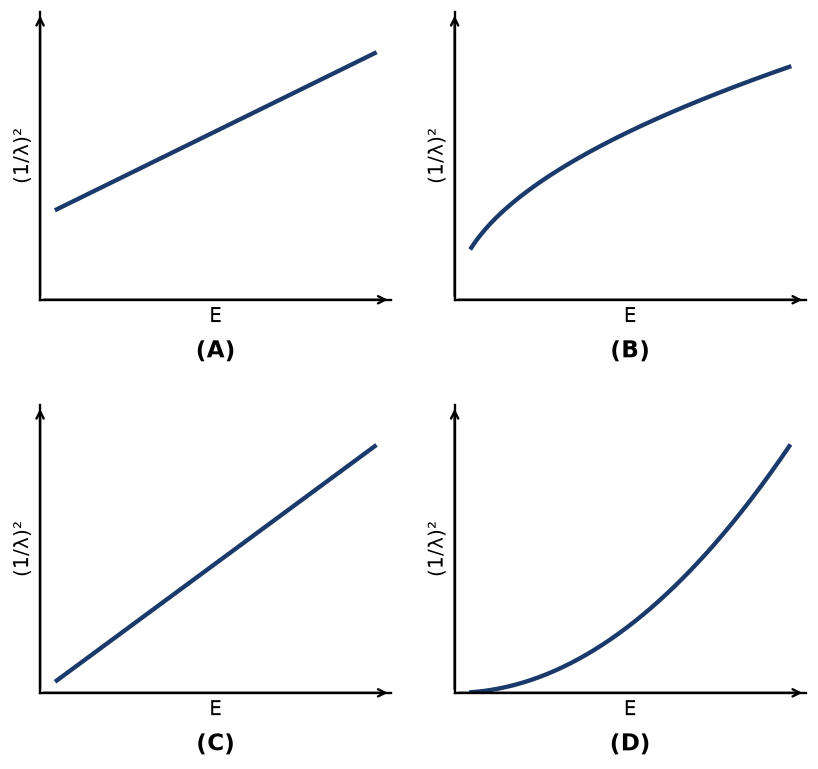
NEET 2024Matter wave

The graph which shows the variation of (1/λ)² and the kinetic energy E of a free particle (where λ is the de Broglie wavelength of the particle) is:
Dual Nature Of Radiation And Matter NEET PYQ diagram
Q24
NEET 2025Electron-photon

A photon and an electron (mass m) have the same energy E. The ratio λ_photon/λ_electron of their de Broglie wavelengths is: (c is the speed of light)

Q25
NEET 2025de Broglie

The de Broglie wavelength of an electron in the n = 2 state of the hydrogen atom is close to (Given Bohr radius a₀ = 0.052 nm):

Q26
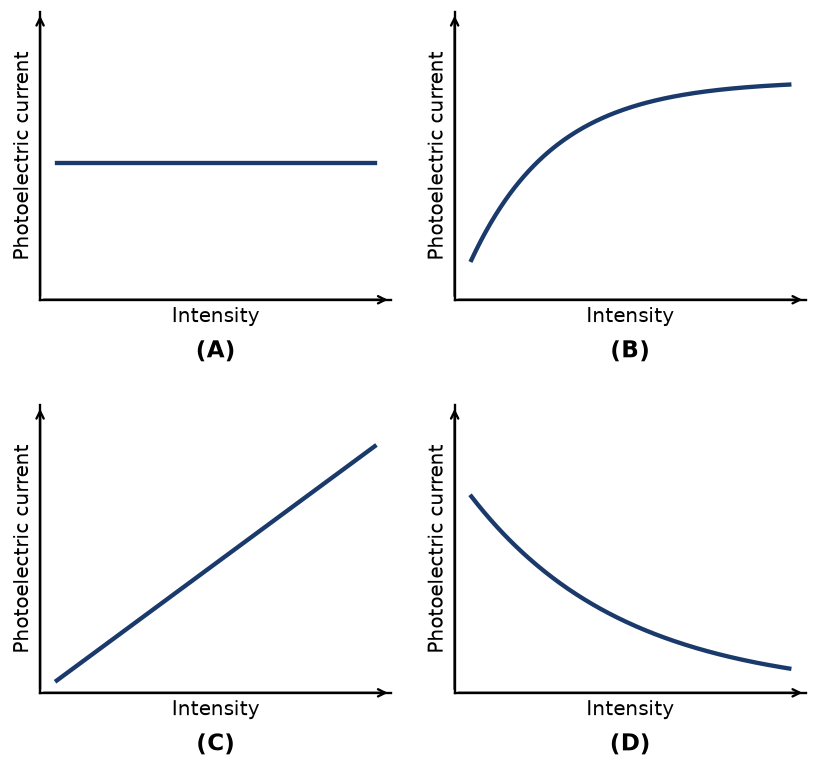
NEET 2025Photocurrent

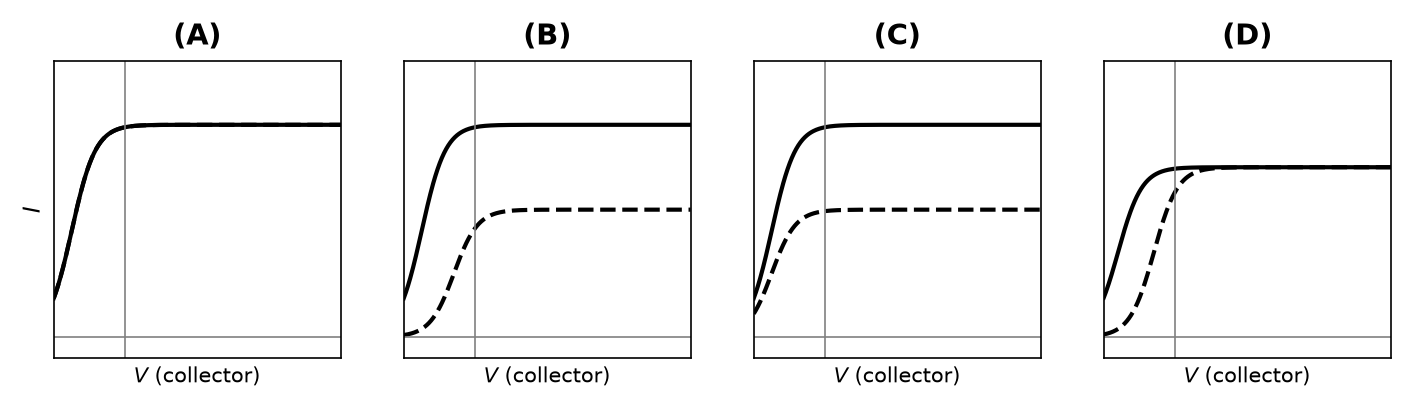
Which of the following options represents the variation of photoelectric current with the property of light (intensity) shown on the x-axis?
Dual Nature Of Radiation And Matter NEET PYQ diagram
Q27
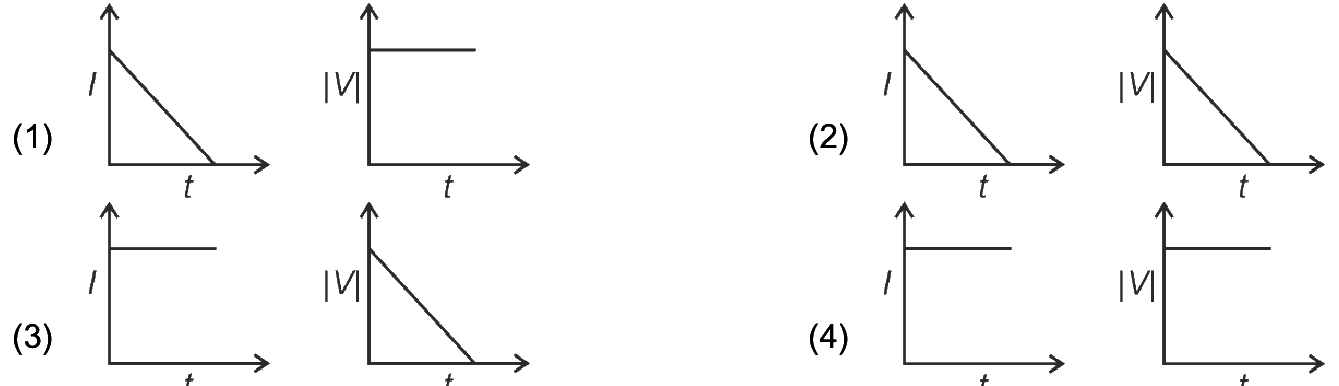
ReNEET 2026Photocurrent

A beam of light falls on a metal surface such that photo-electrons are generated. If the power of the light source starts to decrease linearly with time $t$, then the variation of the photocurrent $I$ and the magnitude of the stopping potential $|V|$ with time is best represented by:
Dual Nature Of Radiation And Matter NEET PYQ diagram
Q28
ReNEET 2026Threshold

A ray of light of wavelength $\lambda$ is incident on three photoelectric cells $1,2,3$ with threshold wavelengths $\lambda_1,\lambda_2,\lambda_3$ and stopping potentials $V_1,V_2,V_3$ respectively. Given $\lambda_1<\lambda,\ \lambda_2>\lambda,\ \lambda_3\gg\lambda$, the correct option is:

Q29
ReNEET 2026Photon momentum

A photon and an electron, each of $20\,$eV energy, move in free space. The ratio of the linear momentum of the electron $p_e$ to that of the photon $p_{ph}$, $\dfrac{p_e}{p_{ph}}$, is: [speed of light $=3\times10^8\,\text{ms}^{-1}$, $e=1.6\times10^{-19}\,$C, $m_e=9\times10^{-31}\,$kg]

Q30
NEET 2026 (1)Threshold

For a metal of work function 6.6 eV, which of the following wavelengths of incident radiation does NOT give rise to the photoelectric effect? (Take Planck's constant as 6.6 × 10⁻³⁴ J·s)

Q31
NEET 2026 (1)Photon energy

Match List I with List II. List-I: A. E = hν B. Diffraction and interference C. λ = h/p D. Compton effect List-II: I. de Broglie wavelength II. Particle nature of light III. Wave nature of light IV. Energy of photon Choose the correct answer from the options given below:

Want more Dual Nature Of Radiation And Matter questions?

MedicNEET has 14,000+ NEET-style Biology questions with detailed NCERT-based explanations — including long, tricky questions that actually come in the exam.

Download MedicNEET App — Free
Practise Dual Nature Of Radiation And Matter MCQs — Free

Beyond the PYQs above — every Physics question format NEET now uses, starting with the newest ReNEET 2026-style reasoning MCQs. Tap an option for the answer and a worked solution. Free, no login.

🔢 Dual Nature Of Radiation And MatterNumericals — PYQ-Based

Exam-style numericals seeded from real NEET previous-year questions, kept inside the NEET syllabus boundary. Each with a worked solution.

  1. Q1. The work function of a metal is φ₀ = 2.48 eV. What is the threshold (longest cut-off) wavelength λ₀ for photoelectric emission from this metal? (Use hc = 1240 eV·nm)
  2. Q2. An electron is accelerated through a potential difference of 100 V. If the de Broglie wavelength associated with it is λ, what will be the de Broglie wavelength when it is accelerated through 400 V?
  3. Q3. A photoelectric surface has a work function of 2.0 eV. When illuminated with light of frequency ν₁, the maximum velocity of emitted photoelectrons is v. When the frequency is increased to 3ν₁, what will be the maximum velocity of the photoelectrons? (Given that hν₁ = 3.0 eV)
  4. Q4. A metal surface with work function φ₀ = 1.5 eV is simultaneously illuminated by two monochromatic light sources. Source 1 has wavelength λ₁ = 400 nm and Source 2 has wavelength λ₂ = 500 nm. If the intensities are adjusted such that Source 1 emits photons at rate N₁ = 10¹⁵ photons/s and Source 2 at rate N₂ = 2 × 10¹⁵ photons/s, what is the ratio of the maximum kinetic energies of photoelectrons ejected by the two sources (K_max1/K_max2)? (Take hc = 1240 eV·nm)
  5. Q5. A proton and an alpha particle have the same de Broglie wavelength. If the kinetic energy of the proton is 1 MeV, what is the kinetic energy of the alpha particle? (Mass of alpha particle = 4 times mass of proton)
  6. Q6. Two different photosensitive materials X and Y are illuminated with light of frequency 2ν₀, where ν₀ is the threshold frequency of material X. The stopping potential for material X is measured to be V₀. If the threshold frequency of material Y is 3ν₀/2, what is the stopping potential for material Y when illuminated with the same light?
  7. Q7. A photoelectric experiment uses light of energy 4.50 eV incident on a metal surface with work function 1.80 eV. The maximum kinetic energy of the emitted photoelectrons is found to be 2.70 eV. If the intensity of the incident light is now doubled while keeping the frequency constant, what will be the new maximum kinetic energy of the photoelectrons?
  8. Q8. A proton is accelerated from rest through a potential difference V. It then enters a uniform magnetic field where it follows a circular path of radius R. If the de Broglie wavelength of the proton in the circular path is λ, and the same proton is now accelerated through a potential difference 4V (all other conditions remaining the same), the new de Broglie wavelength λ' will be:
  9. Q9. For a certain photosensitive material, when radiation of frequency 4ν₀ (where ν₀ is the threshold frequency) is incident, the stopping potential is V₀. When radiation of frequency 10ν₀ is used, the stopping potential becomes:
  10. Q10. Light of frequency 8 × 10¹⁴ Hz is incident on a photosensitive material of work function 2 eV. If the intensity of light is doubled while keeping the frequency constant, the stopping potential will be:

You’ve practised 10 of 43 Dual Nature Of Radiation And Matter questions in this set.

Practise all 43 + every chapter — free app →

📘 Dual Nature Of Radiation And MatterConceptual Theory MCQs

Theory MCQs — assertion-reason, statement and standard — for the part of the physics paper that isn't numericals.

  1. Q1. An electron and a proton are each accelerated from rest through the same potential difference V. Which one has the longer de Broglie wavelength? (mass of proton ≫ mass of electron)
  2. Q2. A monochromatic light source emits radiation of fixed frequency. If the intensity of the beam is doubled while the frequency is kept unchanged, then:
  3. Q3. In a photoelectric effect experiment, light of a certain frequency is shone on a photosensitive metal surface, but no photoelectrons are emitted. If the intensity of this incident radiation is increased, what will be observed?
  4. Q4. Two particles carry different electric charges but are made to have the same momentum p. Which statement about their de Broglie wavelengths is correct?
  5. Q5. Light of energy 2.5 eV per photon is incident on the surfaces of four metals with work functions: P (2.1 eV), Q (2.4 eV), R (2.8 eV), S (3.5 eV). Photoelectrons will be emitted from:
  6. Q6. Given below are two statements: Statement I: For a given photosensitive material, electrons are emitted only if the frequency of incident light is greater than a certain minimum value. Statement II: The minimum frequency required for photoelectric emission is the same for all photosensitive substances. In the light of the above statements, choose the correct answer from the options given below.
  7. Q7. A moving cricket ball and a moving electron may both be assigned a de Broglie wavelength. Why is the wave nature of the cricket ball never observed in everyday experiments?
  8. Q8. The variation of photoelectric current with collector plate potential is shown in the figure for three different intensities of incident radiation I₁, I₂, and I₃, where I₃ > I₂ > I₁. What conclusion can be drawn from the graph?
  9. Q9. Which of the following statements regarding the effect of intensity on photoelectric emission is INCORRECT?
  10. Q10. In an experiment on the photoelectric effect, the frequency of incident radiation and the accelerating potential are kept constant. Which of the following graphs correctly represents the variation of photocurrent with the intensity of incident light?

You’ve practised 10 of 30 Dual Nature Of Radiation And Matter questions in this set.

Practise all 30 + every chapter — free app →

Dual Nature Of Radiation And Matter — NEET PYQ Analysis

Dual Nature Of Radiation And Matter is a Class 12 NEET Physics chapter consistently tested from 2016 to ReNEET 2026. This page has all 31 authentic previous year questions from real NEET papers — with answers and detailed solutions, not model questions.

For full chapter-wise practice in timed test mode, download the MedicNEET app — 22,000+ questions across the full NEET syllabus. Back to the NEET Physics PYQ index.