A solid sphere of mass m and radius R rotates about its diameter. A solid cylinder of the same mass and radius rotates about its geometric axis with twice the sphere's angular speed. The ratio of their rotational kinetic energies (sphere : cylinder) is:
Two rotating bodies A and B (masses m and 2m, moments of inertia I_A and I_B with I_B > I_A) have equal rotational kinetic energy. If L_A and L_B are their angular momenta, then:
A uniform disc of radius 50 cm at rest is free to rotate about a perpendicular axis through its centre. Given a constant angular acceleration 2.0 rad/s², its net linear acceleration (m/s²) at a rim point at the end of 2.0 s is about:
A particle of mass 10 g moves on a circle of radius 6.4 cm with constant tangential acceleration. If its kinetic energy becomes 8×10⁻⁴ J by the end of the second revolution, the tangential acceleration is:
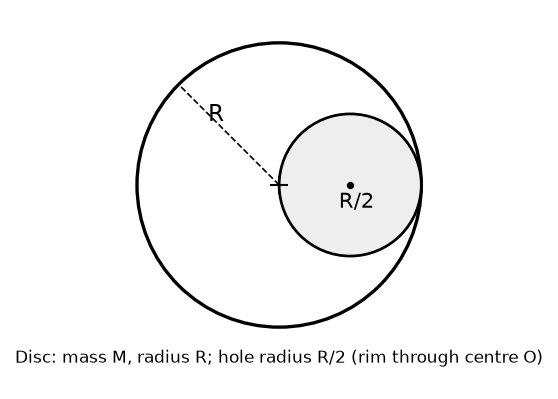
From a disc of mass M and radius R, a circular hole of radius R/2 whose rim passes through the centre is cut out. The moment of inertia of the remaining disc about an axis perpendicular to the plane and passing through the centre O is:
A light rod of length l carries two masses m1 and m2 at its ends. The moment of inertia of the system about an axis perpendicular to the rod through the centre of mass is:
Two ways to go deeper on this chapter
Choose your next step
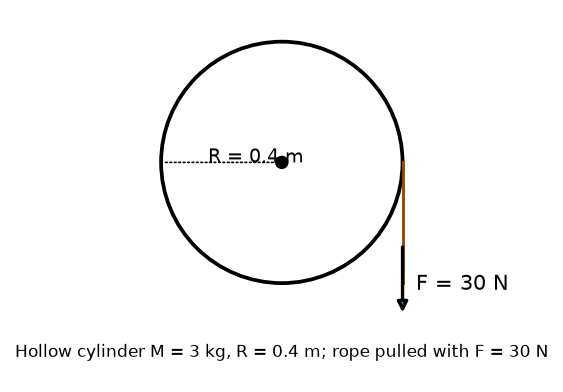
A rope wound on a hollow cylinder of mass 3 kg and radius 40 cm is pulled with a force of 30 N. The angular acceleration of the cylinder is:
Which of the following statements are correct? (a) The centre of mass of a body always coincides with its centre of gravity. (b) The centre of mass is the point where the total gravitational torque on the body is zero. (c) A couple on a body produces both translational and rotational motion. (d) Mechanical advantage greater than one means a small effort can lift a large load.
Two discs of equal moment of inertia I, rotating about their common axis with angular speeds w1 and w2, are brought face-to-face into contact (axes coinciding). The loss of energy in the process is:
The moment of the force F = 4î + 5ĵ + 6k̂ acting at the point (2, 0, -3), about the point (2, -2, -2), is:
A solid sphere rotates freely about its symmetry axis in free space. Its radius is increased keeping the mass constant. Which quantity stays constant?
Three bodies A (solid sphere), B (disc), C (ring), each of mass M and radius R, spin about their symmetry axes with the same angular speed. The work needed to stop them satisfies:
A solid cylinder of mass 2 kg and radius 4 cm rotates about its axis at 3 rpm. The torque required to stop it within 2 revolutions is:
A particle starts from rest and moves in a circle of radius r, attaining speed V0 in the n-th round. Its angular acceleration is:
The torque about the origin when a force 3ĵ N acts on a particle whose position vector is 2k̂ m is:
Two particles of mass 5 kg and 10 kg are attached to the ends of a rigid massless rod of length 1 m. The distance of the centre of mass from the 5 kg particle is nearly:
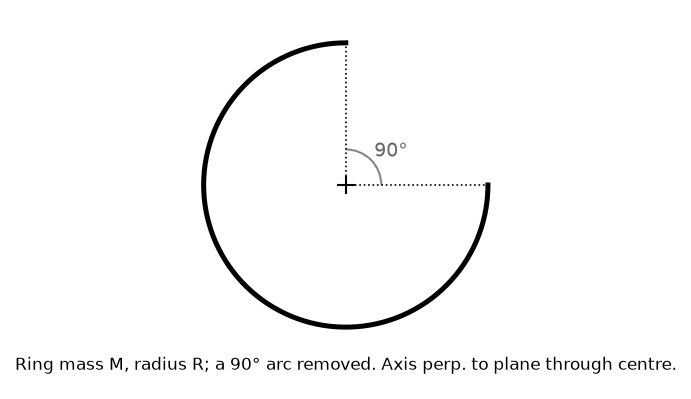
From a circular ring of mass M and radius R, an arc corresponding to a 90° sector is removed. The moment of inertia of the remaining part about an axis through the centre and perpendicular to the plane is K·MR². Then K is:
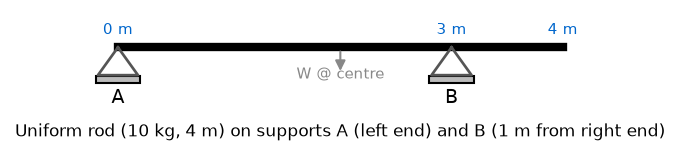
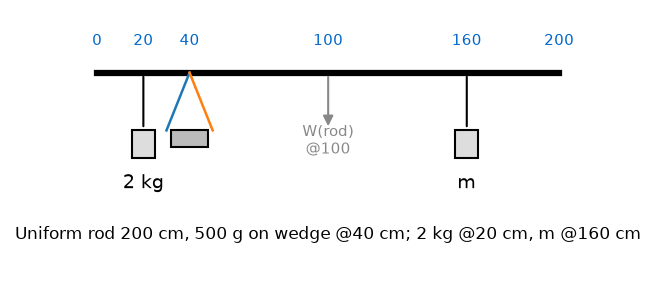
A uniform rod (200 cm, 500 g) is balanced on a wedge at the 40 cm mark. A 2 kg mass hangs at the 20 cm mark and an unknown mass m hangs at the 160 cm mark. For equilibrium, m is: (g = 10 m/s²)
The ratio of the radius of gyration of a thin uniform disc about an axis through its centre and normal to its plane to that about its diameter is:
A flywheel's angular speed changes uniformly from 1200 rpm to 3120 rpm in 16 s. Its angular acceleration (rad/s²) is:
Two objects of mass 10 kg and 20 kg are connected to the ends of a rigid massless rod of length 10 m. The distance of the centre of mass from the 10 kg mass is:
Two particles A and B, initially at rest, move towards each other under their mutual attraction. When A's speed is v and B's speed is 3v, the speed of the centre of mass of the system is:
The ratio of the radius of gyration of a solid sphere (about its own axis) to that of a thin hollow sphere of the same mass and radius (about its axis) is:
A constant torque of 100 N·m turns a wheel of moment of inertia 300 kg·m² about an axis through its centre. Starting from rest, its angular velocity after 3 s is:
The angular acceleration of a body moving along the circumference of a circle is directed:
The moment of inertia of a thin rod about an axis through its mid-point and perpendicular to its length is 2400 g·cm². The length of the 400 g rod is nearly:
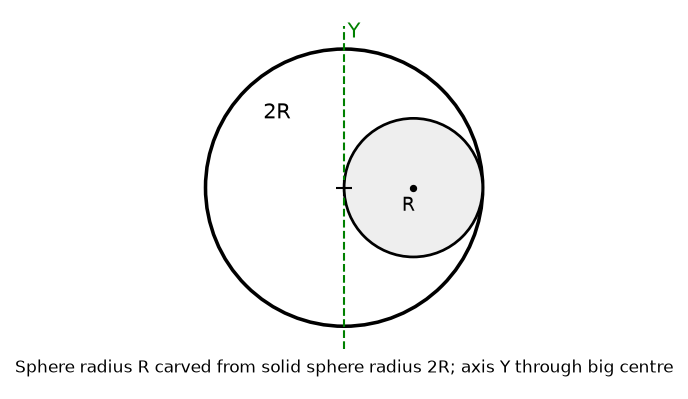
A sphere of radius R is carved out of a uniform solid sphere of radius 2R (internally tangent, so its centre is at distance R from the big centre). The ratio of the moment of inertia of the small sphere to that of the remaining part, both about the Y-axis through the big sphere's centre, is:
The Sun rotates once in 27 days. If it expanded to twice its present radius (uniform-density sphere, no external influence), its new period would be about:
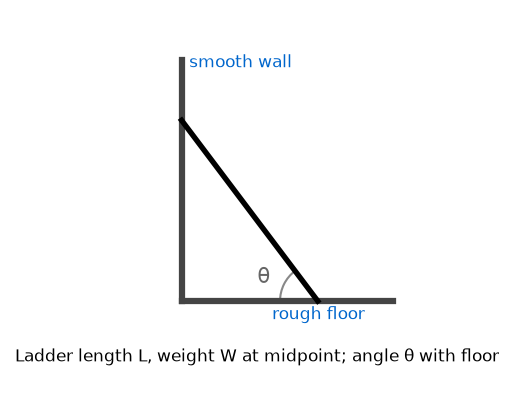
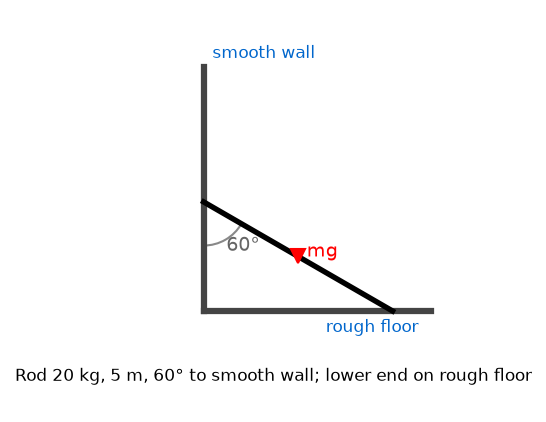
A uniform rod of mass 20 kg and length 5 m leans against a smooth vertical wall, making 60° with the wall; its lower end rests on a rough horizontal floor. The friction force exerted by the floor is: (g = 10 m/s²)
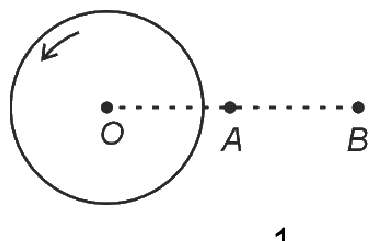
A thin horizontal disc rotates about a vertical axis passing through its fixed centre $O$. Its angular momentum is $L_A$ and $L_B$ when computed about points $A$ and $B$ respectively, where $OB=2\times OA$. The value of $\dfrac{L_A}{L_B}$ is:
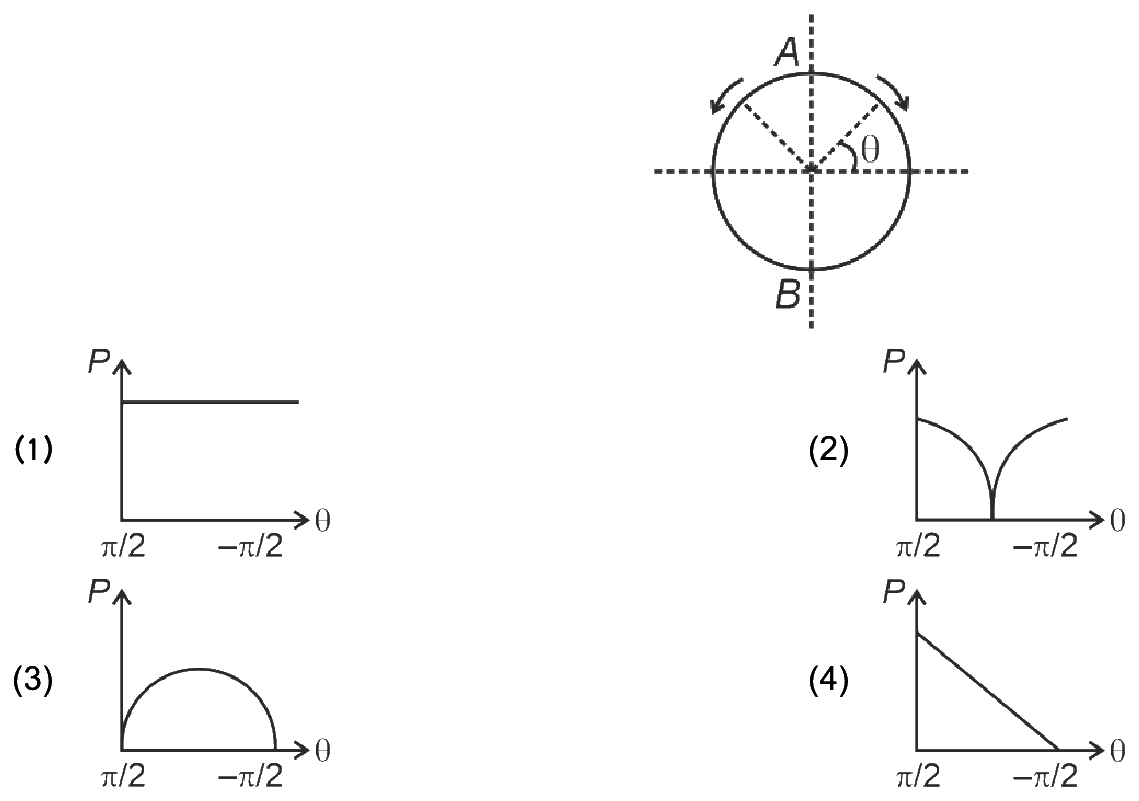
A frictionless circular wire of unit radius lies in a horizontal plane. Two point particles of unit mass start simultaneously from $A\,(\theta=\tfrac{\pi}{2})$ with identical uniform angular speeds in opposite directions and meet again at $B\,(\theta=-\tfrac{\pi}{2})$. Which figure best represents the magnitude of the total linear momentum $P$ of the system as a function of $\theta$?
A flywheel's angular speed increases uniformly from 600 rpm to 1200 rpm in 10 s. The number of revolutions completed in this time is:
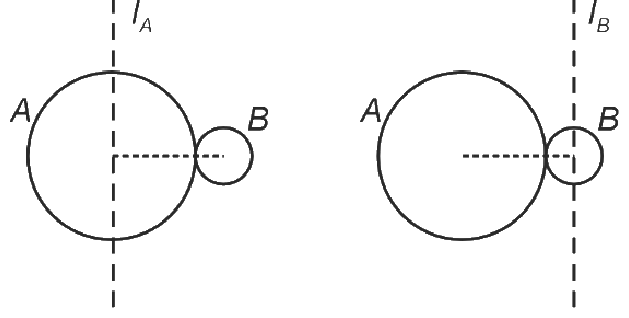
A solid sphere $A$ of radius $R$ and mass $M$ is attached at a point to a smaller solid sphere $B$ of radius $r<R$ and mass $m<M$, their line of centres horizontal. The moment of inertia of the system about a vertical axis through the centre of $A$ is $I_A$, and about a vertical axis through the centre of $B$ is $I_B$. The difference $I_A-I_B$ is:
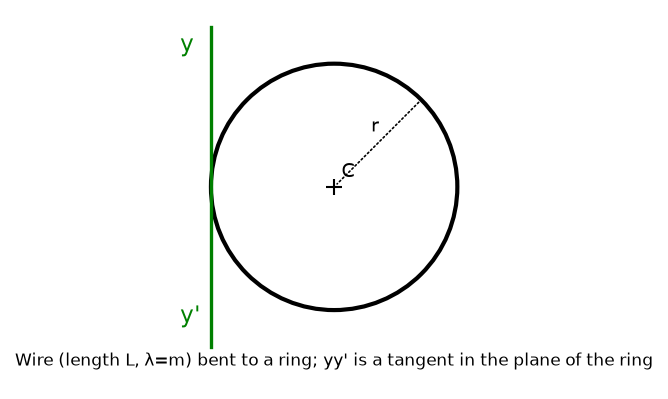
A thin wire of length L and linear mass density m (mass per unit length) is bent into a circular ring lying in the x-y plane with centre C. The moment of inertia of the ring about a tangential axis yy' lying in the plane of the ring is:
Want more System Of Particles And Rotational Motion questions?
MedicNEET has 43,000+ NEET-style questions across Physics, Chemistry & Biology with detailed NCERT-based explanations — including the long, tricky questions that actually come in the exam.
Download MedicNEET App — Free