Year-wise Weightage (2016–2026)

YearQuestions AskedMarks
2026312
202528
202414
2023416
202228
Show earlier years (2016–2021)
202114
2020
2019416
201814
201714
2016312
Q1
NEET 2016 Phase 1

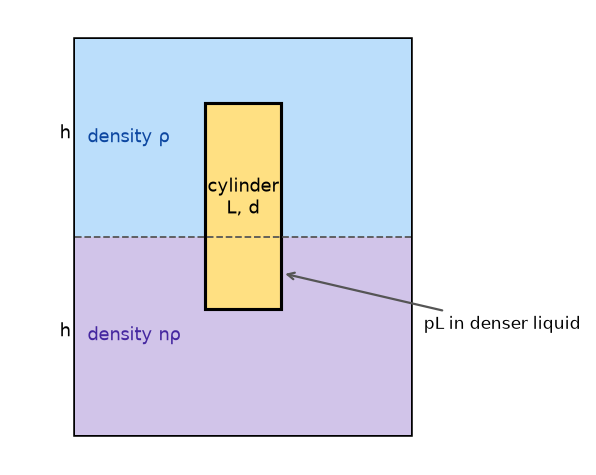
Two non-mixing liquids of densities ρ and nρ (n > 1) are put in a container. The height of each liquid is h. A solid cylinder of length L and density d is put in this container. The cylinder floats with its axis vertical and length pL (p < 1) in the denser liquid. The density d is equal to:
Mechanical Properties Of Fluids NEET PYQ diagram
Q2
NEET 2016 Phase 2Surface energy

A rectangular film of liquid is extended from (4 cm × 2 cm) to (5 cm × 4 cm). If the work done is 3 × 10⁻⁴ J, the value of the surface tension of the liquid is:

Q3
NEET 2016 Phase 2Capillary rise

Three liquids of densities ρ₁, ρ₂ and ρ₃ (with ρ₁ > ρ₂ > ρ₃), having the same value of surface tension T, rise to the same height in three identical capillaries. The angles of contact θ₁, θ₂ and θ₃ obey:

Q4
NEET 2017Manometer

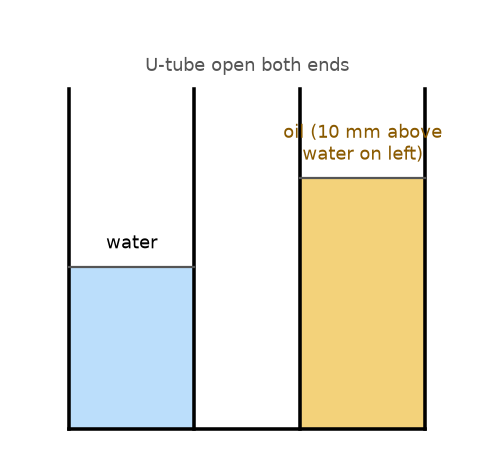
A U-tube with both ends open to the atmosphere is partially filled with water. Oil, which is immiscible with water, is poured into one side until it stands at a distance of 10 mm above the water level on the other side. Meanwhile the water rises by 65 mm from its original level (see figure). The density of the oil is:
Mechanical Properties Of Fluids NEET PYQ diagram
Q5
NEET 2018Terminal velocity

A small sphere of radius 'r' falls from rest in a viscous liquid. As a result, heat is produced due to the viscous force. The rate of production of heat, when the sphere attains its terminal velocity, is proportional to:

Q6
NEET 2019Efflux speed

A small hole of cross-sectional area 2 mm² is present near the bottom of a fully filled open tank of height 2 m. Taking g = 10 m s⁻², the rate of flow of water through the open hole would be nearly:

Q7
NEET 2019Excess pressure

A soap bubble of radius 1 mm is blown from a detergent solution of surface tension 2.5 × 10⁻² N m⁻¹. The pressure inside the bubble equals the pressure at a point Z₀ below the free surface of water in a container. Taking g = 10 m s⁻² and density of water = 10³ kg m⁻³, the value of Z₀ is:

Q8
NEET 2019 OdishaTerminal velocity

Two small spherical metal balls of equal mass are made from materials of densities ρ₁ and ρ₂ (ρ₁ = 8ρ₂) and have radii 1 mm and 2 mm respectively. They fall vertically from rest in a viscous medium of coefficient of viscosity η and density 0.1ρ₂. The ratio of their terminal velocities is:

Q9
NEET 2019 OdishaManometer

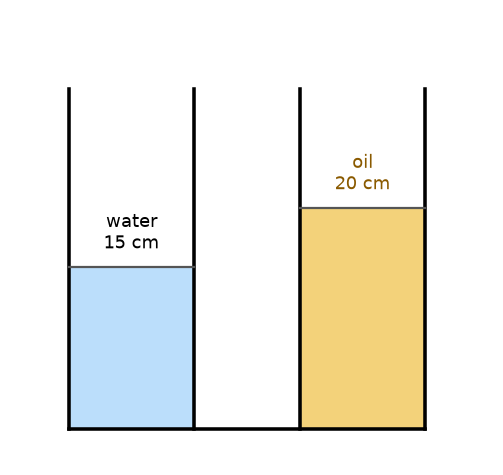
In a U-tube, water and oil are in the left and right arms respectively. The heights of the water and oil columns (measured from the bottom) are 15 cm and 20 cm respectively. The density of the oil is: (take ρ_water = 1000 kg m⁻³)
Mechanical Properties Of Fluids NEET PYQ diagram
Q10
NEET 2021Terminal velocity

The velocity of a small ball of mass M and density d, when dropped in a container filled with glycerine, becomes constant after some time. If the density of glycerine is d/2, then the viscous force acting on the ball will be:

Q11
NEET 2022Terminal velocity

A spherical ball is dropped in a long column of a highly viscous liquid. Which curve in the graph shown represents the speed of the ball (v) as a function of time (t)?
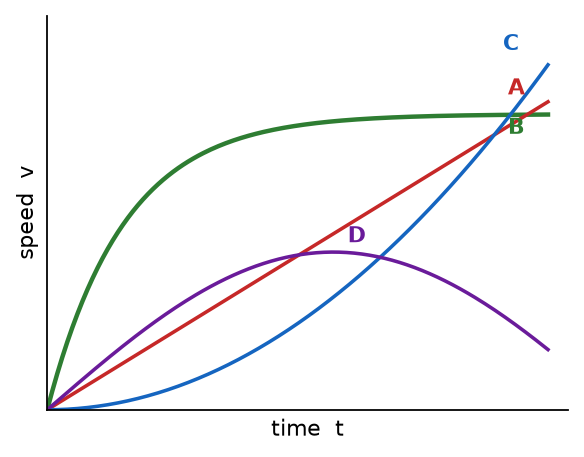
Mechanical Properties Of Fluids NEET PYQ diagram
Q12
NEET 2022Excess pressure

If a soap bubble expands, the pressure inside the bubble:

Q13
NEET 2023 Phase 1Bernoulli

The venturi-meter works on:

Q14
NEET 2023 Phase 1Surface energy

The amount of energy required to form a soap bubble of radius 2 cm from a soap solution is nearly: (surface tension of soap solution = 0.03 N m⁻¹)

Q15
NEET 2023 Phase 2Stokes drag

The viscous drag acting on a metal sphere of diameter 1 mm, falling through a fluid of viscosity 0.8 Pa·s with a velocity of 2 m s⁻¹, is equal to:

Q16
NEET 2023 Phase 2

A simple pendulum oscillating in air has a period of √3 s. If it is completely immersed in a non-viscous liquid having density 1/4 th of the material of the bob, the new period will be:

Q17
NEET 2024Measuring S

A thin flat circular disc of radius 4.5 cm is placed gently over the surface of water. If the surface tension of water is 0.07 N m⁻¹, then the excess force required to take it away from the surface is:

Q18
NEET 2025Excess pressure

A balloon is made of a material of surface tension S and its inflation outlet (from where gas is filled) has small area A. It is filled with a gas of density ρ and takes a spherical shape of radius R. When the gas flows freely out, its radius r changes from R to 0 in time T. If the speed v(r) of gas coming out depends on r as rᵅ and T ∝ Sᵝ Aᵞ Rᵟ ρᵋ, then:

Q19
NEET 2025Angle of contact

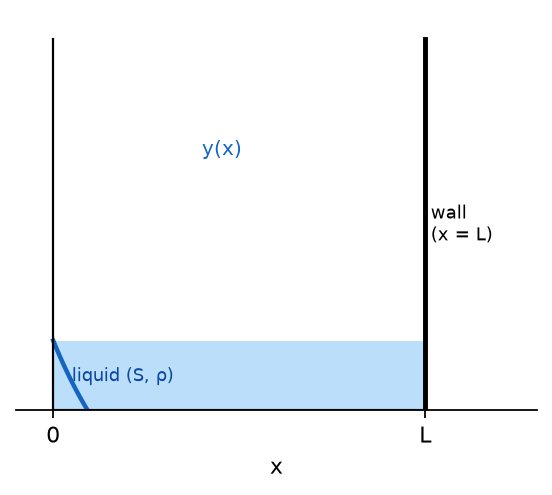
Consider a water tank with one wall at x = L, very wide in the z-direction. When filled with a liquid of surface tension S and density ρ, the liquid surface makes a small angle θ₀ (0 < θ₀ ≪ 1) with the x-axis at x = L. If y(x) is the height of the surface, the equation for y(x) is: (take sinθ(x) ≈ tanθ(x) = dy/dx, g = acceleration due to gravity)
Mechanical Properties Of Fluids NEET PYQ diagram
Q20
ReNEET 2026Bernoulli

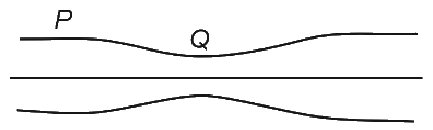
Water flows in streamline motion through a horizontal pipe of circular cross-section as shown. The pressure difference of water between $P$ and $Q$ is $15\,\text{Nm}^{-2}$. The areas of cross-section at $P$ and $Q$ are $40\,\text{cm}^2$ and $20\,\text{cm}^2$ respectively. The rate of flow of water through the pipe (in $\text{cm}^3\text{s}^{-1}$) is: [density of water $=1000\,\text{kg m}^{-3}$]
Mechanical Properties Of Fluids NEET PYQ diagram
Q21
NEET 2026 (1)Fluid pressure

A submarine is designed to withstand an absolute pressure of 100 atm. How deep can it go below the water surface? (density of water = 1000 kg m⁻³, 1 atm = 1 × 10⁵ Pa, g = 10 m s⁻²)

Q22
ReNEET 2026Terminal velocity

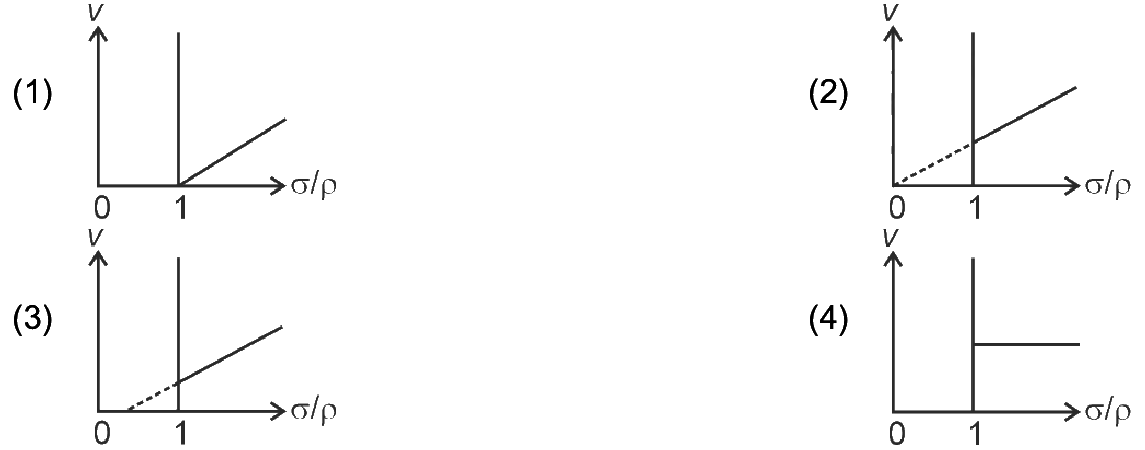
In the measurement of viscosity of liquids using the terminal velocity experiment, spherical balls of the same radius but different densities are used. The variation of the terminal velocity $v$ with the ratio of the density of the spherical ball ($\sigma$) to the density of the liquid ($\rho$), $\sigma/\rho$, is best represented by:
Mechanical Properties Of Fluids NEET PYQ diagram

Want more Mechanical Properties Of Fluids questions?

MedicNEET has 14,000+ NEET-style Biology questions with detailed NCERT-based explanations — including long, tricky questions that actually come in the exam.

Download MedicNEET App — Free
Practise Mechanical Properties Of Fluids MCQs — Free

Beyond the PYQs above — every Physics question format NEET now uses, starting with the newest ReNEET 2026-style reasoning MCQs. Tap an option for the answer and a worked solution. Free, no login.

🔢 Mechanical Properties Of FluidsNumericals — PYQ-Based

Exam-style numericals seeded from real NEET previous-year questions, kept inside the NEET syllabus boundary. Each with a worked solution.

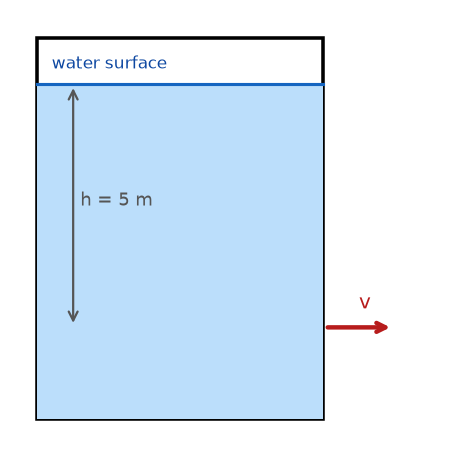
  1. Q1. A large open tank is filled with water. A small hole is made in its side wall at a depth of 5 m below the free surface (see figure). The speed of efflux of water from the hole is (g = 10 m s⁻²):
    NEET question diagram
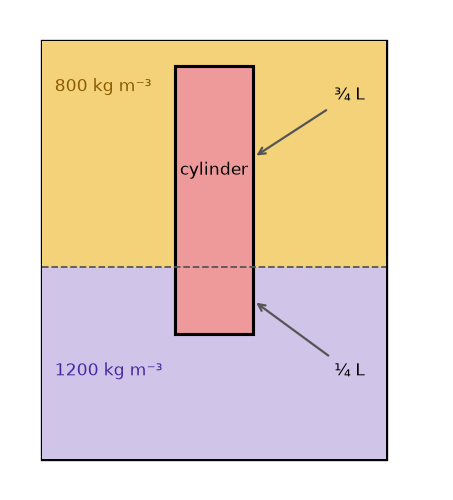
  2. Q2. A solid cylinder floats vertically at the interface of two immiscible liquids, with one-fourth of its length in the lower liquid of density 1200 kg m⁻³ and three-fourths in the upper liquid of density 800 kg m⁻³ (see figure). The density of the cylinder is:
    NEET question diagram
  3. Q3. A mercury drop of radius 1 cm is sprayed into 10⁶ droplets of equal size. The energy expended in the process is (surface tension of mercury = 0.5 N m⁻¹):
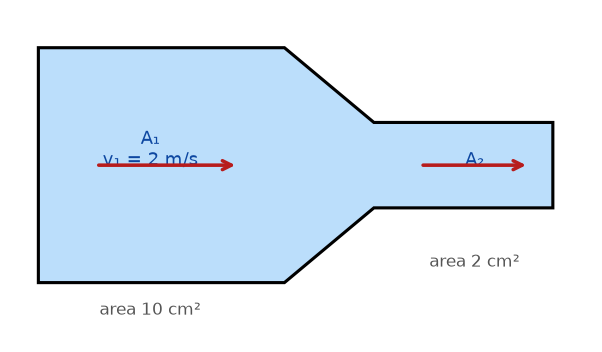
  4. Q4. Water flows steadily through a horizontal pipe whose cross-sectional area decreases from 10 cm² to 2 cm² (see figure). If the speed of water in the wider part is 2 m s⁻¹, its speed in the narrower part is:
    NEET question diagram
  5. Q5. A spherical rain drop of radius 0.3 mm falls through air of viscosity 1.8 × 10⁻⁵ Pa·s. Taking the density of water as 1000 kg m⁻³, g = 10 m s⁻² and neglecting the density of air, its terminal velocity is nearly:
  6. Q6. Two identical spherical balls are falling through two different viscous fluids. Ball A falls through a fluid of viscosity η₁ and attains terminal velocity v₁. Ball B falls through a fluid of viscosity η₂ = 2η₁ and attains terminal velocity v₂. Both fluids have the same density. What is the ratio v₁/v₂?
  7. Q7. A soap bubble of radius 3 mm is formed at the end of a tube. The surface tension of the soap solution is 0.03 N/m. What is the excess pressure inside the bubble compared to atmospheric pressure?
  8. Q8. A soap bubble of radius 3 cm is in equilibrium in air. If the surface tension of the soap solution is 3.0 × 10⁻² N/m, what is the excess pressure inside the bubble? (Atmospheric pressure = 1.0 × 10⁵ Pa)
  9. Q9. A cylindrical tank of height 20 m is filled with water. An orifice is opened at a depth of 5 m below the free surface of water. What is the speed of efflux of water through the orifice? (Take g = 10 m/s²)
  10. Q10. Two identical capillary tubes A and B are dipped vertically in water. In tube A, water rises to a height of 3.0 cm. If tube B is tilted at an angle of 60° to the vertical while keeping its lower end at the same depth in water, what is the length of water column in tube B?

You’ve practised 10 of 50 Mechanical Properties Of Fluids questions in this set.

Practise all 50 + every chapter — free app →

📘 Mechanical Properties Of FluidsConceptual Theory MCQs

Theory MCQs — assertion-reason, statement and standard — for the part of the physics paper that isn't numericals.

  1. Q1. A sharp knife cuts through a fruit easily, whereas a blunt knife requires much more effort to cut the same fruit. Assuming the force applied is the same in both cases, which statement correctly explains this observation?
  2. Q2. Regarding the pressure in a fluid at rest, which of the following statements is INCORRECT?
  3. Q3. The provided graph shows the speed of efflux, v, from a small orifice in a large open tank as a function of the depth, h, of the orifice below the free surface of the liquid. If the speed of efflux at a depth h₀ is v₀, at what depth will the speed of efflux be 2v₀?
  4. Q4. Which of the following statements regarding the flow of fluids is CORRECT?
  5. Q5. Given below are two statements: Statement I: In a fluid at rest, pressure at a point is exerted equally in all directions. Statement II: In a fluid at rest and in equilibrium, the pressure is the same at all points throughout the fluid, regardless of depth. In the light of the above statements, choose the correct answer from the options given below.
  6. Q6. A piece of ice floats in a glass of water filled to the brim. When the ice melts completely, the level of water in the glass:
  7. Q7. Small liquid drops assume a spherical shape because:
  8. Q8. For flow of a liquid through a pipe, which statement about the Reynolds number (Re) is correct?
  9. Q9. How do the viscosities of liquids and gases change as temperature increases?
  10. Q10. The SI unit of the coefficient of viscosity is:

You’ve practised 10 of 23 Mechanical Properties Of Fluids questions in this set.

Practise all 23 + every chapter — free app →

Mechanical Properties Of Fluids — NEET PYQ Analysis

Mechanical Properties Of Fluids is a Class 11 NEET Physics chapter consistently tested from 2016 to ReNEET 2026. This page has all 22 authentic previous year questions from real NEET papers — with answers and detailed solutions, not model questions.

For full chapter-wise practice in timed test mode, download the MedicNEET app — 22,000+ questions across the full NEET syllabus. Back to the NEET Physics PYQ index.