Year-wise Weightage (2016–2026)

YearQuestions AskedMarks
2026416
202514
202414
2023312
202214
Show earlier years (2016–2021)
2021
2020
201928
2018312
201728
2016312
Q1
NEET 2016 Phase 2

The temperature inside a refrigerator is $t_2\,^\circ$C and the room temperature is $t_1\,^\circ$C. The amount of heat delivered to the room for each joule of electrical energy consumed ideally will be

Q2
NEET 2016 Phase 1

A refrigerator works between $4\,^\circ$C and $30\,^\circ$C. It is required to remove 600 calories of heat every second in order to keep the temperature of the refrigerated space constant. The power required is: (Take $1$ cal $=4.2$ J)

Q3
NEET 2016 Phase 1

A gas is compressed isothermally to half its initial volume. The same gas is compressed separately through an adiabatic process until its volume is again reduced to half. Then:

Q4
NEET 2017

The figure shows a $P$-$V$ diagram with three isotherms at $700$ K, $500$ K and $300$ K. Four processes I, II, III and IV start from a common initial state. Match each process with its type:\\ List-I (Process): I, II, III, IV\\ List-II (Type): (a) Adiabatic, (b) Isobaric, (c) Isochoric, (d) Isothermal.\\ Which of the following is the correct matching?
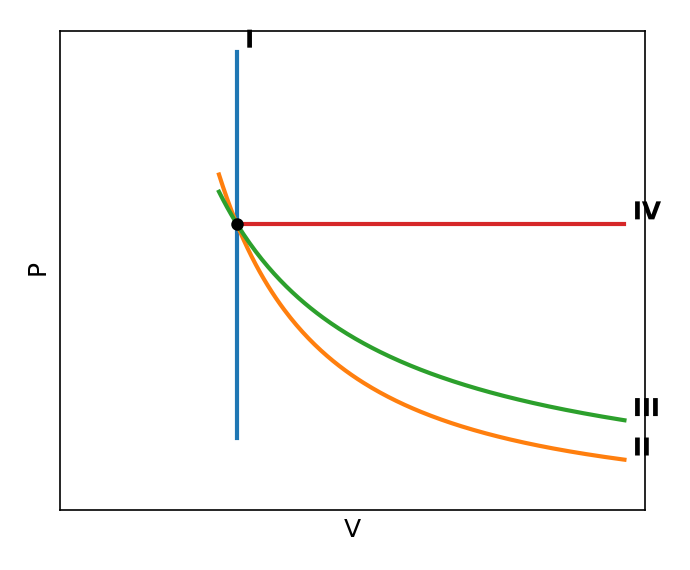
Thermodynamics NEET PYQ diagram
Q5
NEET 2017

A Carnot engine having an efficiency of $\dfrac{1}{10}$ as a heat engine is used as a refrigerator. If the work done on the system is $10$ J, the amount of energy absorbed from the reservoir at lower temperature is

Q6
NEET 2018

The volume ($V$) of a monatomic gas varies with its temperature ($T$), as shown in the graph (a straight line through the origin, from A to B, i.e. an isobaric process). The ratio of the work done by the gas to the heat absorbed by it, when it goes from A to B, is
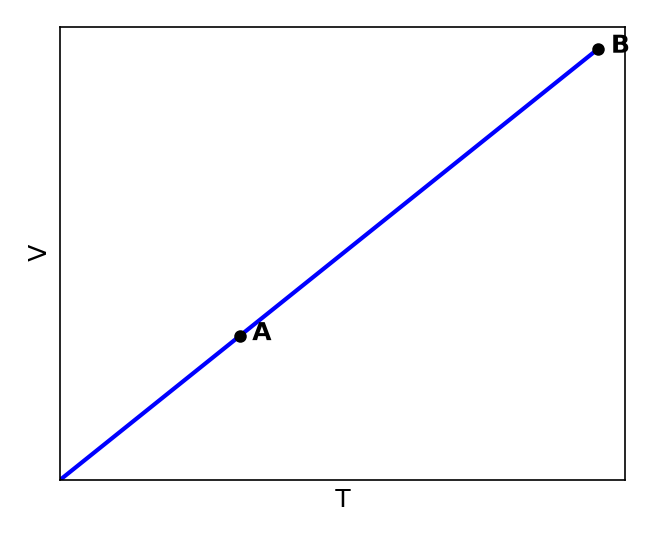
Thermodynamics NEET PYQ diagram
Q7
NEET 2018

The efficiency of an ideal heat engine working between the freezing point and boiling point of water is

Q8
NEET 2018

$0.1$ g of water at $100\,^\circ$C and normal pressure ($1.013\times 10^{5}$ N/m$^2$) requires $54$ cal to convert into steam at $100\,^\circ$C. If the volume of the steam produced is $167.1$ cc, the change in internal energy is

Q9
NEET 2019

In which of the following processes, heat is neither absorbed nor released by a system?

Q10
NEET 2019 Odisha

An ideal gas expands isothermally from $10^{-3}$ m$^3$ to $10^{-2}$ m$^3$ at $300$ K against a constant external pressure of $10^{5}$ N/m$^2$. The work done ON the gas is

Q11
NEET 2022

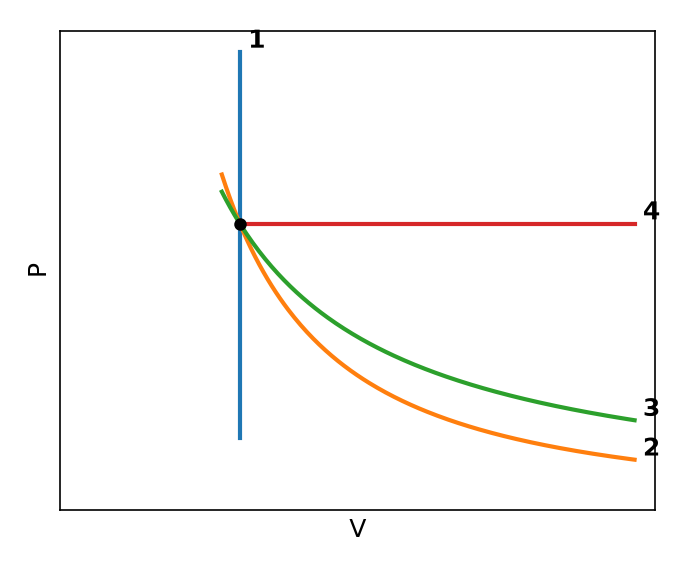
An ideal gas undergoes four different processes from the same initial state (see figure). The processes are adiabatic, isothermal, isobaric and isochoric. The curve which represents the adiabatic process among $1, 2, 3, 4$ is
Thermodynamics NEET PYQ diagram
Q12
NEET 2023 Phase 1

A Carnot engine has an efficiency of $50\%$ when its source is at $327\,^\circ$C. The temperature of the sink is

Q13
NEET 2023 Phase 2

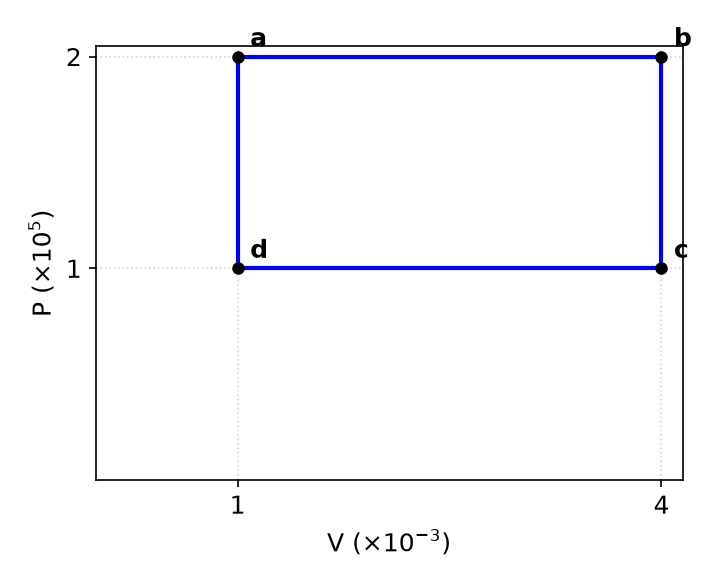
For the given cycle, the work done during the isobaric process is
Thermodynamics NEET PYQ diagram
Q14
NEET 2023 Phase 1

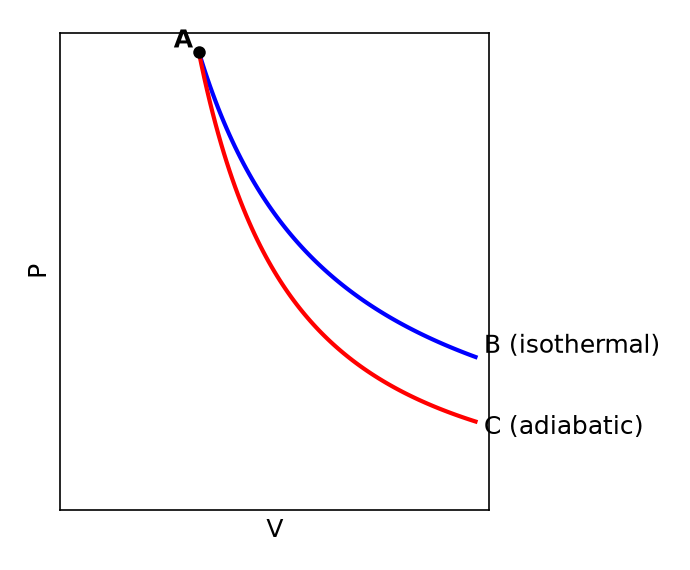
Reversible expansion of an ideal gas under isothermal and adiabatic conditions is shown in the figure, where $AB$ is the isothermal expansion and $AC$ is the adiabatic expansion, both starting from the common state $A$. Which of the following options is NOT correct?
Thermodynamics NEET PYQ diagram
Q15
NEET 2024

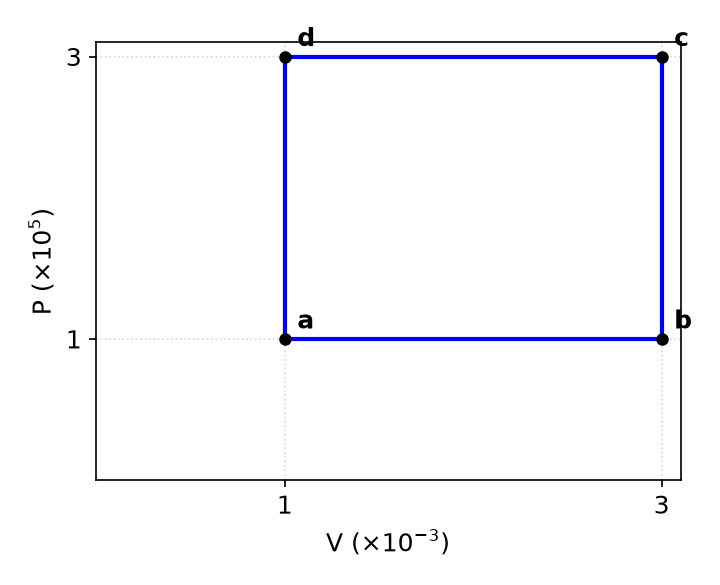
A thermodynamic system is taken through the cycle $abcda$. The work done by the gas along the path $bc$ is
Thermodynamics NEET PYQ diagram
Q16
NEET 2025

Two gases A and B are filled at the same pressure in separate cylinders with movable pistons of radius $r_A$ and $r_B$, respectively. On supplying an equal amount of heat to both gases reversibly at constant pressure, the pistons of A and B are displaced by $16$ cm and $9$ cm, respectively. If the change in their internal energy is the same, then the ratio $\dfrac{r_A}{r_B}$ is

Q17
ReNEET 2026

One mole of an ideal monatomic gas undergoes a cyclic process shown in the figure (rectangle $a\to b\to c\to d$ in the $P$–$V$ plane, with $P$ in N m$^{-2}$ between $100$ and $300$, and $V$ in m$^3$ between $2$ and $5$). The total heat supplied to the gas is:
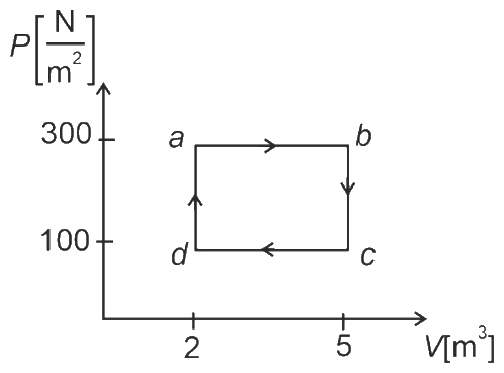
Thermodynamics NEET PYQ diagram
Q18
NEET 2026 (1)

An electric heater supplies heat to a system at a rate of $100$ W. If the system performs work at a rate of $75$ J/s, the rate at which internal energy increases is

Q19
NEET 2026 (1)

At a certain temperature, during a process, $500$ J is absorbed by the system and $200$ J of work is done by the system. The change in internal energy of the system is

Q20
ReNEET 2026

In an adiabatic expansion, the temperature of one mole of an ideal monatomic gas ($\gamma=5/3$) decreases from $60\,$K to $50\,$K. The work done by the gas in the process is: [Take $R=8.3\,\text{J mol}^{-1}\text{K}^{-1}$]

Want more Thermodynamics questions?

MedicNEET has 14,000+ NEET-style Biology questions with detailed NCERT-based explanations — including long, tricky questions that actually come in the exam.

Download MedicNEET App — Free
Practise Thermodynamics MCQs — Free

Beyond the PYQs above — every Physics question format NEET now uses, starting with the newest ReNEET 2026-style reasoning MCQs. Tap an option for the answer and a worked solution. Free, no login.

🔢 ThermodynamicsNumericals — PYQ-Based

Exam-style numericals seeded from real NEET previous-year questions, kept inside the NEET syllabus boundary. Each with a worked solution.

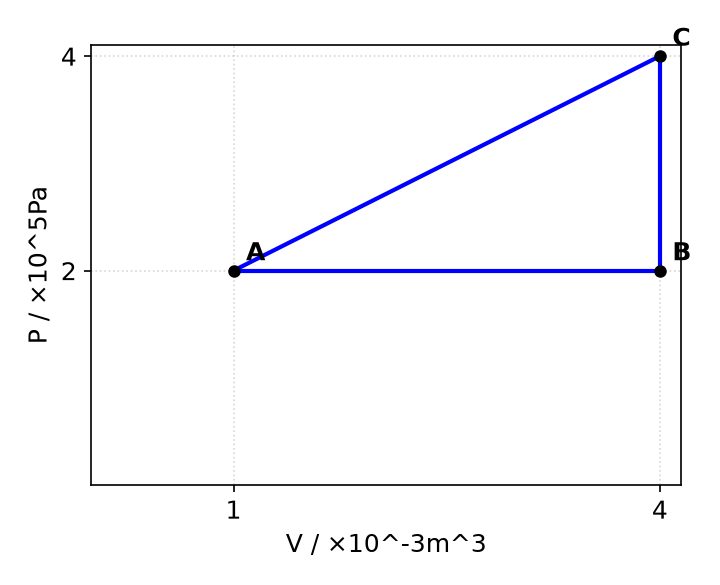
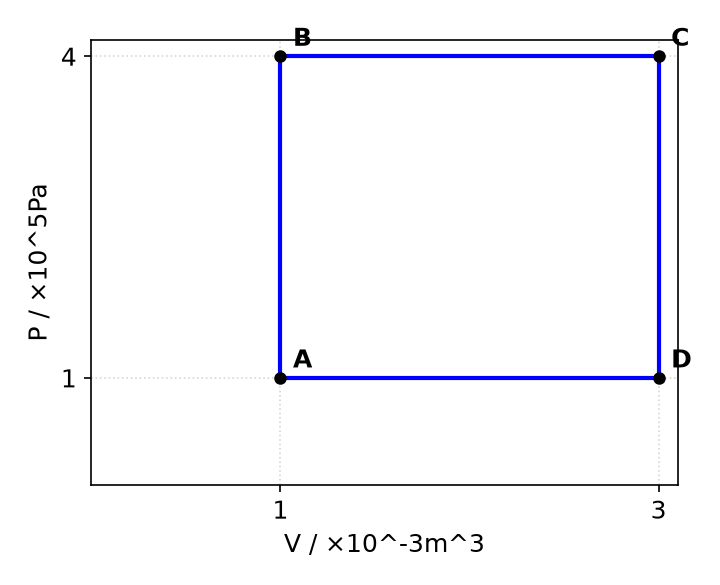
  1. Q1. A gas is taken through the rectangular cycle shown in the - diagram. The volume changes between and while the pressure changes between and . What is the magnitude of the net work done by the gas in one complete cycle?
    NEET question diagram
  2. Q2. A Carnot engine operates between a source at and a sink at . What is its efficiency?
  3. Q3. A heat engine has an efficiency of . It is now run in reverse as a refrigerator, taking in the same amount of work. In each cycle it absorbs of heat from the hot reservoir when working as an engine, and the work per cycle is reused to drive the refrigerator. When run as a refrigerator with this work input , how much heat is extracted from the cold reservoir? (Use with the engine's .)
  4. Q4. A device is used as a heat pump to warm a room at by extracting heat from the outside at . For ideal (Carnot) operation, what is the coefficient of performance of this heat pump?
  5. Q5. A monatomic ideal gas () at pressure is compressed adiabatically to one-eighth of its original volume. What is its final pressure?
  6. Q6. A sample of 0.2 g of water at 100°C and normal pressure (1.0×10⁵ N/m²) requires 108 cal of heat energy to convert to steam at 100°C. If the volume of the steam produced is 334 cm³, the change in internal energy of the sample is: (Take 1 cal = 4.2 J)
  7. Q7. A diatomic gas undergoes a polytropic process described by PV^n = constant. If during this process, the molar heat capacity of the gas is zero, and Cv = 5R/2, what is the value of the polytropic index n?
  8. Q8. A thermodynamic system undergoes a cyclic process ABCDA on a P-V diagram, where AB is an isochoric process, BC is an isobaric expansion, CD is an isochoric process, and DA is an isobaric compression. The system absorbs 800 J of heat during AB and 1200 J during BC. During CD, the system rejects 600 J of heat. During DA, the heat exchanged is zero (Q_DA = 0). If the internal energy of the system at state A is 500 J and at state B is 1300 J, what is the net work done by the system in one complete cycle?
  9. Q9. A thermodynamic system undergoes a cyclic process PQRSP as shown in the P-V diagram. The process QR is an isochoric process at volume 4 L, with pressure changing from 5 × 10⁵ Pa to 2 × 10⁵ Pa. What is the work done by the gas during the process QR?
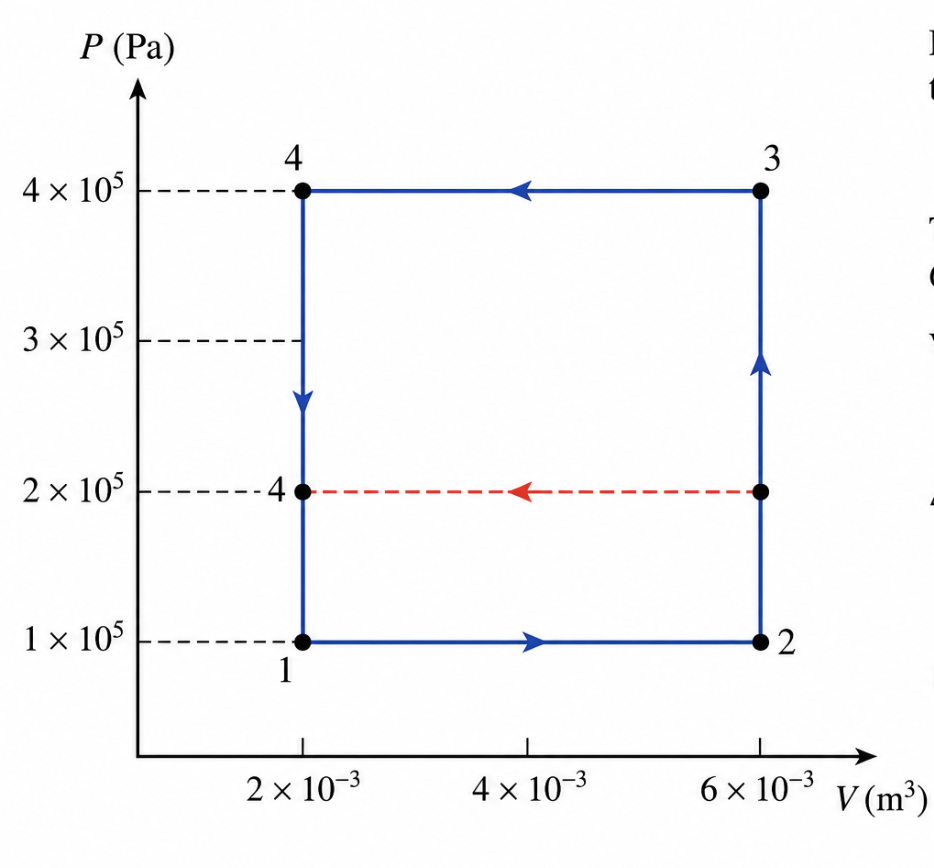
  10. Q10. A gas undergoes a cyclic process 1→2→3→4→1 as shown in a P-V diagram. In the process 3→4, the pressure remains constant at 2 × 10⁵ Pa while the volume decreases from 6 × 10⁻³ m³ to 2 × 10⁻³ m³. What is the work done by the gas in the process 3→4?
    NEET question diagram

You’ve practised 10 of 51 Thermodynamics questions in this set.

Practise all 51 + every chapter — free app →

📘 ThermodynamicsConceptual Theory MCQs

Theory MCQs — assertion-reason, statement and standard — for the part of the physics paper that isn't numericals.

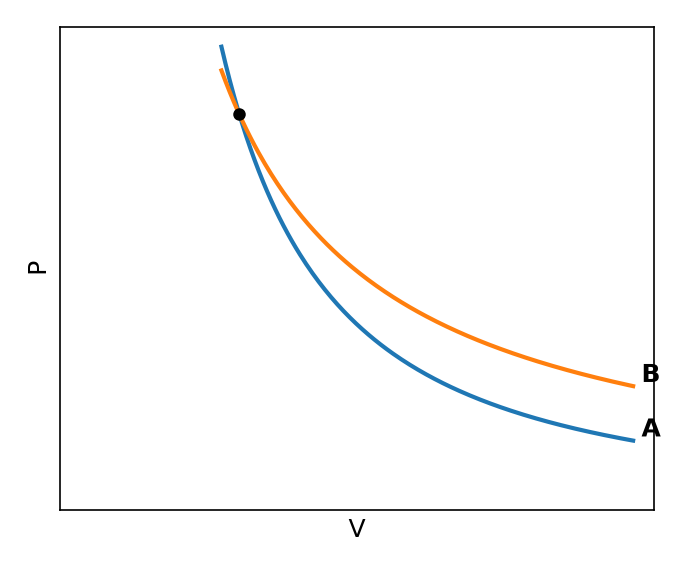
  1. Q1. Given below are two statements: Statement I: On a P-V diagram, the curve for a reversible adiabatic expansion is steeper than the curve for a reversible isothermal expansion through the same initial state. Statement II: For the same change in volume during expansion, the work done by an ideal gas in an isothermal process is greater than the work done in an adiabatic process. In the light of the above statements, choose the correct answer from the options given below.
  2. Q2. A Carnot engine operates between a hot reservoir at temperature T_1 (in Kelvin) and a cold reservoir at temperature T_2 (in Kelvin), with T_1 > T_2. The efficiency of the engine is:
  3. Q3. A Carnot cycle is plotted on a P-V diagram. Which of the following correctly describes the shape of the closed curve?
  4. Q4. An ideal gas undergoes a reversible adiabatic process. Which of the following relations is correct (γ = C_p/C_v)?
  5. Q5. The Kelvin-Planck and Clausius statements of the second law are: (I) Kelvin-Planck: no process is possible whose sole result is the complete conversion of heat from a single reservoir into work. (II) Clausius: no process is possible whose sole result is the transfer of heat from a colder body to a hotter body. Which statement about these two is correct?
  6. Q6. On a P-V diagram, starting from the same point, which curve is steeper and why — the adiabatic or the isothermal?
    NEET question diagram
  7. Q7. A refrigerator is best described as:
  8. Q8. For an ideal gas undergoing an isothermal process, which relation holds?
  9. Q9. A thermodynamic system is taken through the complete cycle shown on the P-V diagram and returns to its starting state. Over one full cycle, the change in internal energy and the net heat absorbed satisfy:
    NEET question diagram
  10. Q10. Which of the following matches a thermodynamic process with the quantity that remains constant in it INCORRECTLY?

You’ve practised 10 of 40 Thermodynamics questions in this set.

Practise all 40 + every chapter — free app →

Thermodynamics — NEET PYQ Analysis

Thermodynamics is a Class 11 NEET Physics chapter consistently tested from 2016 to ReNEET 2026. This page has all 20 authentic previous year questions from real NEET papers — with answers and detailed solutions, not model questions.

For full chapter-wise practice in timed test mode, download the MedicNEET app — 22,000+ questions across the full NEET syllabus. Back to the NEET Physics PYQ index.