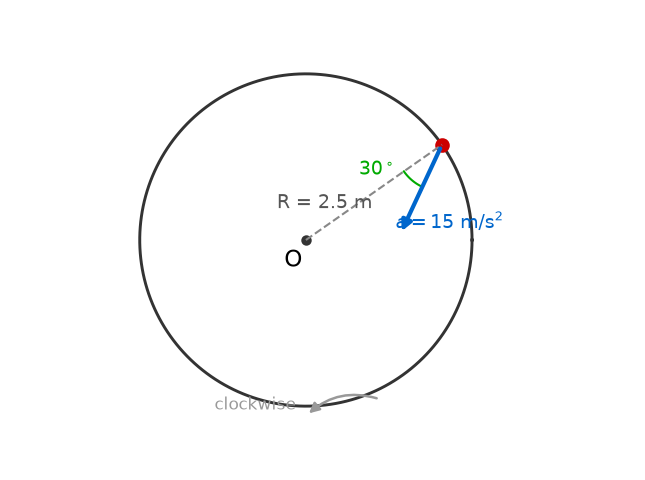
In the figure, $a=15\ \mathrm{m/s^2}$ represents the total acceleration of a particle moving in the clockwise direction in a circle of radius $R=2.5$ m at a given instant of time. The speed of the particle is:
If the magnitude of the sum of two vectors is equal to the magnitude of the difference of the two vectors, the angle between these vectors is:
A particle of mass 10 g moves along a circle of radius 6.4 cm with a constant tangential acceleration. The magnitude of this acceleration, if the kinetic energy of the particle becomes equal to $8\times10^{-4}$ J by the end of the second revolution after the beginning of the motion, is:
A particle moves from a point $(-2\hat i+5\hat j)$ to $(4\hat j+3\hat k)$ when a force of $(4\hat i+3\hat j)$ N is applied. How much work is done by the force?
A particle moves so that its position vector is given by $\vec r=\cos\omega t\,\hat x+\sin\omega t\,\hat y$, where $\omega$ is a constant. Which of the following is true?
The $x$ and $y$ coordinates of a particle at any time $t$ are $x=5t-2t^2$ and $y=10t$ respectively, where $x$ and $y$ are in metres and $t$ in seconds. The acceleration of the particle at $t=2$ s is:
Two ways to go deeper on this chapter
Choose your next step
The moment of the force $\vec F=4\hat i+5\hat j+6\hat k$ acting at the point $(2,0,-3)$, about the point $(2,-2,-2)$, is given by:
Two particles A and B are moving in uniform circular motion in concentric circles of radii $r_A$ and $r_B$ with speeds $v_A$ and $v_B$ respectively. Their time period of rotation is the same. The ratio of the angular speed of A to that of B is:
The speed of a swimmer in still water is 20 m/s. The speed of river water is 10 m/s flowing due east. If he is standing on the south bank and wishes to cross the river along the shortest path, the angle at which he should make his strokes with respect to north is:
Two bullets are fired horizontally and simultaneously towards each other from the rooftops of two buildings 100 m apart and of the same height 200 m, with the same speed 25 m/s. When and where will the two bullets collide? ($g=10\ \mathrm{m/s^2}$)
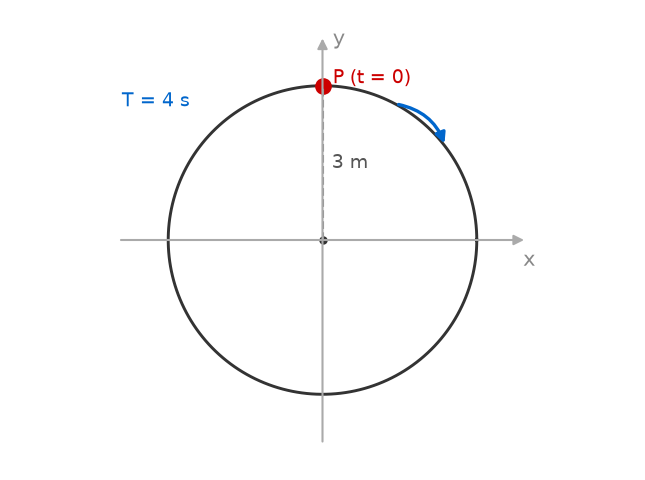
The radius of a circle, the period of revolution, the initial position and the sense of revolution are indicated in the figure (radius 3 m, period $T=4$ s, particle P starts at $t=0$ on the $+y$ axis). The $y$-projection of the radius vector of the rotating particle P is:
A particle starting from rest moves in a circle of radius $r$. It attains a velocity of $V_0$ m/s in the $n$th round. Its angular acceleration is:
In the product $\vec F=q\,\vec v\times\vec B$, for $q=1$, $\vec v=2\hat i+4\hat j+6\hat k$ and $\vec F=4\hat i-20\hat j+12\hat k$, the complete expression for $\vec B$ is:
A car starts from rest and accelerates at $5\ \mathrm{m/s^2}$. At $t=4$ s a ball is dropped out of a window by a person sitting in the car. What are the velocity and acceleration of the ball at $t=6$ s? (Take $g=10\ \mathrm{m/s^2}$)
A particle moving in a circle of radius $R$ with uniform speed takes a time $T$ to complete one revolution. If this particle is projected with the same speed at an angle $\theta$ to the horizontal, the maximum height attained equals $4R$. The angle of projection $\theta$ is given by:
A ball is projected with a velocity $10\ \mathrm{m/s}$ at an angle of $60^\circ$ with the vertical direction. Its speed at the highest point of its trajectory will be:
The position of a particle is given by $\vec r(t)=4t\,\hat i+2t^2\,\hat j+5\hat k$, where $t$ is in seconds and $\vec r$ in metres. Find the magnitude and direction (with respect to the $x$-axis) of the velocity $\vec v(t)$ at $t=1$ s.
A football player is moving southward and suddenly turns eastward with the same speed to avoid an opponent. The force that acts on the player while turning is directed:
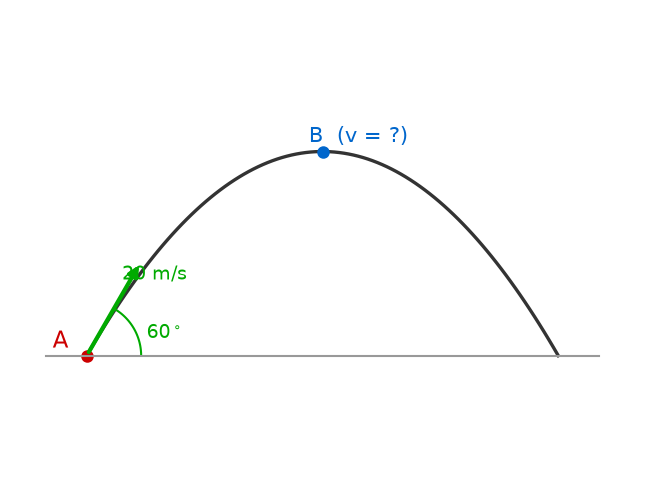
A ball is projected from point A with a velocity 20 m/s at an angle $60^\circ$ to the horizontal direction. At the highest point B of the path, the speed $v$ (in m/s) of the ball will be:
A bullet is fired from a gun at a speed of 280 m/s in a direction $30^\circ$ above the horizontal. The maximum height attained by the bullet is ($g=9.8\ \mathrm{m/s^2}$, $\sin30^\circ=0.5$):
A particle moves with a velocity $(5\hat i-3\hat j+6\hat k)$ m/s under the action of a constant force $(10\hat i+10\hat j+20\hat k)$ N. The instantaneous power supplied to the particle is:
A particle is executing uniform circular motion with velocity $\vec v$ and acceleration $\vec a$. Which of the following is true?
A particle moving with uniform speed in a circular path maintains:
The magnitude and direction of the acceleration produced in a body of mass 5 kg when two mutually perpendicular forces 8 N and 6 N act on it are respectively:
Want more Motion In A Plane questions?
MedicNEET has 43,000+ NEET-style questions across Physics, Chemistry & Biology with detailed NCERT-based explanations — including the long, tricky questions that actually come in the exam.
Download MedicNEET App — Free